
GAS-210 · Lesson 9 of 12 · 23 min
Space heaters and garage heaters
▶ Video coming soon A video version of this lesson is on the way.
On Tuesday, November 3, Jonah went with Rosa to an attached double garage in Stoney Creek where the owner, a retired mechanic, wanted to work on his cars through the winter. He had been running a portable propane "torpedo" heater with the garage door cracked open, and he had a headache most evenings. Rosa's first act was to set her CO monitor on the workbench and ask him to switch the heater on for a minute. The reading climbed past 35 parts per million in under two minutes, and she asked him to shut it off and open the door. "That heater is built for a building site with the walls open," she said. "In a closed garage attached to your house, it's a carbon monoxide generator. Let's do this properly." Properly meant a power-vented gas unit heater, hung from the ceiling and vented outdoors.
This lesson covers gas appliances designed to heat a single room or space: vented room heaters and wall furnaces, unit heaters for garages and workshops, infrared heaters, and the portable heaters a gas technician meets and must often advise against. Garages bring their own hazards, gasoline vapour, vehicle impact and vehicle exhaust, and their own code rules, which take up much of the lesson.
Vented room heaters and wall furnaces
A vented room heater heats the room it stands in, by convection and radiation, without ducts. The most common modern type is the direct-vent wall furnace: a sealed combustion heater mounted on an outside wall, taking combustion air through a concentric wall terminal and sending flue gas out through the same terminal, with a small fan or natural convection moving room air over its heat exchanger. Wall furnaces suit additions, cottages, basements and rooms the central system does not reach, and many run without house power on a millivolt valve, which makes them useful during outages. They are certified under the joint standard for vented space heating appliances.
Older houses may still have a gravity wall furnace, vented through a B-vent within the wall, or a floor furnace set in a floor opening, often in old bungalows and cottages. Both rely on natural draft and draft hoods, like any Category I appliance, and many are decades old with heat exchangers that need careful inspection. Bayline services them where parts and safe condition allow, and recommends replacement when the heat exchanger, the vent or the controls cannot be shown to be sound. GAS-110's rule applies: an appliance that cannot be shown to be safe does not stay in service.
Room heaters are installed to their instructions, with the clearances to furniture, curtains and walls on their plate, the vent terminal's clearances from windows, doors and the ground, and a manual shut-off valve. Because they sit in the living space at body height, their front and top surfaces get hot, and the instructions say what must be kept clear of them. A thermostat on the heater or on the wall controls it.
Unvented heaters
Unvented heaters release their products of combustion into the space. Lesson 7 described how indoor vent-free fireplaces are not sold for use in Canada; this lesson adds the heaters that cause the most harm in practice: portable heaters built for outdoor or construction use. Propane torpedo and convection heaters, patio heaters and tank-top heaters are certified for outdoor use or for construction sites with ventilation, and their instructions say so on the label. Used in a closed garage, a basement, a tent or a house, they produce carbon monoxide faster than the space can clear it, and they deplete oxygen. Every winter, people are poisoned this way.
In Ontario, the propane code CSA B149.2 and TSSA's rules set conditions for using temporary propane heaters on construction sites, including ventilation and supervision; they do not permit such heaters to heat an occupied house or attached garage. A gas technician who finds one being used indoors explains the hazard, tests the air for CO, and makes sure the customer understands before leaving. Where the use is an immediate hazard, the TSSA unsafe-condition procedures GAS-110 described apply.
Why garages are different
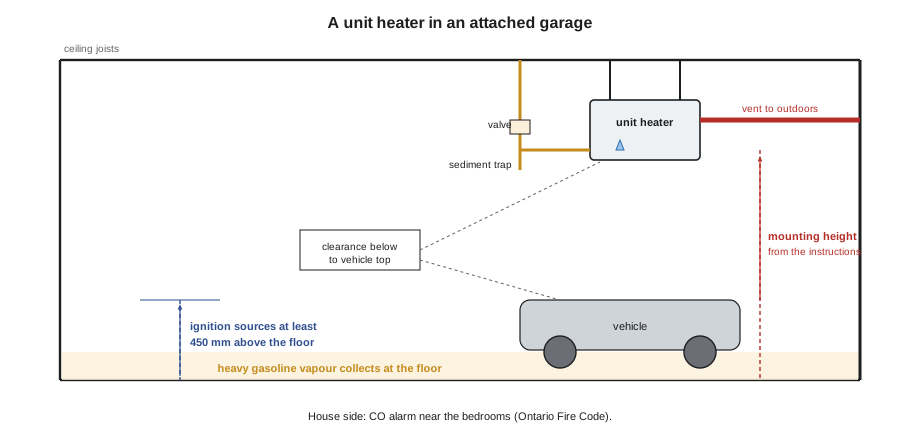
A garage combines three hazards that a house does not. The first is flammable vapour. Gasoline vapour is several times heavier than air, so a spill or a leaking fuel line forms a layer of vapour along the floor, and any open flame or spark at floor level can ignite it. The second is vehicle impact: a car or a snowblower can strike an appliance or its gas piping. The third is exhaust: a vehicle idling in a closed garage produces carbon monoxide, and an attached garage is one of the most common routes by which CO enters a house.
CSA B149.1 deals with the first two directly. An appliance installed in a residential garage must have its burners, burner ignition devices and other ignition sources at least 450 mm above the floor, unless the appliance is certified as suitable for installation at floor level in a garage, as FVIR water heaters often are. Appliances and their piping must be protected from vehicle damage, by location or by barriers. The instructions for a garage heater add their own mounting height and clearances. The Ontario Fire Code requires carbon monoxide alarms in homes with an attached garage, adjacent to each sleeping area, and Bayline checks that they are present and working whenever it works in the garage.
Unit heaters
A gas unit heater is a compact, self-contained heater, usually hung from the ceiling, with a burner and heat exchanger, a propeller fan that blows warm air across the space, and, on most modern residential models, a power venter or inducer that pushes the flue gas through a vent to the outdoors. Separated combustion models also take their combustion air from outdoors through a second pipe or a concentric terminal, which keeps garage air, with its fumes and dust, out of the burner. Unit heaters are certified under the joint standard for gas unit heaters and need a 120-volt supply for the fan, the venter and the controls.
Unit heaters are mounted at the height and with the clearances their instructions give: from the ceiling, the side walls and any combustible material, and below the heater to the top of a vehicle or anything stored beneath it. Most instructions specify a minimum mounting height that is well above the code's ignition-source minimum, partly to keep the hot air flowing where people work rather than blowing straight down. The heater hangs from the structure on threaded rods or a bracket rated for its weight, never from the gas pipe. The gas supply drops to it with a manual shut-off valve within reach, a union and a sediment trap, and the venting follows the instructions' material, length, slope and termination requirements.
Rosa sized the Stoney Creek heater from a heat loss estimate for the garage, which was insulated but had a large uninsulated overhead door. The garage did not need to be kept as warm as a living room, and the owner wanted it at about 15 °C while he worked and set back the rest of the time. A heater with a larger output would warm it faster after a setback, at the cost of more cycling.
Worked problem
Sizing the garage heater
The garage loses about 5.0 kW when it is 15 °C inside and −18 °C outside. Rosa is considering a unit heater with an input of 8.8 kW and a thermal efficiency of 0.80. What is the heater's output, and what is the ratio of output to heat loss?
Show solution
- Output:
- \[8.8 \text{ kW} \times 0.80 = 7.04 \text{ kW}\]
- Ratio:
- \[\frac{7.04}{5.0} \approx 1.4\]
Answer: The heater delivers about 1.4 times the design heat loss. That margin lets it bring the garage up from a setback in reasonable time after the door has been open, without being grossly oversized. The 8.8 kW input was also checked against the gas piping before the order was placed.
Installing the garage heater
The installation took most of a day. Jonah and Rosa marked the heater's position on the ceiling between the two parking bays, toward the back wall where it was clear of the overhead door track and the cars' roofs, and checked every clearance in the instructions, including the clearance below to the top of the owner's van. They hung it from the ceiling joists on threaded rod with the bracket kit, ran the gas line from the house piping with a branch tee, a manual valve, a union and a sediment trap, and installed the separated-combustion vent kit through the side wall, with the terminal clear of the window and the neighbour's lot line.
Bayline's electrical partner had installed a dedicated receptacle and a wall thermostat cable the week before. Once the gas line was tested and purged, Rosa had Jonah start the heater, watch its sequence, measure the inlet and manifold pressures, check the flame through the sight port, take a combustion reading at the vent's test port, and measure CO in the garage with the heater running for half an hour and the overhead door shut. The garage reading stayed at zero. Jonah then checked the house's CO alarms. There was one on the main floor, but none near the bedrooms upstairs, so Rosa sold the owner a second alarm and Jonah mounted it in the upstairs hall.
| Heater type | Venting | Combustion air | Typical use | Key cautions |
|---|---|---|---|---|
| Direct-vent wall furnace | Concentric wall terminal | Outdoors | Additions, cottages, basements | Terminal and furniture clearances |
| Gravity wall or floor furnace | B-vent, natural draft | Room | Older houses | Heat exchanger, draft, spillage |
| Power-vented unit heater | Plastic or metal per instructions | Room | Garages, workshops | Height, clearances, garage fumes |
| Separated-combustion unit heater | Two pipes or concentric | Outdoors | Garages with fumes or dust | Height, clearances |
| Low-intensity infrared tube heater | Power vented | Room or outdoors | Large garages, shops | Clearances below to vehicles and storage |
| Portable construction heater | None | Room | Ventilated construction sites only | Never in a house or closed garage |
Infrared heaters
Infrared heaters warm objects and people directly by radiation rather than heating the air, which suits large, drafty spaces such as big garages, workshops and barns, where warming the air would be wasteful. A low-intensity tube heater fires a burner into a long steel tube, which glows dark and radiates heat downward from a reflector; a power venter at the end of the tube pulls the flue gas through and out. These heaters have large clearances to combustibles, especially below and in front of the tube, given in a chart in the instructions, and the chart must be checked against the tallest vehicle or stack of storage that might sit under the heater. Commercial infrared heaters are covered in GAS-320.
Worked problem
Checking the ignition-source height
A unit heater's instructions require its bottom to be at least 2.4 m above the floor in a garage. Its burner sits 250 mm above the bottom of the cabinet. The garage ceiling is 2.9 m high and the heater cabinet is 400 mm tall, hung 100 mm below the joists. Does it meet both the instructions and the 450 mm code minimum for ignition sources?
Show solution
- Height of the cabinet bottom:
- \[2.9 - 0.10 - 0.40 = 2.40 \text{ m}\]
- Height of the burner:
- \[2.40 + 0.25 = 2.65 \text{ m}\]
Answer: The cabinet bottom is exactly at the 2.4 m the instructions require, and the burner at 2.65 m is far above the 450 mm code minimum. The installation meets both, with no margin on the instructions' figure, so the rods must not be lengthened.
The example shows why both figures are checked. The code minimum protects against vapour at floor level; the instructions' mounting height protects vehicles, people and the heater's own airflow, and it is part of the heater's certification. An installation that meets one and not the other is not acceptable.
Before they left, Rosa took the portable heater and its cylinder out to the owner's truck with him and explained, once more, why it must only be used outdoors. His headache, she pointed out, had come from the heater, and he agreed to see his doctor about it. Jonah recorded the CO reading from the portable heater test in the job notes, with the time and the conditions, as Bayline's procedure requires.
Common mistakes
MistakeUsing a portable construction heater to heat a closed garage.
InsteadInstall a vented unit heater; use portable heaters only where their instructions permit.
MistakeMounting a garage heater with its ignition source low on the wall.
InsteadKeep ignition sources at least 450 mm above the floor and follow the instructions' mounting height.
MistakeHanging a unit heater from its gas pipe.
InsteadHang it from the structure on rods or a rated bracket; support the pipe separately.
MistakeChecking clearances below a heater against an empty garage.
InsteadCheck against the tallest vehicle or storage that will sit under it.
MistakeLeaving an attached-garage house without checking CO alarms.
InsteadConfirm working CO alarms near the sleeping areas.
Summary and key terms
- Vented room heaters, especially direct-vent wall furnaces, heat single rooms without ducts; old gravity wall and floor furnaces need careful inspection.
- Portable construction and outdoor heaters are never used in houses or closed garages.
- Garages add heavy gasoline vapour, vehicle impact and exhaust: CSA B149.1 keeps ignition sources at least 450 mm above the floor unless the appliance is certified for floor level, and appliances must be protected from vehicles.
- Unit heaters hang from the structure at the instructions' height and clearances, with a valve, union and sediment trap, and power-vented or separated-combustion venting.
- Infrared tube heaters have large clearances below.
- Check CO alarms in houses with attached garages.
- Direct-vent wall furnace
- A sealed-combustion room heater mounted on an outside wall with a concentric terminal.
- Floor furnace
- An old gravity heater installed in a floor opening, venting by natural draft.
- Unit heater
- A self-contained, usually ceiling-hung heater with a burner, heat exchanger and propeller fan.
- Separated combustion
- An appliance design that takes combustion air from outdoors through a sealed pipe.
- Power venter
- A fan that pushes or pulls flue gas through an appliance vent.
- Infrared tube heater
- A heater that radiates heat downward from a long, burner-fired steel tube under a reflector.
- Construction heater
- A portable heater certified for ventilated temporary use on construction sites.
Practice problems
Work each problem on paper first, then reveal the answer to check.
Why must ignition sources in a garage be kept above the floor?
Show answer
Gasoline vapour is heavier than air and collects at floor level.
What is the advantage of a separated-combustion unit heater in a garage?
Show answer
It takes combustion air from outdoors, keeping garage fumes and dust out of the burner.
Why are portable propane heaters dangerous in a closed garage?
Show answer
They release CO and use up oxygen with no venting.
A heater with 11 kW input and 0.80 efficiency serves a garage losing 6.0 kW. What is its output-to-loss ratio?
Show answer
8.8 ÷ 6.0 ≈ 1.5.
What must clearances below an infrared heater be checked against?
Show answer
The tallest vehicle or storage that may sit under it.
Lesson quiz · 5 questions
Score 60% or more to complete this lesson.
Create a free account to save your progress, take quizzes and earn a certificate.