
GAS-210 · Lesson 2 of 12 · 24 min
Forced-air furnaces: how they work
▶ Video coming soon A video version of this lesson is on the way.
In the middle of October, a few days after Bayline replaced the cracked vent connector at the Garfield Avenue bungalow, Rosa Delgado took Jonah back to the house to finish the job properly. The furnace was a 2006 mid-efficiency, induced-draft upflow model with an input of 26 kW, the very figure Bayline uses in its examples. The owners had agreed to a full service while the crew was there. Rosa switched the furnace off, pulled both doors and handed Jonah a flashlight. "You've read the plate," she said. "Now I want you to be able to tell me where every molecule of gas, air and flue gas goes in this box, and in what order things happen when the thermostat calls. If you can do that, you can fix almost anything."
This lesson describes how a forced-air furnace works: its parts, the two separate airflows inside it, the heat exchanger that keeps them apart, the main configurations, and the basic sequence from a call for heat to the blower shutting off. It uses the Garfield furnace, a mid-efficiency design, because it is simpler than a condensing furnace and many thousands are still in service. Lesson 3 adds what a condensing furnace does differently, and GAS-220 covers the controls and ignition systems in depth.
Two airflows that must never mix
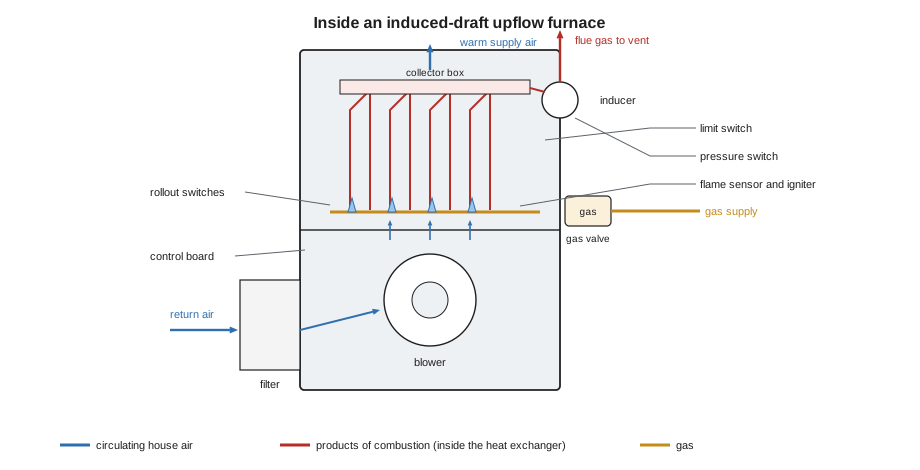
A furnace handles two streams of air that must stay apart. Combustion air is drawn into the burner compartment, mixed with gas and burned; the hot products of combustion then pass through the inside of the heat exchanger, are pulled out by the inducer fan and leave through the vent. Circulating air, also called conditioned air or house air, is drawn from the rooms through the return ducts, passes through the filter and the blower, flows over the outside of the heat exchanger, picks up heat, and goes back to the rooms through the supply ducts. The two streams touch only through the metal walls of the heat exchanger.
That separation is the most important safety feature of a furnace. If a heat exchanger cracks or rusts through, products of combustion can enter the circulating air, or the blower's air can enter the burner area and disturb the flames, pushing them out of the burner compartment. Either way, carbon monoxide and other combustion products can reach the house. GAS-130's Sanford Avenue call, where a rollout switch had tripped because a heat exchanger was cracked, was an example. Heat exchanger inspection is part of every annual service (lesson 11) and is covered in detail in GAS-340.
The parts of a furnace
The cabinet is divided into compartments. In an upflow furnace, the blower compartment sits at the bottom with the filter rack beside or below it, and the burner compartment sits above it with the heat exchanger. The gas valve controls and regulates gas to the burners. Most mid-efficiency and condensing furnaces use inshot burners, small tubes that fire horizontally into the heat exchanger. Older furnaces used ribbon or slotted burners under the heat exchanger. The gas leaves the valve through the manifold, a pipe with a fixed orifice for each burner, and the orifice size together with the manifold pressure sets the input.
The heat exchanger in an induced-draft furnace is usually a set of tubular passes or stamped steel clamshell sections, joined to a collector box at the outlet. The inducer, or draft inducer, is a small fan on the collector box that pulls the products of combustion through the heat exchanger and pushes them into the vent. The pressure switch proves that the inducer is moving enough air before the gas valve may open. The igniter, now almost always a hot surface igniter, lights the gas, and the flame sensor proves that flame is present. The high limit switch opens if the air around the heat exchanger gets too hot, and the rollout switches open if flame rolls out of the burner openings. The control board runs the sequence. GAS-130 covered how these parts are wired; GAS-220 covers how they are tested.
The blower is a centrifugal fan with a forward-curved wheel, driven by a PSC or ECM motor. Its speed sets the airflow, and the airflow sets the temperature rise across the heat exchanger. On most furnaces the same blower also moves the air for central air conditioning through an evaporator coil set in the supply plenum, at a higher speed than for heating. The filter protects the blower, the coil and the heat exchanger from dust. A dirty filter is the most common cause of a furnace running hot and tripping its limit.
| Part | What it does | What goes wrong |
|---|---|---|
| Gas valve and manifold | Opens, regulates and delivers gas to the orifices | Wrong manifold pressure, failed coil, leaking seat |
| Burners and orifices | Mix gas with primary air and fire into the heat exchanger | Dirt, rust, spiders, misalignment, wrong orifice size |
| Heat exchanger | Transfers heat while keeping flue gas out of house air | Cracks, holes from corrosion, blockage |
| Inducer and pressure switch | Moves flue gas; proves the draft before ignition | Worn bearings, blocked vent, cracked hose, water in the line |
| Igniter and flame sensor | Lights the gas; proves flame | Cracked igniter, dirty or worn flame rod |
| Limit and rollout switches | Shut the gas off if the furnace overheats or flames roll out | Tripping from low airflow or a blocked heat exchanger |
| Blower and filter | Move and clean the circulating air | Dirty filter or wheel, failing capacitor or motor |
Configurations
Furnaces are described by the direction the circulating air flows through them. An upflow furnace takes air in at the bottom or side and discharges it at the top; it is the usual choice in a basement. A downflow, or counterflow, furnace takes air in at the top and discharges it at the bottom into ducts below the floor; it suits a main-floor closet over a crawl space or slab ducts. A horizontal furnace lies on its side and moves air from one end to the other; it suits attics and crawl spaces. Many modern furnaces are multipoise: one model can be installed in any of these positions, provided the installer follows the instructions for that position, which may include moving the pressure switch, turning the inducer or relocating the condensate trap.
The installation position affects clearances, how the furnace is supported, where the filter goes and, on a condensing furnace, how the condensate drains. A horizontal furnace in an attic needs a service platform and, often, an auxiliary drain pan. An upflow furnace in a basement needs a solid, level base and enough room in front for service, which the instructions and the code set as a minimum. The Garfield furnace was an upflow unit on a concrete floor, which made it easy to work on.
Natural draft and induced draft
Older furnaces relied on natural draft. The hot flue gas, being lighter than the surrounding air, rose up a chimney or B-vent, and a draft hood on top of the furnace let room air mix into the flue gas to stabilize the draft and protect the burners from downdrafts. These furnaces typically had standing pilots, large heat exchangers and seasonal efficiencies around 60 to 65 out of 100. A few are still running in old houses, and every one needs a careful check for spillage at the draft hood.
From the late 1980s, induced-draft furnaces, also called fan-assisted furnaces, replaced them. The inducer pulls the flue gas through a smaller, more restrictive heat exchanger, which extracts more heat, and the furnace has no draft hood and no dilution air. The flue gas leaves hot enough to avoid condensing in the vent, so the vent is Category I: non-positive pressure and non-condensing, usually B-vent or a lined chimney sized under the code's venting rules, as GAS-120 described. These furnaces reach an AFUE of about 80, which is why they are called mid-efficiency. The Garfield furnace was one, and in GAS-120 its vent connector was the part that failed.
Worked problem
Temperature rise from output and airflow
The Garfield furnace has an input of 26 kW and a steady-state efficiency of 0.80. Its blower moves 520 L/s across the heat exchanger. Use 1.21 kJ per cubic metre per degree Celsius for the heat capacity of air. What temperature rise should Jonah expect?
Show solution
- Find the output:
- \[26 \text{ kW} \times 0.80 = 20.8 \text{ kW}\]
- Convert the airflow to cubic metres per second:
- \[520 \text{ L/s} = 0.52 \ \text{m}^3\text{/s}\]
- Rearrange the heat equation for the rise:
- \[\Delta T = \frac{Q}{1.21 \times \dot V} = \frac{20.8}{1.21 \times 0.52} = \frac{20.8}{0.629} \approx 33 \ ^\circ\text{C}\]
Answer: Jonah should expect a rise of about 33 °C. The plate's range for this furnace was 25 to 42 °C, so 33 °C is comfortably within it. Lesson 4 shows how to measure it.
The sequence of operation
Every modern furnace follows a set sequence of operation, run by its control board and described in its instructions. A simplified version for an induced-draft furnace with hot surface ignition runs as follows. The thermostat closes R to W and calls for heat. The board checks that the limit and rollout switches are closed, then starts the inducer. When the inducer has built enough draft, the pressure switch closes, and the board begins a short pre-purge to clear the heat exchanger. The board then powers the igniter, which glows for a warm-up period of several seconds.
With the igniter hot, the board opens the gas valve, and the burners light. Within a few seconds the flame sensor must prove flame; if it does not, the board closes the valve and tries again a set number of times before going into lockout. Once flame is proved, the igniter switches off. After a blower-on delay, often 30 to 60 seconds, which lets the heat exchanger warm up so the blower does not push cold air into the house, the blower starts. The furnace then runs until the thermostat is satisfied and opens R to W. The gas valve closes, the inducer runs a short post-purge, and the blower keeps running for a blower-off delay, often 90 to 180 seconds, to remove the remaining heat from the heat exchanger.
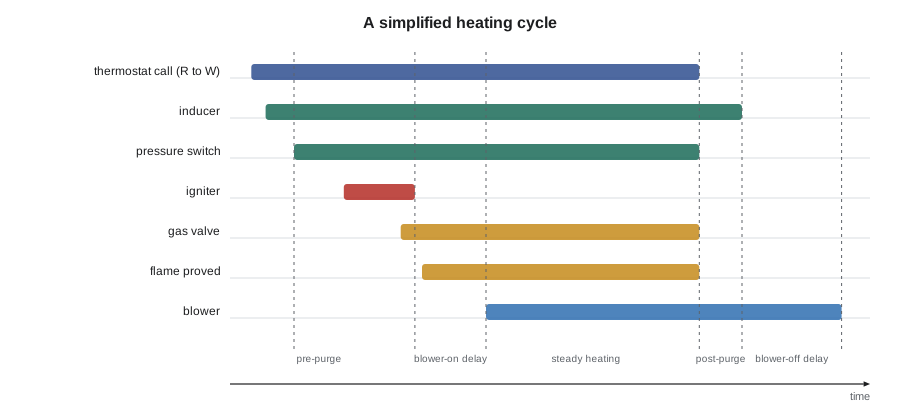
The sequence explains most furnace faults. If the inducer runs but nothing else happens, the pressure switch has not closed. If the igniter glows but the burners never light, the gas valve has not opened or gas is not reaching it. If the burners light and go out after a few seconds, the flame has not been proved. If the furnace runs and then shuts off on its limit, airflow is too low. Rosa made Jonah talk through the sequence aloud while they watched the Garfield furnace run a full cycle, naming each step as it happened. GAS-220 covers the controls behind each step, and the fault codes the board flashes when a step fails.
Single-stage, two-stage and modulating
A single-stage furnace has one firing rate: it is either off or at full input. A two-stage furnace has a gas valve with two outlet pressures and an inducer with two speeds, so it can run at a low fire, often about 60 to 70 in every 100 units of full input, for most of the season and switch to high fire on cold days. A modulating furnace adjusts its input over a range, sometimes down to about 35 or 40 in 100 of full input, to match the heat loss of the house closely. Both kinds run longer, quieter cycles at lower blower speeds, which evens out temperatures and reduces start-up losses.
Worked problem
How long a furnace runs
On a design cold day the Garfield house loses 12 kW. The furnace delivers 20.8 kW when it runs. On a mild day the house loses 6 kW. About how many minutes in each hour does the furnace run on each day?
Show solution
- The fraction of time running is heat needed divided by heat delivered:
- \[\frac{12}{20.8} = 0.577 \qquad 0.577 \times 60 \text{ min} \approx 35 \text{ min}\]
- On the mild day:
- \[\frac{6}{20.8} = 0.288 \qquad 0.288 \times 60 \text{ min} \approx 17 \text{ min}\]
Answer: Even on the coldest day the furnace runs for well under an hour in each hour, so it is larger than the house needs. On mild days it runs only a few short cycles. A two-stage furnace would run at low fire for longer cycles instead, which is gentler on its parts and more comfortable.
What Jonah took away
By the end of the afternoon Jonah had traced both airflows with his flashlight, named every part in the table above, watched the sequence and recorded the inlet and manifold pressures, the temperature rise and the blower current for the service record. Rosa had him finish with the question she asks every apprentice: what keeps the flue gas out of the house air? He gave the right answer: the heat exchanger, the inducer that keeps the inside of the heat exchanger under negative pressure, and the safety switches that shut the gas off if either fails.
Common mistakes
MistakeAssuming a furnace that heats is safe because it heats.
InsteadInspect the heat exchanger and check the vent and the flames on every service.
MistakeRunning a furnace with the blower door off for long periods.
InsteadThe door is part of the air path; leave it off only for the test and use the door switch tool only as long as needed.
MistakeCalling an induced-draft furnace natural draft because it uses a chimney.
InsteadIt has an inducer and no draft hood; it is a fan-assisted Category I appliance.
MistakeReplacing a limit switch that keeps tripping.
InsteadA tripping limit usually means low airflow; check the filter, blower and ducts first.
MistakeMoving a multipoise furnace into a new position without the position's instructions.
InsteadFollow the instructions for that position; parts may have to be moved.
Summary and key terms
- A furnace keeps two airflows apart: combustion air and flue gas inside the heat exchanger, circulating air outside it.
- Its main parts are the gas valve and manifold, burners and orifices, heat exchanger, inducer, pressure switch, igniter, flame sensor, limit and rollout switches, control board, blower and filter.
- Furnaces are upflow, downflow, horizontal or multipoise.
- Old natural-draft furnaces used a draft hood; induced-draft furnaces use an inducer and a Category I vent and reach an AFUE of about 80.
- The sequence runs: call for heat, inducer, pressure switch, pre-purge, igniter, gas valve, flame proved, blower-on delay, run, gas off, post-purge, blower-off delay.
- Two-stage and modulating furnaces match output to the heat loss for longer, gentler cycles.
- Heat exchanger
- The metal passage that transfers heat from the products of combustion to the circulating air while keeping them apart.
- Inducer
- A fan that pulls flue gas through the heat exchanger and pushes it into the vent.
- Inshot burner
- A small tube burner that fires horizontally into a heat exchanger passage.
- Multipoise furnace
- A furnace that can be installed upflow, downflow or horizontal.
- Draft hood
- A fitting on a natural-draft appliance that admits room air to stabilize the draft.
- Sequence of operation
- The order in which a furnace control energizes and proves each component.
- Lockout
- A control state in which an appliance stops trying to light after repeated failures.
Practice problems
Work each problem on paper first, then reveal the answer to check.
What separates the products of combustion from the house air?
Show answer
The walls of the heat exchanger.
What must happen before the igniter is energized on an induced-draft furnace?
Show answer
The inducer must run and the pressure switch must prove the draft.
Why does the blower wait after the burners light?
Show answer
So the heat exchanger warms up and the blower does not push cold air into the house.
What vent category is a mid-efficiency induced-draft furnace?
Show answer
Category I: non-positive pressure and non-condensing.
Name one advantage of a two-stage furnace.
Show answer
Longer, quieter low-fire cycles that even out temperatures and reduce cycling losses.
Lesson quiz · 5 questions
Score 60% or more to complete this lesson.
Create a free account to save your progress, take quizzes and earn a certificate.