
GAS-210 · Lesson 1 of 12 · 25 min
Residential gas appliances and their ratings
▶ Video coming soon A video version of this lesson is on the way.
In his third week at Bayline Gas & Heating, at the end of September, Jonah Clarke spent a slow Friday afternoon in the warehouse with Hank Morrow. A delivery had just come in: two furnaces, a storage water heater, a tankless water heater, a direct-vent fireplace and a range for a builder's model home. Hank handed Jonah a clipboard. "Before you touch a wrench on any of these, read the plate," he said. "Every job in this trade starts at the rating plate. It tells you what gas the appliance burns, how much, at what pressure, how hot it can get, what it needs around it and who tested it. If what you see on site doesn't match the plate, the plate wins, or the appliance doesn't get lit."
Jonah spent two hours copying plates onto the clipboard, and by the end he had questions that took the rest of the week to answer. Why did one furnace show two input ratings? Why did the water heater have a "first hour rating" when the tankless had a flow in litres per minute? Why did the fireplace carry an efficiency figure the furnace did not? This lesson answers those questions. It surveys the gas appliances found in homes, explains how they are rated and labelled, and shows how a gas technician uses the ratings to check that an installation is safe and correctly sized. The rest of the course takes each appliance in turn.
The appliances in a house
A typical gas-heated home has two to five gas appliances. The furnace or boiler heats the house; it is the largest load and the one that runs the longest. A water heater, either a storage tank or a tankless unit, supplies domestic hot water and is the second largest load in most houses. A fireplace or insert gives heat and a flame to look at. A range or cooktop and a clothes dryer are common in kitchens and laundry rooms. Some homes add a garage heater, a pool or spa heater, an outdoor barbecue or fire table, a standby generator or a space heater in a room the central system does not reach well.
Each of these is a certified appliance: it has been tested by an accredited certification body against the product standard that applies to it, and it carries that body's mark. GAS-120 covered certification and field approval; here the point is practical. The product standard sets what the rating plate must show, and the installation instructions that come with the appliance are part of its certification. An installer who departs from them, by using a different vent material, a different clearance or a different gas, is no longer installing a certified appliance.
| Appliance | Typical input range | Main product standard | Lesson |
|---|---|---|---|
| Forced-air furnace | 12 to 35 kW | ANSI Z21.47 / CSA 2.3 | 2 to 4 |
| Storage water heater | 9 to 22 kW | ANSI Z21.10.1 / CSA 4.1 | 5 |
| Tankless water heater | 30 to 59 kW | ANSI Z21.10.3 / CSA 4.3 | 5 |
| Combination boiler | 20 to 59 kW | ANSI Z21.13 / CSA 4.9 | 6 |
| Vented fireplace or insert | 6 to 15 kW | ANSI Z21.88 / CSA 2.33 or Z21.50 / CSA 2.22 | 7 |
| Range | 12 to 22 kW total | ANSI Z21.1 / CSA 1.1 | 8 |
| Clothes dryer | 6 to 7 kW | ANSI Z21.5.1 / CSA 7.1 | 8 |
| Garage unit heater | 9 to 30 kW | ANSI Z83.8 / CSA 2.6 | 9 |
The standards in the table are joint American and Canadian standards, so one appliance can be certified for both countries. That is why the same furnace model is sold in Hamilton and Columbus with a plate that shows both kilowatts and Btu per hour and both certification marks. A plate that shows only one country's mark tells you which market the appliance was certified for, and an appliance certified only for the other country's market is not certified where you are installing it.
Reading a rating plate
The rating plate, also called the data plate or nameplate, is a permanent label fixed to the appliance, usually inside the burner compartment door of a furnace, on the jacket of a water heater or behind the lower grille of a fireplace. It is required by the appliance standard and checked by the certification body. Rosa Delgado's rule, which Jonah copied onto the first page of his notebook, is to read the whole plate on every appliance he works on, even ones he has seen a hundred times, because models are revised and the plate is the only reliable record of what is in front of him.
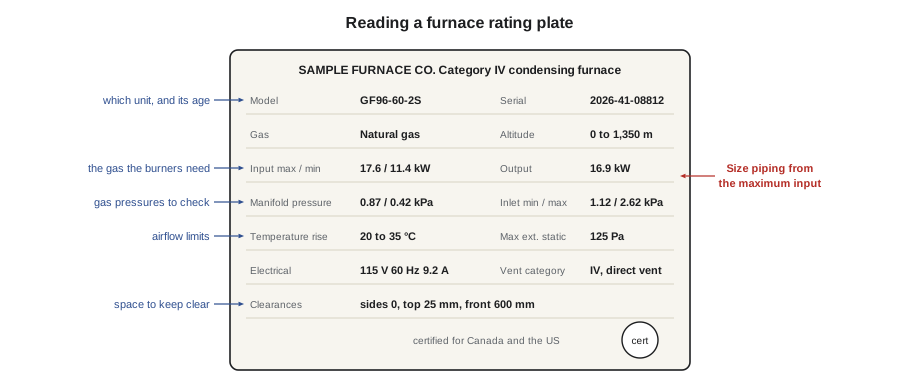
A furnace plate typically shows the following. The model number and serial number identify the appliance; many makers encode the year and week of manufacture in the serial number, which matters when deciding whether a part is still available or whether replacement makes more sense than repair. The gas type says natural gas or propane; a conversion kit, covered in lesson 10, changes this and adds a conversion label beside the plate. The input is the rate at which the appliance burns gas, in kilowatts, with British thermal units per hour beside it. Two-stage and modulating furnaces show a maximum and a minimum input.
The plate goes on. The manifold pressure is the pressure the gas valve's regulator delivers to the burners, and the minimum and maximum inlet pressures are the limits on the pressure arriving at the valve from the house piping. The temperature rise range gives the lowest and highest permitted difference between the air leaving and the air entering the furnace, and the maximum external static pressure limits how restrictive the duct system may be. The electrical rating gives voltage, frequency and current. The vent category, covered in GAS-120, tells you what kind of vent the appliance needs. The clearances to combustibles give the minimum distances from each side, the top, the front and the vent connector. Finally, the certification mark shows who tested it.
Input and output
The input rating is the energy content of the gas burned per hour at full fire. The output, called heating capacity on a furnace or boiler, is the heat actually delivered to the air or water. The difference is lost, mostly up the vent as hot flue gas and water vapour, and a little through the cabinet. For sizing gas piping, which GAS-120 covered, the input is what matters, because the pipe has to carry the gas the appliance burns. For sizing the appliance to the house, the output is what matters, because the house needs a certain amount of heat.
In Canada, appliance inputs are given in kilowatts, often with the equivalent in British thermal units per hour because so many appliances are made for both markets. One kilowatt is 3,412 Btu/h, and one kilowatt-hour is 3.6 megajoules. Natural gas is billed in Ontario by the cubic metre, and Enbridge Gas's typical heating value is about 37.5 MJ per cubic metre, so a furnace burning 2.5 cubic metres per hour has an input of about 93.75 MJ/h, or 26 kW. These are the figures Bayline uses as its standard example, as GAS-110 did.
Worked problem
From input to output
A two-stage condensing furnace's plate gives a maximum input of 17.6 kW and an output capacity of 16.9 kW. What is its steady-state efficiency at high fire, and what is the input in Btu/h?
Show solution
- Efficiency is output divided by input:
- \[\eta = \frac{16.9 \text{ kW}}{17.6 \text{ kW}} = 0.960\]
- Convert the input to Btu/h:
- \[17.6 \text{ kW} \times 3412 \ \frac{\text{Btu/h}}{\text{kW}} = 60\,051 \text{ Btu/h}\]
Answer: The furnace delivers 96 in every 100 units of heat it burns at high fire, and its input is about 60,000 Btu/h, which is how it would be listed in a US catalogue. This furnace returns in lesson 12.
Efficiency ratings
A single efficiency figure cannot describe every appliance, so each kind has its own rating, set by a test method in a standard. Annual fuel utilization efficiency (AFUE) applies to furnaces and boilers. It estimates the heat delivered over a whole heating season, including the losses during start-up, cool-down and standby, divided by the energy of the fuel used. An AFUE of 96 means that, under the test conditions, 96 of every 100 units of fuel energy end up as heat in the house over a season. Steady-state efficiency, sometimes called thermal efficiency, is measured with the appliance running continuously at full fire and is always a little higher than AFUE for the same appliance.
Water heaters are rated by uniform energy factor (UEF), a number below 1 that compares the energy delivered as hot water with the energy used over a simulated day of use that includes standby losses. A storage water heater also has a first-hour rating (FHR), the volume of hot water it can deliver in an hour starting with a full tank, which is the figure to compare with a household's peak demand. A tankless water heater has no stored water, so it is rated by its maximum flow rate at a stated temperature rise. Both kinds are tested in one of four usage bins, very small, low, medium or high, based on their FHR or flow, and the UEF is compared only within a bin.
Gas fireplaces in Canada are rated by fireplace efficiency (FE), measured under CSA P.4.1, which accounts for the pilot's gas use and the heat lost up the vent over a typical season. Natural Resources Canada's Energy Efficiency Regulations require heating gas fireplaces made on or after January 1, 2020 to reach an FE of at least 50 and limit how long a pilot may burn continuously (lesson 7). Ranges and dryers have no efficiency rating on the plate, though dryers carry an energy rating under separate rules.
Worked problem
What efficiency is worth over a year
A house needs 60 GJ of heat delivered over a heating season. How much gas, in cubic metres, would a furnace with an AFUE of 80 use, compared with one with an AFUE of 96? Use 37.5 MJ per cubic metre.
Show solution
- Gas energy needed is heat delivered divided by AFUE:
- \[\frac{60 \text{ GJ}}{0.80} = 75.0 \text{ GJ} \qquad \frac{60 \text{ GJ}}{0.96} = 62.5 \text{ GJ}\]
- Convert each to cubic metres (1 GJ = 1,000 MJ):
- \[\frac{75\,000 \text{ MJ}}{37.5 \ \text{MJ/m}^3} = 2000 \text{ m}^3 \qquad \frac{62\,500 \text{ MJ}}{37.5 \ \text{MJ/m}^3} \approx 1667 \text{ m}^3\]
- Find the difference:
- \[2000 - 1667 = 333 \text{ m}^3\]
Answer: The higher-efficiency furnace uses about 333 cubic metres less gas a year for the same heat, about one-sixth less. The house is just as warm; less heat goes up the vent.
Minimum efficiency rules
Federal rules decide which appliances may be sold. Under Amendment 15 to Natural Resources Canada's Energy Efficiency Regulations, gas furnaces with an input up to about 66 kW made on or after July 3, 2019 must reach an AFUE of 95, which in practice means a condensing furnace; through-the-wall furnaces and units marked for replacement in manufactured homes have lower limits. Gas tankless water heaters for homes have had to meet condensing-level efficiency since January 1, 2020. Storage water heaters, ranges and dryers have their own minimums. A technician cannot sell or install a new mid-efficiency furnace in an Ontario house today, though thousands are still running and need service.
Rules like these change what customers buy and what technicians install, so Bayline's office keeps a one-page summary of current minimums and updates it whenever a rule changes. For a technician, the practical consequences come in lesson 3: a condensing appliance needs a condensate drain, a different vent and more care at start-up than the appliance it replaces, and replacing one appliance can leave another orphaned in a chimney, as GAS-120 showed.
Sizing and the house
A rating only means something when it is compared with the job the appliance has to do. A furnace should be sized from a heat loss calculation, a room-by-room estimate of how much heat the house loses on a design cold day, made with a method such as CSA F280. The old furnace's input is not a sizing method. Many older houses have furnaces far larger than they need, because the house has since been insulated and its windows replaced, and an oversized furnace short-cycles, wears its parts and heats unevenly. Bayline's rule, which Hank repeats to every customer, is that a furnace is chosen from a heat loss calculation and the duct system's capacity, never from the old plate.
Water heaters are sized from the household's peak hour demand, estimated from the number of bathrooms, people and fixtures, and compared with the FHR or, for tankless units, with the flow needed at the incoming water temperature. Fireplaces and space heaters are sized to the room they serve. Lesson 12 works through sizing for a real replacement.
Altitude and other conditions
Ratings apply at the conditions stated on the plate. At high altitude the air is thinner, so there is less oxygen in each cubic metre and an appliance must be derated or fitted with high-altitude parts; most manufacturers require changes above about 600 metres. Hamilton and its surrounding area are well below that, so Bayline rarely derates, but technicians who move west learn the rules quickly. An appliance installed in an unusual setting, such as a garage, a closet or a mobile home, has its own limits on the plate and in the instructions. Lessons 7 and 9 return to these.
By the end of the following week, Jonah could read every plate in the warehouse and say what each number meant. Hank's final check was simple. He pointed at a tankless water heater and asked what it would need from the gas piping. Jonah read off the input, worked out the gas flow from it, and said the house's main would have to be checked against it before the unit was hung. Hank nodded. That was exactly the problem GAS-120's case study had found at the Fairhaven house.
Common mistakes
MistakeSizing a replacement furnace from the old furnace's input.
InsteadSize from a heat loss calculation and the duct system's capacity.
MistakeComparing a water heater's UEF with one in a different usage bin.
InsteadCompare UEF only within the same bin; compare FHR with peak demand.
MistakeTreating AFUE and steady-state efficiency as the same thing.
InsteadAFUE is seasonal and includes cycling and standby losses; steady-state efficiency is higher.
MistakeUsing the output rating to size gas piping.
InsteadSize piping from the input, the gas the appliance actually burns.
MistakeIgnoring a second input figure on a two-stage plate.
InsteadNote both maximum and minimum inputs; piping and checks use the maximum.
Summary and key terms
- Homes use furnaces or boilers, water heaters, fireplaces, ranges, dryers and other appliances, each certified to a joint American and Canadian standard.
- The rating plate gives the gas type, input, pressures, temperature rise, static pressure, electrical data, vent category, clearances and certification.
- Input is the gas burned; output is the heat delivered; the ratio is the efficiency.
- AFUE rates furnaces and boilers over a season, UEF and FHR rate water heaters, and FE under CSA P.4.1 rates fireplaces.
- Canada requires an AFUE of 95 for most new gas furnaces made since July 3, 2019.
- Appliances are sized from a heat loss calculation or peak hot water demand, not from the old plate.
- Rating plate
- The permanent label on an appliance giving its gas type, input, pressures, limits, clearances and certification.
- Input
- The rate at which an appliance burns gas, in kilowatts or Btu per hour.
- Output
- The heat an appliance delivers to the air or water; for a furnace, its heating capacity.
- AFUE
- Annual fuel utilization efficiency: seasonal heat delivered divided by fuel energy used.
- UEF
- Uniform energy factor: a water heater rating comparing hot water energy delivered with energy used over a simulated day.
- First-hour rating
- The volume of hot water a storage water heater can deliver in an hour starting with a full tank.
- Heat loss calculation
- A room-by-room estimate of the heat a house loses on a design cold day, used to size heating equipment.
Practice problems
Work each problem on paper first, then reveal the answer to check.
Where would you find a furnace's maximum external static pressure?
Show answer
On its rating plate, and in its installation instructions.
Convert 26 kW to Btu/h.
Show answer
26 × 3,412 ≈ 88,700 Btu/h.
Why is AFUE lower than steady-state efficiency for the same furnace?
Show answer
AFUE includes start-up, cool-down and standby losses over a season.
Which rating should be compared with a household's peak hot water demand?
Show answer
The first-hour rating of a storage water heater, or the flow at the needed rise for a tankless unit.
Why does Bayline not size a replacement furnace from the old plate?
Show answer
The house may have been improved since, and the old furnace may have been oversized from the start.
Lesson quiz · 5 questions
Score 60% or more to complete this lesson.
Create a free account to save your progress, take quizzes and earn a certificate.