
GAS-210 · Lesson 7 of 12 · 24 min
Gas fireplaces, inserts and decorative appliances
▶ Video coming soon A video version of this lesson is on the way.
In the middle of October, Rosa and Jonah spent two days at a 1924 brick house in Kirkendall whose owners wanted to stop burning wood. The living room had a masonry fireplace with a clay-tile-lined chimney that had not been used in years. The owners had chosen a direct-vent gas fireplace insert, a steel firebox with a glass front, designed to slide into the old fireplace opening and vent through two flexible liners run down the chimney: one carrying flue gas up, the other bringing outdoor air down. "A fireplace is the appliance people sit closest to," Rosa told Jonah as they unloaded it. "They watch it, they put children and dogs in front of it, they hang a television over it. So we get the glass, the clearances and the venting exactly right."
This lesson covers the gas appliances whose purpose is partly or wholly the flame itself: vented fireplace heaters, decorative appliances, inserts, gas logs and freestanding stoves. It explains how they are classified and certified, how they are vented and lit, the safety rules around their glass and their surroundings, and what goes into installing and starting one. Space heaters and garage heaters, which are built for heat alone, follow in lesson 9.
Kinds of gas fireplace
Gas fireplaces are classified by what they are designed to do. A vented gas fireplace heater is built and certified to provide heat as well as a flame, under the joint standard ANSI Z21.88 / CSA 2.33; it has a sealed firebox, a glass front, usually a blower option, and an efficiency rating. A vented decorative appliance, certified under ANSI Z21.50 / CSA 2.22, is built mainly for the look of its flame and may deliver little heat. An insert is a fireplace heater designed to be installed into an existing masonry or factory-built wood fireplace. A gas log set is a burner with ceramic logs designed for installation in a working solid-fuel fireplace, venting through the chimney with the damper held open. A freestanding gas stove looks like a wood stove and is often direct-vented through a wall.
Unvented, or vent-free, gas fireplaces and log sets, which release all their combustion products into the room, are sold in parts of the United States, but indoor vent-free fireplaces are not sold for use in Canada and are not certified for installation in Canadian homes. A technician in Ontario who finds one, usually brought across the border, treats it as an uncertified appliance under the rules GAS-120 described, and does not connect or service it. Outdoor fire tables and fire pits are a separate class with their own standards.
Venting a fireplace
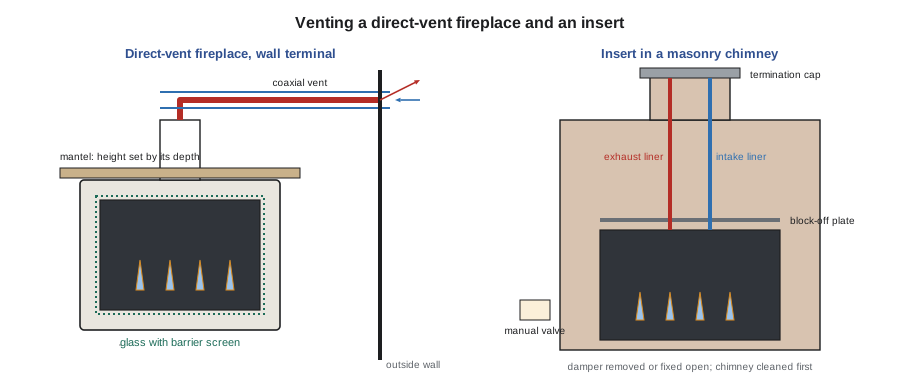
Most modern gas fireplaces are direct vent: a sealed firebox with a coaxial vent, a pipe within a pipe, that takes outdoor air down the outer passage and sends flue gas out the inner one. Because the combustion air comes from outdoors and the firebox is sealed by its glass, a direct-vent fireplace neither draws room air nor depends on the house pressure, and it can vent horizontally through a wall or vertically through the roof. The vent is the system the instructions list, from the same maker, with the terminations, lengths, rises and offsets their venting tables allow. Many fireplaces have a restrictor plate in the vent collar that is set according to the vent configuration, and getting it wrong spoils the flame.
An insert in a masonry chimney is usually vented with two flexible aluminium liners, commonly 75 mm in diameter, running the full height of the chimney, one connected to the insert's exhaust collar and one to its air intake, ending in a termination cap at the top. Some systems use a coaxial liner instead. Older B-vent or natural-vent fireplaces with a draft hood are still found; like any Category I appliance, they depend on the house not being depressurized. A gas log set relies on the existing chimney and an open damper, which is why the log set's instructions require the damper to be permanently fixed open or removed, and set a minimum chimney size.
Preparing a chimney for an insert
An insert depends on the chimney it vents through, so the chimney is prepared before the insert goes in. The chimney is inspected and cleaned by a qualified chimney professional, a WETT-certified sweep in Ontario, to remove creosote and check the flue and crown. Creosote left in a chimney can ignite from the heat of a gas vent, and a cracked liner or crown lets water and debris in. The old damper is removed or fixed fully open, as the insert's instructions require, so the liners can pass. A block-off plate, usually sheet metal sealed at the throat or the top of the firebox, keeps warm room air from escaping up the chimney around the liners.
At the Kirkendall house, the sweep had cleaned the chimney the week before and left a written report: sound clay liner, cracked crown repaired by a mason. Rosa and Jonah ran the two liners from the roof, connected them to the insert's collars with the maker's adapters and stainless screws, sealed the block-off plate, and fitted the termination cap. The insert's instructions set both a minimum and a maximum vertical length for this kind of installation; the chimney was well within the range.
Clearances, mantels and televisions
A fireplace's instructions give its clearances to combustibles: from the sides and top of the firebox, from the vent, and above all from a mantel and any combustible trim beside the opening. A mantel's permitted height depends on how far it projects: the deeper the mantel, the higher above the opening it must be. The instructions usually give this as a chart or a diagram, and the installer measures against it. Non-combustible facing material, such as stone, tile or cement board, may be required within a certain distance of the opening. The vent and any framing around the vent pipe have their own clearances, and the vent's firestops must be fitted where it passes through floors or walls.
Customers often want a television above a fireplace. A television is not a combustible in the code sense, but the heat rising from a fireplace can damage it, and the fireplace's instructions may say where electronics can and cannot go. Many makers publish separate guidance or offer heat-deflecting hoods, and some fireplaces are designed with a cool-wall feature for just this purpose. Bayline's practice is to show the customer the instructions' figures and the television maker's limits before the framing is finished, not after.
| What to check | Where the requirement comes from | Typical consequence if wrong |
|---|---|---|
| Firebox clearances to framing | Fireplace instructions | Charred or burning framing |
| Mantel height and depth | Instructions chart or diagram | Overheated mantel; fire risk |
| Non-combustible facing | Instructions | Scorched trim |
| Vent clearances and firestops | Instructions and code | Fire in the wall or attic |
| Termination clearances | Instructions and code | Flue gas entering windows or air intakes |
| Barrier screen in place | Product standard and instructions | Contact burns from hot glass |
| Logs and media placement | Instructions diagram | Sooting, flame impingement, carbon monoxide |
Hot glass and barrier screens
The glass front of a gas fireplace becomes very hot, hot enough to cause a serious contact burn in a second or two, and children have been badly hurt by touching it. Since January 1, 2015, the joint product standards for vented fireplace heaters, decorative appliances and related appliances have required a barrier, usually a fine mesh screen, in front of glass that gets hot enough to burn, on units made after that date. The barrier is part of the certified appliance. It must be installed, and the installer is expected to point it out to the customer and explain that it protects children and others from the glass. Older units without a barrier can usually be fitted with one from the maker.
The glass itself is a ceramic glass made for the job, sealed to the firebox by a gasket. It must be replaced only with the maker's part, never with ordinary or tempered glass, and the gasket must be intact, because the glass is part of the seal that keeps flue gas out of the room on a direct-vent appliance. A cracked or loose glass front is a reason to shut the appliance off until it is repaired.
Lighting systems and pilots
Fireplaces use the same ignition families as other appliances. Many older and some current fireplaces use a standing pilot with a thermocouple and a thermopile, the millivolt system GAS-130 described, which needs no house power and runs a wall switch or remote receiver on the thermopile's output. Newer fireplaces mostly use intermittent pilot ignition (IPI): the pilot lights only when there is a call, by spark from a module powered by the house supply or batteries, and goes out when the call ends. Some offer a switchable continuous pilot mode for cold climates, which keeps the firebox and vent warm so the fireplace starts cleanly and glass does not fog.
In Canada, the Energy Efficiency Regulations require gas fireplaces made on or after January 1, 2020 to be able to put out the pilot automatically when the main burner shuts off. If the pilot can be set to burn continuously, it must not do so for more than seven days without a call before it shuts off. The same rules require heating fireplaces to reach a minimum fireplace efficiency of 50 under CSA P.4.1, and decorative fireplaces to be direct vent unless marked for replacement use only. A technician servicing an older standing-pilot fireplace may advise the customer to turn the pilot off in summer, which saves a surprising amount of gas.
Worked problem
What a standing pilot costs
A standing pilot burns about 0.3 kW of gas. How much gas, in cubic metres, does it burn over a 150-day summer when the fireplace is not used? Use 37.5 MJ per cubic metre.
Show solution
- Energy per day:
- \[0.3 \text{ kW} \times 24 \text{ h} = 7.2 \text{ kWh} = 7.2 \times 3.6 = 25.9 \text{ MJ}\]
- Over 150 days:
- \[25.9 \times 150 = 3885 \text{ MJ}\]
- In cubic metres:
- \[\frac{3885}{37.5} \approx 104 \text{ m}^3\]
Answer: The pilot burns about 104 cubic metres over the summer, heating a room nobody wants heated. That is the reason for the 2020 rules, and for the summer advice.
Logs, media and the flame
The ceramic logs, embers, glass beads or stones in a fireplace are part of its certified design. Their placement is shown in a diagram in the instructions, and it matters: a log placed in the wrong position can sit in the flame, causing flame impingement, which cools the flame, produces soot and carbon monoxide, and blackens the glass. Media must be the maker's product, in the amount the instructions specify, kept away from the burner ports and the pilot. A customer who "improves" the look of a fireplace by adding extra embers or rearranging the logs can turn a clean flame into a sooty one.
A good fireplace flame looks different from a furnace flame. Fireplaces are often designed with yellow, lazy flames for appearance, so yellow tips are not in themselves a fault; but soot on the glass or logs, a smell of combustion products in the room, or flames that lift off the burner or reach the top of the firebox are. A combustion test at the vent, where the instructions provide a port, gives the true picture.
Starting up a fireplace
Start-up follows the same order as any appliance: confirm the gas type and plate, check the connection with leak detection solution, purge the line, confirm the manual shut-off valve is accessible, usually behind the lower grille or in an adjacent wall box, and measure inlet and manifold pressures at the valve's taps. Light the pilot and check that its flame envelops the thermocouple or flame sensor as the instructions' diagram shows, then light the main burner and watch the flame pattern with the logs in place. Check that the wall switch, thermostat or remote works, and that the blower, if fitted, starts and stops as it should.
Worked problem
Sizing the insert to the room
The Kirkendall insert has an input of 10.3 kW and a fireplace efficiency of 72. The living and dining rooms it heats lose about 5 kW on a cold day. What heat does the insert deliver at full input, and what does that mean for how it should be run?
Show solution
- Delivered heat:
- \[10.3 \text{ kW} \times 0.72 = 7.4 \text{ kW}\]
- Compare with the rooms' heat loss:
- \[\frac{7.4}{5} \approx 1.5\]
Answer: At full input the insert delivers about one and a half times what the rooms lose even on a cold day, so it would overheat them. Rosa set up the insert's thermostat remote and showed the owners its low-flame setting, which suits the rooms far better.
A new fireplace gives off a smell for its first few hours of use as the paint on the firebox and the binders in the logs cure. The instructions tell the installer to run it on high for a period with windows open and to warn the customer. Jonah did that on the Thursday afternoon, then measured CO in the room and at the vent test port, recorded the pressures, checked the termination cap from the ground with binoculars, and walked the owners through lighting, the remote, the barrier screen, the summer pilot setting and the annual service the insert would need.
Common mistakes
MistakeLeaving the barrier screen in the box because it spoils the look.
InsteadInstall it; it is part of the certified appliance and protects children from hot glass.
MistakePlacing logs or adding media by eye.
InsteadFollow the instructions' diagram exactly to avoid impingement, soot and CO.
MistakeRunning liners through a chimney that has not been cleaned.
InsteadHave a qualified sweep inspect and clean it first.
MistakeReplacing fireplace glass with tempered glass.
InsteadUse only the maker's ceramic glass and gasket.
MistakeFitting a mantel without checking its depth against the clearance chart.
InsteadMeasure height and depth against the instructions' chart.
Summary and key terms
- Gas fireplaces include vented fireplace heaters (ANSI Z21.88 / CSA 2.33), decorative appliances (Z21.50 / CSA 2.22), inserts, gas logs and freestanding stoves.
- Indoor vent-free units are not sold for use in Canada. Most are direct vent with a coaxial vent or two liners in a chimney, which must be cleaned and inspected first, with the damper fixed open or removed and a block-off plate fitted.
- Follow the instructions' clearances for framing, mantels, facing and vents.
- Since 2015, hot glass must have a barrier screen.
- Ignition is standing pilot or IPI; Canada's 2020 rules limit continuous pilots to seven days without a call.
- Logs and media go exactly where the diagram shows.
- Start-up checks pressures, pilot and flame, controls and CO.
- Fireplace heater
- A vented gas fireplace certified to provide heat as well as a visible flame.
- Decorative appliance
- A vented gas appliance built mainly for the appearance of its flame.
- Insert
- A gas fireplace designed to be installed into an existing solid-fuel fireplace.
- Coaxial vent
- A pipe within a pipe that brings combustion air in and takes flue gas out.
- Block-off plate
- A sealed plate at the throat of an old fireplace that stops room air escaping around the liners.
- Barrier screen
- A mesh guard in front of fireplace glass that prevents contact burns.
- Flame impingement
- Flame striking a surface such as a log, which cools it and produces soot and CO.
Practice problems
Work each problem on paper first, then reveal the answer to check.
Why must the damper be fixed open for a gas log set?
Show answer
The log set vents through the chimney; a closed damper would send flue gas into the room.
What must be done to a chimney before an insert is installed?
Show answer
Have it inspected and cleaned by a qualified sweep, and repair any defects.
What has been required on hot fireplace glass since 2015?
Show answer
A barrier screen to prevent contact burns.
Why can an extra handful of embers cause a problem?
Show answer
Media in the wrong place or amount can cause impingement, soot and CO.
What does a new fireplace smell of in its first hours?
Show answer
Curing paint and log binders; run it on high with ventilation as the instructions say.
Lesson quiz · 5 questions
Score 60% or more to complete this lesson.
Create a free account to save your progress, take quizzes and earn a certificate.