
GAS-210 · Lesson 3 of 12 · 23 min
High-efficiency condensing furnaces
▶ Video coming soon A video version of this lesson is on the way.
On Wednesday, November 11, Rosa and Jonah set the furnace at 14 Fairhaven Crescent in Binbrook, the new house whose gas rough-in Bayline had taken over from another contractor earlier in the month. The builder had chosen a two-stage condensing furnace with an input of 26 kW at high fire. Jonah carried in the box, and Rosa had him unpack it slowly, laying out the parts that a mid-efficiency furnace does not have: a condensate trap, a bag of rubber couplings and clamps, a vent termination kit with two pipes and a printed sheet headed "Venting and condensate." "This furnace gets its last ten points of efficiency by making water," she said. "Everything that's different about installing it comes down to that water, and to the plastic pipe that carries the flue gas away cold."
This lesson explains how a condensing furnace extracts more heat than a mid-efficiency furnace, what that means for its heat exchangers, venting, combustion air and condensate, and what a technician has to get right when installing and servicing one. It describes the design and the requirements; lesson 4 covers the installation and start-up steps, and GAS-230 covers vent design and combustion analysis in depth.
Where the extra heat comes from
Burning natural gas produces carbon dioxide and water vapour. For each molecule of methane burned, two molecules of water are formed, and in a mid-efficiency furnace all of that water leaves up the vent as vapour, carrying with it the heat that was needed to turn it into vapour in the first place. That heat is the latent heat of the water. If the flue gas is cooled below its dew point, the vapour condenses back into liquid water and gives up its latent heat, which the furnace can then deliver to the house. That is what a condensing furnace does.
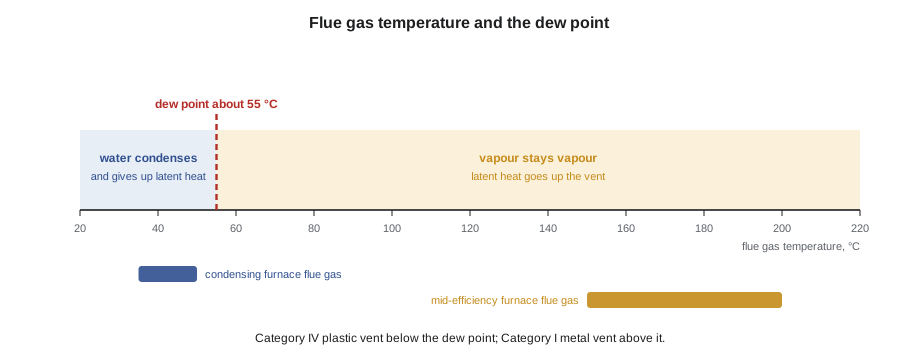
The dew point of the flue gas from a natural gas appliance depends on how much excess air is in it, but for typical furnace combustion it is roughly 55 °C. A mid-efficiency furnace keeps its flue gas well above that, often at 150 to 200 °C, so that nothing condenses in the heat exchanger or the vent. A condensing furnace adds a second heat exchanger that cools the flue gas to around 35 to 50 °C, below the dew point, so water condenses inside it. The cooler the circulating air entering the furnace, the more the flue gas is cooled and the more water condenses, which is why return air temperature affects efficiency.
Primary and secondary heat exchangers
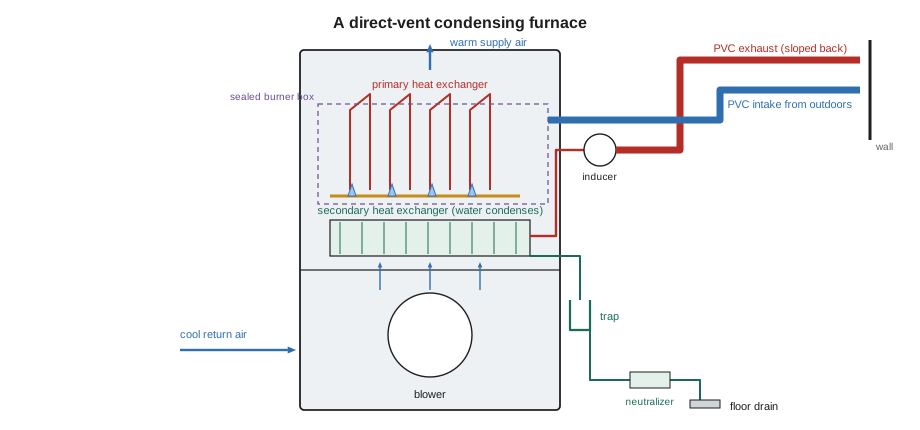
A condensing furnace has two heat exchangers in series. The primary heat exchanger is similar to the one in a mid-efficiency furnace: the burners fire into it, and it takes most of the sensible heat out of the hot flue gas. The flue gas then passes through a secondary heat exchanger, usually a finned coil of stainless steel tubes or a plastic-coated steel coil, placed so that the coldest return air passes over it first. The flue gas cools below its dew point in the secondary, and the water that condenses there drains to a collector box and the trap.
The condensate is acidic, typically with a pH of about 3 to 4, because some of the carbon dioxide and traces of sulphur and nitrogen compounds dissolve in it. That is why the secondary heat exchanger, the collector box and the vent have to be made of materials that resist corrosion, and why condensate must never be allowed to run into a mid-efficiency appliance's metal vent or a masonry chimney. It is also why contaminated combustion air is a problem: chlorine and fluorine compounds from laundry products, paint strippers, pool chemicals and refrigerants form much stronger acids in the condensate and can eat through a secondary heat exchanger in a few years.
Venting a condensing furnace
Because the flue gas leaves cool and wet, a condensing furnace needs a Category IV vent: positive pressure, because the inducer pushes the flue gas out, and condensing, because water forms in the vent too. Metal B-vent and masonry chimneys cannot be used; they would leak flue gas under positive pressure and be destroyed by the condensate. The vent is a sealed plastic or stainless steel pipe, sloped back towards the furnace so that condensate drains back to the trap rather than collecting in the pipe or dripping from the termination.
In Canada, CSA B149.1 requires plastic vent pipe for Category IV appliances to be certified to ULC S636, the standard for plastic venting systems, and to be the system the appliance's instructions specify. Ordinary PVC drain pipe from a plumbing supplier is not acceptable for venting unless it carries S636 certification as part of a vent system. ULC S636 systems in PVC, CPVC and polypropylene are sold with matching fittings, primer and cement, and the instructions limit which may be used, how hot each may get, and where. Bayline uses only the system the furnace maker lists, with its own cement.
Most condensing furnaces can be installed as direct vent, with two pipes, or as single-pipe units that take combustion air from the room. In a direct-vent installation, one pipe brings outdoor air to a sealed burner box and the other carries the flue gas out, so the combustion process is isolated from the house. That protects the furnace from house depressurization caused by exhaust fans and from contaminated indoor air, and protects the house from the furnace. Bayline installs condensing furnaces as direct vent whenever the house allows it. The two pipes may end in separate terminations or in a concentric termination, one pipe inside the other, that needs only one hole in the wall.
The instructions give a maximum equivalent length for each pipe size, with each elbow counted as a set length of straight pipe, and often a minimum length as well. They also set the termination's clearances from windows, doors, air intakes, gas meters and regulators, the ground and the expected snow level, and from each other. GAS-120 introduced termination clearances; GAS-230 covers vent sizing and termination in depth. Frost and ice from the plume are a real concern in Hamilton winters, so the termination should not discharge over a walkway, a deck or a neighbour's window.
Worked problem
Checking equivalent vent length
A sample manufacturer's table allows a maximum equivalent length of 21 m for 75 mm pipe on the Fairhaven furnace, counting each 90-degree elbow as 1.5 m. The exhaust route has 9.0 m of straight pipe and 4 elbows, and the termination kit counts as zero. Is the route within the limit?
Show solution
- Add the elbows' equivalent length:
- \[4 \times 1.5 \text{ m} = 6.0 \text{ m}\]
- Add the straight pipe:
- \[9.0 \text{ m} + 6.0 \text{ m} = 15.0 \text{ m}\]
- Compare with the limit:
- \[15.0 \text{ m} < 21 \text{ m}\]
Answer: The route is 15.0 m equivalent, inside the 21 m limit. The intake pipe is checked the same way. The figures here are a sample; the real table is in each furnace's instructions and differs between models and altitudes.
Condensate: trap, drain and neutralizer
Every condensing furnace has a condensate trap, a U-shaped or chambered fitting that holds a column of water. The trap lets condensate drain out while stopping flue gas from escaping through the drain and stopping the inducer from pulling air in through it. The trap must be primed with water at start-up, because a dry trap lets the inducer draw air through the drain and the pressure switch may not close, or lets flue gas into the room. The trap position depends on the furnace's orientation, which is one reason a multipoise furnace has position-specific instructions.
From the trap, condensate runs by gravity to a floor drain, a laundry tub, a standpipe or a condensate pump, through tubing sloped continuously downhill. It must not drain into a sump that discharges outdoors in freezing weather without freeze protection, and an air gap or the method the instructions show is needed where it enters a drain, so that sewer gas and backflow cannot reach the trap. Where a pump is used, its overflow safety switch should be wired to shut the furnace down if the pump fails, rather than letting condensate flood the floor. On the Fairhaven job, the condensate ran 2 metres to the floor drain the builder had placed beside the furnace pad.
Many installers fit a neutralizer, a small cartridge of limestone or similar media through which the condensate flows before the drain. It raises the pH so the condensate does not attack cast iron drain lines or concrete, and some municipal sewer by-laws and some manufacturers require one. The media is used up over time and has to be checked and replaced at the annual service. Lesson 11 covers the maintenance; for now the point is that a condensing furnace's drain system is part of the appliance and is installed and checked as carefully as its vent.
Worked problem
How much water a condensing furnace makes
The Fairhaven furnace burns 2.5 cubic metres of natural gas per hour at high fire. Treating the gas as methane, each cubic metre burned forms about 1.5 kg of water vapour. Suppose half of it condenses and the furnace runs 10 hours on a cold day. About how many litres of condensate drain away?
Show solution
- Water vapour formed per hour:
- \[2.5 \ \text{m}^3\text{/h} \times 1.5 \ \text{kg/m}^3 = 3.75 \text{ kg/h}\]
- Half condenses:
- \[3.75 \div 2 = 1.875 \text{ kg/h}\]
- Over 10 hours, with 1 kg of water about 1 L:
- \[1.875 \times 10 \approx 19 \text{ L}\]
Answer: Close to 19 litres of mildly acidic water can drain from one furnace on a cold day. That is why a blocked drain, a frozen line or a failed pump can shut a furnace down, or flood a finished basement, within hours.
Pressure switches and condensate faults
A condensing furnace usually has more than one pressure switch, or a switch that senses the pressure at the collector box as well as the inducer. If condensate cannot drain, because the trap is blocked, the drain is kinked or frozen, or the vent is sagging and holding water, the water backs up into the collector box and the pressure switch opens. The furnace stops before water reaches the inducer. The symptom on the board is usually a pressure switch fault code, and the cause is often found by looking at the trap and the drain before touching any electrical parts. GAS-220 covers pressure switch testing; lesson 11 covers keeping the condensate system clean.
| Feature | Mid-efficiency furnace | Condensing furnace |
|---|---|---|
| Typical AFUE | About 80 | 90 to 98 |
| Heat exchangers | Primary only | Primary and secondary |
| Flue gas leaving | Hot, above the dew point | Cool, below the dew point |
| Vent category | Category I | Category IV |
| Vent material | B-vent or lined chimney | ULC S636 plastic or listed stainless |
| Combustion air | From the room | Usually piped from outdoors (direct vent) |
| Condensate | None in normal operation | Trap, drain, often a neutralizer or pump |
Contaminated combustion air
Rosa's first question at any condensing furnace that has failed early is where its combustion air comes from. A single-pipe furnace in a laundry room or beside a workshop draws in the vapours from bleach, fabric softener, solvents, aerosol sprays and paint, and the chlorine and fluorine compounds in them turn into hydrochloric and hydrofluoric acid in the condensate. A direct-vent furnace with its intake outdoors avoids most of this, but an intake terminal placed near a dryer exhaust, a pool or a hot tub can still draw in contaminants. The instructions list the contaminants to avoid and where intakes may not be placed.
On the Fairhaven job, the intake and exhaust went out the north wall of the basement as two pipes, well away from the dryer vent and the meter, because GAS-120's code review had already moved the tankless water heater's terminal to that wall to keep clear of the meter. Jonah measured each clearance against the instructions and recorded it on the job sheet. The furnace was wired that afternoon, as GAS-130 described, and started up the next day, following the steps in lesson 4.
Common mistakes
MistakeVenting a condensing furnace into an existing chimney or B-vent.
InsteadUse the Category IV vent system listed in the instructions, sealed and sloped back to the furnace.
MistakeUsing plumbing PVC that is not part of a ULC S636 system.
InsteadUse only ULC S636 certified vent pipe, fittings and cement listed for the furnace.
MistakeStarting a condensing furnace with a dry trap.
InsteadPrime the trap with water before start-up.
MistakeDraining condensate into a line that can freeze.
InsteadRoute the drain indoors or protect it from freezing; wire a pump's safety switch to stop the furnace.
MistakePutting a single-pipe furnace beside a laundry or workshop.
InsteadPipe combustion air from outdoors away from contaminant sources.
Summary and key terms
- A condensing furnace cools its flue gas below the dew point in a secondary heat exchanger so the water vapour condenses and gives up its latent heat, raising AFUE to 90 or more.
- The condensate is acidic, so the secondary heat exchanger, vent and drain must resist corrosion, and contaminated combustion air shortens the furnace's life.
- The vent is Category IV, positive pressure and condensing, certified to ULC S636, sloped back to the furnace and kept within the instructions' equivalent lengths and termination clearances.
- Direct vent isolates combustion from the house.
- The trap must be primed, the drain sloped and protected from freezing, and a neutralizer or pump maintained.
- Latent heat
- Heat absorbed when water evaporates and released when it condenses.
- Dew point
- The temperature below which water vapour in a gas condenses.
- Secondary heat exchanger
- The second heat exchanger in a condensing appliance, in which flue gas condenses.
- Category IV vent
- A vent that operates under positive pressure and handles condensing flue gas.
- Direct vent
- An installation in which combustion air is piped from outdoors and the burner is sealed from the room.
- Condensate trap
- A water-filled fitting that drains condensate while blocking flue gas and air.
- Neutralizer
- A cartridge of mineral media that raises the pH of condensate before it reaches the drain.
Practice problems
Work each problem on paper first, then reveal the answer to check.
Why does a condensing furnace make water?
Show answer
Its secondary heat exchanger cools the flue gas below the dew point, so the water vapour condenses.
Why can a condensing furnace not use a B-vent?
Show answer
Its vent runs under positive pressure and carries condensate, which B-vent cannot contain or resist.
What happens if the condensate drain blocks?
Show answer
Water backs into the collector box, the pressure switch opens and the furnace stops.
Why is a direct-vent installation preferred?
Show answer
It isolates combustion from house pressures and from contaminated indoor air.
Name three sources of chlorine or fluorine compounds that harm condensing furnaces.
Show answer
Bleach and laundry products, paint strippers or solvents, pool chemicals, refrigerants or aerosols.
Lesson quiz · 5 questions
Score 60% or more to complete this lesson.
Create a free account to save your progress, take quizzes and earn a certificate.