
GAS-210 · Lesson 10 of 12 · 23 min
Conversions between natural gas and propane
▶ Video coming soon A video version of this lesson is on the way.
On Friday, November 6, Luis Ferreira took Jonah out to the rural customer in Ancaster whose switch from cylinders to a 1,890-litre propane tank GAS-120 described. The tank had been set and filled, and two new appliances were waiting in their cartons: a range for the farmhouse kitchen and a unit heater for the workshop. Both had been shipped, like most gas appliances, set up for natural gas. Each carton held a small bag from the manufacturer: a conversion kit. "This bag is the only thing that lets this range burn propane," Luis said, holding it up. "Not a drill, not a handful of orifices from the truck, not a guess. The kit, the instructions, and the label at the end that tells the next technician what we did."
This lesson explains why natural gas and propane need different appliance parts, what a conversion changes, the rules that govern who may convert an appliance and how, and the step-by-step procedure, with the checks that prove a conversion worked. Propane systems themselves, from cylinders and tanks to regulators and vehicle fuel systems, are the subject of GAS-240.
Why one appliance cannot burn both
Natural gas and propane are both hydrocarbons, but their properties differ enough that an appliance built for one will burn the other badly or dangerously. Propane carries about two and a half times as much energy per unit volume as natural gas, and it is about one and a half times as heavy as air, while natural gas is about six-tenths as heavy. Propane is supplied to appliances at a higher pressure. GAS-110 introduced these properties; the table below sets them side by side as they matter for conversions.
| Property | Natural gas | Propane |
|---|---|---|
| Heating value | About 37.5 MJ/m³ | About 93 MJ/m³ |
| Specific gravity (air = 1) | About 0.60 | About 1.52 |
| Typical appliance supply pressure | About 1.75 kPa | About 2.75 kPa |
| Typical furnace manifold pressure | About 0.87 kPa | About 2.5 kPa |
| Air needed per unit volume burned | About 9.6 volumes | About 24 volumes |
| Behaviour if it leaks | Rises and disperses | Sinks and collects in low places |
An appliance's input depends on how much gas passes through each burner orifice and on how much energy that gas carries. The flow through an orifice increases with the orifice area and with the square root of the pressure across it, and decreases with the square root of the gas's specific gravity. Because propane carries so much more energy per unit volume, a propane appliance needs much smaller orifices to deliver the same input, even though it runs at a higher manifold pressure. Put propane through natural gas orifices and the appliance overfires severely, with long, lazy, sooting flames, overheating and very high carbon monoxide. Put natural gas through propane orifices and the appliance underfires, with small flames that may lift off or fail to carry across the burner.
Worked problem
How much smaller a propane orifice must be
A furnace burner orifice for natural gas is 2.08 mm in diameter at a manifold pressure of 0.87 kPa. For the same input on propane at 2.49 kPa, what orifice diameter is needed? Use heating values of 37.5 and 93.5 MJ/m³ and specific gravities of 0.60 and 1.52. The orifice area needed is proportional to 1 ÷ (heating value × √(pressure ÷ specific gravity)).
Show solution
- Ratio of heating values, natural gas to propane:
- \[\frac{37.5}{93.5} = 0.401\]
- Ratio of the pressure terms:
- \[\sqrt{\frac{0.87 / 0.60}{2.49 / 1.52}} = \sqrt{\frac{1.450}{1.638}} = \sqrt{0.885} = 0.941\]
- Area ratio, propane to natural gas:
- \[0.401 \times 0.941 = 0.377\]
- Diameter ratio is the square root of the area ratio:
- \[\sqrt{0.377} = 0.614 \qquad 2.08 \times 0.614 \approx 1.28 \text{ mm}\]
Answer: The propane orifice needs to be about 1.28 mm across, a little over six-tenths of the natural gas size, and less than four-tenths of its area. The kit supplies orifices drilled and marked to the maker's exact size; the calculation shows why they look so small, not how to make them.
The rules for conversions
CSA B149.1 permits an appliance to be converted from one gas to another only where the conversion is made with the manufacturer's certified conversion kit for that appliance, following the kit's instructions, and the appliance is then marked to show the conversion. Under Ontario's O. Reg. 212/01 and O. Reg. 215/01, the work must be done by a gas technician holding a certificate that covers that appliance and gas, working for a registered contractor. Where no certified kit exists, the appliance cannot be field-converted; it would need a field approval under CSA B149.3 or replacement, as GAS-120 described for Marigold Kitchen's imported wok range.
These rules exist because a conversion changes the appliance's certified configuration. The kit contains the parts that were tested in the certification: orifices of the exact size, a regulator spring or a new gas valve, sometimes pilot orifices, burner inserts or control settings, and a conversion label. Drilling out orifices, swapping in parts from another appliance or borrowing a regulator spring from the truck leaves an appliance whose behaviour nobody has tested. Bayline keeps no loose orifices for conversions, for exactly this reason.
What a conversion kit changes
A kit for a furnace or water heater usually includes burner orifices, sometimes a pilot orifice, and either a regulator conversion for the gas valve, a spring and a cap or a small assembly, or a complete gas valve set up for the new gas. Some furnaces with electronic gas valves are converted by changing a setting on the control. A kit may also include instructions to change the pressure switch, adjust the air shutters, or replace a burner insert, and on some condensing furnaces and boilers it changes a parameter in the control that sets the fan speed and gas ratio. The kit's instructions list every step, and every step is done.
A range kit typically includes new orifices or orifice hoods for the top burners, a new oven orifice or an instruction to screw down the oven's adjustable orifice hood, and an instruction to convert the appliance regulator, usually by reversing or changing the cap. A clothes dryer kit includes a burner orifice and a valve spring or regulator change. A fireplace kit includes the burner and pilot orifices and often a different regulator or valve. Kits are specific to the model and sometimes to the serial number range, so the first step is always to confirm that the kit matches the appliance's plate.
The procedure
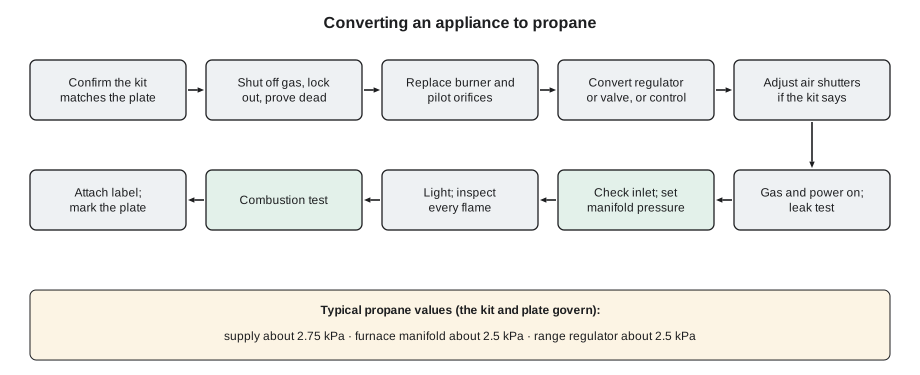
Luis had Jonah convert the range while he watched. Jonah confirmed that the kit's part number matched the one listed on the range's plate and in its manual, shut off the gas, unplugged the range, and laid out the kit's parts on a towel. Following the instructions, he removed each top burner cap and base, unscrewed the natural gas orifices with the nut driver the kit specified, and installed the propane orifices, each stamped with its size and matched to its burner by position. He converted the regulator by removing its cap, reversing the insert to the propane setting and reinstalling it, and adjusted the oven's orifice as the instructions directed. He checked that every original orifice was accounted for before putting them in a bag for the customer's file.
With the gas back on, Jonah leak-tested every joint he had disturbed, measured the inlet pressure at the range with all the farmhouse appliances running, and confirmed it was within the plate range for propane. He lit each top burner and the oven, checked the flames on high and low, and adjusted the top burners' low-flame settings, which the instructions require after a conversion so the small flame does not go out when a knob is turned down quickly. He measured CO at the oven vent after ten minutes. Then he filled in the conversion label, with the date, the company, his name and certificate or licence number and the kit's part number, attached it beside the rating plate, and marked the plate to show the appliance was now set for propane.
Checking a converted appliance
A conversion is proved by measurement. The inlet pressure must be within the plate range for the new gas, which on propane depends on the tank, the regulators and the piping, covered in GAS-240. The manifold pressure, on furnaces, water heaters and fireplaces, is set to the value in the kit's instructions with a manometer at the outlet tap. The flames must be the right size and character for the new gas. On natural gas, the input could be confirmed by clocking the meter, but a propane system usually has no meter at the house, so the check rests on correct orifices, correct manifold pressure and a combustion analysis: the flue gas readings, compared with the instructions' range, show whether the appliance is burning its gas cleanly at the right rate. GAS-230 covers the analysis.
The workshop unit heater was converted the same way: new burner orifices, the valve's regulator spring and cap from the kit, and a change to the pressure switch tubing position the kit's instructions showed. Luis set its manifold pressure to the kit's propane value, took a combustion reading at the vent's test port, and had Jonah record it beside the reading from the natural gas start-up figures in the manual, which showed how different the two gases are. Both appliances got their labels.
Worked problem
Comparing the gases by Wobbe index
The Wobbe index of a gas, its heating value divided by the square root of its specific gravity, predicts how much heat flows through a given orifice at a given pressure. Using 37.5 MJ/m³ and 0.60 for natural gas and 93.5 MJ/m³ and 1.52 for propane, calculate each Wobbe index and their ratio.
Show solution
- Natural gas:
- \[W = \frac{37.5}{\sqrt{0.60}} = \frac{37.5}{0.775} \approx 48.4 \ \text{MJ/m}^3\]
- Propane:
- \[W = \frac{93.5}{\sqrt{1.52}} = \frac{93.5}{1.233} \approx 75.8 \ \text{MJ/m}^3\]
- Ratio:
- \[\frac{75.8}{48.4} \approx 1.57\]
Answer: Through the same orifice at the same pressure, propane delivers about 1.57 times the heat of natural gas. A natural gas appliance run on propane at its natural gas pressure would overfire by more than half; at propane's higher pressure it would be worse still. Gases with similar Wobbe indices are interchangeable on the same orifices; these two are not.
Converting the other way, and other cautions
Converting from propane to natural gas is less common but follows the same rules, and it has its own hazard: a propane appliance moved to natural gas without conversion underfires and can light poorly or produce flames that lift and go out, and if the larger natural gas orifices are not fitted the appliance may never reach a safe, stable flame. A propane barbecue cannot be connected to a natural gas outdoor line without the maker's conversion kit, which also changes or removes the regulator; many barbecue makers sell a separate natural gas model instead.
Some appliances are not field-convertible at all; their plates and instructions say so, and they must be ordered for the gas they will burn. Some conversions require changes that only the factory can make. Appliances above certain sizes, or in some jurisdictions, need an inspection after conversion. And propane behaves differently in a building: it sinks when it leaks, so a propane appliance's leak checks pay special attention to low places, floor drains and basements, and the customer's propane leak detector, if fitted, should be mounted low, as its instructions say. GAS-240 returns to these.
Before leaving, Luis walked the customer through the range and the workshop heater, showed her the conversion labels, and explained that any future service technician should see them and use propane settings. Jonah added both conversions to the job sheet with the kit part numbers, the manifold pressures and the combustion readings, and put the bags of original natural gas orifices in the customer's file box in the basement, labelled, in case the appliances were ever converted back.
Common mistakes
MistakeDrilling out or swapping orifices without the maker's kit.
InsteadUse only the certified conversion kit for that model, and follow every step.
MistakeConverting the burner orifices but not the regulator.
InsteadConvert or replace the regulator, or change the control setting, as the kit directs.
MistakeSkipping the conversion label.
InsteadFill in and attach the label beside the plate, and mark the plate.
MistakeAssuming a conversion is right because the burners light.
InsteadCheck inlet and manifold pressure, the flames and a combustion analysis.
MistakeConnecting a propane barbecue to a natural gas line.
InsteadConvert it only with the maker's kit, or use a natural gas model.
Summary and key terms
- Propane has about two and a half times the heating value of natural gas per unit volume, is heavier than air, and is supplied at a higher pressure, so it needs much smaller orifices; its Wobbe index is about 1.57 times that of natural gas.
- CSA B149.1 and Ontario's regulations allow conversion only with the manufacturer's certified kit, by a certified gas technician, with the appliance marked.
- Kits change orifices, pilots, regulators or valves and sometimes control settings and air shutters.
- The procedure is: match the kit, shut off and lock out, change the parts, leak test, check inlet and set manifold pressure, inspect flames, run a combustion test, and attach the conversion label.
- Some appliances cannot be field-converted.
- Conversion kit
- The manufacturer's set of parts and instructions for changing an appliance to another gas.
- Orifice
- A precisely sized opening that meters gas to a burner.
- Conversion label
- A label attached beside the rating plate recording who converted an appliance, when and with which kit.
- Wobbe index
- A gas's heating value divided by the square root of its specific gravity; it predicts heat flow through an orifice.
- Overfiring
- Burning gas at a higher rate than an appliance is designed for.
- Underfiring
- Burning gas at a lower rate than an appliance is designed for.
- Field-convertible
- Able to be converted to another gas on site with a certified kit.
Practice problems
Work each problem on paper first, then reveal the answer to check.
Why does a propane appliance need smaller orifices than a natural gas one?
Show answer
Propane carries much more energy per unit volume, so less volume is needed for the same input.
What happens if a natural gas appliance is run on propane without conversion?
Show answer
It overfires, with large sooty flames, overheating and high CO.
Why is a converted propane appliance checked by combustion analysis rather than clocking?
Show answer
A propane system usually has no meter at the house to clock.
What goes on a conversion label?
Show answer
The date, the company, the technician and certificate or licence number, and the kit part number.
Where should propane leak checks pay special attention?
Show answer
Low places such as basements, floor drains and pits, because propane sinks.
Lesson quiz · 5 questions
Score 60% or more to complete this lesson.
Create a free account to save your progress, take quizzes and earn a certificate.