
GAS-210 · Lesson 8 of 12 · 24 min
Ranges, dryers and other household appliances
▶ Video coming soon A video version of this lesson is on the way.
Once the new main was in at the Garfield Avenue bungalow, as GAS-120 described, the owners' new gas range and gas dryer could be connected. On Friday, October 23, Rosa sent Jonah to do both with Luis Ferreira checking his work. The kitchen contractor had already raised the cabinet over the range to the clearance the code requires. "These are the appliances people think of as easy," Luis said as they slid the range out of its carton. "Plug the cord in, screw the connector on, done. Then they're the ones that leak behind the stove for ten years, or fill a laundry room with lint until the dryer catches fire. Easy appliances get done right too."
This lesson covers the household gas appliances outside the heating and hot water systems: ranges, cooktops and wall ovens, clothes dryers, and a group of smaller appliances including barbecues, outdoor lights, pool heaters and standby generators. They share the gas piping and code rules covered in GAS-120 and the safety principles of the earlier lessons, but each has its own way of being connected, vented and checked.
How a gas range works
A gas range has two separate sets of burners. The top burners on the cooktop are atmospheric burners: gas flows through a fixed orifice at each burner, draws in primary air through an opening or shutter, and burns at a cap with a ring of ports. On a sealed burner cooktop, the burner base is sealed to the cooktop so spills cannot run into the burner box, and the burner cap sits loosely on top; it must be seated correctly or the flame will be ragged. Top burners are lit by a spark igniter beside each burner, and many ranges re-spark automatically if a flame goes out.
The oven has a bake burner under the oven floor and often a broil burner at the top, controlled by a thermostat. Most gas ovens use a hot surface igniter, often called a glow bar, wired in series with a safety valve: the valve opens only when enough current flows through the igniter to show it is hot enough to light the gas. A weak igniter that still glows but draws too little current will not open the valve, so the oven fails to light while the igniter appears to work; GAS-220 covers how to test it. Some ovens use spark ignition with flame sensing instead.
Every range has an appliance pressure regulator, usually on the back where the gas enters, set for the gas the range is built for, often about 1.0 kPa for natural gas. Most are convertible: a cap or insert on the regulator is turned or reversed to set it for propane at about 2.5 kPa, as part of a conversion described in lesson 10. The range's plate gives the total input, the sum of every burner's rating, which is the figure that went into GAS-120's pipe sizing for Garfield Avenue.
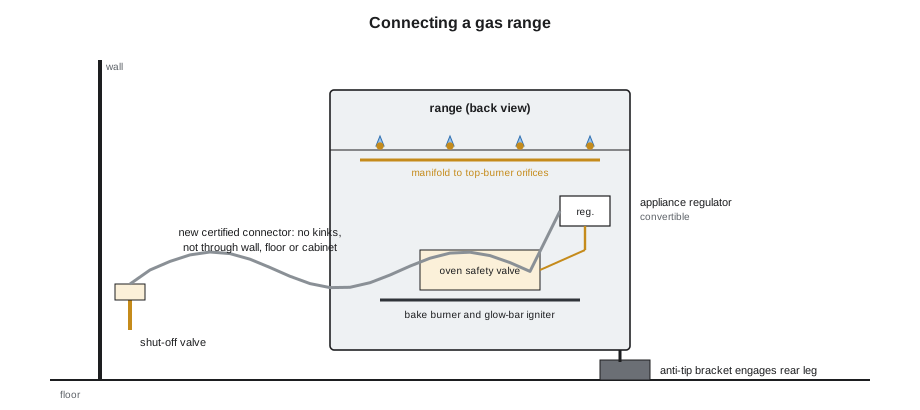
Connecting a range
A range is connected with a certified flexible appliance connector, a corrugated metal hose with factory fittings, or with rigid pipe where the instructions and the code allow. The connector must be new, never reused from the old appliance, and of the type and length its certification and the code permit. It may not pass through a wall, floor, ceiling or cabinet partition, may not be concealed, and must not be kinked, twisted or stretched. A manual shut-off valve must be in the same room as the range, accessible without moving the range where the code requires it, usually behind a drawer or in an adjacent cabinet, or directly behind the range where the instructions and code allow it to be reached by removing a drawer.
Fittings are assembled with the sealant the connector's instructions call for on threaded joints and never on flare fittings, which seal metal to metal. Every joint is tested with leak detection solution, including the connection at the range's regulator, which is easy to miss once the range is in place. Finally the anti-tip bracket is installed. A range can tip forward if a child stands on the open oven door, pulling hot pots onto the child and, with gas, possibly pulling the connector apart. The bracket, which comes with every range, is fastened to the floor or wall and engages a rear leg, and the installer checks it by trying to tip the range.
Clearances, hoods and carbon monoxide
The range's instructions and the code set clearances above the cooktop and beside it. GAS-120 covered the overhead cabinet clearance that the Garfield kitchen contractor had to correct. The side clearance to combustible walls and the depth of combustible surfaces behind the range are in the instructions, and some ranges are certified for zero side clearance between cabinets. A range hood, if fitted, must suit the range's width and output, and a large hood brings the make-up air question GAS-110 raised: an exhaust hood moving hundreds of litres of air a second can depressurize a house enough to spill flue gas from an atmospheric water heater.
Ranges are unvented appliances: their products of combustion enter the kitchen. That is acceptable only because a correctly adjusted range burns cleanly, its burners run for short periods, and the kitchen is ventilated. A range must never be used to heat a home, and a top burner with yellow, lazy flames or an oven producing carbon monoxide is a fault to fix. Bayline checks top-burner flames visually and measures CO at the oven vent after the oven has run for several minutes, comparing it with the maker's guidance and Bayline's own action level, and tells the customer to use the range hood whenever the range is on.
| Burner flame | What it means | Likely cause |
|---|---|---|
| Blue with a distinct inner cone | Good combustion | Correct orifice, pressure and air |
| Yellow tips or lazy yellow flame | Too little primary air | Blocked air opening, wrong orifice, cap misplaced |
| Lifting off the ports | Too much primary air or pressure | Wrong orifice after conversion, high pressure |
| Ragged or uneven ring | Some ports blocked or cap off-centre | Spills in the ports, cap not seated |
| Flame that lights slowly with a pop | Delayed ignition | Weak spark, wet igniter, blocked ports |
How a gas dryer works
A gas clothes dryer heats air with a small burner, typically around 6.5 kW, and a blower pulls that air through the rotating drum and out through an exhaust duct to the outdoors. The burner is usually lit by a hot surface igniter, and a radiant flame sensor proves ignition by sensing the heat of the igniter and then the flame. Two gas valve coils open in sequence once the sensor confirms the igniter is hot. High-limit thermostats on the burner housing and the exhaust shut the burner off if the airflow is restricted.
The exhaust carries hot, moist, lint-laden air and some products of combustion. It must be ducted to the outdoors, never into a chimney, an attic, a crawl space, a garage or a gas vent. The duct is smooth-walled metal, usually 100 mm in diameter, joined so that the joints run in the direction of flow and without screws that project into it, because screws catch lint. Plastic or foil flexible duct is not acceptable for the concealed part of a run; a short, listed transition duct may connect the dryer to the wall. The run must be no longer than the dryer's instructions and the code allow, each elbow counting against the limit, and it ends at an outdoor hood with a backdraft damper and no screen.
Worked problem
Checking a dryer exhaust run
The Garfield dryer's instructions allow a maximum of 10.7 m of 100 mm rigid duct, reduced by 1.5 m for each 90-degree elbow. The new run has 4.2 m of straight duct and 3 elbows. Is it within the limit?
Show solution
- Add the elbow allowance to the straight length:
- \[4.2 + 3 \times 1.5 = 4.2 + 4.5 = 8.7 \text{ m}\]
- Compare:
- \[8.7 \text{ m} < 10.7 \text{ m}\]
Answer: The run is 8.7 m equivalent, inside the 10.7 m limit. Had it been longer, a booster fan listed for dryer exhaust, or a different route, would be needed.
Dryer safety
Lint is the dryer's main hazard. Lint that collects in a long, crushed or screwed duct, in the dryer's own housing, or behind the lint screen is highly flammable, and dryer fires are a well-known cause of house fires. A restricted duct also makes the dryer run longer and hotter, trips its limits and wastes gas. A technician connecting or servicing a dryer checks the whole exhaust route, cleans it if it is dirty and tells the customer to clean the lint screen after every load.
A dryer also needs make-up air to replace what its blower exhausts, which can be a substantial flow. In an open basement this is rarely a problem, but a dryer in a closed laundry closet needs the openings or louvred door its instructions call for. Like a range hood, a dryer exhausting from a tight house can depressurize the space around an atmospheric water heater, which is one of the reasons Bayline's spillage test in lesson 4 runs the dryer. The dryer's gas connection follows the same rules as the range's: a new certified connector of a permitted length, a shut-off valve in the same room, and leak testing of every joint.
At Garfield Avenue, Jonah found the old electric dryer's vent was a crushed foil duct snaking across the laundry floor to a hole in the rim joist. He replaced it with rigid 100 mm duct along the joists, sealed the joints with foil tape rather than screws, and fitted a new hood with a damper. Luis watched him connect the dryer, test the joints, run it on a timed dry and check that the exhaust hood's damper opened fully.
Other household gas appliances
Many homes have smaller gas appliances. A fixed natural gas barbecue is supplied by an outdoor line, as GAS-120 showed for the outdoor kitchen, ending at a shut-off valve and often a quick-disconnect fitting certified for outdoor use; a portable barbecue built for a propane cylinder cannot be connected to natural gas without the maker's conversion kit. Outdoor gas lights and fire tables have their own standards, clearances and controls. A pool or spa heater is often installed outdoors, with clearances from windows, doors and the pool itself in its instructions, and is a large load for the piping. A standby generator, like the one at the rural propane customer in GAS-120, may be the largest single load in the house, and must be set the distance its instructions and the code require from windows, doors and air intakes because its engine exhaust contains carbon monoxide.
Each of these appliances is certified to its own standard and comes with installation instructions. The gas technician's work is the same as for any appliance: confirm the plate, check the piping can carry the load, connect with the permitted materials and a shut-off valve, test for leaks, purge, check the pressures and the flame, test the controls, and explain safe use to the customer. The rule about outdoor appliances used indoors is absolute: a barbecue, patio heater, camp stove or generator built for outdoor use must never be used inside a house, garage or tent, because each produces carbon monoxide with nowhere to go.
Worked problem
Converting regulator settings between units
A range's regulator is set for natural gas at 1.0 kPa, and its propane setting is 2.5 kPa. Express both in inches of water column, using 1 in. w.c. = 0.249 kPa.
Show solution
- Natural gas:
- \[\frac{1.0}{0.249} \approx 4.0 \text{ in. w.c.}\]
- Propane:
- \[\frac{2.5}{0.249} \approx 10.0 \text{ in. w.c.}\]
Answer: The same regulator reads about 4 in. w.c. or 1.0 kPa on natural gas and about 10 in. w.c. or 2.5 kPa on propane. Manuals for appliances sold in both countries often give both units, and a technician should be able to move between them without hesitation.
Finishing the job
Before leaving Garfield Avenue, Jonah lit each top burner on high and low, checked the flames against the table above, ran the oven for ten minutes and measured CO at its vent, checked the anti-tip bracket, and showed the owners where the range and dryer shut-off valves were. He recorded both appliances' plates, the connectors used, the leak tests and the readings on the job sheet. Luis signed it off with one note: the range hood should be run whenever the oven is on, which Jonah had already told the owners.
Common mistakes
MistakeReusing the old range's flexible connector.
InsteadFit a new certified connector of a permitted type and length.
MistakeSkipping the anti-tip bracket because the range sits between cabinets.
InsteadAlways fit and check the bracket; cabinets do not stop a range tipping forward.
MistakeRunning a dryer duct with screws through the joints.
InsteadJoin with the joints in the direction of flow and seal with foil tape or clamps, no projecting screws.
MistakeVenting a dryer into an attic, garage or chimney.
InsteadDuct it to the outdoors through a hood with a backdraft damper.
MistakeAccepting yellow, lazy top-burner flames as normal.
InsteadCheck the orifice, air opening, burner cap and pressure.
Summary and key terms
- A range has atmospheric top burners with fixed orifices and spark ignition, and an oven with a bake burner usually lit by a glow-bar igniter in series with a safety valve.
- Its convertible regulator is set for natural gas or propane.
- Connect it with a new certified connector of permitted length that stays in the room, a manual shut-off valve in the same room, leak-tested joints and an anti-tip bracket.
- Ranges are unvented, so flames must be clean, oven CO checked and the hood used.
- A dryer's burner uses hot surface ignition and a radiant sensor; its exhaust is rigid metal duct to the outdoors, within the instructions' length, with no projecting screws, ending at a damper hood.
- Lint and depressurization are its hazards.
- Barbecues, lights, fire tables, pool heaters and generators follow their own instructions, and outdoor appliances are never used indoors.
- Sealed burner
- A cooktop burner whose base is sealed to the cooktop, with a removable cap.
- Glow-bar igniter
- An oven hot surface igniter whose current opens a series safety valve.
- Appliance regulator
- A regulator on an appliance that sets its burner pressure for the gas used.
- Flexible appliance connector
- A certified corrugated metal hose with factory fittings for connecting an appliance.
- Anti-tip bracket
- A bracket that stops a range tipping forward under a load on its open door.
- Radiant flame sensor
- A dryer sensor that proves ignition by sensing heat from the igniter and flame.
- Make-up air
- Outdoor air supplied to replace air removed by exhaust appliances.
Practice problems
Work each problem on paper first, then reveal the answer to check.
Why does a weak glow-bar igniter stop an oven lighting even though it glows?
Show answer
It draws too little current to open the series safety valve.
Name two places a range connector may not pass.
Show answer
Through a wall, floor, ceiling or cabinet partition.
Why must dryer duct joints not have projecting screws?
Show answer
Screws catch lint, which restricts the duct and can catch fire.
A dryer allows 10.7 m less 1.5 m per elbow. A run has 6.0 m and 2 elbows. Is it within the limit?
Show answer
6.0 + 3.0 = 9.0 m, within 10.7 m.
Why must an outdoor barbecue never be used in a garage?
Show answer
It produces carbon monoxide that has nowhere to go.
Lesson quiz · 5 questions
Score 60% or more to complete this lesson.
Create a free account to save your progress, take quizzes and earn a certificate.