
FAT-340 · Lesson 9 of 12 · 20 min
Voice, mass notification and integration review
The fifth review session covers the systems that sit on top of the basic fire alarm: voice evacuation, firefighter telephones and two-way communication, mass notification, monitoring, and the interfaces that make the fire alarm part of the building rather than something bolted onto it. These are the topics where Nadia has the least experience and Sasha the most recent, after the Riverlight voice commissioning. Gerry lets Sasha teach the voice half. 'If you can explain it to her,' he says, 'you can answer it on the exam.' This lesson reviews FAT-310 and FAT-320.
Voice evacuation
Voice messages get people moving sooner than tones because they say what is happening and what to do (FAT-310 lesson 1). The NBC requires a voice communication system in high buildings under Subsection 3.2.6 and in some other buildings, with the ability to address each zone separately and to give live instructions from the central alarm and control facility. A voice system has a control unit, message generators, microphones, amplifiers, speaker zones and supervised speaker circuits (FAT-310 lesson 2). Amplifiers are sized for the total tapped load with spare capacity, commonly 20 to 25 percent, and a backup amplifier or other arrangement covers an amplifier failure.
# Amplifier sizing: total tapped load plus spare capacity
taps_w = {"floor 8 corridor": 18 * 1.0, "floor 8 suites": 24 * 0.5, "floor 9 corridor": 18 * 1.0, "floor 9 suites": 24 * 0.5}
load = sum(taps_w.values())
spare = 0.25
need = load * (1 + spare)
sizes = [60, 100, 120, 150, 250]
pick = next(s for s in sizes if s >= need)
print(f"Tapped load {load:.0f} W, with {spare:.0%} spare {need:.1f} W -> {pick} W amplifier")Tapped load 60 W, with 25% spare 75.0 W -> 100 W amplifier
Speakers are constant-voltage devices on 25 V or 70 V lines, each with a tap that sets its power; doubling the tap adds about 3 dB (FAT-310 lesson 3). Supervision checks the wiring, not the sound: a speaker on the wrong tap or connected backwards causes no trouble signal, which is why every speaker must be listened to at testing. Messages follow a sequence: an alert tone, then the message, repeated at least three times, with evacuation, relocation, shelter-in-place and all-clear versions as the building's plan requires (FAT-310 lesson 4).
Phased evacuation and intelligibility
In high buildings and hospitals, not everyone leaves at once (FAT-310 lesson 5). A phased evacuation sends the evacuation message to the fire floor and the floors above and below, and an alert or stand-by message to the rest; a hospital relocates patients horizontally to the next smoke compartment. The exam asks which floors get which message, and what happens when the fire spreads or a second floor alarms.
A voice message that cannot be understood is worse than a tone. Intelligibility is measured with the Speech Transmission Index, STI, from 0 to 1 (FAT-310 lesson 6). The common target in the NFPA 72 annex is an average of at least 0.50 in each acoustically distinguishable space, with at least 90 percent of measuring points at 0.45 or more. Spaces where speech cannot be made intelligible, such as a mechanical room, may be identified in the design and given other signals.
# STI measurements in one acoustically distinguishable space: does it meet the target?
points = [0.58, 0.52, 0.49, 0.61, 0.47, 0.55, 0.44, 0.53, 0.50, 0.57]
avg = sum(points) / len(points)
share_ok = sum(1 for p in points if p >= 0.45) / len(points)
print(f"Average STI {avg:.2f} (target 0.50), points at 0.45 or more: {share_ok:.0%} (target 90%)")
print("Meets target" if avg >= 0.50 and share_ok >= 0.90 else "Does not meet target")Average STI 0.53 (target 0.50), points at 0.45 or more: 90% (target 90%) Meets target
Worked problem
A failed intelligibility space
In a stairwell at Riverlight, the measured STI averages 0.41 and half the points are below 0.45. The sound level is well above the required audibility. What is going on, and what is the fix?
Show solution
- Loud but unintelligible is the classic reverberant space: hard concrete walls reflect sound, and the reflections smear speech.
- Turning the speakers up makes it louder, not clearer.
- The fix is usually more speakers at lower taps, closer to the listeners, so that more of what they hear is direct sound.
- The design may also identify the stair as a space where intelligibility is not required, if the authority accepts that, and rely on tone and visual signals there.
Answer: Reverberation is the problem; more, quieter speakers are the usual fix.
Two-way communication
Firefighter telephones let firefighters talk to the central alarm and control facility from stairs and other locations (FAT-310 lesson 7). Two-way communication systems for areas of refuge and elevator lobbies let people who cannot use stairs call for help (FAT-310 lesson 8); the call station must be accessible, give a visual indication, and be answered at a monitored location, with calls that go unanswered routed to an outside number.
Mass notification
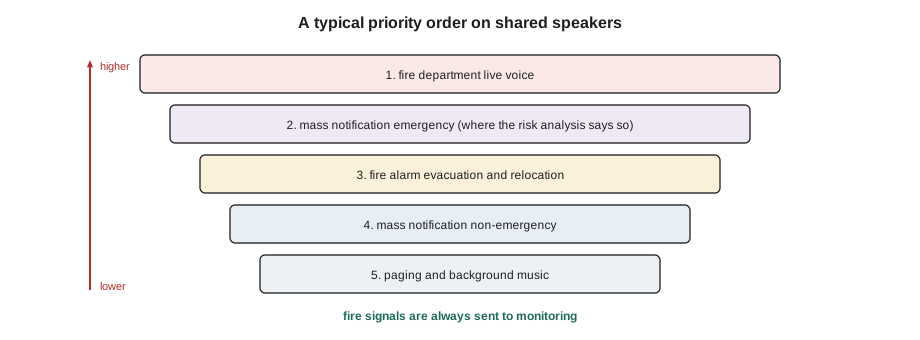
Mass notification systems give instructions for emergencies other than fire: severe weather, lockdowns, hazardous releases (FAT-310 lessons 9 and 10). They come in layers: in-building systems, wide-area outdoor systems, distributed recipient systems such as text messages, and public alerting such as Alert Ready. CAN/ULC-S576 covers mass notification equipment. Where mass notification shares a building with fire alarm, a priority matrix decides which message wins when both are active: a lockdown message may override a fire alarm evacuation message for a set time if the risk analysis says so, but fire alarm signals must still be transmitted and the override must time out.
Monitoring and interfaces
Most fire alarm systems send their signals to a signal receiving centre, which calls the fire department and the building contacts (FAT-320). In Canada, signal receiving centres and their services are covered by CAN/ULC-S561, and the equipment by S559; the connection is supervised, so a lost communication path is reported as trouble. The fire alarm also controls other systems: elevator recall, fan shutdown, smoke control, door release and lock release, as lesson 7 reviewed. On the exam, these questions usually ask what the fire alarm must do, how quickly, and what happens when the connection fails.
# Priority matrix: which source plays when two are active?
priority = ["fire department live voice", "mass notification emergency", "fire alarm evacuation",
            "mass notification non-emergency", "paging"]
def plays(active):
    return min(active, key=priority.index)
for active in (["fire alarm evacuation", "paging"],
               ["mass notification emergency", "fire alarm evacuation"],
               ["fire department live voice", "mass notification emergency"]):
print(f"Active {active} -> plays: {plays(active)} (fire signal still sent to monitoring)")Active ['fire alarm evacuation', 'paging'] -> plays: fire alarm evacuation (fire signal still sent to monitoring) Active ['mass notification emergency', 'fire alarm evacuation'] -> plays: mass notification emergency (fire signal still sent to monitoring) Active ['fire department live voice', 'mass notification emergency'] -> plays: fire department live voice (fire signal still sent to monitoring)
Practice set: voice and integration
Sasha wrote this set herself, using things she saw at Riverlight. Gerry checked the answers and added the last two.
Question 1. A 70 V speaker circuit has 30 speakers tapped at 1 W and 10 at 2 W. What amplifier is needed with 25 percent spare? Answer: the tapped load is 30 + 20 = 50 W; with 25 percent spare, 62.5 W. The next size up from the usual sizes is 100 W, or a 75 W amplifier if one is available and listed for the system.
Question 2. A speaker in a corridor is silent during testing, but the panel shows no trouble on the circuit. What is the most likely cause? Answer: a fault in the speaker itself or its tap, or a connection to the speaker that is not part of the supervised path. Supervision checks the wiring, not whether each speaker makes sound. This is why every speaker is listened to.
Question 3. In a 20-storey building with phased evacuation, a smoke detector on floor 12 alarms. Which floors get the evacuation message? Answer: floors 11, 12 and 13. The other floors get the alert message. If an alarm then comes in on floor 14, floor 14 and floor 15 are added to the evacuation message.
Question 4. A school's mass notification system plays a lockdown message, and a smoke detector alarms in a classroom. What happens? Answer: it depends on the priority matrix set by the risk analysis. If lockdown has priority, the lockdown message continues, the fire alarm signal is still sent to monitoring, and the fire alarm evacuation message plays when the lockdown ends or the override times out. Staff and the fire department see both conditions at the control equipment.
Question 5. A firefighter telephone jack in a stairwell has a broken wire. What should the system show? Answer: a trouble signal, because firefighter telephone circuits are supervised. A telephone that cannot be used must not go unnoticed.
Question 6. A two-way communication station in an elevator lobby calls the monitored location, but no one answers. What should happen? Answer: the call is routed automatically to an outside monitored number, so that a person who cannot use the stairs is never left without an answer.
Question 7. The monitoring company calls to say it has lost communication with the building's panel. What does the panel show? Answer: a trouble signal for the communication path. The technician checks the communicator, the phone lines or network, and the cellular or radio backup, and restores the path.
Where to look
| Topic | Course and lesson | Exam angle |
|---|---|---|
| Voice system architecture | FAT-310 lesson 2 | Parts and their supervision |
| Speakers and taps | FAT-310 lesson 3 | Taps, decibels, amplifier sizing |
| Messages and their sequence | FAT-310 lesson 4 | Alert tone, message, three repetitions |
| Phased evacuation | FAT-310 lesson 5 | Which floors get which message |
| Intelligibility | FAT-310 lesson 6 | STI targets and fixes |
| Firefighter telephones and two-way | FAT-310 lessons 7 and 8 | Supervision and call routing |
| Mass notification and priority | FAT-310 lessons 9 and 10 | The priority matrix |
| Monitoring | FAT-320 | Path supervision and response |
Decibels without a calculator
A few decibel rules answer most voice questions in seconds. Doubling the power adds about 3 dB. Ten times the power adds 10 dB. Doubling the distance from a speaker in open space reduces the level by about 6 dB. Two equal sources together are about 3 dB louder than one.
The NBC requires the alarm signal to be at least 10 dBA above the ambient sound level and not less than 65 dBA, with a 110 dBA limit in normally occupied spaces. A question that gives an ambient of 60 dBA and asks for the minimum alarm level is answered with 70 dBA, unless the space is a sleeping room, where 75 dBA applies.
# Decibel rules of thumb
import math
def add_db(*levels):
    return 10 * math.log10(sum(10 ** (l / 10) for l in levels))
print(f"Two 80 dB sources together: {add_db(80, 80):.1f} dB")
print(f"Tap doubled from 1 W to 2 W: +{10 * math.log10(2):.1f} dB")
print(f"Distance doubled (open space): {20 * math.log10(0.5):.1f} dB")
ambient, margin = 60, 10
print(f"Ambient {ambient} dBA -> minimum alarm level {ambient + margin} dBA")Two 80 dB sources together: 83.0 dB Tap doubled from 1 W to 2 W: +3.0 dB Distance doubled (open space): -6.0 dB Ambient 60 dBA -> minimum alarm level 70 dBA
Testing a voice system
Voice questions also cover testing. Each speaker is listened to with the system operating, because supervision cannot tell whether a speaker works. Each message is played and checked for the right content in each zone. The microphone at the control location is tested for each zone and for all-call. Amplifier failure is simulated, to confirm the backup takes over. Intelligibility is checked by listening, and measured with STI where the design or the authority calls for it. The firefighter telephones are tested by calling from each station, and two-way stations by placing a call and confirming it is answered and that the unanswered-call routing works.
Sasha's tip from Riverlight is to bring a colleague: one person at the control location, one walking the floor with a radio. Walking alone means going back and forth for every zone, and the test takes twice as long.
Common mistakes
MistakeTurning up a speaker to fix poor intelligibility.
InsteadAdd speakers at lower taps closer to listeners.
MistakeExpecting supervision to find a wrong speaker tap.
InsteadListen to every speaker at testing.
MistakeSending the evacuation message to every floor in a phased plan.
InsteadFire floor, above and below get evacuation; others get alert.
MistakeLetting mass notification silence fire signals to monitoring.
InsteadFire signals are always transmitted.
MistakeForgetting the unanswered-call rule for two-way stations.
InsteadUnanswered calls go to an outside monitored number.
Summary and key terms
- Voice systems give zone-by-zone instructions and are required in tall buildings.
- Amplifiers carry the tapped load plus 20 to 25 percent spare.
- Intelligibility target: STI average 0.50 with 90 percent of points at 0.45.
- Two-way communication serves people who cannot use stairs.
- A priority matrix decides between mass notification and fire alarm messages.
- Speech Transmission Index
- A measure of speech intelligibility from 0 to 1.
- Acoustically distinguishable space
- An area with its own acoustic character for intelligibility design.
- Phased evacuation
- Evacuating the fire floor and the floors around it first.
- Mass notification
- A system giving instructions for emergencies other than fire.
- Priority matrix
- The order in which sources play when more than one is active.
Practice problems
Work each problem on paper first, then reveal the answer to check.
Which floors get the evacuation message in a phased plan?
Show answer
The fire floor and the floors immediately above and below.
How many times is a voice message repeated?
Show answer
At least three times.
What is the STI average target?
Show answer
At least 0.50.
What is the usual fix for a loud but unintelligible stairwell?
Show answer
More speakers at lower taps.
Is a lost monitoring path an alarm or a trouble?
Show answer
A trouble.
Lesson quiz · 5 questions
Score 60% or more to complete this lesson.
Create a free account to save your progress, take quizzes and earn a certificate.