
FAT-340 · Lesson 10 of 12 · 22 min
Verification and commissioning review (CAN/ULC-S537)
Verification is the work that puts a new system into service, and in Canada it is the work a registered technician is most often asked to sign. 'An inspection tells the owner the system still works,' Gerry says. 'A verification tells everyone it was built right in the first place. Your name on an S537 report is a statement that every device was there, wired right and worked.' This lesson reviews FAT-330: what verification and commissioning mean, how S537 is organized, the roles of the contractor, the technician, the engineer and the authority, planning, pre-testing, device-by-device verification, integrated testing, deficiencies and handover.
Three words that are not the same
Verification, under CAN/ULC-S537, is the process of confirming that a new or altered fire alarm system is installed as the standard and the design require and that every component works (FAT-330). The NBC requires verification before a system is put into service. Commissioning is a broader process that confirms all the building's life safety systems work together as designed; integrated testing to CAN/ULC-S1001 is the part that proves the interactions. Inspection and testing to S536, reviewed in lesson 8, is the ongoing work on an existing system. A common exam question asks which standard applies to a given situation: new system, S537; alteration, S537 for the altered part and what it affects; annual test, S536; integrated systems, S1001.
Roles
The contractor installs the system and pre-tests it. The verifying technician, who may work for the contractor, the manufacturer's representative or an independent company, carries out the S537 verification and signs the report. The designer, often a professional engineer, provides the design and may need to review changes. The authority having jurisdiction accepts the system and may witness tests. The owner receives the system, the documentation and the training, and from then on is responsible for its inspection and testing (FAT-330).
Planning and pre-testing
Verification goes faster and finds fewer surprises when it is planned (FAT-330). The test matrix lists every device, circuit and function from the device schedule and the cause-and-effect matrix, and the plan groups them by floor or zone so the crew can move efficiently. The contractor's pre-test should have found and fixed most faults; a verification that finds dozens of basic wiring faults means the pre-test was not done properly. The monitoring company, the building operator, the elevator contractor and the other trades are scheduled for the times their systems are involved.
# Verification plan: crew hours by floor from device counts (illustrative minutes per device)
minutes = {"smoke": 4, "heat": 4, "manual station": 3, "notification": 2, "module": 5}
floors = {
    "Level 1": {"smoke": 22, "heat": 6, "manual station": 4, "notification": 30, "module": 12},
    "Level 2": {"smoke": 34, "heat": 2, "manual station": 4, "notification": 38, "module": 8},
    "Level 3": {"smoke": 34, "heat": 2, "manual station": 4, "notification": 38, "module": 8},
}
total = 0
for floor, counts in floors.items():
    m = sum(minutes[k] * n for k, n in counts.items())
    total += m
    print(f"{floor}: {sum(counts.values())} items, about {m / 60:.1f} crew hours")
print(f"Total about {total / 60:.1f} crew hours, before integrated testing")Level 1: 74 items, about 4.1 crew hours Level 2: 86 items, about 4.5 crew hours Level 3: 86 items, about 4.5 crew hours Total about 13.1 crew hours, before integrated testing
Device-by-device
S537 requires every device and function to be verified, not a sample (FAT-330). For each initiating device, the technician confirms its type, location and label match the drawings, that it is installed correctly, and that it initiates the right signal at the control unit and the annunciator. For each notification appliance, the technician confirms its operation, and measures audibility and checks synchronization where the standard requires. For each circuit, the technician confirms supervision by introducing opens, shorts and ground faults. For the control unit, the technician checks every function, including power failure and battery operation. Results go on the S537 forms, device by device.
Worked problem
Finding a wrong label
During verification of the Eastview north wing, a detector at room 4-118 operates the annunciator as 'room 4-116'. The detector works. Does it pass?
Show solution
- The test checks not just that the device works but that the system reports it correctly.
- A firefighter reading 'room 4-116' would go to the wrong room.
- The device fails until the label is corrected in the programming and the record drawings.
- After the correction, the device is retested and the result recorded.
Answer: It fails. A working device with the wrong description is a deficiency, and in a hospital a serious one.
Integrated testing
When fire alarm, sprinklers, elevators, smoke control, door hardware and other systems interact, CAN/ULC-S1001 requires an integrated test that proves the interactions work as the design says (FAT-330). The integrated testing coordinator writes a test plan from the cause-and-effect matrices of all the systems, and each scenario is run with every affected trade present. A common finding is timing: a door that releases late, a fan that restarts after reset, an elevator that recalls to the wrong floor.
# Integrated test scenario: did each output happen, and in time?
expected = {"elevator recall to level 1": 10, "AHU-3 stop": 10, "smoke doors 4-East release": 10, "stair door locks release": 10}
observed = {"elevator recall to level 1": 6, "AHU-3 stop": 4, "smoke doors 4-East release": 14, "stair door locks release": 3}
for out, limit in expected.items():
    t = observed.get(out)
    result = "missing" if t is None else ("pass" if t <= limit else f"late ({t} s)")
print(f"{out:<30s} limit {limit:>2d} s {result}")elevator recall to level 1 limit 10 s pass AHU-3 stop limit 10 s pass smoke doors 4-East release limit 10 s late (14 s) stair door locks release limit 10 s pass
The ten-second limits in the code are the test plan's figures for this scenario, not values from a standard. The smoke doors on 4-East released late because the door holder's power supply was on a delay meant for a different set of doors; the fix was in the door hardware, and the scenario was run again.
Deficiencies, reports and handover
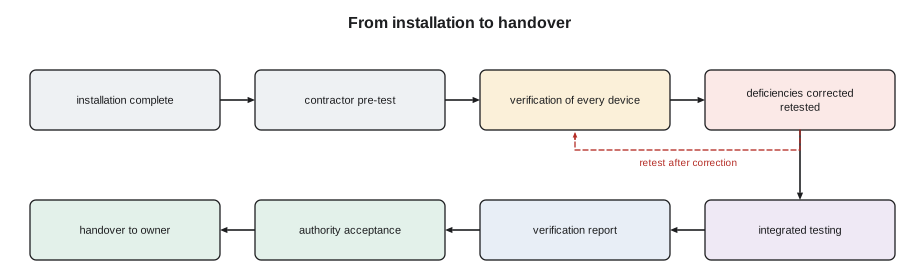
Deficiencies found during verification are listed, corrected and retested before the report is issued (FAT-330). The S537 report records every device and function and the result, and the verifying technician signs it; a certificate or letter of verification is issued for the authority. The handover package gives the owner the record drawings, the verification report, the sequence of operation, the software, the manuals and the training, and makes clear that the owner is now responsible for S536 inspection and testing.
Practice set: commissioning
Captain Strand sat in on one of Gerry's review evenings and set these questions from the fire department's side of a verification.
Question 1. The verification is finished, but two devices failed and are waiting for parts. Can the verification certificate be issued? Answer: not as a complete verification. The report lists the outstanding items, and those devices are verified once they are corrected. The authority decides whether occupancy can proceed with the items outstanding.
Question 2. The fire department asks to see the elevator recall operate from the lobby smoke detector. The contractor says it was tested last week. What happens? Answer: the witness test is done again with the authority present, if the authority asks. A test the authority did not witness may be accepted on the record, but the authority can ask to see it.
Question 3. A device was added after the verification was complete. What is needed? Answer: the added device, and anything it controls, is verified, and the verification report is updated. A change to the system after verification is not covered by the original report.
Question 4. During the integrated test, the fire alarm signals the smoke control system, but the stair pressurization fan does not start. Whose problem is it? Answer: the integrated test's job is to find exactly this. The fire alarm technician confirms the output was sent; the mechanical contractor checks the fan's controls. The test is repeated until the whole sequence works, and the results are recorded for all the systems involved.
Question 5. An annunciator shows 'Zone 7' for every device on the third floor, but the floor has three areas that firefighters need to tell apart. Is that acceptable? Answer: the descriptions must be specific enough for responders to find the alarm. The descriptions are corrected and retested.
Question 6. The system passed its tests, but the as-built drawings were not delivered. Is the project complete? Answer: no. Documentation is part of the deliverable: drawings, the cause-and-effect matrix, the program, the test records, the manuals and the training record. Lesson 10's checklist lists them.
The commissioning sequence
| Step | Who | Record |
|---|---|---|
| Pre-test: wiring and installation checked | Installer | Installer's records |
| Verification of each device and circuit | Verifying technician | S537 verification report |
| Cause-and-effect tested | Technician and programmer | Marked-up matrix |
| Integrated testing to S1001 | Integrated testing coordinator and all trades | Integrated test report |
| Authority's witness tests | Fire department and contractor | The authority's acceptance |
| Handover | Contractor to owner | Documents and training record |
Exam questions about commissioning often ask who is responsible for a step, or which document records it. The sequence in the table is the order on most projects, though the steps overlap on large jobs.
Testing when the system is partly occupied
Large projects are often handed over floor by floor, so part of the building is occupied while other floors are still being tested. The fire alarm on the occupied floors must stay in service. Testing on the construction floors must not sound the alarm on the occupied floors, and an alarm in the occupied floors must still work fully. The technician works with the building's management and the authority on a plan: which zones are disabled for testing, how occupants are warned, and how the monitoring company is kept informed. A mistake here can either evacuate a hospital floor for nothing or, worse, leave occupied areas without protection.
Worked problem
Planning a phased handover test
Floors 1 to 6 are occupied, and floors 7 to 12 are being verified. How is the test day planned?
Show solution
- Agree the plan with the authority and the building manager, in writing.
- Bypass the notification outputs for floors 7 to 12 only, and confirm that floors 1 to 6 still sound in alarm.
- Tell the monitoring company which zones are in test, and for how long.
- Test floors 7 to 12, then restore every bypass and confirm normal at the control unit.
- Record the bypasses and their restoration, with times.
Answer: The occupied floors are never left unprotected, and every bypass is restored and recorded.
What the authority looks for
Captain Strand ended the evening with the four things he checks on every final inspection in Saskatoon. Firstly, the annunciator: at the entrance, with clear descriptions and a zone map. Secondly, the documents: the verification report, the drawings and the matrix, on site and current. Thirdly, the functions he cares most about as a firefighter: elevator recall, door release, smoke control and the monitoring signal, which he asks to see operate. Fourthly, the building's people: someone on site who knows how to silence, acknowledge and reset the panel, and who to call. 'If those four are right,' he says, 'I usually find the rest is right too. If one is wrong, I start looking harder.'
Nadia asks what the most common failure is. He does not hesitate: descriptions. A panel that says 'Zone 3' when a firefighter needs 'Floor 3 east corridor' costs time on the worst night of someone's life. The second most common is a monitoring signal that was never tested from the building to the receiving centre and back.
Training the owner
Handover includes training the people who will live with the system. The owner's staff learn what each signal means, how to acknowledge and silence, when they may reset and when they must not, how to read the annunciator, and whom to call for service and for monitoring. They are shown where the documents are kept and how to arrange the periodic inspections. The training is recorded with the names of those trained and the date, and the record goes with the handover documents. An exam question that asks what completes the handover expects training among the answers, not just the test results.
Common mistakes
MistakeVerifying a sample of devices.
InsteadS537 requires every device and function.
MistakePassing a device that works but reports the wrong location.
InsteadThe description is part of the test.
MistakeTreating the contractor's pre-test as the verification.
InsteadThe verification is a separate, documented process.
MistakeTesting systems one at a time and calling it integrated.
InsteadRun the scenarios with all affected systems together.
MistakeHanding over without training.
InsteadTrain the owner and give them the documents.
Summary and key terms
- Verification (S537) proves a new system; inspection (S536) keeps it proven.
- Every device and function is tested, not a sample.
- Pre-testing by the contractor comes first; verification is separate.
- Integrated testing (S1001) proves the interactions.
- The signed report and certificate go to the authority and owner.
- Verification
- Confirming that a new or altered system is installed correctly and works, to CAN/ULC-S537.
- Integrated testing
- Testing the interactions between life safety systems, to CAN/ULC-S1001.
- Pre-test
- The contractor's own test before verification.
- Test matrix
- A list of every device and function to be verified.
- Handover
- Delivering the system, documents and training to the owner.
Practice problems
Work each problem on paper first, then reveal the answer to check.
Which standard covers verification of a new system?
Show answer
CAN/ULC-S537.
Which standard covers integrated testing?
Show answer
CAN/ULC-S1001.
Does a working device with the wrong label pass?
Show answer
No; it is a deficiency until corrected and retested.
Who signs the verification report?
Show answer
The verifying technician.
Who is responsible for the system after handover?
Show answer
The owner.
Lesson quiz · 5 questions
Score 60% or more to complete this lesson.
Create a free account to save your progress, take quizzes and earn a certificate.