
FAT-340 · Lesson 8 of 12 · 20 min
Inspection and testing review (CAN/ULC-S536)
Inspection and testing is the work Sasha knows best, because it has filled her third year. It is also the heart of the practical exam, which tests exactly what S536 describes. 'The trap with inspection questions,' Gerry says, 'is that you answer them the way we do them at Bramwell instead of the way the standard says. Usually that's the same thing. When it isn't, the standard wins on the exam.' This lesson reviews FAT-230: why existing systems are inspected and tested, how S536 is organized, the frequencies and methods for each component, battery testing, interconnected systems, deficiencies, impairments and records.
Why and who
The National Fire Code makes the building owner responsible for inspecting and testing the fire alarm system to CAN/ULC-S536 (FAT-230 lessons 1 and 2). The owner may contract the work, but cannot contract away the responsibility. The standard sets daily, monthly and annual inspections and tests; the annual inspection and test is done by a qualified technician and covers the whole system. Every device is tested every year under S536: there is no sampling of devices on the annual test.
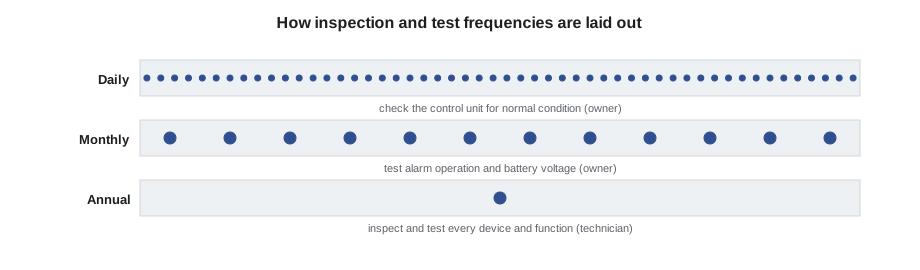
Frequencies
S536's daily and monthly checks are owner's checks: the daily check confirms the control unit shows normal, and the monthly test operates at least one alarm initiating device to confirm the system goes into alarm and checks the batteries and other functions the standard lists (FAT-230 lesson 3). The annual inspection and test covers every component: control unit and annunciators, power supplies and batteries, every initiating device, every notification appliance, every interconnection, and the transmission to the monitoring company. Results go on the S536 forms.
# What is due this visit? (simplified S536 frequency table, illustrative)
freq_months = {"all initiating devices": 12, "all notification appliances": 12, "control unit and annunciators": 12, "battery load test": 12, "monthly owner test": 1}
last_done = {"all initiating devices": 12, "all notification appliances": 12, "control unit and annunciators": 12, "battery load test": 12, "monthly owner test": 1}     # months since each item was last done
for item, every in freq_months.items():
    due = last_done[item] >= every
print(f"{item:<34s} every {every:>2d} months, last {last_done[item]:>2d} months ago: {'DUE' if due else 'not due'}")all initiating devices every 12 months, last 12 months ago: DUE all notification appliances every 12 months, last 12 months ago: DUE control unit and annunciators every 12 months, last 12 months ago: DUE battery load test every 12 months, last 12 months ago: DUE monthly owner test every 1 months, last 1 months ago: DUE
The intervals in the code are simplified for the exercise. On the exam, the trap is the word 'all': under S536, the annual test covers every device, so a question offering 'a representative sample' is wrong.
Test methods
Each device is tested by the method the standard gives, not by whatever is quickest (FAT-230 lessons 5 to 9). Smoke detectors are tested with a listed aerosol or smoke that enters the chamber, never by just pressing a test button, which checks only the electronics. Heat detectors are tested with a heat source that will not damage them; non-restorable fixed-temperature detectors are tested mechanically and electrically, and after 15 years a sample is removed for laboratory testing. Manual stations are operated. Waterflow switches are tested by flowing water through the inspector's test connection, and the alarm must come within 90 seconds. Valve supervisory switches must signal within two turns or one-fifth of travel. Notification appliances are operated and checked for audibility and synchronization; voice systems are checked for message content and intelligibility.
Worked problem
Choosing the test method
During the annual test at Riverlight, Nadia reaches a smoke detector in a corridor and presses its test button. The panel shows an alarm. Has she tested the detector?
Show solution
- The test button checks the detector's electronics and its communication with the panel.
- It does not show that smoke can enter the chamber; a blocked screen or a covered detector would still pass.
- The standard requires a functional test with smoke or a listed aerosol entering the chamber.
- Nadia repeats the test with the aerosol and records the result.
Answer: No. The test button is not the functional test; smoke must enter the chamber.
Batteries
Batteries are inspected for date, condition and terminal corrosion, their voltage is measured with the charger connected and disconnected, and a load test confirms they can carry the alarm load (FAT-230 lesson 6). Sealed lead-acid batteries typically last four to five years, less in a hot room; a battery that fails its test is replaced, and many owners replace batteries on a schedule.
# Battery load test: voltage under load (illustrative pass level)
readings = {"panel batteries (installed 2023)": 24.6, "RPS-9 batteries (installed 2020)": 21.1}      # battery: voltage under the test load
limit = 21.6         # V, a typical minimum for a 24 V pair under the test load
for bat, v in readings.items():
print(f"{bat}: {v:.1f} V under load -> {'pass' if v >= limit else 'FAIL, replace'}")panel batteries (installed 2023): 24.6 V under load -> pass RPS-9 batteries (installed 2020): 21.1 V under load -> FAIL, replace
Interconnected systems
The annual test includes every function the fire alarm system operates: elevator recall to the primary and alternate floors, fan shutdown, damper closure, door release, lock release and the signal to the monitoring company (FAT-230 lesson 10). Each is tested from a real device, and each needs coordination: the elevator contractor for recall, the building operator for fans, the monitoring company told before and after. A test that operates the interconnection but not the controlled equipment is incomplete.
Deficiencies, impairments and records
Faults found are recorded as deficiencies, ranked by how much they affect the system, and reported to the owner, who arranges correction (FAT-230 lesson 11). When part of the system is out of service, it is impaired: the owner must notify the fire department and the monitoring company, and arrange measures such as a fire watch until the system is restored, as the fire code and the authority require. The annual report, signed by the technician, records every device tested and every deficiency found, and is kept by the owner.
# Impairment: does it need a fire watch? (the authority sets the measures; Bramwell uses 4 h as its trigger)
impairments = {"floor 9 loop": 2.5, "parking level NAC": 7.0}     # zone: hours out of service in the last 24 h
for zone, h in impairments.items():
    action = "fire watch or other measures required" if h > 4 else "notify, track and restore"
print(f"{zone:<22s} out {h:>4.1f} h -> {action}")floor 9 loop out 2.5 h -> notify, track and restore parking level NAC out 7.0 h -> fire watch or other measures required
Practice set: inspection and testing
Ravi runs the inspection crew, and his questions come from S536 reports he has reviewed. 'Most inspection questions are about two things,' he says. 'How often, and how. If you know the frequency table and the method for each device, you've got most of the marks.'
Question 1. A building owner asks whether the annual test can cover half the detectors this year and half next year. Answer: no. S536 requires every device to be tested on the annual inspection and test. Splitting the test over two years is a sampling approach the standard does not allow for the annual test.
Question 2. A technician tests a smoke detector by pressing its test button. Is that a valid functional test? Answer: no. The test button checks the electronics, not whether smoke can reach the sensor. A functional test introduces smoke or listed aerosol into the chamber, so that the screen, the chamber and the sensor are all tested.
Question 3. During the annual test, the technician finds a detector covered by a plastic bag left by painters. What is recorded? Answer: the detector is recorded as a deficiency until the cover is removed and the device tested. The building owner is told at once, because the area has been unprotected. S536 reports list every deficiency with its location.
Question 4. A heat detector of the fixed-temperature, non-restorable type is in place. How is it tested? Answer: it is not tested with heat, because that would destroy it. It is inspected visually and its circuit is tested mechanically or electrically. Non-restorable detectors are replaced on a schedule or sample-tested in a laboratory, depending on the standard's requirements.
Question 5. The battery on a panel is three years old and passes a load test. Can it stay in service? Answer: yes, if it passes the test and shows no damage, leaks or swelling. Many technicians and manufacturers recommend replacement at about four or five years regardless, and the battery's date is marked on it so that the next inspector can see its age.
Question 6. A waterflow switch is tested by opening the inspector's test valve, and the alarm comes in 75 seconds. Does that pass? Answer: yes. The requirement is an alarm within 90 seconds of flow. The time is recorded, so that a trend toward a longer delay can be seen over years.
Frequencies to know
| Item | Frequency | Method |
|---|---|---|
| Control unit, trouble signals | Daily or as the owner's checks require; annual test | Operate and observe |
| Batteries (lead-acid) | Monthly visual, annual load test | Voltage, load and charger |
| Smoke detectors | Annual functional | Listed aerosol or smoke |
| Heat detectors (restorable) | Annual functional | Heat source that does not damage them |
| Manual stations | Annual | Operate as a person would |
| Waterflow switches | Annual (more often under the sprinkler standard) | Inspector's test valve |
| Valve supervisory switches | Annual | Two turns or one-fifth of travel |
| Notification appliances | Annual | Operate, listen and look |
The frequency table is a classic source of exam questions, and a classic source of traps: a question may give the sprinkler standard's frequency for a waterflow switch and ask for the fire alarm standard's. Read which standard the question is asking about.
Writing a good deficiency
A deficiency is useful only if someone else can find and fix it. Ravi's rule is the four Ws: what was found, where it is, why it matters, and what was done. Compare 'Detector bad' with 'Photoelectric detector, room 214 ceiling, did not alarm with listed aerosol after three attempts; head replaced with like type, retested, passed.' The second one can be checked, billed and trusted. Exam questions sometimes show a poorly written deficiency and ask what is missing.
Deficiencies are also ranked. An item that leaves part of the building unprotected, such as a disconnected circuit or a failed panel, is reported to the owner immediately and may need a fire watch. A minor item, such as a faded label, is listed on the report for correction. The ranking tells the owner what to fix first.
Before and after the test
Inspection questions are not only about devices. The exam also asks what happens before testing starts and after it ends, because that is where buildings are left unprotected. Before testing, the technician tells the building's management and the occupants, notifies the monitoring company and puts the account in test, and checks the previous report for outstanding deficiencies. Systems that the fire alarm controls, such as elevators, fans, door holders and suppression releases, are either tested deliberately or bypassed with care, so that a test does not dump a clean agent into a server room or recall every elevator during a busy morning.
After testing, every bypass is removed and the panel shows normal, the monitoring company confirms it has received the test signals and takes the account out of test, and the building is told testing is finished. The report goes to the owner with deficiencies listed. If the system cannot be returned to service, the owner and the authority are told, and a fire watch may be required until it is repaired. Exam questions about this sequence are easy marks for a candidate who has done it on site and hard for one who has only read about it.
| Before | After |
|---|---|
| Notify management and occupants | Remove every bypass, confirm normal |
| Put the monitoring account in test | Confirm signals received, take the account out of test |
| Review the last report | List deficiencies on the new report |
| Bypass or prepare controlled systems | Restore controlled systems |
| Check tools and meters | Tell management testing is finished |
Common mistakes
MistakePressing the test button as the functional test.
InsteadUse smoke or a listed aerosol in the chamber.
MistakeTesting a sample of devices on the annual test.
InsteadS536 tests every device every year.
MistakeTreating the owner's responsibility as the contractor's.
InsteadThe owner is responsible; the contractor does the work.
MistakeTesting an interface relay without the controlled equipment.
InsteadProve the elevator, fan or door actually responds.
MistakeLeaving an impairment unreported.
InsteadNotify the fire department and the monitoring company, and arrange measures.
Summary and key terms
- The NFC makes the owner responsible for testing to S536.
- The annual test covers every device and function.
- Each device is tested by the method the standard gives.
- Batteries are inspected, measured and load-tested.
- Impairments need notification and measures; deficiencies go on the report.
- Inspection
- A visual check of the system and its components.
- Functional test
- A test that operates a device as a fire would.
- Sensitivity test
- A measurement of a smoke detector's response level.
- Impairment
- A condition where all or part of the system is out of service.
- Fire watch
- Trained people patrolling to watch for fire while a system is impaired.
Practice problems
Work each problem on paper first, then reveal the answer to check.
What must enter a smoke detector during its functional test?
Show answer
Smoke or a listed aerosol.
Within how long must a waterflow alarm come during the test?
Show answer
90 seconds.
How long do sealed lead-acid batteries typically last?
Show answer
Four to five years.
Who is responsible for inspection and testing?
Show answer
The building owner.
What is tested along with each interface relay?
Show answer
The equipment it controls.
Lesson quiz · 5 questions
Score 60% or more to complete this lesson.
Create a free account to save your progress, take quizzes and earn a certificate.