
FAT-340 · Lesson 6 of 12 · 18 min
Control panels and circuits review
The third review evening is about the control unit and the circuits that leave it. Gerry draws a box on the whiteboard and labels it with the three things every panel does: it receives signals, it decides what they mean, and it acts on them. 'Everything else,' he says, 'is detail about how it does those three things reliably.' This lesson reviews FAT-210: conventional and addressable panels, circuit classes and pathway survivability, initiating and notification circuits, single-stage and two-stage operation, programming and sequences of operation, annunciators and networked panels.
What the control unit does
The fire alarm control unit receives alarm, supervisory and trouble signals, indicates them, and operates outputs: the alarm signals, the transmission to the monitoring company, and the interfaces with other building systems (FAT-210 lesson 1). It also supervises itself and its circuits, so that a broken wire, a ground fault or a failed power supply is reported as trouble rather than being found in a fire. Control units in Canada are listed to CAN/ULC-S527. The three signal types are an exam staple: alarm means a fire condition; supervisory means a condition that needs attention but is not a fire, such as a closed sprinkler valve or a duct detector set to supervisory; trouble means a fault in the system itself.
Conventional and addressable systems
A conventional system divides the building into zones, each wired as an initiating device circuit with an end-of-line device; the panel knows which zone is in alarm but not which detector (FAT-210 lesson 2). An addressable system connects devices on a signalling line circuit, and each device has an address, so the panel reports exactly which device has operated and can read analog values from detectors (FAT-210 lesson 3). Addressable loops use isolator modules so that a short circuit takes out only the section between two isolators, not the whole loop.
The NBC limits the area a single zone may cover, commonly about 2000 m² and one storey, so that firefighters can find the fire quickly; in an addressable system the zone is a group of addresses on the annunciator, but the same principle applies. A single fault on a loop must not disable more than a set amount of the system, which is why S524 sets rules on isolation between floors and areas.
Circuit classes
Circuits are classified by how they perform under faults (FAT-210 lesson 4). On a Class B circuit, the wiring runs out to the devices and ends at an end-of-line device; an open circuit is reported as trouble, but devices beyond the break are lost. On a Class A circuit, the wiring returns to the panel on a separate path, so a single open is reported and every device keeps working from one end or the other. S524 requires Class A wiring in specific cases and sets rules for how the outgoing and return legs are routed: they must not run together in the same raceway or cable, so that one event cannot cut both. Older drawings use the term style rather than class; Style 6 corresponds to Class A.
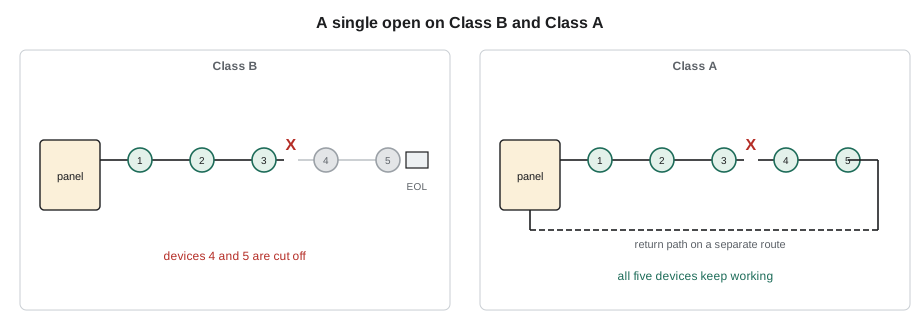
# What does a single open do on a Class B and a Class A circuit of 8 devices?
def working(cls, break_after, n=8):
    if cls == "B":
        return list(range(1, break_after + 1))          # devices beyond the break are lost
    return list(range(1, n + 1))                        # Class A feeds from both ends
for cls in ("B", "A"):
    w = working(cls, break_after=5)
print(f"Class {cls}: open after device 5 -> {len(w)} of 8 devices still work, panel shows trouble")Class B: open after device 5 -> 5 of 8 devices still work, panel shows trouble Class A: open after device 5 -> 8 of 8 devices still work, panel shows trouble
A favourite exam trap is the difference between what a Class A circuit tolerates and what it reports. It keeps working through a single open, but the panel must still report the trouble, and the fault must be repaired. Another is routing: a Class A circuit with both legs in the same conduit is not really Class A at all.
Notification circuits and synchronization
Notification appliance circuits are supervised by reversing their polarity: in standby, the panel sends a small current one way through the end-of-line device; in alarm, it reverses the polarity and drives the appliances, which have diodes so they only operate in alarm (FAT-210 lesson 6). Strobes on the same circuit, and across circuits in the same field of view, are synchronized by the panel or the power supply, and audible signals use synchronized temporal-three patterns. Remote power supplies must follow the panel's sync signal; an unsynchronized booster is one of the most common faults found at verification.
Programming and the sequence of operation
The sequence of operation says, for every input, what outputs the system will operate (FAT-210 lessons 8 and 9). It is usually shown as an input/output matrix, also called a cause-and-effect matrix: inputs down the side, outputs across the top, and a mark where an input operates an output. Programming turns the matrix into panel software, and testing proves every mark. Most programming errors are not in the panel's logic but in the matrix itself, or in a device assigned to the wrong group.
# Check observed test results against the cause-and-effect matrix
matrix = {
    "Smoke, floor 4 corridor":   {"alarm signals", "elevator recall", "door release floor 4", "fan AHU-2 stop"},
    "Duct detector AHU-2":       {"supervisory", "fan AHU-2 stop"},
    "Waterflow floor 4":         {"alarm signals", "door release floor 4"},
    "Manual station floor 1":    {"alarm signals", "door release floor 1"},
}
observed = {
    "Smoke, floor 4 corridor":   {"alarm signals", "elevator recall", "door release floor 4", "fan AHU-2 stop"},
    "Duct detector AHU-2":       {"supervisory", "fan AHU-1 stop"},
    "Waterflow floor 4":         {"alarm signals", "door release floor 4"},
    "Manual station floor 1":    {"alarm signals", "door release floor 1"},
}
for inp, want in matrix.items():
    got = observed[inp]
    missing, extra = want - got, got - want
    result = "pass" if not missing and not extra else f"FAIL missing {sorted(missing)} extra {sorted(extra)}"
print(f"{inp:<26s} {result}")Smoke, floor 4 corridor pass Duct detector AHU-2 FAIL missing ['fan AHU-2 stop'] extra ['fan AHU-1 stop'] Waterflow floor 4 pass Manual station floor 1 pass
The example repeats the fault Sasha found in her FAT-210 capstone at Tamarind House: the AHU-2 duct detector was programmed into the AHU-1 group. Every other input passed, and the matrix test found the one that did not.
Annunciators and the fire department
The annunciator shows firefighters where the alarm is, at the building entrance they will use (FAT-210 lesson 10). The NBC requires an annunciator in many buildings, with each zone indicated, and S524 sets its location, layout and the controls it provides; an oriented floor plan beside it is a common request from the fire department. Firefighters need to silence signals, acknowledge, and reset only when the cause is cleared, and the controls must be protected from unauthorized use.
Practice set: panels and circuits
Donna sets this set for Nadia and Sasha on a Thursday evening. Each question is followed by the answer and the reasoning, written the way Donna wants them to explain it to an assessor: what the panel sees, why, and what a technician does about it.
Question 1. A Class B initiating circuit has an open between the third and fourth of eight detectors. Which detectors still work? Answer: the first three, between the panel and the open. The panel shows trouble because the end-of-line device is no longer seen, but detectors beyond the break are cut off. On a Class A circuit, all eight would keep working because the circuit is fed from both ends.
Question 2. A technician sees a ground fault trouble on a panel, with no other symptoms. Is the system still working? Answer: probably yes, which is exactly why a ground fault matters. One ground fault usually does not stop the circuit, but a second ground fault on another conductor can create a path that disables a circuit or causes a false alarm. A ground fault is found and fixed promptly, using the panel's ground fault detection and isolation by circuit.
Question 3. An addressable loop reports a device as missing, but the device is in place and its LED blinks. What are the likely causes? Answer: a duplicate address, a device of the wrong type at that address, or a wiring problem affecting communication. The technician reads the device's address, compares it with the program, and checks the loop for a second device at the same address.
Question 4. A heat detector, a sprinkler waterflow switch and a valve tamper switch are all connected to the same conventional zone. What is wrong? Answer: the tamper switch produces a supervisory signal and must not share a zone with alarm devices, because the panel would report it as an alarm. Supervisory devices go on supervisory circuits or are programmed as supervisory on an addressable system.
Question 5. On a two-stage system, a manual station on floor 4 is operated with a key-switch. What should happen? Answer: the alert signal sounds first, and if it is not acknowledged within five minutes, the alarm signal sounds automatically. A key at the station or the panel can move directly to the alarm signal. Lesson 3 reviewed when the NBC allows a two-stage system.
Question 6. The panel's battery reads 23.1 V under no load after a power failure test. Is that a problem? Answer: on a 24 V lead-acid battery, a rested voltage of about 25.5 to 27 V shows a healthy charged battery; 23.1 V after a short test suggests a battery that is weak or was not fully charged. The battery is load tested, and replaced if it cannot carry the load for the required time.
Where to look
| Topic | Course and lesson | Exam angle |
|---|---|---|
| Signal types: alarm, supervisory, trouble | FAT-130 lesson 2 | Which signal a device produces |
| Circuit classes A, B and X | FAT-130 lesson 6, FAT-210 lesson 3 | What survives an open, a short, a ground |
| End-of-line devices | FAT-130 lesson 5 | Readings and their meaning |
| Addressable loops and isolators | FAT-210 lessons 4 and 5 | How many devices a short can disable |
| Power supplies and batteries | FAT-130 lesson 8 | Charging, standby, load testing |
| Two-stage operation | FAT-210 lesson 9 | Timing and who may acknowledge |
| Cause-and-effect programming | FAT-230 lesson 3 | What the matrix says and how it is tested |
A short-circuit isolator question
An addressable loop has 150 devices and isolators every 25 devices. A short occurs between devices 60 and 61. How many devices are lost? The isolators on either side of the short open, so only the devices between those two isolators are lost: at most the 25 in that segment, and on a Class A loop the devices on the other side of the isolated segment are still fed from the far end. Without isolators, the whole loop would be lost. Exam questions often give the isolator spacing and ask for the worst-case number of devices lost.
Reading a panel display
Many exam questions show what a panel displays and ask what it means or what to do. The display tells you the signal type, the device or zone, and its description, and a good technician reads all three before acting. An alarm means respond as a fire until proved otherwise. A supervisory means a system that protects the building is not in its normal state: a closed valve, a low air pressure, a fire pump problem. A trouble means the fire alarm system itself has a fault: an open, a ground, a power failure, a missing device. Acknowledging a signal silences the panel's buzzer and records that someone has seen it; it does not fix the cause. Resetting clears the panel only if the cause has gone; an alarm that returns at once after reset is still there.
A frequent trap is a question in which the panel shows a trouble and the answer choices include 'reset the panel'. Resetting does nothing for a trouble whose cause is still present, and it may erase information the next technician needs. The answer is to find the cause.
Common mistakes
MistakeCalling a supervisory signal a trouble.
InsteadSupervisory: a condition needing attention; trouble: a fault in the system.
MistakeRunning both legs of a Class A circuit together.
InsteadRoute them separately so one event can't cut both.
MistakeIgnoring a trouble on a Class A circuit because it still works.
InsteadReport and repair every fault.
MistakeLeaving a remote power supply unsynchronized.
InsteadEvery supply in a field of view follows the panel's sync.
MistakeTesting the panel instead of the matrix.
InsteadTest every input against its row of the matrix.
Summary and key terms
- The control unit receives, decides and acts, and supervises itself.
- Alarm, supervisory and trouble are different signal types.
- Addressable loops identify each device; isolators limit the effect of shorts.
- Class A survives a single open; its legs must be routed apart.
- The cause-and-effect matrix is the test plan for programming.
- Signalling line circuit
- A circuit that carries data to and from addressable devices.
- Isolator
- A module that disconnects a shorted section of a loop.
- Class A
- A circuit that keeps working through a single open, with a separate return path.
- Cause-and-effect matrix
- A table of inputs and the outputs each one operates.
- Annunciator
- A display that shows firefighters the location of an alarm.
Practice problems
Work each problem on paper first, then reveal the answer to check.
Which signal type is a closed sprinkler valve?
Show answer
Supervisory.
What does an isolator module do?
Show answer
It disconnects a shorted section of an addressable loop.
Why must Class A legs be routed separately?
Show answer
So that a single event cannot cut both.
How is a notification circuit supervised in standby?
Show answer
By a small current through the end-of-line device with reversed polarity.
What was wrong at Tamarind House in the matrix test?
Show answer
The AHU-2 duct detector was in the AHU-1 group.
Lesson quiz · 5 questions
Score 60% or more to complete this lesson.
Create a free account to save your progress, take quizzes and earn a certificate.