
FAT-340 · Lesson 1 of 12 · 20 min
Certification paths: CFAA technician registration
Sasha Vukovic is in her fourth year at Bramwell Fire Protection. She has pulled cable at Willowbank, mounted devices in the Eastview north wing, programmed the Tamarind House panel and spent most of the last year on Gerry Tremaine's inspection crew. Her trainee registration with the Canadian Fire Alarm Association has been in her wallet since her first month, and she has finished all five CFAA technician courses. What is left is the part that makes it count: the theory exam, the practical exam and her registration as a fire alarm technician. 'Until you're registered,' Gerry tells her, 'my name goes on every report you work on. After, yours can. That's the difference between helping with an inspection and being the person the building owner relies on.' This course is the review that gets her there. This first lesson sets out the certification paths open to a fire alarm technician in Canada, what each one proves, and how they fit together with provincial rules and the employer's own requirements.
Why fire alarm work is certified
A fire alarm system sits idle for years and then has to work perfectly for a few minutes. Nobody in the building can tell, from the outside, whether it will. The owner relies on the people who install, verify, inspect and test it, and so do the fire department, the insurer and the authority having jurisdiction. Certification is how those people show, to someone who was not standing beside them, that they know the standards and can do the work. It does not replace experience or supervision, but it gives the industry a common measure: a technician who holds a recognized credential has passed a written examination on the codes and standards and, in most programs, has shown hands-on skill or verified field experience.
Certification also protects the technician. A signed inspection report or verification certificate is a professional statement that the system was tested as the standard requires. When something goes wrong later, the first question will be whether the person who signed was qualified. Holding the credential the owner, the code or the contract asked for is the first part of the answer.
The CFAA technician program
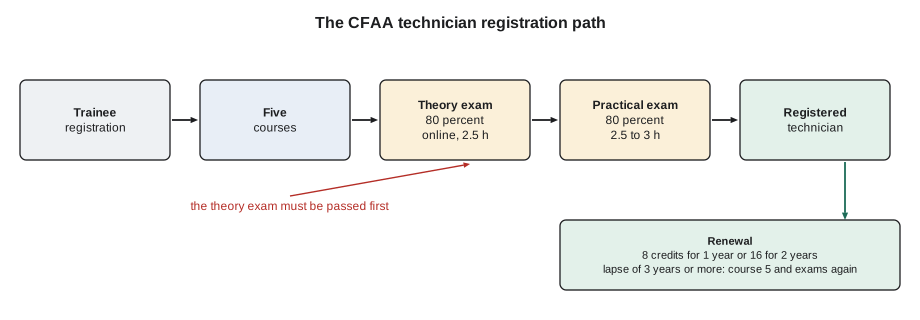
In most of Canada, the recognized credential for fire alarm technicians is registration with the Canadian Fire Alarm Association. The CFAA program has three parts. First, a person registers as a trainee and completes the five-course technician training program, either through the CFAA's online courses or through a partner college; most people take one and a half to two years part-time, though some finish faster. Second, the trainee writes the theory examination: a proctored, online, multiple-choice exam of about two and a half hours. Third, a trainee who has passed the theory exam takes the practical examination: a hands-on test of about two and a half to three hours, one-on-one with an invigilator, on the verification, inspection and testing of fire alarm systems. Both exams need a mark of 80 percent to pass, and a candidate must pass the theory exam before booking the practical. A trainee who passes both becomes a registered fire alarm technician and receives a registration card.
Registration is kept current by continuing education and an annual fee. A registered technician renews for one year with eight continuing education credits, or for two years with sixteen. A registration that lapses for three years or more cannot simply be renewed: the technician must complete the final course again or challenge its exam, pass both exams again and pay a reinstatement fee. Credits come from courses, seminars, manufacturer training and similar activities, and the technician keeps the records.
What the exams actually test
The theory exam is drawn from the material in the five courses: fire alarm fundamentals, the National Building Code and National Fire Code requirements that apply to fire alarm systems, the installation standard CAN/ULC-S524, the verification standard CAN/ULC-S537, the inspection and testing standard CAN/ULC-S536, and the electrical theory and practice a technician needs. The practical exam tests whether the candidate can do what S536 and S537 describe: test devices and circuits correctly, recognize faults, use the right test methods and record results. In both, the standards are the backbone. A candidate who knows where things are in S524, S536 and S537, and why the rules exist, will do far better than one who has memorized isolated numbers.
Lesson 2 looks at the exam formats in more detail and turns the blueprint into a study plan. For now, the important point is that the exam rewards the same thing the job does: knowing which document governs a question and being able to find the answer in it.
Provincial rules and other credentials
CFAA registration is not, in itself, a provincial licence. In many provinces, the fire code or the local authority requires that inspection, testing and verification be done by a qualified person, and accepts CFAA registration as the evidence; some municipalities and many building owners require it outright in their contracts. Saskatchewan, where Bramwell works, adopts the National Building Code and National Fire Code, and the authorities Bramwell deals with expect verification and annual inspection reports to be signed by a registered technician. Installation wiring is electrical work and falls under the provincial electrical rules, so fire alarm installers usually work under an electrical contractor's permit or are themselves journeyperson electricians. Ontario, British Columbia and other provinces have their own arrangements, and some have a separate electrical licence category for fire alarm and low-voltage work. A technician who moves provinces checks the rules before signing anything.
Manufacturers add another layer. Most addressable panel makers require factory training before a technician may program or service their equipment, and some will not sell programming software or parts without it. Bramwell keeps a training matrix showing which technicians are certified on which panels. None of these replaces CFAA registration, but each is a condition of doing particular work.
How certification fits a career
Certification is not the end of learning; it marks a point where the technician is trusted to work with less supervision. At Bramwell, Donna Achebe, the service manager, uses certification as one of the conditions for three steps: working an inspection as the lead technician, signing reports, and supervising a trainee. Ravi Menon, the designer, came up through the same path and then moved into layout and submittals. Lesson 12 returns to these paths and the choices Sasha will make after the exam.
For Sasha, the timing matters for a practical reason. Bramwell has won the three-year inspection contract for Riverlight Tower, the building she inspected in her third year, and the owner's contract requires that the annual report be signed by a registered technician. Donna would like Sasha to lead it next December, which means passing both exams by autumn.
Worked problem
Checking Sasha's eligibility
Before Sasha books her theory exam, Donna checks her file. What must be in place?
Show solution
- Trainee registration with the CFAA: current, renewed each year since her first month.
- All five technician courses completed, with the course records in her file.
- No exemptions claimed, so nothing extra to document.
- The theory exam is booked first; the practical can be booked only after she has passed it with at least 80 percent.
- Bramwell's internal sign-off: Gerry confirms she has done enough supervised verification and inspection work to be ready.
Answer: Everything is in place. She books the theory exam for June and plans the practical for September.
# Certification eligibility checker (illustrative) for CFAA registration
candidate = {"courses completed": 5, "trainee registration (years)": 4, "theory exam mark (percent)": 0}
rules = {"courses completed": 5, "trainee registration (years)": 1}
ok = True
for item, need in rules.items():
    have = candidate.get(item, 0)
    status = "met" if have >= need else "NOT MET"
    if have < need:
        ok = False
    print(f"{item:<34s} have {have:>3}  need {need:>3}  {status}")
print("Ready to book:", "yes" if ok else "no")courses completed have 5 need 5 met trainee registration (years) have 4 need 1 met Ready to book: yes
What employers and owners look for
Bramwell's bids list the credentials of the people who will do the work, and owners increasingly ask for them. The questions Donna hears most are simple: who will lead the work, what credential they hold, whether they are trained on the panel, and who signs the report. A technician whose credentials answer those questions is easier to put on a job, and that is the most direct way certification shows up in pay and responsibility. Lesson 12 compares the career paths in more detail.
Two habits help any candidate. The first is keeping a clean record of training, experience and continuing education from the first day: course certificates, manufacturer training, projects worked, and the hours spent on each kind of work. The second is treating every job as practice for the exam: asking where in the standard a requirement comes from, rather than just what the answer is. Sasha has done both, and Gerry thinks that is why she is ready.
Keeping a record from day one
Sasha's file at Bramwell has four parts, and Donna recommends the same structure to every trainee. The first is credentials: her trainee registration card, the five course completion certificates and, later, her registration card. The second is training: every manufacturer course, safety course and seminar, with dates and hours, because each one may count as a continuing education credit after registration. The third is experience: a log of the buildings she has worked in, the kind of work done, and the hours, signed off monthly by her lead. The fourth is evidence: copies of reports she helped prepare, with her role noted. When she applies for anything, from a provincial licence to a job with another company, the file answers the questions before they are asked.
The experience log matters most and is the easiest to neglect. Gerry has seen good technicians delay certification by a year because they could not show when they had done the work. A line a day is enough: date, building, task, hours, and who supervised.
| Part of the file | What goes in it | Why it matters |
|---|---|---|
| Credentials | Registration or certification cards, course certificates | Proves eligibility |
| Training | Course, seminar and manufacturer training records | Counts toward renewal and panel authorizations |
| Experience | Daily or weekly work log, signed monthly | Shows hours and kinds of work |
| Evidence | Reports and drawings worked on, with the technician's role | Supports applications and references |
Certification in other countries
Some candidates ask whether CFAA registration is recognized elsewhere. In the United States, the common credential is NICET certification, and many US employers look for it even from Canadian technicians; the two programs test different standards, so a technician who moves across the border usually needs the other credential. Within Canada, CFAA registration is national, but provincial and municipal rules differ, as this lesson described, and should be checked before signing work in a new province.
Whatever the country, the pattern is the same: a national credential that proves knowledge, local rules that decide who may do the work, and manufacturer training that decides who may work on a given panel.
Questions people ask Donna
Donna hears the same questions from every new technician, and her answers are a fair summary of this lesson. Does the registration transfer to another province? It is a national program, and it is widely recognized, but each province and municipality decides what it requires, so a technician moving to another province checks the local rules and the contracts there. Does the employer pay? At Bramwell, the company pays for the courses and the first attempt at each exam, and the technician pays for a retake. Policies differ, and it is worth asking at an interview. How long does it take? Most technicians at Bramwell complete the five courses in two to three years while working, and sit the exams soon after the last course, while the material is fresh.
Her last answer is always the same: start the file now. Every month of work that is written down with dates and tasks is a month that counts later; every month that is not becomes an argument with your own memory.
Common mistakes
MistakeTreating CFAA registration as a provincial licence.
InsteadCheck the provincial and local rules too; registration is one part.
MistakeBooking the practical before passing the theory exam.
InsteadPass the theory exam with 80 percent first.
MistakeLetting continuing education records slide.
InsteadKeep certificates and hours as you earn them.
MistakeStudying only the edition your jurisdiction uses.
InsteadStudy the edition the exam is based on, and know the differences.
MistakeAssuming manufacturer training is optional.
InsteadMany panels may only be programmed by factory-trained technicians.
Summary and key terms
- Certification shows that a technician knows the standards and can do the work.
- CFAA registration needs the five courses, a theory exam and a practical exam, each passed at 80 percent.
- Registration is renewed with 8 continuing education credits a year (or 16 for two years).
- Provincial rules, contracts and manufacturer training add conditions of their own.
- Certification marks the point where a technician can lead and sign work.
- Registered technician
- A person who has passed the CFAA theory and practical exams and keeps registration current.
- Trainee registration
- Registration with the CFAA while completing the courses and exams.
- Continuing education credit
- A unit of approved learning used to renew registration.
- Theory exam
- The CFAA written multiple-choice examination.
- Practical exam
- The CFAA hands-on examination with an invigilator.
Practice problems
Work each problem on paper first, then reveal the answer to check.
What mark is needed to pass each CFAA exam?
Show answer
80 percent.
Which CFAA exam must be passed first?
Show answer
The theory exam.
How many continuing education credits renew registration for one year?
Show answer
Eight.
What happens if registration lapses for three years or more?
Show answer
The technician must redo the final course or challenge it, pass both exams again and pay a reinstatement fee.
Is CFAA registration a provincial licence?
Show answer
No; it is a credential that provinces, authorities and owners may require.
Lesson quiz · 5 questions
Score 60% or more to complete this lesson.
Create a free account to save your progress, take quizzes and earn a certificate.