
FAT-210 · Lesson 6 of 12 · 19 min
Notification circuits and synchronization
During the spring fire drill at Willowbank School, a teacher tells Sasha that the strobes in the new gym 'flicker like a disco'. Sasha stands in the doorway with her phone's slow-motion camera running and counts: the six strobes on the gym walls are flashing at the right rate, but not together. Two flash a fraction of a second after the others. 'That is not just annoying,' Gerry says when she shows him the video. 'Strobes that aren't synchronized flash several times a second in total, and for some people that can trigger a seizure. The standards require them to be synchronized wherever more than a couple can be seen at once.' This lesson covers how notification appliance circuits work, how the panel drives and supervises them, how signals are coded, and how strobes and horns are kept in step across circuits and power supplies.
How a notification circuit works
A conventional notification appliance circuit, or NAC, connects horns, strobes, horn-strobes and speaker-strobes to the panel or to a remote power supply. In the normal standby state, the panel doesn't power the appliances. Instead it applies a small supervisory voltage of reversed polarity through the circuit and its end-of-line resistor, and each appliance has a diode inside that blocks current in that direction. The panel measures the supervisory current, exactly as it would on an initiating circuit, and reports an open or a short as a trouble. When an alarm occurs, the panel reverses the polarity and applies full power; the diodes now conduct, and every appliance on the circuit operates.
This polarity reversal is why notification appliances are marked with plus and minus terminals and why connecting one backwards matters. A reversed appliance passes the supervisory current in standby, so it can look like a short or a low-resistance fault, and it stays silent in alarm. During acceptance testing every appliance is seen and heard to operate, which catches reversed ones. Addressable notification is also available, with appliances on an addressable loop or on a special circuit that lets the panel command each one separately; it is used where individual control or detailed supervision is wanted, but the conventional reversed-polarity NAC is still the most common.
# Notification circuit loading against the circuit rating (illustrative currents at 24 V)
RATING = 2.5                 # NAC output rating (A)
appliances = {                    # appliance: (current in A, quantity)
    "horn-strobe 15 cd": (0.066, 4),
    "horn-strobe 30 cd": (0.094, 6),
    "horn-strobe 75 cd": (0.163, 3),
    "strobe 110 cd": (0.206, 2),
}
total = sum(i * n for i, n in appliances.values())
for name, (i, n) in appliances.items():
    print(f"{n:2d} x {name:18s} {i * n:5.3f} A")
print(f"Total {total:5.3f} A on a {RATING:.1f} A circuit = {total / RATING * 100:4.1f} % loaded")
spare = RATING * 0.8 - total
print("Spare at 80 % design loading:", f"{spare:5.3f} A" if spare >= 0 else "none, split the circuit")4 x horn-strobe 15 cd 0.264 A 6 x horn-strobe 30 cd 0.564 A 3 x horn-strobe 75 cd 0.489 A 2 x strobe 110 cd 0.412 A Total 1.729 A on a 2.5 A circuit = 69.2 % loaded Spare at 80 % design loading: 0.271 A
The script adds the alarm current of every appliance and compares it with the circuit rating. Many designers keep each circuit below about 80 percent of its rating so that appliances can be added later. Voltage drop along the wire usually limits a circuit before its current rating does, which FAT-130 covers in its calculations.
Coded signals: the temporal pattern
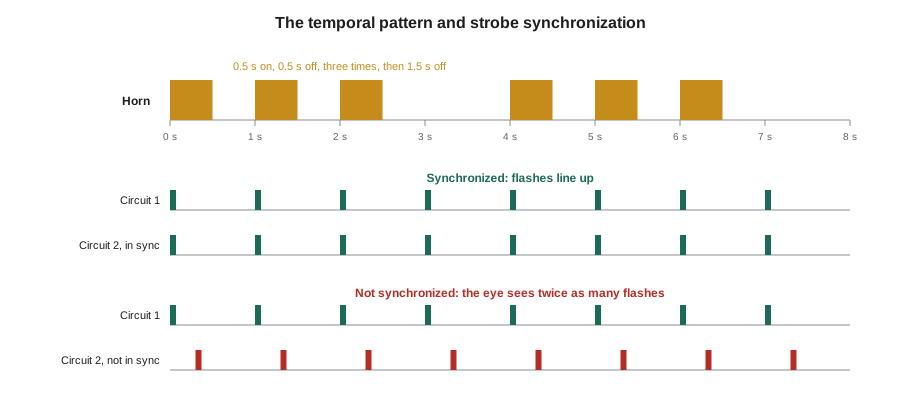
Horns and bells don't just sound continuously. Since the 1990s the evacuation signal in both Canada and the US has used a three-pulse temporal pattern: three half-second tones, each followed by a half-second pause, then a one-and-a-half-second pause before the pattern repeats. The pattern is the same in every building, so people learn that it means 'leave now', and it is distinct from bells used for school classes or factory shift changes. Strobes don't use the temporal pattern; they flash steadily at about once per second.
Canadian two-stage systems also use an alert signal, a distinctive pattern different from the temporal-three alarm signal, to tell staff to investigate. Lesson 7 covers how the alert and alarm stages work together. The panel or the appliance generates the pattern; in most modern systems the horns are programmed or set to produce the temporal pattern themselves when powered, and the sync module or panel keeps them in step.
# The three-pulse temporal pattern: on and off times in one cycle
ON, GAP, PAUSE = 0.5, 0.5, 1.5
cycle = []
for k in range(3):
    cycle.append(("tone", ON))
    cycle.append(("gap", GAP if k < 2 else PAUSE))
t = 0.0
for kind, d in cycle:
    print(f"{t:4.1f} s to {t + d:4.1f} s  {kind}")
    t += d
print(f"Cycle length {t:.1f} s; tone on {sum(d for k, d in cycle if k == 'tone') / t * 100:.1f} % of the time")0.0 s to 0.5 s tone 0.5 s to 1.0 s gap 1.0 s to 1.5 s tone 1.5 s to 2.0 s gap 2.0 s to 2.5 s tone 2.5 s to 4.0 s gap Cycle length 4.0 s; tone on 37.5 % of the time
Synchronization
When strobes flash at random relative to each other, a person who can see several of them sees a rapid combined flash rate, which is more confusing and, for people with photosensitive epilepsy, potentially dangerous. The standards therefore require strobes to be synchronized where more than two can be seen from one place, and in practice designers synchronize every strobe in a building. Horns are synchronized too, so that the temporal pattern sounds as one signal through the building instead of overlapping patterns that blur together.
Synchronization is achieved by the panel, a sync module or a remote power supply sending a timing signal down the circuit, usually as brief pulses in the power that every appliance recognizes. The appliances must be from the same manufacturer's family or listed as compatible with the sync protocol, because each maker's protocol is different. Within one circuit this is straightforward. Across circuits, panels and remote power supplies, every source of sync must be linked, so that all of them start their flashes at the same moment. Manufacturers typically keep synchronized flashes within about 10 milliseconds of each other, well inside the human eye's ability to see the difference.
In the Willowbank gym, the four strobes on one wall were on a circuit from the main panel, and the two on the other wall were on a circuit from a remote power supply added with the gym. The power supply had its own sync generator, and nobody had linked it to the panel's sync output. Sasha connects the panel's sync output to the power supply's sync input, sets the power supply to follow rather than generate sync, and the next video shows all six strobes flashing as one.
# Synchronization check from flash times recorded by a test meter (ms within each second)
LIMIT_MS = 10
flashes = {                     # appliance: times of its last five flashes (ms from the start of the test)
    "Gym N1 (panel NAC 3)": [12, 1012, 2013, 3012, 4012],
    "Gym N2 (panel NAC 3)": [13, 1013, 2012, 3013, 4013],
    "Gym S1 (power supply A)": [310, 1311, 2310, 3311, 4310],
    "Gym S2 (power supply A)": [311, 1310, 2311, 3310, 4311],
}
ref = flashes["Gym N1 (panel NAC 3)"]
for name, times in flashes.items():
    worst = max(abs(a - b) for a, b in zip(times, ref))
print(f"{name:26s} worst offset {worst:4d} ms -> {'in sync' if worst <= LIMIT_MS else 'NOT in sync'}")Gym N1 (panel NAC 3) worst offset 0 ms -> in sync Gym N2 (panel NAC 3) worst offset 1 ms -> in sync Gym S1 (power supply A) worst offset 299 ms -> NOT in sync Gym S2 (power supply A) worst offset 299 ms -> NOT in sync
Silenceable and non-silenceable circuits
When the building has been evacuated, or the cause of the alarm found, firefighters or authorized staff press signal silence. What should go quiet, and what should keep operating? Audible appliances are normally silenced, because the noise makes it hard for responders to talk. Strobes, however, may need to keep flashing until the system is reset, to warn people who can't hear that the building is still in alarm, and some codes and owners require this. For this reason horns and strobes are often wired on separate circuits, or on circuits whose appliances accept a separate silence command, so the panel can silence the horns while the strobes continue.
The silence behaviour of each circuit is part of the sequence of operations and is decided with the authority having jurisdiction. Many Canadian systems also have a minimum period after an alarm during which the signals can't be silenced, set in the panel's programming, so that occupants hear the alarm for long enough to react. CAN/ULC-S524 and the panel listing describe what is permitted.
Dividing circuits for the building's strategy
How notification circuits are divided depends on how the building responds to a fire. A building that evacuates everyone at once can use circuits that cover several floors, divided only by current and voltage drop. A building with staged evacuation, such as Riverlight Tower or Eastview General Hospital, needs each floor or each notification zone on its own circuit, so the panel can sound the fire floor and the floors next to it first and the rest later. The circuits must also be arranged so that a fault on one floor's circuit can't silence another floor. Those circuits are often Class A or have survivable pathways, as lesson 4 described.
Worked problem
A horn-strobe that won't sound
At Tamarind House, one horn-strobe on the third floor doesn't operate during the annual test, although every other appliance on the same circuit works. In standby the panel showed no trouble on that circuit. What could cause this?
Show solution
- Every other appliance working rules out the panel output and most of the wiring.
- No trouble in standby means the circuit was supervised through the appliance, so it isn't an open.
- The likely causes are a failed appliance, a reversed appliance or one whose wires are connected in a way that bypasses it.
- Sasha checks the appliance's terminals: the incoming and outgoing wires are under the correct terminals but swapped plus for minus.
Answer: The appliance was connected with reversed polarity during the fourth-floor fit-out's ceiling work below. Its diode passed the supervisory current in standby and blocked it in alarm. She reconnects it correctly, it operates, and she checks every other appliance the fit-out crew had touched.
Testing notification circuits
Notification circuits are tested in three ways during acceptance and annual inspections. First, every appliance is seen and heard to operate in alarm, which proves its wiring, polarity and setting. Second, the circuit's supervision is tested by opening it at its end and confirming the panel reports a trouble, and by checking for ground faults. Third, the circuit's performance is measured: sound levels in the rooms the appliances serve, strobe synchronization with a meter or slow-motion video, and the voltage at the last appliance while the whole circuit is in alarm, which proves the voltage drop calculation from FAT-130 holds in the real building.
Silence behaviour is tested as part of the same visit. With the system in alarm, the technician presses signal silence and confirms that the appliances meant to go quiet do, and that any appliances meant to keep operating, such as strobes on a non-silenceable circuit, continue. The panel then shows its signals-silenced indication. A second alarm from a new device after silence must sound the appliances again on most systems, which is called resound, and the test confirms it. All of these results are recorded per circuit, with any appliance that failed listed by location.
When an appliance must be replaced, the replacement must be the same model or one the manufacturer lists as compatible with the circuit's sync protocol and the panel, with the same candela and sound settings. A different strobe from the hardware store shelf may look the same and still flash on its own timing, putting the whole room out of sync again. The service van carries the models used in each building for exactly this reason.
Common mistakes
MistakeConnecting a notification appliance with reversed polarity.
InsteadFollow the plus and minus terminals; test every appliance in alarm.
MistakeMixing appliances from different sync families on one circuit.
InsteadUse appliances listed for the same sync protocol.
MistakeLetting a remote power supply generate its own sync.
InsteadLink every power supply to one sync source.
MistakeFilling a circuit to 100 percent of its rating.
InsteadLeave spare capacity and check voltage drop.
MistakePutting horns and strobes on one circuit when strobes must keep flashing after silence.
InsteadSeparate them or use appliances with separate silence control.
Summary and key terms
- A conventional notification circuit is supervised in standby by reversed polarity through an end-of-line device.
- In alarm the panel reverses the polarity and applies full power to the appliances.
- The evacuation signal is the three-pulse temporal pattern; strobes flash about once per second.
- Strobes and horns are synchronized across circuits, panels and power supplies using one sync source.
- Silence behaviour and circuit division follow the building's sequence of operations and strategy.
- Circuit loading is checked against the output rating and, in FAT-130, against voltage drop.
- Notification appliance circuit
- A circuit that powers horns, strobes or other notification appliances.
- Polarity reversal
- Supervising a notification circuit in standby with reversed voltage blocked by appliance diodes.
- Temporal pattern
- The standard three-pulse evacuation signal.
- Synchronization
- Making strobes flash and horns sound in step across a building.
- Sync module
- A device that sends the timing signal that keeps appliances in step.
- Non-silenceable circuit
- A circuit whose appliances keep operating after signal silence until reset.
Practice problems
Work each problem on paper first, then reveal the answer to check.
A 2.5 A circuit carries 1.73 A of appliances. What percentage is that?
Show answer
About 69 percent.
How long is one cycle of the temporal pattern?
Show answer
4 seconds.
Why must every remote power supply follow one sync source?
Show answer
So all strobes flash at the same moment across the building.
Why might horns and strobes be on separate circuits?
Show answer
So horns can be silenced while strobes keep flashing.
Lesson quiz · 5 questions
Score 60% or more to complete this lesson.
Create a free account to save your progress, take quizzes and earn a certificate.