
FAT-210 · Lesson 2 of 12 · 19 min
Conventional panels and zones
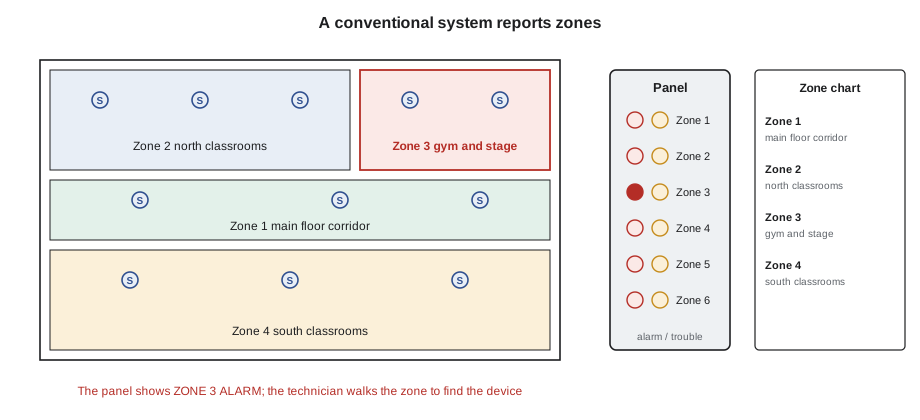
Willowbank School still runs on a conventional panel, installed when the school was last renovated and expanded since then one zone card at a time. Its door has a laminated zone chart taped inside: zone 1 main floor corridor, zone 2 north classrooms, zone 3 gym and stage, and so on to zone 12, the waterflow switch for the 1968 wing. Gerry has brought Sasha to do the annual inspection with him. 'A conventional panel tells you which zone and nothing more,' he says. 'Everything else you need is in your head, on that chart and on the drawings. That is why you learn it properly here, because you will still be servicing panels like this for twenty years.' This lesson covers how conventional panels are built, how zones are planned and annunciated, and how to find a fault or an alarm on a zone that could have thirty devices on it.
How a conventional panel works
A conventional panel has a fixed number of initiating circuits, often called zones, each with its own terminals, its own supervision and its own LED. Every device on a zone is wired in parallel across the same pair of wires, with an end-of-line device at the far end. When any device on the zone operates, the panel sees the circuit current rise and reports that zone in alarm. It can't tell which device operated, how many did, or whether the device is a smoke detector, a heat detector or a pull station, unless the zone was planned so that only one type of device is on it. The panel's notification circuits, relays and communicator are then operated by the zone, according to simple programming such as 'any alarm zone operates all notification circuits'.
Conventional panels are reliable, simple to understand and still cheaper for small buildings, which is why many remain in service. Their limits are just as clear. A building with many zones needs a large panel and long wire runs, because each zone is a separate circuit back to the panel. A fault on a zone, such as an open wire, disables every device beyond it. The panel can't monitor the condition of each detector, so a detector with a dirty chamber may only show up when it causes a nuisance alarm. And because the panel only knows the zone, finding the device in alarm means walking the zone and looking at device LEDs.
Planning zones
Zones exist so that responders can find a fire quickly. A zone that covers a whole school tells the fire department almost nothing; a zone that covers one corridor sends them straight to the right place. The building code sets the maximum size of a zone, and the designer usually makes zones smaller than the limit so that the annunciator matches how people find their way around the building. Good zoning follows the building's own layout: one floor, one wing or one fire compartment per zone, with the zone names on the annunciator matching the names on the signs in the corridors.
In Canada, the National Building Code requires annunciation of alarm zones in most buildings with more than a minimal fire alarm system, and it limits a zone to one storey and a maximum floor area, commonly cited as 2 000 m², with further rules for spaces such as stairs, shafts and the floor areas served by each sprinkler zone. Each sprinkler waterflow switch, and each supervised valve, is normally given its own zone or annunciator point so the fire department can see which part of the sprinkler system is flowing. CAN/ULC-S524 sets how the zones are wired and annunciated. The designer on each project checks the current edition of the code for the exact limits that apply.
# Zone plan for a building, using a maximum zone area (illustrative check)
import math
MAX_AREA = 2000          # maximum area of one alarm zone (m2)
floors = [("Main floor", 3600), ("Second floor", 2900), ("Gym and stage", 1400), ("Lower floor", 1100)]
zone = 0
for name, area in floors:
    n = math.ceil(area / MAX_AREA)
    for k in range(n):
        zone += 1
        part = f" part {k + 1} of {n}" if n > 1 else ""
        print(f"Zone {zone:2d}: {name}{part}  (about {area / n:,.0f} m2)")
for extra in ("Waterflow, main riser", "Waterflow, 1968 wing", "Valve supervisory"):
    zone += 1
    print(f"Zone {zone:2d}: {extra}")
print("Zones needed:", zone)Zone 1: Main floor part 1 of 2 (about 1,800 m2) Zone 2: Main floor part 2 of 2 (about 1,800 m2) Zone 3: Second floor part 1 of 2 (about 1,450 m2) Zone 4: Second floor part 2 of 2 (about 1,450 m2) Zone 5: Gym and stage (about 1,400 m2) Zone 6: Lower floor (about 1,100 m2) Zone 7: Waterflow, main riser Zone 8: Waterflow, 1968 wing Zone 9: Valve supervisory Zones needed: 9
The script splits each area into the fewest zones that fit the limit and then adds zones for the waterflow switches and valves. A real designer would also split by fire compartment and by how people move through the building, so the plan the script produces is a minimum. At Willowbank the panel has twelve zones, more than the minimum, because each classroom wing has its own.
Zone cards, LEDs and the zone chart
On a conventional panel each zone usually has three indications: an alarm LED, a trouble LED and sometimes a supervisory LED where the zone is used for valves. Larger panels use plug-in zone cards, each with four or eight zones, so the panel can grow with the building. Each card has its own supervision and fuse, and a failed card shows up as a trouble on every zone it carries. Because nothing on the panel says what a zone covers, the zone chart is part of the system. The installation standard requires the annunciation to be clearly labelled, and a technician who changes the zoning must change the chart and the drawings to match.
On the Willowbank inspection, Sasha checks the chart against the building and finds that zone 7 is labelled 'library' but also covers two classrooms added beside the library in the summer of 2009. Gerry has her note it as a deficiency: the annunciation doesn't describe the zone correctly, and a firefighter sent to the library for a fire in one of those classrooms would lose time. The fix is a new label and an updated chart and record drawing, approved by the school board.
Mixing device types on a zone
Conventional zones can carry smoke detectors, heat detectors and manual stations together, but there are good reasons to keep some types apart. Waterflow switches and valve tamper switches are kept on their own zones because a waterflow is an alarm that the fire department wants to see separately, and a tamper is a supervisory signal that must not cause an alarm at all. Smoke detectors are sometimes kept on separate zones from manual stations so that alarm verification can be applied to the smoke detector zones only, since verification is not permitted for pull stations. Duct detectors that only shut down a fan are often on their own zone so that their signal can be handled as the mechanical code requires.
The two-wire smoke detector limit is the other reason to watch what goes on a zone. Each two-wire detector draws a small standby current, and too many on one zone can look like an alarm or stop the panel recognizing a real one. The panel's compatibility document lists which detectors can be used and how many per zone. When an older zone has been extended over the years, as several at Willowbank have, the first thing to check is the device count against that limit.
Finding an alarm or a fault on a conventional zone
When a conventional zone goes into alarm, the technician walks the zone looking for a device with its alarm LED on steady. Most conventional detectors latch their LED in alarm until the zone is reset, so the device stays identifiable even after the smoke has cleared. Pull stations show a broken glass rod, a pulled handle or a flag, and heat detectors with fusible elements show a melted link. Once the device is found, the technician records it before resetting the zone, because resetting clears the LED.
A trouble on a conventional zone is usually an open circuit, and the classic way to find it is to halve the circuit. With the zone disabled and the building's staff told, the technician goes to a device near the middle of the run and checks for the circuit voltage there. If the voltage is present, the break is between that device and the end of the line; if not, it is between the panel and that device. Each test halves the length of wire that could contain the fault, so even a long zone takes only a few steps. A short circuit is found the same way with the circuit disconnected at the panel, using a meter to measure resistance from each point.
# Halving a zone to find an open circuit (what each test tells you)
devices = [f"D{n:02d}" for n in range(1, 28 + 1)]   # devices in wiring order from the panel
fault = devices.index("D19")                   # the open is just beyond this device
low, high = 0, len(devices) - 1                     # the last device with voltage lies in this range
steps = 0
while low < high:
    mid = (low + high + 1) // 2
    steps += 1
    present = mid <= fault                          # voltage reaches every device before the break
    print(f"Test {steps}: at {devices[mid]} voltage {'present' if present else 'missing'}")
    if present:
        low = mid
    else:
        high = mid - 1
print(f"Open circuit just beyond {devices[low]}; found in {steps} tests on a {len(devices)}-device zone")Test 1: at D15 voltage present Test 2: at D22 voltage missing Test 3: at D18 voltage present Test 4: at D20 voltage missing Test 5: at D19 voltage present Open circuit just beyond D19; found in 5 tests on a 28-device zone
On a 28-device zone, the open is found in a handful of tests instead of opening every device. In the field the 'test' is a meter reading at a device base, and the technician keeps a marked-up copy of the zone's wiring drawing so each reading means something.
Upgrading a conventional system
Many owners eventually replace a conventional panel with an addressable one. The new panel can often reuse much of the existing wiring, either by replacing every device with an addressable one, if the wire is suitable for the loop, or by connecting each old zone to an addressable zone module that turns the whole zone into one address. The second approach is cheaper but keeps the old limitation: the zone module still only reports the zone. Designers usually replace devices in the areas where locating a fire quickly matters most, such as corridors and assembly spaces, and keep zone modules elsewhere until those areas are renovated.
Any change of this kind is a modification of the fire alarm system, so the work has to be designed, permitted where the authority requires it, and verified under CAN/ULC-S537 for the parts that were changed. The Willowbank board has budgeted to replace the panel within three years, and Ravi Menon is already counting zones, devices and wire runs for the design.
Worked problem
A zone that won't reset
During the inspection, zone 9 (south classrooms, upper floor) goes into alarm when Sasha tests the third detector, and it won't reset. Every detector in the zone shows a normal flashing LED. What could cause this, and how should she proceed?
Show solution
- A zone that won't reset with no device in alarm suggests a short or a low resistance across the circuit, not a device.
- The test detector may have been left in alarm, but its LED shows normal, so look elsewhere.
- A pinched wire in a junction box, water in a box or a damaged device base can put a low resistance across the pair.
- Disconnect the zone at the panel and measure the resistance across the pair, then halve the circuit.
Answer: The reading shows a few hundred ohms across the pair. Halving the circuit leads to a junction box above a classroom ceiling where a roof leak has wet the terminals. Sasha dries and replaces the connections, the zone resets, and the roof leak is reported to the custodian as the root cause.
Common mistakes
MistakeResetting a zone before finding the device in alarm.
InsteadFind and record the device first; the reset clears its LED.
MistakePutting tamper switches on an alarm zone.
InsteadValve supervisory devices need a supervisory zone or point.
MistakeExtending a zone without checking the device limit.
InsteadCheck the panel's two-wire detector count for each zone.
MistakeLeaving the zone chart out of date after changes.
InsteadUpdate the chart and record drawings with every change.
MistakeOpening every device to find an open circuit.
InsteadHalve the circuit with meter readings.
Summary and key terms
- A conventional panel reports zones, not devices, and each zone is a separate supervised circuit.
- The NBC limits zone size (one storey and a maximum floor area) and requires annunciation; CAN/ULC-S524 sets wiring and labelling.
- Waterflow and valve supervisory devices are kept on their own zones or points.
- Two-wire smoke detector counts per zone are limited by the panel's compatibility document.
- Opens and shorts on a zone are found quickly by halving the circuit.
- Upgrades can reuse wiring with new devices or with zone modules.
- Zone
- An area of a building whose initiating devices report together as one signal.
- Zone card
- A plug-in board that provides several conventional initiating circuits.
- Zone chart
- The label or list that says what area each zone covers.
- Two-wire smoke detector
- A conventional detector powered and monitored over the same two wires.
- Zone module
- An addressable module that connects a whole conventional zone to a loop at one address.
- Halving
- Finding a wiring fault by testing the middle of the remaining suspect length each time.
Practice problems
Work each problem on paper first, then reveal the answer to check.
A floor of 4,300 m² must be zoned with a 2 000 m² limit. How many zones does it need at minimum?
Show answer
4,300 / 2,000 = 2.15, so 3 zones.
Why are tamper switches kept off alarm zones?
Show answer
A tamper is a supervisory condition and must not start an alarm.
A 32-device zone has an open circuit. About how many halving tests are needed at most?
Show answer
About 5, because 2 to the power 5 is 32.
What does a zone module do?
Show answer
It connects a whole conventional zone to an addressable loop as one address.
Lesson quiz · 5 questions
Score 60% or more to complete this lesson.
Create a free account to save your progress, take quizzes and earn a certificate.