
FAT-210 · Lesson 4 of 12 · 20 min
Circuit classes and pathway survivability
Riverlight Tower is eighteen storeys of apartments, and its fire alarm riser runs up a rated shaft beside the stairs. Ravi Menon has asked Sasha to help him check the riser drawings for the tower's planned panel upgrade, and the first question on his list is not about devices at all. 'How does each circuit behave when something goes wrong with the wire?' he asks. 'One break, one short, one wire touching the conduit. And how long does the wire survive if there is a fire on the floor it passes through?' Those two questions, fault tolerance and survivability, are what circuit classes and pathway survivability levels describe. This lesson explains both, and how the designer decides which a building needs.
Why classes exist
Every fire alarm circuit can suffer three basic wiring faults: an open, where a wire breaks; a short, where the two wires touch each other; and a ground fault, where a wire touches the building's metal or earth. The panel must notice each of these and report it as a trouble. What differs between circuits is what happens to the devices while the fault is present. On some circuits, an open cuts off every device beyond it; on others, the panel keeps talking to every device. Circuit classes are the names for these different levels of performance, so a designer can specify, and an inspector can check, what a circuit must keep doing during a fault.
In Canada, CAN/ULC-S524 and the control unit standard CAN/ULC-S527 classify circuits as Class A or Class B. Older drawings and equipment may also use 'style' letters and numbers, borrowed from US practice of the 1990s and 2000s, which described the same ideas in more detail; current editions have dropped them, and technicians now read a style on an old drawing as Class A or Class B. The building code and S524 then set where Class A is needed, for example on circuits serving more than one zone or on links between panels, and the designer may choose Class A elsewhere for reliability.
Class B
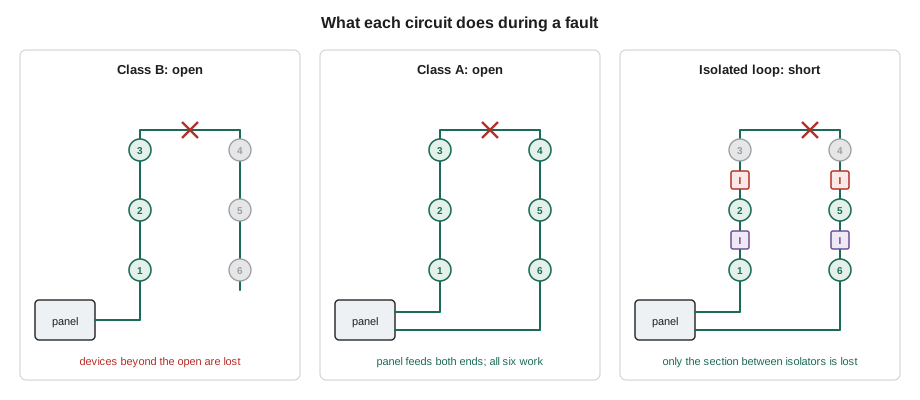
A Class B circuit runs out from the panel to its devices and ends, with an end-of-line device at the far end for a conventional circuit or simply the last device on an addressable loop. The panel supervises it, so an open, a short or a ground fault is reported as a trouble. But during an open, every device beyond the break is cut off: a detector there can't report, and a horn there won't sound. During a short on a conventional circuit, the whole circuit is lost, and on an addressable loop without isolators the short collapses the whole loop. Most systems can still operate with a single ground fault on a Class B circuit, and report it. Class B is simple, uses less wire and allows T-taps on addressable loops, which is why it is the most common class.
Class A
A Class A circuit leaves the panel on one set of terminals, passes every device, and returns to the panel on a second set. When the panel sees an open, it drives the circuit from both ends, so every device on both sides of the break keeps working while the panel reports the trouble. A single ground fault also doesn't stop the circuit operating. Class A does not, by itself, survive a wire-to-wire short: on a conventional circuit the short still takes out the circuit, and on an addressable loop it takes out the section between the nearest isolators, or the whole loop if there are none.
Class A only works if the outgoing and returning wires are kept apart. If both run side by side in the same cable or raceway, a single event such as a ceiling collapse or a careless saw cut can break both at once, and the circuit behaves as if it were Class B. For that reason the standards require the outgoing and return paths of Class A circuits to be routed separately, with limited exceptions for short lengths such as the drop into a device box or the run into the panel cabinet. At Riverlight Tower, the riser for each Class A loop goes up one shaft and comes back down the other stair shaft.
Short circuits and isolated loops
A Class A addressable loop with an isolator at each device, or with isolators placed so that a short affects only a small section, behaves much better than a plain Class A loop: a single short takes out only the devices between two isolators, while the rest keep working from both ends. Canadian designers achieve this through the isolation rules in CAN/ULC-S524 and the panel manual rather than through a separate class name. On high-rise jobs such as Riverlight Tower, Ravi specifies isolators at every floor entry and exit and at each zone boundary, so that no single fault of any kind can disable more than one floor's devices.
# Which devices keep working during a fault (illustrative model of a 6-device circuit)
def working(cls, fault, at):
    n = 6
    ok = [True] * n
    if fault == "open":
        if cls == "B":
            ok = [i < at for i in range(n)]          # devices beyond the break are cut off
    elif fault == "short":
        if cls in ("B", "A"):
            ok = [False] * n                          # the short collapses the whole circuit
        elif cls == "isolated":
            ok = [i not in (at - 1, at) for i in range(n)]   # only the section between isolators
    return ok
for cls in ("B", "A", "isolated"):
    for fault in ("open", "short", "ground"):
        ok = working(cls, fault, 3)
print(f"Class {cls:8s} {fault:6s}: {sum(ok)} of 6 devices working " + "".join("o" if x else "x" for x in ok))Class B open : 3 of 6 devices working oooxxx Class B short : 0 of 6 devices working xxxxxx Class B ground: 6 of 6 devices working oooooo Class A open : 6 of 6 devices working oooooo Class A short : 0 of 6 devices working xxxxxx Class A ground: 6 of 6 devices working oooooo Class isolated open : 6 of 6 devices working oooooo Class isolated short : 4 of 6 devices working ooxxoo Class isolated ground: 6 of 6 devices working oooooo
The model is deliberately simple, but it shows the pattern. A ground fault leaves every class working, an open defeats only Class B, and a short defeats both Class B and plain Class A, while the isolated loop loses only the two devices between the isolators either side of the short. Real circuits also report every one of these faults as a trouble, whatever the class.
Pathway survivability
Fault tolerance is about wiring faults; survivability is about fire. A circuit that passes through a burning floor may lose its insulation, short and fail long before the people on other floors have finished moving. For most systems this doesn't matter much, because the building is evacuated as soon as the alarm sounds. But in buildings that rely on staged evacuation, relocation or defend-in-place strategies, such as high-rise residential buildings and hospitals, the fire alarm must keep working on the floors that aren't burning for as long as people are still inside. The circuits that serve those floors must survive a fire on the floor they pass through.
In Canada, the National Building Code requires conductors serving certain fire alarm and voice communication functions, notably in high buildings, to be protected so they keep working during a fire for a set time. The protection can be cable listed for circuit integrity, conductors in a rated enclosure or shaft, or conductors buried in noncombustible construction, as the code describes. CAN/ULC-S524 adds wiring rules for these circuits, and the designer checks which circuits need protection: typically the risers and the circuits that serve floors other than the one they pass through.
Survivability is a property of the installed pathway, not just the cable. A circuit-integrity cable is listed with specific supports, spacing, splices and conduit, and installing it with ordinary cable ties or plastic boxes defeats the listing. Ravi's riser specification for Riverlight lists the exact cable system, the support spacing and the splice kits, and Sasha's job on site will be to check that what is installed matches.
| Question | Answered by | Example |
|---|---|---|
| What does the circuit do during an open, short or ground? | Circuit class | Class A loop keeps all devices during one open |
| Does the circuit survive a fire on the floor it passes through? | Survivability protection | Two-hour rated riser cable in a rated shaft |
| How much can one short take out? | Isolator placement | One floor's devices at most |
| Are the outgoing and return paths apart? | Routing rules | Up one shaft, down the other |
Choosing classes for a building
The designer starts with what the code requires and then adds what the owner's strategy needs. A small single-storey building may use Class B throughout. A large building with many floors usually uses Class A for the loops and the links between panels, isolators at every floor, and survivable risers where the evacuation strategy relies on some floors staying in operation. Notification circuits for a building that evacuates everyone at once are often Class B, while those for a staged evacuation building may be Class A with survivable pathways. The circuit class of each pathway is shown on the drawings and in the system's record documents, so the next technician knows how it is meant to behave.
At Riverlight Tower the design calls for Class A loops with isolators at each floor, a protected riser in two separate shafts and, because the tower uses voice communication and staged evacuation, protected circuits for the speakers and firefighter telephones, which FAT-310 covers.
Testing class performance
A circuit's class is proven during acceptance testing by creating the faults it is meant to survive. For a Class A circuit, the technician opens the circuit at a point in the middle, confirms the panel reports a trouble, then operates a device on each side of the break and confirms both are received. A ground fault is simulated by connecting one conductor to ground through the test lead and checking the trouble report. For an isolated loop, a short is applied between two points and the technician confirms only the expected devices drop out. These tests are recorded with the location of each fault, because a circuit that was installed with both paths in the same raceway can pass a simple open test and still fail in a real fire.
Worked problem
A Class A loop that behaves like Class B
During the acceptance test of a new loop at Eastview General Hospital, Sasha opens the loop on the third floor. The panel reports a trouble, but the devices beyond the break, toward the return terminals, all go missing. The loop is drawn as Class A. What does this tell her?
Show solution
- In a working Class A loop the panel drives the return end too, so no devices should go missing.
- If the far-side devices drop out, the panel isn't reaching them from the return end.
- Likely causes are a return pair not connected, connected to the wrong terminals, or a loop card not configured as Class A.
- She checks the panel's loop configuration and the return terminations before looking anywhere else.
Answer: The return pair was landed on the terminals of a second loop card. Once it is moved to the correct terminals and the card is set for Class A, the open test passes: all devices stay online and the panel reports only the trouble.
Reading class information on drawings and equipment
Circuit class information appears in three places, and a technician checks that all three agree. The riser diagram and the device drawings mark each loop and notification circuit with its class, often as 'A' or 'B' beside the circuit number. The panel's configuration sets each loop card and notification output to the class it is wired for, because a card set for Class B ignores its return terminals. And the installation itself shows the class: a Class A circuit has two pairs landed at the panel and two separate routes in the field. When the three don't match, the drawing is not the proof; the configuration and the field wiring decide how the circuit really behaves, and the test in this lesson's example is how the mismatch is found.
Common mistakes
MistakeCalling a circuit Class A when both paths share one raceway.
InsteadRoute the outgoing and return paths separately.
MistakeAssuming Class A survives a wire-to-wire short.
InsteadOnly isolation confines a short; plan isolators for it.
MistakeInstalling circuit-integrity cable with ordinary supports.
InsteadUse the cable system's listed supports, splices and spacing.
MistakeReading an old 'style' designation as something new.
InsteadTranslate old styles into today's classes when reading old drawings.
MistakeTesting only that a trouble is reported.
InsteadAlso confirm devices on both sides of the fault still work.
Summary and key terms
- Circuit classes describe what a circuit keeps doing during an open, a short or a ground fault.
- Class B loses devices beyond an open; Class A keeps them by driving the circuit from both ends.
- Isolators confine a short to one section; Canadian practice places them by floor and zone under CAN/ULC-S524.
- Class A outgoing and return paths must be routed apart.
- Survivability keeps circuits working through a fire; the NBC requires protected conductors for some functions, especially in high buildings.
- Class performance is proven by creating real faults during acceptance testing.
- Class A
- A circuit that returns to the panel and keeps all devices working during a single open.
- Class B
- A circuit that ends at its last device and loses devices beyond an open.
- Ground fault
- A conductor touching the building's metal or earth.
- Pathway survivability
- The ability of a circuit to keep working while exposed to a fire.
- Circuit integrity cable
- Cable listed to keep working for a set time in a fire when installed as listed.
- Return path
- The second route by which a Class A circuit comes back to the panel.
Practice problems
Work each problem on paper first, then reveal the answer to check.
A Class B notification circuit opens after the fourth of ten horns. How many horns still sound?
Show answer
Four.
Why must the return path of a Class A loop be routed apart from the outgoing path?
Show answer
So one event can't break both and turn it into Class B.
Which fault does plain Class A not survive?
Show answer
A wire-to-wire short.
Why do staged evacuation buildings need survivable pathways?
Show answer
Floors away from the fire must keep receiving signals while people are still inside.
Lesson quiz · 5 questions
Score 60% or more to complete this lesson.
Create a free account to save your progress, take quizzes and earn a certificate.