
ELEC-120 · Lesson 9 of 12 · 28 min
Grounding and bonding
Grounding and bonding are the parts of the code most often misunderstood, by homeowners, by apprentices and sometimes by experienced electricians. They are also among the most important for safety, because they decide what happens when something goes wrong: when a hot conductor touches a metal box, when lightning strikes a line, or when a transformer fails. A properly grounded and bonded system makes a fault trip the breaker in a fraction of a second. A poorly bonded one can leave a metal appliance or water pipe energized at a lethal voltage, silently, until someone touches it.
In the CEC, grounding and bonding are covered in Section 10, which was reorganized in recent editions to separate system grounding, grounding electrodes, equipment bonding and special cases more clearly. Bonding conductor sizes are in Table 16. This chapter explains the principles and the main rules; always confirm the details in the edition your province has adopted.
Two different jobs
Grounding and bonding are related but different, and keeping them separate in your mind solves most confusion:
- Grounding connects the electrical system to the earth. Its purposes are to limit the voltage imposed by lightning, line surges and accidental contact with higher-voltage lines, and to stabilize the system voltage relative to earth during normal operation.
- Bonding connects all the non-current-carrying metal parts (enclosures, raceways, equipment frames, metal piping) to each other and back to the source, through a low-impedance path. Its purpose is to carry fault current back to the source quickly so that the overcurrent device trips, and to keep all metal parts at the same potential so that a person touching two of them is not shocked.
The single most important fact in this chapter: the earth is not a good path for fault current. Clearing a fault depends on bonding, a conductor path back to the source, not on the ground rod.
System grounding at the service
In a typical North American system, the utility transformer's secondary has a centre point (neutral) that is grounded at the transformer. At the building's service, the neutral is grounded again and connected to the equipment bonding system at one point. This connection is what lets fault current return to the source: a fault from a hot conductor to a metal enclosure flows through the bonding path to the service, across the neutral-to-ground connection, and back to the transformer on the neutral, a low-impedance loop that trips the breaker.
At the service, the grounded (identified) conductor is connected to the service equipment enclosure through a main bonding connection, and to the grounding electrode through the grounding conductor. Downstream of the service, the neutral and the bonding conductors must be kept separate: in subpanels, the neutral bar is isolated from the enclosure, and the bonding conductor is connected to the enclosure.
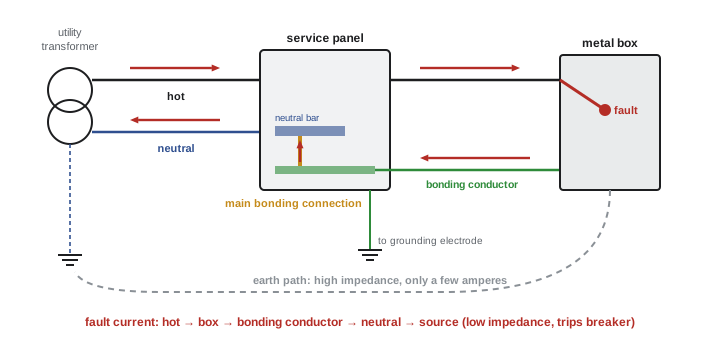
Why only one neutral-to-ground connection?
If the neutral were bonded to ground again at a subpanel, normal neutral current would divide: some would flow on the neutral and some on the bonding conductors, metal raceways, cable armour and even water pipes. Metal parts would then carry current all the time, creating shock risk, electrical noise, overheating of small bonding paths, and false trips of ground fault protection. This is why the code insists on a single bond at the service (or at each separately derived system), and why a four-wire feeder (two hots, neutral and bonding conductor) is required to subpanels.
Worked problem
A subpanel wiring error
An inspector finds a subpanel in a garage where the neutral bar is bonded to the enclosure with its green bonding screw, and the feeder has a separate bonding conductor. What is wrong, and what is the fix?
Show solution
- The neutral is bonded to ground at the subpanel as well as at the service: two bonding points.
- Neutral current now returns partly on the bonding conductor and any metal paths in parallel with it.
- Fix: remove the bonding screw or strap so the neutral bar is isolated from the enclosure; land the feeder's bonding conductor on a bonding bar connected to the enclosure.
Answer: The subpanel should have an isolated neutral and a bonded enclosure. The bonding screw supplied with many panels is only for use when the panel is service equipment.
Grounding electrodes
The grounding electrode is the physical connection to the earth. A building usually uses several electrodes bonded together into a grounding electrode system.
The CEC recognizes in-situ electrodes, which are already part of the building, such as metal water piping in contact with the earth (with conditions) and a concrete-encased electrode formed by reinforcing steel or a bare copper conductor in the footing, and manufactured electrodes, such as ground rods and plates, which must meet minimum dimensions and, in the case of rods, are typically installed as more than one rod with a minimum spacing between them. The grounding conductor that connects the service to the electrode is sized according to the size of the service conductors. Check the electrode and grounding conductor rules of Section 10 for the exact requirements in your edition.
The concrete-encased electrode, often called a Ufer ground after the engineer who developed it during the Second World War, is usually the best electrode available, because concrete in contact with the earth holds moisture and presents a large contact area. Designers and electricians should arrange to connect to the footing reinforcement before the concrete is poured; afterwards the opportunity is lost.
Grounding electrodes have a resistance to earth of a few ohms at best, and often 10 to 100 Ω. That is fine for their job (limiting voltages from lightning and surges, and stabilizing the system) but far too high to carry fault current that will trip a breaker, as the next example shows.
The effective fault current path
Worked problem
Why bonding, not the earth, clears a fault
A 120 V branch circuit runs 30 m in 12 AWG copper (about 6.5 Ω/km at operating temperature) to a metal box. The hot conductor faults to the box. Assume 0.05 Ω of source impedance. (a) With a 12 AWG bonding conductor back to the panel, what current flows? (b) If the bonding conductor were missing and the box were connected only to a ground rod of 25 Ω (with about 5 Ω through the earth back to the utility ground), what current would flow, and what voltage would the box have?
Show solution
- (a) Hot: \(0.030 \times 6.5 = 0.195\) Ω; bonding conductor the same. Loop: \(0.195 + 0.195 + 0.05 = 0.44\) Ω. Current: \(120/0.44 = 273\) A.
- About 270 A is more than 13 times the rating of a 20 A breaker, enough to trip its instantaneous (magnetic) element in a fraction of a second.
- (b) Loop: \(0.195 + 25 + 5 \approx 30.2\) Ω. Current: \(120/30.2 = 4.0\) A.
- A 20 A breaker will never trip on 4 A. The box sits at about \(4.0 \times 25 = 99\) V relative to the earth nearby.
Answer: With a proper bonding conductor, about 270 A flows and the breaker clears the fault almost instantly. Through the earth alone, only about 4 A flows, the breaker holds, and the box stays energized at nearly 100 V indefinitely, a lethal shock hazard. Bonding, not grounding, clears faults.
Bonding conductors are sized from Table 16 according to the rating of the overcurrent device protecting the circuit. A metal raceway or armoured cable can serve as the bonding path where the code allows, provided every joint and connector is tight; in non-metallic raceways and cables, a separate bonding conductor is installed with the circuit conductors.
Bonding other metal systems
Any metal system that could become energized must be bonded so that it cannot rise to a dangerous voltage. This includes metal water piping, gas piping (bonded, but never used as an electrode), structural steel, metal ducts in some cases, and, in pools and spas, the entire area around the water (an equipotential bonding grid covered in later courses). At the service, extra care is taken because the fault currents are highest and the service conductors have no overcurrent protection on the line side: service raceways are bonded with bonding bushings or jumpers, not relying on locknuts alone.
The 2024 CEC added an option to bond gas piping through the circuit of the gas appliance (Rule 10-702), reflecting how gas piping is typically connected to appliances that also have electrical supplies.
Separately derived systems
A transformer, generator or other source whose output conductors have no direct electrical connection to the supply conductors creates a new system. That system needs its own neutral-to-ground connection (a system bonding jumper) and its own connection to a grounding electrode, at the source or at its first disconnecting means. A dry-type transformer in a commercial building that steps 600 V or 480 V down to 120/208 V is the most common example. Treating its secondary like a subpanel, with no neutral-to-ground bond, leaves the secondary ungrounded and faults on it would not trip the breakers.
GFCI, AFCI and isolated grounds
Ground fault circuit interrupters (GFCIs) protect people, not equipment. A GFCI compares the current on the hot and neutral conductors; if they differ by about 5 mA (Class A devices trip at 4 to 6 mA), current is leaking somewhere, possibly through a person, and the device opens the circuit within a fraction of a second. A GFCI works even without a bonding conductor, which is why it is accepted as a way to replace old two-wire receptacles in some cases, but it does not replace bonding for clearing faults to metal. Arc fault circuit interrupters (AFCIs) detect the electrical signature of arcing in damaged cords and wiring and are required for many dwelling circuits; ELEC-130 covers where each is required.
An isolated ground receptacle (marked with an orange triangle) has its grounding terminal insulated from its mounting strap, so that a separate insulated grounding conductor can be run back to the panel for sensitive electronic equipment, reducing electrical noise. The metal box must still be bonded in the normal way.
Lesson 12 applies these rules to a complete installation, including the grounding electrode and isolated neutral at a detached building.
Common mistakes
MistakeBelieving the ground rod will trip the breaker during a fault.
InsteadEarth resistance is far too high; the bonding conductor path back to the source clears faults.
MistakeBonding neutral to ground in a subpanel.
InsteadBond neutral to ground only at the service or at a separately derived system; isolate the neutral in subpanels.
MistakeRunning a three-wire feeder (no bonding conductor) to a new subpanel.
InsteadUse a four-wire feeder with a separate bonding (equipment grounding) conductor.
MistakeUsing gas piping as a grounding electrode.
InsteadGas piping is bonded but never used as an electrode.
MistakeForgetting to ground and bond a transformer secondary.
InsteadEach separately derived system needs its own system bonding jumper and grounding electrode connection.
Summary and key terms
- Grounding connects the system to earth to limit surge voltages and stabilize it; bonding connects metal parts into a low-impedance fault path back to the source.
- The earth is a poor fault path: a fault through a 25 Ω rod draws only a few amperes and will not trip a breaker.
- The neutral is bonded to ground at one point only: the service, or each separately derived system.
- Subpanels have an isolated neutral, a bonded enclosure and a four-wire feeder.
- Grounding electrodes include in-situ (concrete-encased, water pipe) and manufactured (rods, plates) types; sizes and spacing are in Section 10.
- Bonding conductors are sized from Table 16 by overcurrent device rating; metal raceways may serve as the bonding path with tight joints.
- Bond metal water and gas piping, structural steel and service raceways; never use gas piping as an electrode.
- GFCIs trip at about 5 mA to protect people; isolated ground receptacles reduce noise but do not replace bonding.
- Grounding
- Connecting the electrical system to the earth through a grounding conductor and electrode.
- Bonding
- Joining non-current-carrying metal parts into a continuous low-impedance path for fault current.
- Grounding electrode
- A conductor, rod, plate or other object in contact with the earth.
- Concrete-encased electrode
- Reinforcing steel or bare copper in a concrete footing used as a grounding electrode.
- Grounding conductor
- The conductor connecting the system or service to the grounding electrode.
- Bonding conductor
- The conductor connecting metal parts to the service or system grounding point.
- Main bonding connection
- The connection between the identified conductor and the bonding system at the service.
- Separately derived system
- A system supplied by a transformer or generator with no direct connection to the supply conductors.
- Fault current path
- The low-impedance path that carries fault current back to the source.
- GFCI
- Ground fault circuit interrupter: a device that trips on a small difference between hot and neutral current.
- Isolated ground receptacle
- A receptacle whose grounding terminal is insulated from its mounting strap.
Practice problems
Work each problem on paper first, then reveal the answer to check.
State the main purpose of grounding and the main purpose of bonding.
Show answer
Grounding limits voltages from lightning, surges and contact with higher-voltage lines and stabilizes the system; bonding provides a low-impedance fault path so overcurrent devices trip, and keeps metal parts at the same potential.
A 240 V fault from a hot conductor to a metal enclosure has a loop impedance of 0.3 Ω. What current flows, and will a 40 A breaker trip quickly?
Show answer
240/0.3 = 800 A, 20 times the rating: yes, on its instantaneous element.
Without a bonding conductor, the same enclosure connects to a 50 Ω ground rod. Roughly what current flows (ignore other resistances)?
Show answer
About 240/50 = 4.8 A: the breaker will not trip.
Where should the neutral be bonded to the enclosure in a building with a main panel and two subpanels?
Show answer
Only at the main (service) panel; the subpanels have isolated neutrals and bonded enclosures.
Why does a feeder to a detached garage subpanel need four conductors in a modern installation?
Show answer
Two hots, a neutral and a separate bonding (equipment grounding) conductor, so the neutral and bonding paths stay separate downstream of the service.
Where would you find the size of a bonding conductor for a 60 A circuit?
Show answer
Table 16, which bases the bonding conductor size on the rating of the overcurrent device.
Why is a concrete-encased electrode usually better than a single ground rod?
Show answer
It has a large contact area with moist earth through the concrete, giving a lower and more stable resistance to earth.
A 600 V to 120/208 V dry-type transformer feeds a panel. What grounding and bonding does its secondary need?
Show answer
A system bonding jumper connecting the secondary neutral to ground at the transformer or first disconnect, a grounding electrode conductor to the building's grounding electrode system, and bonding of the enclosure.
At what current does a Class A GFCI trip, and does it need a bonding conductor to work?
Show answer
About 4–6 mA of imbalance; no, it compares hot and neutral currents and works without a bonding conductor.
Why must gas piping be bonded but never used as a grounding electrode?
Show answer
Bonding keeps it from becoming energized; using it as an electrode would deliberately pass current through gas piping, risking arcing at joints and corrosion.
Lesson quiz · 5 questions
Score 60% or more to complete this lesson.
Create a free account to save your progress, take quizzes and earn a certificate.