
ELEC-120 · Lesson 1 of 12 · 27 min
How the code is organized and adopted
Every electrical installation in Canada, from a single receptacle in a garage to the switchgear of a hospital, must meet the Canadian Electrical Code, Part I. For an electrician, the code is not something you read once in school and forget. It is the reference you open every week to size a conductor, choose a box, check a clearance or settle a question with an inspector. Being fast and accurate with the code is one of the skills that separates a journeyperson from an apprentice, and it is a large part of the Red Seal and provincial certification exams.
This course teaches you to use the code: how it is organized, how it becomes law, how to find what you need, and the requirements that apply to almost every job: definitions and general rules, conductor sizing, wiring methods, and grounding and bonding. Later courses cover the rules for dwellings (ELEC-130) and for feeders, motors, hazardous locations and special systems (ELEC-220). Always work from the edition your jurisdiction has adopted; this course explains principles and gives examples, but it is not a substitute for the code book itself.
What the code is, and what it is not
The Canadian Electrical Code, Part I (CEC), published by CSA Group as CSA C22.1, is a safety standard for electrical installations. Its object, stated in Section 0, is to establish safety standards for the installation and maintenance of electrical equipment, to protect people and property from shock, fire and other hazards. It sets minimum requirements. It does not try to make an installation efficient, convenient or adequate for future expansion; those are design choices. An installation can meet the code and still be a poor design, but it can never be a good design if it fails the code.
The CEC has two companions that together form the Canadian Electrical Code family. Part I covers installations. Part II is a series of more than a hundred product safety standards (the CSA C22.2 series) that electrical equipment is tested and certified against. Part III covers outside wiring such as utility lines. Electricians work mostly with Part I, and rely on Part II through the certification marks on the products they install.
How the code becomes law
CSA Group publishes a new edition of the CEC every three years; the 2024 edition is the 26th. The code is written by a technical committee of volunteers representing inspection authorities, utilities, manufacturers, contractors, labour, engineers and others, and anyone can submit a proposal for change. But the CEC is a model code: on its own it has no legal force. Each province and territory adopts it by regulation, usually with its own amendments and on its own timetable, so in any given year different provinces may be enforcing different editions.
- Ontario adopts the CEC as the Ontario Electrical Safety Code, enforced by the Electrical Safety Authority (ESA), which also issues bulletins interpreting it.
- Québec adopts it as Chapter V (Electricity) of the Québec Construction Code, administered by the Régie du bâtiment du Québec, with significant Québec amendments.
- British Columbia enforces it through Technical Safety BC; Alberta through Safety Codes Officers under the Safety Codes Act; other provinces and territories through their own safety branches or municipal inspection departments.
In each jurisdiction, the inspection authority (often called the inspection department or authority having jurisdiction) is responsible for interpreting the code, issuing permits and inspecting work. Where the code allows a judgement ("acceptable to the inspection authority"), it is the inspector's judgement that counts.
Worked problem
Which edition applies?
A contractor based in Ontario takes a job in another province. The latest CEC edition has been published, but the second province has not yet adopted it. Which edition governs the job, and where should the contractor check?
Show solution
- The code that applies is the edition adopted by the province where the work is done, with that province's amendments, not the newest published edition and not the contractor's home province code.
- Check the provincial regulation or the inspection authority's website for the adopted edition, the effective date and any amendments or bulletins.
- Confirm permit and licensing requirements in that jurisdiction before starting work.
Answer: The adopted edition of the province where the job is, with its amendments. Electricians who work across provinces keep track of which edition each one enforces, and of the provincial rules for permits and certification.
How the code is organized
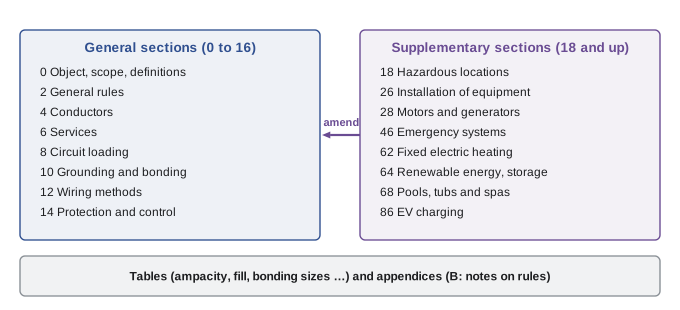
The CEC is divided into numbered sections, and every rule has a number made of the section and a rule number, such as Rule 8-104 (Section 8, rule 104). Rules are divided into subrules (1), (2) and items (a), (b). Sections fall into two groups:
- General sections (Sections 0 to 16) apply to all installations: Section 0 (object, scope and definitions), Section 2 (general rules), Section 4 (conductors), Section 6 (services and service equipment), Section 8 (circuit loading and demand factors), Section 10 (grounding and bonding), Section 12 (wiring methods), Section 14 (protection and control) and Section 16 (Class 1 and Class 2 circuits).
- Supplementary or amendatory sections (Section 18 onward) cover particular equipment, occupancies and conditions, such as Section 18 (hazardous locations), Section 26 (installation of electrical equipment), Section 28 (motors and generators), Section 30 (lighting), Section 46 (emergency systems), Section 62 (fixed electric heating), Section 64 (renewable energy and energy storage), Section 68 (pools, tubs and spas) and Section 86 (electric vehicle charging).
- The general rules apply unless a supplementary section amends them. When a supplementary section says something different, it takes precedence for that installation.
At the back of the book, the tables (for example Tables 1 to 4 of ampacities and Table 16 of bonding conductor sizes) carry the data you will use most, and the appendices give explanatory material. Appendix B contains notes on many rules, explaining their intent; it is not mandatory but is often the key to applying a rule correctly. An index and the rule numbers in the margins help you navigate.
Finding your way in the code
Code questions on the job, and on exams, are usually answered in three steps:
- Identify the topic and go to the right section. Use the index (alphabetical, by keyword) or, once you know the code, go straight to the section: conductor sizes are in Section 4 and its tables; box fill and cable support are in Section 12; bonding conductor sizes are in Section 10 and Table 16.
- Read the whole rule, including its subrules, exceptions and any references to other rules or tables. Many errors come from reading only the first sentence.
- Check whether a supplementary section modifies the rule for your installation (for example, Section 26 for receptacles in dwellings, or Section 62 for heating), and read the Appendix B note if there is one.
Worked problem
Navigating a question
An apprentice asks: "What is the maximum continuous load on a 20 A branch circuit breaker in a commercial building?" Where in the CEC is the answer, and what is it?
Show solution
- Topic: circuit loading. Section 8 covers circuit loading and demand factors.
- Rule 8-104 limits the continuous load to 80% of the rating of a standard overcurrent device (100% if the device and assembly are marked for continuous operation at 100%).
- 20 A × 0.80 = 16 A (or equivalently, 16 A × 1.25 = 20 A).
Answer: 16 A of continuous load, from Rule 8-104. Knowing which section to open is most of the work.
Permits, inspection and certified equipment
In every province, electrical work requires a permit (or notification) before it starts, except for some minor work listed in the provincial rules. Permits are normally taken out by a licensed electrical contractor; homeowners may be allowed to do work on their own single dwelling under a homeowner permit in some provinces. The inspector reviews the work at rough-in (before walls are closed) and at completion, and the installation must not be connected or used until it passes. All electrical equipment must be approved, meaning certified by an accredited certification body (CSA Group, UL, Intertek and others) and bearing its mark for use in Canada (Rule 2-024). Uncertified equipment must receive a field evaluation before it can be connected.
Certification marks matter on the job. A product marked only for another country, or a counterfeit with a fake mark, may not have been tested to North American standards and must not be installed. Electricians are often the last line of defence against unsafe products bought online.
Licensing and scope of practice
Electrician is a compulsory trade in most provinces: only certified journeypersons, or registered apprentices working under their supervision, may do electrical work for others. The Construction and Maintenance Electrician (309A in Ontario) trade carries the interprovincial Red Seal endorsement, which allows certified electricians to work across provinces. Contractors also need a contractor licence from the provincial authority. Apprentices log hours and complete technical training at each level, and the code is tested at every level.
How this course is organized
This course follows the code roughly in the order an installer meets it. Lessons 1 and 2 cover how the code is organized and its definitions and general rules. Lessons 3 to 5 cover branch circuits, conductor sizing and ampacity, and overcurrent protection. Lessons 6 to 8 cover wiring methods; switches, receptacles and luminaires; and disconnecting means, panelboards and enclosures. Lesson 9 covers grounding and bonding, Lesson 10 damp, wet and corrosive locations with cords and temporary wiring, and Lesson 11 Class 2, communications and fire alarm circuits. Lesson 12 brings everything together in permits, inspections and a complete worked installation.
Common mistakes
MistakeWorking from the newest edition when the jurisdiction has not adopted it.
InsteadUse the edition and amendments in force where the work is done.
MistakeReading only the first sentence of a rule.
InsteadRead the whole rule, including subrules, exceptions and references to tables and other rules.
MistakeIgnoring sections that modify the general rules.
InsteadCheck the supplementary sections (or Chapters 5–7) for the type of installation.
MistakeTreating explanatory notes as requirements, or ignoring them.
InsteadNotes are not mandatory, but they explain the intent and how inspectors apply the rule.
MistakeInstalling equipment without a recognized certification or listing mark.
InsteadCheck for a recognized mark for use in your country; uncertified equipment needs a field evaluation.
Summary and key terms
- The CEC, Part I (CSA C22.1) sets minimum safety requirements for electrical installations; Part II product standards certify equipment.
- A new edition is published every three years (the 26th in 2024); provinces adopt it by regulation with amendments on their own schedule.
- The inspection authority interprets and enforces the code; permits and inspections are required before energizing.
- General Sections 0–16 apply everywhere; supplementary sections (18 and up) amend them for particular equipment and occupancies.
- Rules are numbered by section and rule (e.g. Rule 8-104); tables and Appendix B notes are essential tools.
- Find answers by topic, read the whole rule and check for modifying sections.
- Equipment must be certified for use in Canada (Rule 2-024); electrical work is a compulsory, Red Seal trade.
- Canadian Electrical Code, Part I
- CSA C22.1, the safety standard for electrical installations in Canada.
- CSA C22.2 standards
- The Part II product safety standards that electrical equipment is certified against.
- Model code
- A code published for adoption by governments, with no legal force until adopted.
- Inspection authority
- The organization responsible for enforcing the code in a province or municipality.
- Amendment
- A provincial change to a rule of the adopted code.
- General sections
- Sections 0 to 16, which apply to all installations.
- Supplementary sections
- Sections 18 and up, which amend the general rules for particular installations.
- Appendix B
- Explanatory notes on rules, not mandatory but explaining intent.
- Approved equipment
- Equipment certified by an accredited certification body for use in Canada.
- Permit
- Authorization from the inspection authority to carry out electrical work.
- Red Seal
- The interprovincial standard of excellence endorsement for certified trades.
Practice problems
Work each problem on paper first, then reveal the answer to check.
What is the CSA standard number of the CEC, Part I, and which edition was published in 2024?
Show answer
CSA C22.1; the 26th edition (CSA C22.1:24).
Why can two jurisdictions enforce different editions of the code at the same time?
Show answer
The code is a model code; each jurisdiction adopts it by its own law or regulation, with its own timing and amendments.
Who interprets the CEC when a rule says something must be "acceptable to the inspection authority"?
Show answer
The inspection authority (the inspector) for that jurisdiction.
In Rule 12-510(1), what do "12", "510" and "(1)" mean?
Show answer
Section 12 (wiring methods), rule 510, subrule (1).
Which CEC sections apply to every installation, and what do the higher-numbered sections do?
Show answer
Sections 0–16 apply generally; Sections 18 and up amend or supplement them for particular equipment, occupancies and conditions.
Are Appendix B notes mandatory?
Show answer
No, but they explain the intent of rules and how they are normally applied.
A customer buys a cheap light fixture online with no recognized certification mark and asks you to install it. What should you do?
Show answer
Decline to install it unless it receives a field evaluation; equipment must be certified or listed for use in the jurisdiction.
What three steps help you answer a code question accurately?
Show answer
Find the right section or article by topic or index; read the whole rule with its exceptions and references; check for sections that modify it for the installation.
Using Rule 8-104, what is the maximum continuous load on a standard 30 A breaker?
Show answer
30 × 0.8 = 24 A.
Why do inspections happen at rough-in as well as at completion?
Show answer
Once walls and ceilings are closed, wiring, boxes, supports and connections cannot be seen; rough-in inspection checks them while they are still exposed.
Lesson quiz · 5 questions
Score 60% or more to complete this lesson.
Create a free account to save your progress, take quizzes and earn a certificate.