
ELEC-120 · Lesson 8 of 12 · 30 min
Disconnecting means, panelboards and enclosures
Every piece of electrical equipment must be able to be switched off safely, and every circuit must start somewhere that is protected, labelled and accessible. This lesson covers the equipment that does that: disconnecting means for buildings, motors and appliances; panelboards and their ratings and connections; the enclosure types that suit indoor, outdoor, wet and corrosive locations; and the installation practices, from torque values to unused openings, that inspectors check on every job.
In the Canadian Electrical Code, disconnecting means and control are covered mainly in Section 14, service equipment in Section 6, motors in Section 28 and the general installation of equipment, including panelboards, in Section 26. Enclosure types are defined by CSA C22.2 No. 94.
Disconnecting means
A disconnecting means is a device that disconnects the conductors of a circuit from their source: a switch, a circuit breaker, a pull-out, or for small cord-connected equipment, the attachment plug. Its purpose is to let people make equipment safe to work on and to cut power quickly in an emergency. The code sets three recurring requirements:
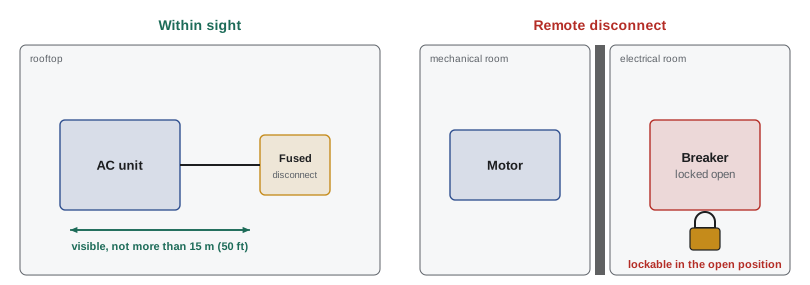
- Where: each building or structure needs a disconnecting means at the point where its supply enters; equipment such as motors, air conditioners and water heaters needs a disconnecting means within sight of it (visible and not more than about 15 m, 50 ft, away), or one capable of being locked in the open position.
- What: the disconnecting means must open all ungrounded conductors, be rated for the load (horsepower-rated for motors), and plainly indicate whether it is open or closed.
- How: it must be readily accessible and identified as to its purpose.
Worked problem
Is the disconnect acceptable?
A rooftop air-conditioning unit is supplied from a breaker in an electrical room two floors below. No disconnect is installed on the roof. A technician will service the unit. What is the problem and the fix?
Show solution
- The breaker is not within sight of the unit, so the technician cannot see whether it is open and someone else could close it.
- Air-conditioning and refrigeration equipment generally requires a disconnecting means within sight of, and readily accessible from, the unit.
- Fix: install a rated, weatherproof disconnect switch on the roof beside the unit.
Answer: A disconnect within sight of the unit is needed. Lockable remote breakers are permitted for some equipment, but rooftop HVAC units generally need a local disconnect, and every lockout still requires verifying absence of voltage before work (ELEC-110, Lesson 7).
Panelboards
A panelboard is an assembly of buses and overcurrent devices in a cabinet, from which branch circuits and feeders are distributed. Its key ratings are:
- Bus rating, such as 100 A, 225 A or 400 A, which must be at least the rating of the overcurrent device protecting it.
- Voltage and configuration, such as 120/240 V single-phase or 208Y/120 V three-phase.
- Short-circuit current rating, which must equal or exceed the available fault current (Lesson 5).
- Number of spaces or circuits.
A main breaker panelboard includes its own protective device; a main lug only (MLO) panelboard has no main and must be protected by an upstream device not exceeding its bus rating.
Worked problem
Protecting a main lug panelboard
A 225 A main-lug-only panelboard is fed from a 400 A switchboard. What overcurrent protection is required, and where?
Show solution
- The panelboard bus is rated 225 A, so it must be protected at not more than 225 A.
- The feeder breaker in the switchboard must therefore be 225 A or less (and sized for the feeder conductors and load).
Answer: A feeder breaker of 225 A or less in the switchboard, which also protects the feeder conductors. A 400 A feeder to a 225 A MLO panel would leave the panel bus unprotected; in that case a 225 A main breaker would be needed in the panel.
Neutrals and grounds in panelboards
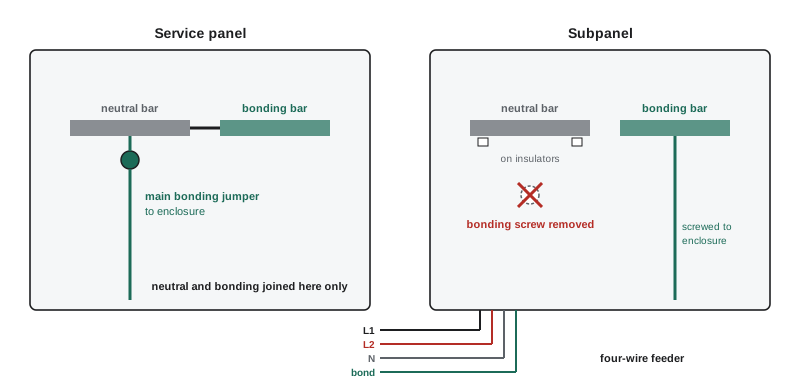
At the service, the neutral is bonded to the enclosure and the grounding electrode system through the main bonding jumper (Lesson 9). In every panelboard downstream of the service (a subpanel), the neutral bar must be isolated from the enclosure, and the bonding conductors land on a separate bonding bar that is bonded to the enclosure. Bonding the neutral in a subpanel creates parallel paths so that neutral current flows on raceways and bonding conductors.
Good practice inside panels
- One conductor per terminal unless the terminal is marked for more.
- Terminations torqued to the manufacturer's values with a calibrated torque tool; loose connections cause heating and fires, over-tight ones damage conductors.
- Conductors routed neatly, not crossing in front of bus or breakers, with adequate bending space.
- Unused openings closed with listed filler plates or knockout seals.
- Breakers of the type listed for the panelboard: "classified" or look-alike breakers must be listed for use in that panel.
- A complete, specific circuit directory (Lesson 3).
The CEC requires the panelboard's circuit directory, prohibits more than one conductor per terminal unless the terminal is approved for it, and requires equipment to be installed according to its certification markings and instructions.
Enclosures
Enclosures protect equipment from the environment and protect people from live parts. They are classified by type, defined by the standards above. Common types are:
| Type | Typical location | Protection provided |
|---|---|---|
| 1 | Indoor, dry | Contact with live parts, falling dirt |
| 3R | Outdoor | Rain, sleet, snow, external ice |
| 4 | Indoor or outdoor, washdown | Hose-directed water, splashing |
| 4X | Indoor or outdoor, corrosive | As type 4, plus corrosion (stainless or non-metallic) |
| 12 | Indoor, industrial | Dust, lint, dripping non-corrosive liquids |
Worked problem
Choosing an enclosure
Choose an enclosure type for (a) a disconnect beside a rooftop unit, (b) a control panel in a food plant washed down daily with hoses and cleaning chemicals, (c) a panelboard in a dry electrical room.
Show solution
- (a) Outdoor, rain and snow: type 3R (type 4 if exposed to hose cleaning).
- (b) Washdown with chemicals: type 4X, stainless steel or non-metallic.
- (c) Indoor, dry: type 1.
Answer: 3R, 4X and 1. Enclosure ratings apply only when installed as intended: drilling an unsealed hole in the top of a 3R enclosure or leaving a gasket damaged defeats the rating.
Equipment installation in general
A few general rules apply to all electrical equipment:
- Use only certified (listed) equipment, and install and use it according to its markings and instructions (Lesson 1).
- Provide and maintain the required working space and headroom (Lesson 2).
- Mark equipment with its ratings, and where required with arc flash warnings and the available fault current.
- Protect equipment from physical damage, moisture and corrosion appropriate to its location.
- Keep the inside of equipment free of debris, paint overspray and drywall dust, which can cause tracking and failures.
Labels, directories and field markings
Equipment must tell the next person what it is and what it can do. Every panelboard needs a circuit directory that identifies each circuit by its specific purpose and location, such as "Kitchen counter receptacles, east wall" rather than "Plugs". Spare breakers and blank spaces are marked as such. Disconnects that are not obviously associated with their equipment must be labelled with what they control, and where a building has more than one source of supply, such as a generator or solar system, signs at the service must show where all the disconnects are.
Several markings are applied in the field because they depend on the installation rather than the product:
- Arc flash warning labels on switchboards, panelboards and other equipment likely to be examined or worked on while energized, warning qualified persons of the hazard.
- The available fault current at service equipment in non-dwelling occupancies, with the date it was calculated, so that the interrupting ratings of devices added later can be checked.
- Voltage and phase identification where more than one nominal voltage system exists in a building, so that conductors of a 600Y/347 V or 480Y/277 V system are not confused with those of a 208Y/120 V system.
In the CEC, Rule 2-306 requires equipment such as switchboards and panelboards in other than dwelling units to be marked to warn of the shock and arc flash hazards, and CSA Z462 sets out how electrical work is done safely.
Worked problem
Checking a new breaker against the label
A commercial service panel is labelled "Available fault current 18 kA, calculated 2024". An electrician wants to add a breaker rated 10 kA interrupting. Is it acceptable?
Show solution
- The device must interrupt at least the available fault current: 10 kA is less than 18 kA.
- Unless the panel and breaker are part of a listed series-rated combination that covers 18 kA, the breaker is not acceptable.
Answer: No. A breaker with an interrupting rating of at least 18 kA (commonly 22 kA) is needed, or a tested series-rated combination identified on the panel's label.
Surge protection
Surge protective devices (SPDs) limit the brief high-voltage transients caused by lightning and utility switching, which can damage electronics. A Type 1 SPD may be installed on the line side of the service disconnect, a Type 2 on the load side (often as a breaker-mounted device in the panel), and Type 3 devices at the point of use, such as plug strips. An SPD works by diverting the surge to the bonding system, so it must be installed with short, straight leads; every 30 cm of lead adds voltage during the fast surge and reduces its effect.
The CEC permits surge protective devices and sets installation rules for them; whether one is required depends on the application, and many designers specify them for services feeding sensitive equipment.
Common mistakes
MistakeRelying on a remote, unlockable breaker to service equipment.
InsteadProvide a disconnect within sight or a lockable means as permitted, and verify absence of voltage.
MistakeFeeding a main-lug panel from a breaker larger than its bus rating.
InsteadProtect the bus at or below its rating.
MistakeBonding the neutral in a subpanel.
InsteadIsolate the neutral bar and bond the enclosure with a separate bonding bar.
MistakeTightening terminals by feel.
InsteadUse a calibrated torque tool and the marked values.
MistakeInstalling a type 1 enclosure outdoors.
InsteadChoose the enclosure type for the environment.
Summary and key terms
- Disconnecting means must open all ungrounded conductors, be rated, accessible and identified.
- Equipment such as motors and HVAC units needs a disconnect within sight or lockable where permitted.
- Panelboards are rated for bus current, voltage, SCCR and spaces; MLO panels need upstream protection at or below bus rating.
- Neutral and ground are bonded only at the service or source; subpanels keep them separate.
- Torque, one conductor per terminal, filler plates and listed breakers are basic panel workmanship.
- Enclosure types match the environment: 1 indoor, 3R outdoor, 4/4X washdown and corrosive, 12 industrial dust.
- Disconnecting means
- A device that disconnects a circuit's conductors from their source.
- Within sight
- Visible and within a specified distance of the equipment.
- Lockable in the open position
- Able to be padlocked off, with the lock not depending on the device being closed.
- Panelboard
- An assembly of buses and overcurrent devices for distributing circuits.
- Main lug only
- A panelboard with no main overcurrent device.
- Subpanel
- A panelboard downstream of the service.
- Bonding bar
- A terminal bar for bonding conductors, bonded to the enclosure.
- Torque value
- The specified tightening force for a terminal.
- Enclosure type
- A rating describing the environmental protection an enclosure gives.
- Filler plate
- A listed cover for an unused panelboard opening.
Practice problems
Work each problem on paper first, then reveal the answer to check.
Name three forms of disconnecting means.
Show answer
Switch, circuit breaker, attachment plug (also pull-outs).
What does "within sight" mean?
Show answer
Visible from the equipment and within about 15 m (50 ft).
Why must disconnects for motors be horsepower-rated?
Show answer
To interrupt motor current safely.
A 125 A MLO panel is fed from a 200 A breaker. Acceptable?
Show answer
No; the panel bus would be unprotected.
Where is the main bonding jumper installed?
Show answer
At the service (or the source of a separately derived system).
In a subpanel, where do bonding conductors land?
Show answer
On a bonding bar attached to the enclosure, separate from the neutral bar.
May two conductors share one breaker terminal?
Show answer
Only if the terminal is marked for two conductors.
Enclosure type for a car wash control panel?
Show answer
Type 4 or 4X.
Why close unused openings in panels?
Show answer
To keep fingers and objects out of live parts and preserve the enclosure.
What tool should tighten panel terminations?
Show answer
A calibrated torque screwdriver or wrench.
Lesson quiz · 5 questions
Score 60% or more to complete this lesson.
Create a free account to save your progress, take quizzes and earn a certificate.