
ELEC-120 · Lesson 6 of 12 · 28 min
Wiring methods
A wiring method is the system used to carry conductors from one point to another and protect them on the way: a cable, a raceway with conductors pulled into it, a busway, or a cable tray. Choosing and installing the right method is most of an electrician's daily work. The code permits each method only in certain locations and uses, and sets rules for how it is supported, protected, filled and terminated. Most installation deficiencies that inspectors write up are wiring method violations: unsupported cable, overfilled boxes, missing bushings, or a cable used where it is not permitted.
In the CEC, wiring methods are covered in Section 12, which is organized by method: general requirements first, then rules for conductors in free air, non-metallic sheathed cable, armoured cable, mineral-insulated cable, raceways of each type (rigid metal conduit, rigid PVC conduit, electrical metallic tubing, flexible conduit and so on), cable trays, and boxes and fittings. Section 12 rules apply in addition to the general rules of Section 2 and the conductor rules of Section 4.
Cables
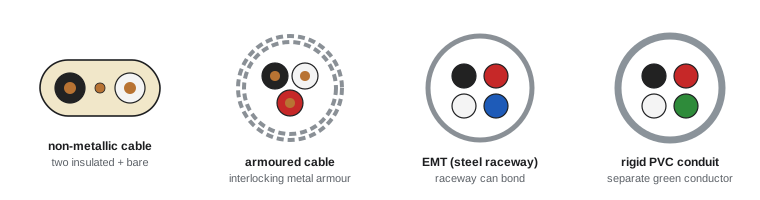
- Non-metallic sheathed cable (NMSC, such as NMD90): insulated conductors and a bare bonding conductor in a PVC jacket. It is the standard method for dwellings and permitted in many other buildings of combustible construction, but it must be protected from mechanical damage and is not permitted in some locations (for example where exposed to damage, or embedded in concrete).
- Armoured cable (AC90, Rules 12-600 series): conductors with an interlocking aluminum armour. The armour protects against mechanical damage and serves as the bonding path (with a bonding strip). Common in commercial work and wherever exposed cable needs protection.
- TECK90 cable: armoured cable with an overall PVC jacket, suitable for wet locations, direct burial and industrial use, terminated with special connectors.
Cables must be supported and secured at intervals and close to boxes so that their weight does not pull on terminations, and they must be protected where they pass through framing so that nails and screws driven into the wall cannot reach them.
For NMSC, the cable must be secured within 300 mm of a box and at intervals of not more than 1.5 m, and where it runs through holes in wooden framing it must be kept back from the face of the framing or protected with steel plates (Rule 12-500 series and related rules).
Raceways
A raceway is a channel designed to hold conductors: conduit, tubing, wireway or surface raceway. Conductors are pulled into the raceway after it is installed, so wiring can be changed later. Metal raceways also serve as a bonding path when properly installed. The main types are:
- Rigid metal conduit (RMC): heavy-wall threaded steel or aluminum, for maximum protection, outdoors and in industrial and hazardous locations.
- Electrical metallic tubing (EMT): thin-wall steel tubing joined with set-screw or compression fittings, the most common raceway in commercial buildings.
- Rigid PVC conduit: non-metallic, corrosion-resistant, used underground, in concrete and in wet or corrosive areas; it expands with temperature and needs expansion joints on long exposed runs. Because it is not conductive, a separate bonding conductor must be pulled in with the circuit.
- Flexible conduit (metal or liquidtight) for connections to motors and vibrating equipment and short runs where rigid raceway is impractical, with limits on length and on its use as a bonding path.
Conduit fill
Conductors must fit into a raceway with enough free space to be pulled without damaging their insulation and to dissipate heat. The codes limit the percentage of the raceway's internal cross-sectional area that conductors may occupy:
- One conductor: 53%.
- Two conductors: 31% (two round conductors tend to jam).
- Three or more conductors: 40%.
In the CEC, these percentages are in Table 8, and the dimensions of conductors and the internal areas of raceways are given in the code's tables.
Worked problem
How many conductors fit?
How many 12 AWG T90 Nylon conductors (cross-sectional area about 8.6 mm² each) may be installed in trade size 21 EMT, whose internal area is about 344 mm²?
Show solution
- Three or more conductors: 40% fill. Allowable area \(= 0.40 \times 344 = 137.6\) mm².
- Number \(= 137.6/8.6 = 16.0\), so 16 conductors.
Answer: 16 conductors. Remember that 16 current-carrying conductors in one raceway would need a large ampacity adjustment (Lesson 4), so the fill limit is rarely the only constraint.
Bends and pull points
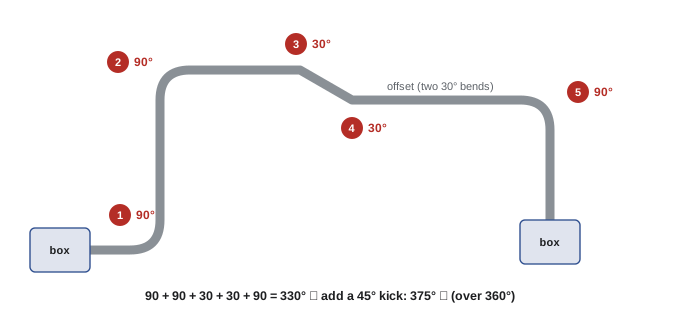
Every bend adds friction when conductors are pulled. Both codes limit the bends between pull points (boxes, conduit bodies or fittings where the conductors can be accessed) to the equivalent of four quarter bends: a total of 360°. Offsets and saddles count too: a pair of 30° offset bends adds 60°, and a three-bend saddle with a 45° centre bend adds 90°. When a run needs more, a pull box or conduit body is added.
Worked problem
Counting bends
An EMT run between two boxes has three 90° bends and a 30° offset (two 30° bends). Is it within the limit? What if a 45° kick is added?
Show solution
- Three 90° bends: 270°. Offset: \(2 \times 30 = 60°\). Total 330°: within 360°.
- Adding a 45° kick: 375°, over the limit.
Answer: 330° is acceptable; 375° is not, so a pull point would be needed. Many electricians plan runs with no more than three quarter bends to make pulling easier.
Raceway installation
Raceways must be complete between boxes before conductors are pulled in, reamed so no sharp edges damage insulation, fitted with bushings or insulated throats where conductors of 4 AWG and larger enter boxes, supported at specified intervals and within a short distance of each box, and protected against corrosion where needed. Metal raceways used as the bonding path must have tight, continuous joints, because a loose coupling can break the fault return path.
Boxes and box fill
Every splice, device and connection must be in a box (or other approved enclosure) that remains accessible. Boxes must be large enough for their contents. A crowded box makes connections hard to do well, damages insulation when devices are pushed in, and traps heat. The codes therefore limit box fill: the total volume required by the conductors, devices, clamps and fittings in a box must not exceed the box's volume.
In the CEC, box fill is calculated by allowing a certain usable volume per conductor according to its size, given in a table, and comparing the total with the box capacity marked on the box or listed in the code. Conductors that pass through without a splice, devices, and the conductors connected to them all count; check the counting rules in the box fill rule of Section 12 before calculating.
Worked problem
Box fill for a receptacle
A device box will hold one duplex receptacle fed by one 14/2 NMSC cable and continuing to the next receptacle with another 14/2 cable (four insulated conductors and two bare bonding conductors). Describe how you would check that the box is large enough.
Show solution
- Count the conductors that enter and terminate or splice in the box, including the bonding conductors as the rule specifies, and the allowance for the device.
- Look up the usable volume required per conductor of that size in the box fill table, and multiply.
- Compare the total with the box capacity marked on the box; choose a deeper box or an extension ring if the total exceeds it.
Answer: The box is acceptable only if the total required volume does not exceed its marked capacity. Device boxes fill up quickly; when in doubt use a deeper box or a 4 in square box with a device ring.
Other box rules appear constantly on the job: boxes in walls must be set so that their front edge is flush with (or only slightly recessed from) a combustible finish; boxes supporting light fixtures must be rated for the weight; ceiling fans need boxes listed for fan support; and every box must remain accessible without removing any part of the building structure or finish.
Underground and wet locations
Underground wiring must be buried deep enough to avoid damage, protected where it emerges from the ground, and suitable for wet locations, because conduits underground fill with water over time. Conductors in underground raceways must be rated for wet locations, and raceways entering buildings from underground must be sealed to keep water and gases out.
The CEC sets minimum cover depths in Rule 12-012 and its table, depending on the wiring method and whether it is under a driveway or roadway; direct-buried cable typically needs more cover than conduit, and cables must be protected with a warning tape or planking above them in many cases.
Wiring methods for damp, wet and corrosive locations, and the limits on flexible cords and temporary wiring, are covered in Lesson 10; low-voltage and communications cabling is covered in Lesson 11.
Common mistakes
MistakeUsing NM/NMSC cable in locations where it is not permitted, such as wet locations, exposed to damage, or in concrete.
InsteadCheck the permitted and prohibited uses for each wiring method before choosing it.
MistakeForgetting to secure cable close to boxes.
InsteadSecure within the specified distance of each box and at the specified intervals.
MistakeOverfilling a box because "it closes".
InsteadCalculate box fill; count conductors, devices, clamps and grounding/bonding conductors as the rules require.
MistakeAdding bends until the run is over 360°.
InsteadCount every bend, including offsets and saddles, and add pull points.
MistakeRelying on PVC conduit as a bonding path.
InsteadPVC is non-conductive; pull in a separate bonding or equipment grounding conductor.
Summary and key terms
- Wiring methods are in Section 12, organized by method, applying with Sections 2 and 4.
- Cables: NMSC (NMD90) for dwellings, AC90 armoured, TECK90 for wet and industrial use.
- Raceways: rigid metal, EMT, PVC and flexible conduit, each with permitted uses; metal raceways can serve as the bonding path.
- Conduit fill: 53% for one conductor, 31% for two, 40% for three or more.
- Bends between pull points: 360° maximum, including offsets and saddles.
- Every splice and device goes in an accessible box sized for its fill.
- Secure and protect cables; ream and bush raceways; bury underground wiring to the required depth with wet-rated conductors.
- Wiring method
- A system for carrying and protecting conductors, such as a cable or raceway.
- Raceway
- An enclosed channel designed to hold conductors, such as conduit or tubing.
- EMT
- Electrical metallic tubing: thin-wall steel raceway joined with compression or set-screw fittings.
- Rigid metal conduit
- Heavy-wall threaded metal conduit giving maximum protection.
- Rigid PVC conduit
- Non-metallic rigid conduit, corrosion-resistant but not conductive.
- Armoured cable
- Cable with an interlocking metal armour protecting its conductors.
- Non-metallic sheathed cable
- Cable with insulated conductors and a bare conductor in a plastic jacket, used in dwellings.
- Conduit fill
- The percentage of a raceway's internal area occupied by conductors.
- Pull point
- A box, conduit body or fitting where conductors can be accessed to pull them.
- Offset
- A pair of bends that shifts a conduit run sideways around an obstruction.
- Box fill
- The volume required by the contents of a box, which must not exceed its capacity.
- Bushing
- A fitting that protects conductor insulation where it enters a box from a raceway.
- Cover depth
- The depth from the top of an underground cable or raceway to the finished surface.
Practice problems
Work each problem on paper first, then reveal the answer to check.
What maximum fill percentage applies to a raceway with two conductors, and why is it lower than for three?
Show answer
31%; two round conductors can jam against the raceway wall when pulled.
How many conductors of area 8.6 mm² fit in a raceway with an internal area of 532 mm²?
Show answer
0.40 × 532 = 212.8 mm²; 212.8/8.6 = 24.7, so 24 conductors.
A run has two 90° bends, a 45° kick and a three-bend saddle with a 45° centre bend. What is the total, and is it acceptable?
Show answer
180 + 45 + 90 = 315°: acceptable.
Why must a separate bonding or equipment grounding conductor be installed in PVC conduit?
Show answer
PVC is non-conductive and cannot carry fault current.
Within what distance of a box must NMSC be secured, and at what maximum interval?
Show answer
Within 300 mm of the box and at intervals of not more than 1.5 m.
Name a cable suitable for a wet industrial location and direct burial.
Show answer
TECK90 (armoured, PVC-jacketed) cable.
A box holds four insulated 14 AWG conductors, their bonding conductors and one switch. Which items count toward box fill?
Show answer
The four insulated conductors, the bonding/grounding conductors (as the rules specify), the device, and any internal clamps.
Calculate the box fill for: two 14/2 NMSC cables with bonding conductors and one switch, using these exercise values (not taken from the code): 24.6 mL per conductor, a box rated 300 mL, and a counting rule in which each insulated conductor counts 1, all bonding conductors together count 1 and the device counts 2.
Show answer
(4 + 1 + 2) × 24.6 = 172 mL, within 300 mL. (Check the actual table and counting rule in your edition.)
Why should underground conductors be rated for wet locations even inside conduit?
Show answer
Underground raceways accumulate water from condensation and seepage, so the conductors are effectively in a wet location.
Give three requirements for a properly installed EMT run.
Show answer
Any three: reamed ends; tight couplings and connectors for bonding continuity; supported at specified intervals and near boxes; no more than 360° of bends between pull points; fill within limits; bushings or insulated throats for 4 AWG and larger.
Lesson quiz · 5 questions
Score 60% or more to complete this lesson.
Create a free account to save your progress, take quizzes and earn a certificate.