
ELEC-120 · Lesson 2 of 12 · 29 min
Definitions and general rules
The code is a legal document, and like any legal document it depends on precise words. "Bonding" and "grounding" mean different things; a "feeder" is not a "branch circuit"; "readily accessible" is a stricter requirement than "accessible". Many disagreements with inspectors, and many wrong answers on exams, come from reading a word in its everyday sense instead of its code definition. This chapter covers the definitions every electrician needs, then the general rules that apply to every installation: approval and marking, workmanship and connections, identification of conductors, locations and enclosures, and working space.
Where the definitions are
In the CEC, definitions are in Section 0. A defined term has the meaning given there everywhere in the code, unless a particular section defines it differently for its own purposes (for example, Section 18 defines terms used for hazardous locations). When a rule seems ambiguous, the first step is to check whether its key words are defined.
Essential definitions
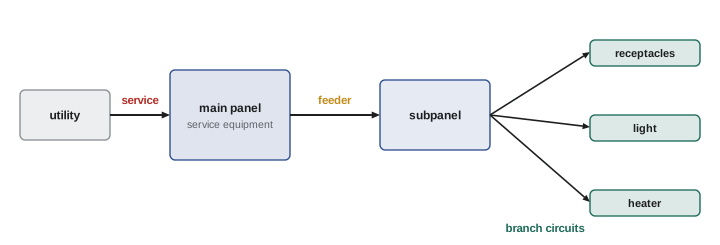
Circuits: service, feeder and branch circuit
- Consumer's service (often just "service"): the conductors and equipment from the supply authority's point of connection to the service box or equivalent, which controls and protects the whole installation.
- Feeder: the conductors between the service equipment (or another source, such as a transformer or generator) and the final branch-circuit overcurrent device. A feeder from the main panel to a subpanel is the common example.
- Branch circuit: the conductors between the final overcurrent device and the outlets it supplies. A 15 A receptacle circuit in a bedroom is a branch circuit.
Different rules apply to each, so identifying which one you are working on is the first step in sizing conductors and protection.
Grounding and bonding
- Grounding: a permanent and continuous conductive path to the earth with sufficient ampacity to carry any fault current liable to be imposed on it. The grounding conductor connects the system (or equipment) to the grounding electrode.
- Bonding: a low-impedance path obtained by permanently joining all non-current-carrying metal parts to ensure electrical continuity and having the capacity to conduct safely any current likely to be imposed. The bonding conductor connects metal enclosures, raceways and equipment back to the service or system grounding point.
- Identified conductor: the conductor intentionally connected to ground in a grounded system, usually the neutral. It is identified by white or grey insulation and is a current-carrying conductor, not a bonding conductor.
The distinction matters on every job. The neutral carries normal load current back to the source. The bonding or equipment grounding conductor carries current only during a fault, to trip the breaker. Connecting them together anywhere other than the service (or a separately derived source) puts normal current on metal parts, a common and dangerous error (Lesson 9).
Load and location terms
- Continuous load: a load where the maximum current is expected to continue for three hours or more. Water heaters, space heating, many lighting loads and most commercial loads are continuous.
- Ampacity: the current a conductor can carry continuously under its conditions of use without exceeding its temperature rating (Lesson 4).
- Dwelling unit: one or more rooms used as a housekeeping unit by one or more persons, with space for eating, living and sleeping, and permanent provisions for cooking and sanitation.
- Dry, damp and wet locations: a dry location is not normally subject to moisture; a damp location is partly protected but subject to moderate moisture (such as a covered porch or some basements); a wet location is exposed to weather, water or saturation (outdoors exposed, underground, in concrete in contact with earth). Wiring methods and equipment must suit the location.
- Readily accessible: capable of being reached quickly for operation, renewal or inspection, without climbing over obstacles or using a portable ladder. "Accessible" alone is less demanding: it may require removing a cover.
- Live (energized): electrically connected to a source of voltage difference, or electrically charged so as to have a potential different from ground.
Worked problem
Applying the definitions
Classify each: (a) the cable from a house's main panel to a 60 A subpanel in the garage; (b) the cable from a 20 A breaker in the subpanel to the garage receptacles; (c) the bare copper conductor inside a cable that is connected to the metal receptacle box; (d) a water heater element that runs for hours at a time.
Show solution
- (a) Between service equipment and the final overcurrent devices: a feeder.
- (b) Between the final overcurrent device and outlets: a branch circuit.
- (c) It connects non-current-carrying metal parts back to the service: a bonding conductor.
- (d) Maximum current for three hours or more: a continuous load.
Answer: Feeder, branch circuit, bonding conductor and continuous load. Each classification leads to different rules for sizing and protection.
General rules for every installation
Approval, marking and instructions
Equipment must be approved (certified for use in Canada) and used within its rating and marking (Rule 2-024 and related rules). Equipment must be marked with its ratings, such as voltage, current and the manufacturer, and the 2024 edition added a requirement to mark the maximum permitted load (Rule 2-100). Installing equipment contrary to its certification or instructions, for example using a breaker in a panelboard it is not certified for, is a code violation.
Workmanship and connections
Work must be done in a neat and workmanlike manner. Connections are the weakest points of any installation and cause many electrical fires. Terminals must be suitable for the conductor material (copper, aluminum or both, marked for example "AL7CU" or "AL9CU"), the number of conductors per terminal must be within the terminal's rating, and terminals must be tightened to the torque specified by the manufacturer. Conductor temperature ratings must suit the terminal temperature rating (usually 60 °C or 75 °C), which limits the ampacity that can be used (Rule 4-006 and Lesson 4).
Loose connections heat up under load: the resistance of a poor joint turns current into heat, which oxidizes the contact, which raises resistance further. A connection that is fine on day one can fail years later. Torque specifications exist precisely to prevent this.
Worked problem
Heat at a loose connection
A receptacle terminal carrying 15 A has developed a contact resistance of 0.1 Ω because the screw was never tightened properly. How much heat does the connection produce, and how does that compare with a good connection of 0.002 Ω?
Show solution
- Loose: \(P = I^2R = 15^2 \times 0.1 = 22.5\) W.
- Good: \(P = 15^2 \times 0.002 = 0.45\) W.
Answer: 22.5 W concentrated in a tiny terminal inside a box, fifty times more than a good connection. That is enough to scorch the device and ignite surrounding material over time. Proper torque prevents it.
Identification of conductors
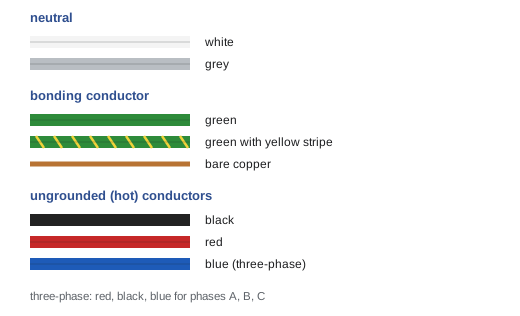
Conductor colours are not a matter of preference:
- The identified (neutral) conductor must be white or grey (Rule 4-036). White or grey insulation must not be used for any other purpose, except where the code specifically permits re-identification, such as a white conductor in a cable used as a switch leg and marked accordingly.
- Bonding conductors must be bare, or have green insulation, or green with one or more yellow stripes (Rule 4-038).
- Ungrounded (hot) conductors use other colours. For single-phase systems, black and red are normal; for three-phase systems, red, black and blue are used for phases A, B and C (Rule 4-038).
Locations and enclosures
Equipment and enclosures must suit their environment. Enclosures are rated by type numbers that indicate their protection against dust, water, ice and corrosion. Common types include:
| Enclosure type | Typical use |
|---|---|
| Type 1 | Indoor, general purpose; protects against contact with live parts |
| Type 3R | Outdoor; rain, sleet and snow, ice on the enclosure |
| Type 4 / 4X | Indoor or outdoor; hose-directed water; 4X adds corrosion resistance |
| Type 12 | Indoor industrial; dust, dirt and dripping non-corrosive liquids |
A panelboard installed outdoors in a Type 1 enclosure, or a Type 3R enclosure in a food plant washed down daily with hoses, is a violation even if every wire inside is correct.
Working space
Equipment that may need examination, adjustment, servicing or maintenance while energized, such as panelboards, switchboards and motor control centres, must have clear working space in front of it so that a worker can do the job and escape quickly if something goes wrong. The space must be kept clear; storage in front of a panel is one of the most common violations found in existing buildings.
The CEC requires a minimum working space of 1 m in front of such equipment, with adequate headroom, and the space must not be used for storage (Rule 2-308). Equipment likely to be worked on while energized must also be marked to warn of shock and arc flash hazards (Rule 2-306).
Worked problem
Is this installation acceptable?
A 600 V panelboard is installed in a storage room with shelving 0.8 m in front of it. Is the working space acceptable?
Show solution
- The minimum working space is 1 m (Rule 2-308), and it must not be used for storage.
- Shelving at 0.8 m both reduces the space below 1 m and uses it for storage.
Answer: Not acceptable. The shelving must be moved to give at least 1 m of clear space, and the area kept clear.
Protection of live parts and interrupting ratings
Live parts must be enclosed or guarded so that people cannot accidentally contact them. Unused openings in panels and boxes must be closed with approved fillers; missing knockouts and breaker filler plates are frequent findings. Every overcurrent device must also have an interrupting rating at least equal to the fault current available where it is installed; a residential breaker rated 10 kA installed where 22 kA is available could fail violently during a fault. ELEC-320 returns to fault current and coordination; for now, remember that equipment ratings include more than just amperes and volts.
The general rules of this lesson are applied to branch circuits in Lesson 3 and to devices and panelboards in Lessons 7 and 8.
Common mistakes
MistakeCalling the bonding conductor the "ground" and the neutral the "common" interchangeably.
InsteadThey are different conductors with different jobs: the neutral carries load current; the bonding or grounding conductor carries fault current only.
MistakeUsing white or grey insulation for a hot conductor without re-identification where permitted.
InsteadWhite and grey are reserved for the neutral; re-identify only where the code allows.
MistakeTightening terminals "by feel".
InsteadTorque to the manufacturer's specification; loose connections overheat.
MistakeStoring materials in front of panels.
InsteadWorking space must be kept clear at all times.
MistakeChoosing an enclosure by size only.
InsteadMatch the enclosure type to the location: dry, damp, wet, corrosive or dusty.
Summary and key terms
- Definitions are in Section 0; defined terms have their code meaning everywhere.
- Service, feeder and branch circuit are distinct, and each has its own rules.
- Grounding connects to earth; bonding joins metal parts into a low-impedance fault path; the identified conductor (neutral) carries load current.
- Continuous loads run three hours or more; locations are dry, damp or wet.
- Use certified equipment within its ratings and instructions; mark ratings (Rules 2-024, 2-100).
- Make connections with suitable terminals torqued to specification; terminal temperature ratings limit ampacity.
- Neutral white or grey; bonding bare, green or green/yellow; three-phase hots red, black, blue.
- Provide at least 1 m of clear working space (Rule 2-308) and arc flash marking (Rule 2-306).
- Consumer's service
- The conductors and equipment from the supply authority's connection to the service box.
- Feeder
- Conductors between the service (or other source) and the final branch-circuit overcurrent devices.
- Branch circuit
- Conductors between the final overcurrent device and the outlets.
- Grounding
- A permanent, continuous conductive path to earth.
- Bonding
- Joining non-current-carrying metal parts into a low-impedance path able to carry fault current.
- Bonding conductor
- The conductor connecting metal enclosures and raceways to the service or system grounding point.
- Identified conductor
- The grounded conductor, usually the neutral, identified by white or grey insulation.
- Continuous load
- A load with maximum current expected to continue for three hours or more.
- Damp location
- A location subject to moderate moisture, partly protected from weather.
- Wet location
- A location exposed to weather, water or saturation.
- Readily accessible
- Reachable quickly without climbing over obstacles or using a portable ladder.
- Working space
- The clear space required in front of electrical equipment.
Practice problems
Work each problem on paper first, then reveal the answer to check.
A cable runs from a 100 A breaker in the main panel to a subpanel in a barn. Is it a feeder or a branch circuit?
Show answer
A feeder: it ends at overcurrent devices (the subpanel breakers), not at outlets.
What is the difference in function between the neutral and the bonding (equipment grounding) conductor?
Show answer
The neutral carries normal load current back to the source; the bonding/equipment grounding conductor carries current only during a fault, to trip the protective device.
Which of these are continuous loads: a 30-minute microwave use, an office lighting circuit on for 10 hours, a storage water heater element?
Show answer
Office lighting and the water heater (three hours or more); the microwave is not.
Is a covered outdoor patio a dry, damp or wet location? A lawn sprinkler control box exposed to weather?
Show answer
Covered patio: damp. Exposed box: wet.
A connection carrying 20 A has 0.05 Ω of contact resistance. How much heat does it produce?
Show answer
20² × 0.05 = 20 W.
What colours may a bonding conductor have?
Show answer
Bare, green, or green with one or more yellow stripes.
Can a white conductor in a cable be used as a hot conductor?
Show answer
Only where the code specifically permits it (such as a switch leg or loop in cable) and it is re-identified at each end and where visible.
What enclosure type would you choose for a disconnect switch on a rooftop, and for one in a food plant washdown area?
Show answer
Rooftop: Type 3R (or 4); washdown: Type 4X (corrosion-resistant, hose-down).
What is the minimum working space in front of a panelboard, and what else does the rule require?
Show answer
1 m, kept clear and not used for storage, with adequate headroom (Rule 2-308).
A breaker is rated 10 kA interrupting and the available fault current at the panel is 14 kA. What is the problem?
Show answer
The breaker may fail to interrupt a fault safely and could explode; every device needs an interrupting rating at least equal to the available fault current.
Lesson quiz · 5 questions
Score 60% or more to complete this lesson.
Create a free account to save your progress, take quizzes and earn a certificate.