
ELEC-120 · Lesson 5 of 12 · 27 min
Overcurrent protection
Lesson 4 chose conductor sizes and the overcurrent device ratings that protect them. This lesson looks at the devices themselves and the rules for applying them: the kinds of fuses and circuit breakers, the voltage, current and interrupting ratings every device carries, where overcurrent protection must be placed, the tap rules that allow some conductors to start without protection, and the location and accessibility requirements that let people operate devices safely. ELEC-110, Lesson 12, explained how fuses and breakers work; here the focus is on applying them to code.
In the Canadian Electrical Code, overcurrent protection is covered in Section 14 (Protection and control), with the interrupting rating requirements in Rule 14-012 and the ratings of overcurrent devices for conductors in Rule 14-104 and Table 13.
Fuses
A fuse is the simplest and often the most reliable protective device: a calibrated metal element that melts and opens the circuit. Fuses are classified by their dimensions and performance so that the right fuse can be installed and the wrong one cannot:
- Plug fuses (Edison base and type S) for old residential panels, limited to 125 V circuits. Type S fuses use adapters that prevent a larger fuse from being installed in a socket for a smaller circuit.
- Cartridge fuses in standard classes, such as H, K, R, J, T, CC and L, each with its own size, voltage rating and interrupting rating. Classes J, T, CC, R and L are current-limiting, with interrupting ratings of 200,000 A or more.
- Rejection features: class R fuses have a notch, and fuse holders for them reject older class H and K fuses, so that a current-limiting fuse cannot be replaced by one with a lower interrupting rating.
Fuses also come in time-delay (dual-element) and non-time-delay versions; time-delay fuses ride through motor starting currents (ELEC-110, Lesson 12).
Circuit breakers
Moulded-case circuit breakers are the most common overcurrent device in modern installations. Small plug-on and bolt-on breakers in panelboards have fixed thermal-magnetic trips; larger breakers may have adjustable magnetic trips or electronic trip units with long-time, short-time, instantaneous and ground fault settings. Breakers used as switches for fluorescent lighting must be marked for switching duty (SWD or HID). Breakers can be reset after a trip, but they must not simply be reset repeatedly: a breaker that trips has done its job, and the cause must be found (ELEC-110, Lesson 12).
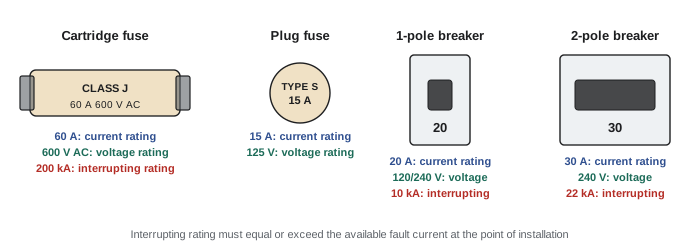
Three ratings that must all be right
Current rating
The current rating must protect the conductors (Lesson 4): generally not more than their ampacity, with the round-up permitted to the next standard rating for devices up to 800 A, and with the small-conductor limits for 14, 12 and 10 AWG copper.
Voltage rating
A device must be rated for the voltage of the circuit. Breakers with a slash rating, such as 120/240 V or 480Y/277 V, may be used only on solidly grounded systems where the voltage from any conductor to ground does not exceed the lower figure and the voltage between conductors does not exceed the higher figure. A breaker with a straight rating, such as 240 V or 480 V, has been tested to interrupt the full voltage across a single pole and may be used on any system up to that voltage.
Worked problem
Slash ratings
Can a 480Y/277 V slash-rated two-pole breaker be used (a) on a 480Y/277 V solidly grounded wye system, (b) on a 480 V corner-grounded delta system, (c) on a 480 V ungrounded delta system?
Show solution
- (a) Line to ground 277 V, line to line 480 V: within both figures. Yes.
- (b) On a corner-grounded delta, two phases are 480 V to ground, above 277 V. No.
- (c) On an ungrounded delta, a ground fault on one phase raises the others to 480 V above ground, and a single pole may have to interrupt the full 480 V. No.
Answer: Only on the solidly grounded wye. On delta systems, a breaker with a straight 480 V rating is required. Using a slash-rated breaker on the wrong system is a common error found in industrial plants with older delta services.
Interrupting rating
A device must be able to interrupt the maximum fault current available at its line terminals. Residential breakers are commonly rated 10,000 A (10 kA), commercial breakers 14 kA to 65 kA or more, and current-limiting fuses 200 kA or 300 kA. Equipment such as panelboards, motor controllers and HVAC units also carries a short-circuit current rating (SCCR), which must equal or exceed the available fault current.
Worked problem
Checking interrupting ratings
A new 208Y/120 V panelboard in a commercial building is fed from a transformer close by, and the available fault current at the panel is 18 kA. The specified branch breakers are rated 10 kA. What are the options?
Show solution
- The breakers (10 kA) are below the available fault current (18 kA): not acceptable as installed.
- Option 1: use breakers rated 22 kA.
- Option 2: use a series-rated combination, in which an upstream current-limiting device and the downstream breakers have been tested and listed together for 18 kA or more, as marked on the panelboard.
- Option 3: reduce the available fault current, for example with a smaller or higher-impedance transformer or longer feeders, and recalculate.
Answer: The 10 kA breakers cannot be used on their own. Series ratings must be exactly as tested and marked, and the panel must be labelled; substituting a different upstream device voids the rating. Many jurisdictions also require the available fault current to be marked on service equipment and updated when it changes.
Where overcurrent protection goes
The general rule is that conductors must be protected at the point where they receive their supply: an overcurrent device at the beginning of each feeder and branch circuit, in each ungrounded conductor. The grounded (neutral) conductor is not normally fused or switched on its own, because opening the neutral while the hot conductors remain live leaves equipment energized and can put loads in series (Lesson 3).
Taps
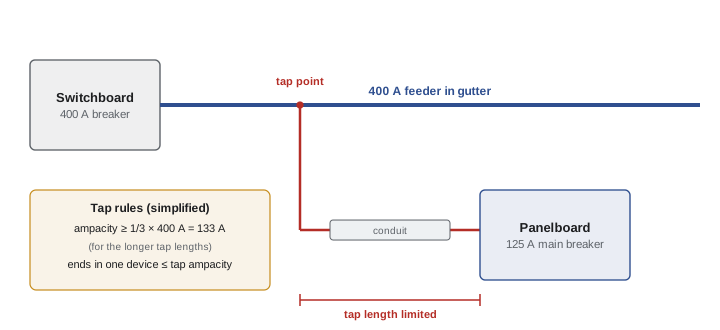
A tap is a conductor connected to a larger feeder without its own overcurrent protection at the point of connection. The code permits short taps under strict conditions, because the tap is protected only by the much larger feeder device until it reaches its own protection. The conditions limit the tap's length, require its ampacity to be a minimum fraction of the feeder protection, require it to end in a single overcurrent device that protects it, and require physical protection, typically by enclosing it in raceway.
The CEC permits taps without overcurrent protection at the point of supply under the conditions of Rule 14-100, with limits on length (short taps of a few metres) and on the ampacity of the tap compared with the feeder protection.
Worked problem
Sizing a 25-foot tap
A panelboard is to be tapped from a feeder protected at 400 A, using a 7 m (23 ft) tap. Under a rule requiring the tap ampacity to be at least one-third of the feeder protection and to end in a single overcurrent device, what is the smallest copper tap conductor (75 °C), and what is the largest breaker it may end in?
Show solution
- Minimum ampacity: \(400/3 = 133\) A.
- From the 75 °C column: 1/0 AWG copper is rated 150 A; 1 AWG is 130 A, too small. Use 1/0 AWG.
- The tap must end in a single device rated not more than the tap ampacity: a 150 A breaker (or smaller, to suit the panel and load).
Answer: 1/0 AWG copper, ending in a breaker of 150 A or less. The tap rules are tempting shortcuts but each condition matters; inspectors check length, ampacity, termination and protection. Check the exact rule in the adopted code edition.
Location and accessibility
Overcurrent devices must be readily accessible to the people who need to operate them, so that circuits can be switched off quickly in an emergency or for maintenance. Common requirements are:
- The operating handle at its highest position must be within a maximum height above the floor or working platform, about 2 m.
- Devices must not be located where they are exposed to physical damage, near easily ignitible material such as in clothes closets, or (for dwelling panels) in bathrooms.
- Panelboards must have the required working space in front of them, kept clear of storage (Lesson 2).
- In multi-occupancy buildings, each occupant must have ready access to the overcurrent devices that serve their unit.
In Canada, the CEC sets the maximum mounting height of panelboard and overcurrent device handles and the locations where panelboards may not be installed; provincial amendments may add requirements.
Supplementary protection and coordination
Small fuses and breakers inside equipment, such as a 5 A fuse in a control transformer or a miniature breaker in a light fixture, are supplementary protection. They protect the equipment but do not replace the branch-circuit overcurrent device, and devices marked only as supplementary protectors must not be used as branch-circuit protection.
Where several devices are in series, coordination means arranging their ratings and time-current characteristics so that only the device nearest a fault operates, leaving the rest of the system in service. Selective coordination is required by code for some systems where continuity is vital, such as emergency systems, elevators and critical operations power systems, and is studied using time-current curves (ELEC-110, Lesson 12; ELEC-220).
Common mistakes
MistakeReplacing a fuse with a different class or a higher rating.
InsteadUse the same class and rating, and find the cause of the fault.
MistakeUsing slash-rated breakers on delta systems.
InsteadUse straight-rated breakers where line-to-ground voltage may exceed the lower figure.
MistakeInstalling breakers rated below the available fault current.
InsteadUse adequate interrupting ratings or a tested, marked series combination.
MistakeTreating supplementary protectors as branch-circuit protection.
InsteadProvide listed branch-circuit overcurrent devices.
MistakeUsing tap rules without meeting every condition.
InsteadCheck length, ampacity, termination and physical protection.
Summary and key terms
- Fuses are classified by class; rejection features prevent unsafe substitutions.
- Breakers range from fixed thermal-magnetic to adjustable electronic trips.
- Every device needs correct current, voltage and interrupting ratings.
- Slash-rated breakers are only for solidly grounded systems within both voltage figures.
- Protection is placed where conductors receive their supply; taps are narrow exceptions.
- Devices must be readily accessible, within height limits and away from closets and dwelling bathrooms.
- Supplementary protectors do not replace branch-circuit protection; selective coordination is required for critical systems.
- Fuse class
- A standardized category of fuse dimensions and performance.
- Current-limiting fuse
- A fuse that opens a high fault within the first half-cycle.
- Rejection fuse holder
- A holder that accepts only fuses of a specific class.
- Slash rating
- A dual voltage rating such as 120/240 V that limits where a breaker may be used.
- Interrupting rating
- The maximum fault current a device can safely interrupt.
- SCCR
- Short-circuit current rating of equipment.
- Series rating
- A tested combination of devices with a combined interrupting rating.
- Tap
- A conductor connected to a feeder without overcurrent protection at the connection.
- Supplementary protector
- A device inside equipment that does not serve as branch-circuit protection.
- Selective coordination
- Arranging devices so only the nearest one to a fault operates.
Practice problems
Work each problem on paper first, then reveal the answer to check.
Why do class R fuse holders reject class H fuses?
Show answer
To prevent replacement with a fuse of lower interrupting rating.
Can a 120/240 V breaker be used on a 208Y/120 V system?
Show answer
Yes, line to ground 120 V and line to line 208 V are within the figures.
Can a 120/240 V breaker be used on a 240 V delta with a high leg?
Show answer
Not where a conductor is more than 120 V to ground (the high leg is 208 V to ground).
Available fault current 25 kA, breaker rated 22 kA. Acceptable alone?
Show answer
No.
Why is the neutral not normally fused?
Show answer
Opening it alone leaves equipment live and can put loads in series.
Minimum ampacity of a one-third-rule tap from a 600 A feeder?
Show answer
200 A.
Maximum breaker at the end of a tap with 150 A ampacity?
Show answer
150 A.
Approximate maximum handle height for overcurrent devices?
Show answer
About 2 m.
Is a miniature fuse in a luminaire branch-circuit protection?
Show answer
No, it is supplementary protection.
Name a system where selective coordination is required.
Show answer
Emergency systems (also elevators, critical operations power systems).
Lesson quiz · 5 questions
Score 60% or more to complete this lesson.
Create a free account to save your progress, take quizzes and earn a certificate.