
ELEC-120 · Lesson 1 of 12 · 26 min
How the code is organized and adopted
Every electrical installation in the United States, from a single receptacle in a garage to the switchgear of a hospital, must meet the electrical code adopted where the work is done, which is almost always the National Electrical Code. For an electrician, the code is not something you read once in school and forget. It is the reference you open every week to size a conductor, choose a box, check a clearance or settle a question with an inspector. Being fast and accurate with the code is one of the skills that separates a journeyman from an apprentice, and it is the core of every state and local licensing exam.
This course teaches you to use the code: how it is organized, how it becomes law, how to find what you need, and the requirements that apply to almost every job: definitions and general rules, conductor sizing, wiring methods, and grounding and bonding. Later courses cover the rules for dwellings (ELEC-130) and for feeders, motors, hazardous locations and special systems (ELEC-220). Always work from the edition your jurisdiction has adopted; this course explains principles and gives examples, but it is not a substitute for the code book itself.
What the code is, and what it is not
The National Electrical Code (NEC), published by the National Fire Protection Association as NFPA 70, exists for "the practical safeguarding of persons and property from hazards arising from the use of electricity" (Section 90.2). It sets minimum requirements. It is not a design specification or an instruction manual for untrained people, and compliance alone does not make an installation efficient, convenient or adequate for future expansion; those are design choices. An installation can meet the code and still be a poor design, but it can never be a good design if it fails the code.
The NEC works alongside product safety standards. Equipment is tested and listed against standards (most published by UL) by Nationally Recognized Testing Laboratories, and the NEC requires equipment to be approved by the authority having jurisdiction, which in practice means listed and installed according to its listing and instructions. Electricians work mostly with the NEC, and rely on the product standards through the listing marks on the products they install.
How the code becomes law
NFPA publishes a new edition of the NEC every three years; the 2026 edition was published in 2025. The code is developed in an open process: anyone can submit a public input, and code-making panels representing contractors, inspectors, manufacturers, labor, utilities, engineers and others vote on every change. But the NEC is a model code: on its own it has no legal force. States, counties and cities adopt it by law, often with local amendments and on their own timetable, so a contractor working in several states may be working under the 2017, 2020, 2023 and 2026 editions at the same time.
- Most states adopt the NEC statewide, sometimes allowing cities to adopt a different edition or stricter amendments.
- A few states leave adoption entirely to local governments, so the rules can change from one city to the next.
- Large cities, such as New York and Chicago, have historically maintained their own electrical codes based on, but different from, the NEC.
In each jurisdiction, the authority having jurisdiction (AHJ), usually the electrical inspector or building department, is responsible for interpreting and enforcing the code (Section 90.4). Where the code requires something to be "approved" or allows a judgment, it is the AHJ's decision that counts, and the AHJ can grant special permission for alternative methods that give equivalent safety.
Worked problem
Which edition applies?
A contractor licensed in one state takes a job in a neighboring state that has adopted an older NEC edition, with a city amendment requiring metal raceway in commercial buildings. Which rules govern the job, and where should the contractor check?
Show solution
- The rules that apply are those adopted where the work is done: the state's adopted edition plus the city amendment, not the newest published NEC and not the contractor's home state rules.
- Check the state electrical board or building department and the city's code amendments for the adopted edition and effective date.
- Confirm permit and licensing requirements in that jurisdiction before starting work.
Answer: The adopted edition of the place where the job is, with its amendments (here including the metal raceway requirement). Contractors who work in several jurisdictions keep a list of which edition and amendments each one enforces.
How the code is organized
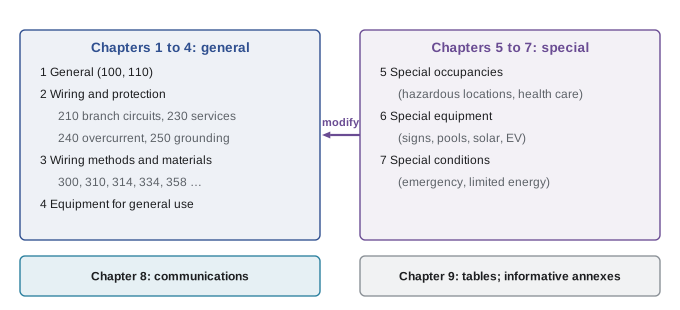
The NEC is divided into chapters, articles, parts and sections. A section number such as 210.20(A) means Article 210 (branch circuits), section 20, subdivision (A). The chapters fall into a logical structure:
- Chapters 1 to 4 apply generally: Chapter 1 (general: definitions in Article 100 and requirements in Article 110), Chapter 2 (wiring and protection: branch circuits, feeders, services, overcurrent protection, grounding and bonding), Chapter 3 (wiring methods and materials) and Chapter 4 (equipment for general use).
- Chapters 5, 6 and 7 apply to special occupancies (such as hazardous locations and health care facilities), special equipment (such as signs, elevators, pools and solar systems) and special conditions (such as emergency systems and limited-energy circuits). They supplement or modify the general rules of Chapters 1 to 7.
- Chapter 8 covers communications systems, which are largely independent of the other chapters, and Chapter 9 contains tables, such as conduit dimensions and conductor properties. Informative annexes give examples and calculations but are not mandatory.
Mandatory requirements use "shall" or "shall not"; permissive rules use "shall be permitted". Informational notes explain or point to other documents but are not enforceable. A vertical line in the margin marks changes from the previous edition, which is how experienced electricians learn what is new in each code cycle.
Finding your way in the code
Code questions on the job, and on exams, are usually answered in three steps:
- Identify the topic and go to the right article. Use the index or, once you know the code, go straight to the article: ampacity is in Article 310; branch circuit rules are in Article 210; box fill is in 314.16; equipment grounding conductor sizes are in Table 250.122.
- Read the whole rule, including its subrules, exceptions and any references to other rules or tables. Many errors come from reading only the first sentence.
- Check whether Chapters 5 to 7 modify the rule for your installation (for example, Article 680 for pools, or Article 517 for health care), and read the informational notes.
Worked problem
Navigating a question
An apprentice asks: "What is the maximum continuous load on a 20 A branch circuit breaker in a commercial building?" Where in the NEC is the answer, and what is it?
Show solution
- Topic: branch circuit ratings and continuous loads. Article 210 covers branch circuits.
- Section 210.20(A) requires the overcurrent device to be rated at least 125% of the continuous load plus the non-continuous load (unless the assembly is listed for 100% operation), and 210.19(A) applies the same to conductors.
- 20 A × 0.80 = 16 A (or equivalently, 16 A × 1.25 = 20 A).
Answer: 16 A of continuous load, from 210.19(A) and 210.20(A). Knowing which article to open is most of the work.
Permits, inspection and certified equipment
In nearly every jurisdiction, electrical work requires a permit before it starts, apart from minor work listed in local rules. Permits are normally taken out by a licensed electrical contractor; homeowners may be allowed to do work on their own single-family dwelling in many places. The inspector reviews the work at rough-in (before walls are closed) and at final inspection, and the utility will not connect a new service until it passes. Equipment must be approved by the AHJ (110.2), which in practice means listed by a Nationally Recognized Testing Laboratory such as UL, Intertek (ETL) or CSA Group and installed according to its listing and instructions (110.3(B)). Unlisted equipment requires a field evaluation.
Certification marks matter on the job. A product marked only for another country, or a counterfeit with a fake mark, may not have been tested to North American standards and must not be installed. Electricians are often the last line of defense against unsafe products bought online.
Licensing and scope of practice
Licensing is set by states and, in some places, cities. A typical path is apprentice, journeyman and master electrician, with required hours of supervised work, classroom training and a licensing exam based on the adopted NEC edition. Contractors usually need a separate contractor license and insurance. Some states recognize licenses from others through reciprocity agreements. The code is open-book on most exams, which is why fast navigation matters so much.
How this course is organized
This course follows the code roughly in the order an installer meets it. Lessons 1 and 2 cover how the code is organized and its definitions and general rules. Lessons 3 to 5 cover branch circuits, conductor sizing and ampacity, and overcurrent protection. Lessons 6 to 8 cover wiring methods; switches, receptacles and luminaires; and disconnecting means, panelboards and enclosures. Lesson 9 covers grounding and bonding, Lesson 10 damp, wet and corrosive locations with cords and temporary wiring, and Lesson 11 Class 2, communications and fire alarm circuits. Lesson 12 brings everything together in permits, inspections and a complete worked installation.
Common mistakes
MistakeWorking from the newest edition when the jurisdiction has not adopted it.
InsteadUse the edition and amendments in force where the work is done.
MistakeReading only the first sentence of a rule.
InsteadRead the whole rule, including subrules, exceptions and references to tables and other rules.
MistakeIgnoring sections that modify the general rules.
InsteadCheck the supplementary sections (or Chapters 5–7) for the type of installation.
MistakeTreating explanatory notes as requirements, or ignoring them.
InsteadNotes are not mandatory, but they explain the intent and how inspectors apply the rule.
MistakeInstalling equipment without a recognized certification or listing mark.
InsteadCheck for a recognized mark for use in your country; uncertified equipment needs a field evaluation.
Summary and key terms
- The NEC (NFPA 70) sets minimum requirements for the practical safeguarding of persons and property; product standards and NRTL listing cover equipment.
- A new edition is published every three years (2026 is current); states and cities adopt editions with amendments on their own schedule.
- The AHJ interprets and enforces the code; permits and inspections are required before energizing.
- Chapters 1–4 apply generally; Chapters 5–7 modify them; Chapter 8 covers communications; Chapter 9 has tables.
- Sections are numbered by article (e.g. 210.20(A)); "shall" is mandatory, informational notes are not.
- Find answers by topic, read the whole rule and check for modifying sections.
- Equipment must be approved, normally by NRTL listing (110.2, 110.3(B)); licensing is set by states and cities.
- National Electrical Code
- NFPA 70, the model installation code adopted throughout the United States.
- Model code
- A code published for adoption by governments, with no legal force until adopted.
- Authority having jurisdiction (AHJ)
- The organization or official responsible for enforcing the code.
- Article
- A major division of the NEC covering one topic, such as Article 250 for grounding and bonding.
- Informational note
- Explanatory text in the NEC that is not an enforceable requirement.
- Shall / shall be permitted
- Wording for mandatory requirements and for permitted alternatives.
- Listed
- Included in a list published by a testing laboratory, indicating the product meets a standard.
- NRTL
- Nationally Recognized Testing Laboratory, such as UL or Intertek.
- Special permission
- Written consent of the AHJ for an alternative method giving equivalent safety.
- Permit
- Authorization from the AHJ to carry out electrical work.
- Journeyman and master electrician
- License levels for electricians, set by state or local law.
Practice problems
Work each problem on paper first, then reveal the answer to check.
What is the NFPA number of the NEC, and how often is a new edition published?
Show answer
NFPA 70; every three years (2017, 2020, 2023, 2026).
Why can two jurisdictions enforce different editions of the code at the same time?
Show answer
The code is a model code; each jurisdiction adopts it by its own law or regulation, with its own timing and amendments.
Who interprets the NEC when a rule requires something to be "approved"?
Show answer
The authority having jurisdiction (AHJ), usually the electrical inspector.
In Section 250.122(A), what do "250", "122" and "(A)" mean?
Show answer
Article 250 (grounding and bonding), section 122, first-level subdivision (A).
Which NEC chapters apply generally, and what do Chapters 5, 6 and 7 do?
Show answer
Chapters 1–4 apply generally; Chapters 5–7 supplement or modify them for special occupancies, equipment and conditions.
Are informational notes enforceable?
Show answer
No; they explain or refer to other material but are not requirements.
A customer buys a cheap light fixture online with no recognized certification mark and asks you to install it. What should you do?
Show answer
Decline to install it unless it receives a field evaluation; equipment must be certified or listed for use in the jurisdiction.
What three steps help you answer a code question accurately?
Show answer
Find the right section or article by topic or index; read the whole rule with its exceptions and references; check for sections that modify it for the installation.
Using 210.20(A), what is the maximum continuous load on a standard 30 A breaker?
Show answer
30 × 0.8 = 24 A.
Why do inspections happen at rough-in as well as at completion?
Show answer
Once walls and ceilings are closed, wiring, boxes, supports and connections cannot be seen; rough-in inspection checks them while they are still exposed.
Lesson quiz · 5 questions
Score 60% or more to complete this lesson.
Create a free account to save your progress, take quizzes and earn a certificate.