
DCT-350 · Lesson 9 of 12 · 26 min
Maintenance and incident response review
Maintenance keeps redundancy real, and incident response limits the damage when something fails anyway. DCT-340 taught both at Stonebridge: the maintenance program, condition monitoring, emergency operating procedures, the incident process, root cause analysis and shift hand-offs. Exams test these ideas through scenarios more than definitions, so this review gives you the vocabulary, the arithmetic of reliability, and a set of worked cases built from incidents earlier in the program.
Kinds of maintenance
- Preventive maintenance (PM) is done on a schedule, by time or run hours, whether or not anything looks wrong: filter changes, belt checks, battery inspections, breaker exercising.
- Predictive or condition-based maintenance acts on measurements that show wear: infrared scans of electrical joints, battery ohmic readings, vibration on fans and pumps, oil analysis on generators.
- Corrective maintenance repairs something that has failed or is out of specification.
- Run-to-failure is a deliberate choice for cheap, non-critical items whose failure does no harm, such as some lamps; it is never chosen for anything in the critical path.
A maintenance program lists every asset, the tasks for each, their intervals, who does them (staff or vendor) and the procedures. Electrical maintenance programs in North America often follow NFPA 70B, which became a standard with mandatory requirements in its 2023 edition, and testing specifications such as NETA MTS. Generators are exercised under load monthly and load-banked annually under the site's program, in line with CSA C282 (DCT-220 lesson 7). Batteries are inspected and measured to IEEE practices or the maker's instructions (DCT-220 lesson 5).
Concurrent maintenance in practice
A Tier III site such as Stonebridge is designed so that any component can be removed for maintenance without shutting down IT load. That does not mean maintenance is free of risk. While a unit is out, the system runs with less redundancy, often at N, so maintenance is planned as a change with a MOP, scored for risk in the reduced state, and scheduled in a change window (lesson 8, DCT-330). PM compliance, the share of scheduled tasks done on time, is one of the main measures of a maintenance program, and a growing backlog of overdue PMs is an early sign of trouble.
Condition monitoring
Infrared thermography finds loose or corroded electrical connections, which run hotter than their neighbours. Scans are usually done under load, through infrared windows or by qualified staff with covers removed, and results are graded by the temperature rise over a similar component or over ambient. Battery ohmic readings (internal resistance or conductance) trend upward as cells age, and a rise of a set percentage over the cell's baseline triggers replacement; DCT-220 lesson 5 found UPS-A2 string 2's failing blocks from the runtime trend. Vibration on fan and pump bearings rises before they fail.
Worked problem
Interpreting an infrared result
An infrared scan of PDU-A2-05 shows the B-phase lug at 58 °C while the A and C phase lugs read 41 °C and 42 °C under the same load. The site grades a rise of 1 to 3 K over similar components as monitor, 4 to 15 K as repair at the next opportunity, and over 15 K as repair immediately. What grade is it?
Show solution
- Rise over similar components: 58 − 42 = 16 K (using the warmer neighbour).
- 16 K is over 15 K.
- Grade: repair immediately, as a planned change with the PDU's load moved to the other side first.
Answer: Repair immediately. The technician's job is to report and record; the repair is done by qualified electricians under a MOP. The grading bands here are an illustrative site table.
Reliability arithmetic
Mean time between failures (MTBF) is the average operating time between failures; mean time to repair (MTTR) is the average time to restore service after one. Availability from these two is MTBF / (MTBF + MTTR). Shortening MTTR, with spares on site, clear procedures and trained staff, improves availability as much as making failures rarer.
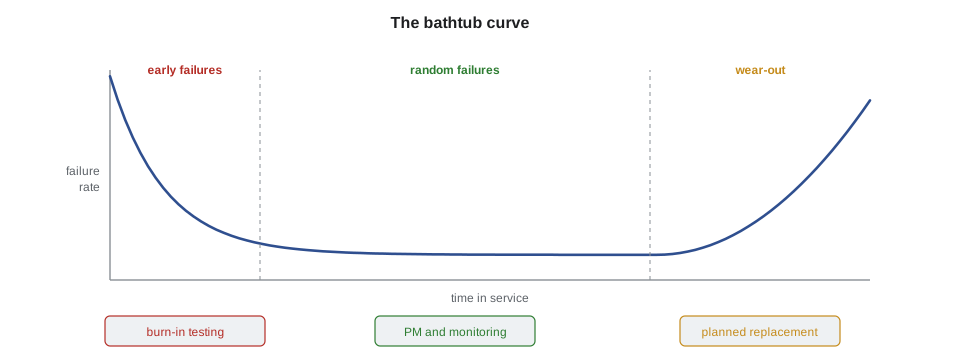
Failure rates are not constant over a component's life. The bathtub curve shows early failures in the first weeks (infant mortality, from defects and installation errors), a long period of low, steady random failures, and a rise at the end of life as wear sets in. Good practice is burn-in testing for new equipment (as in the DCT-310 capstone) and replacement before the wear-out period for items such as batteries, capacitors and fans.
# Reliability review: availability from MTBF and MTTR, and PM compliance
def availability(mtbf_h, mttr_h):
    return mtbf_h / (mtbf_h + mttr_h)
for mttr in (24, 8, 2):
    a = availability(50000, mttr)
    print(f"MTBF 50,000 h, MTTR {mttr:>2} h -> {a * 100:.4f} %, {(1 - a) * 8760 * 60:.0f} min a year down")

events = [  # (unit, hours in service, failures, total repair hours) over one year
    ("CRAH fans", 12 * 8760, 3, 18), ("CDU pumps", 18 * 8760, 2, 7), ("Rack PDUs", 400 * 8760, 5, 10)]
for unit, hours, n, rep in events:
    print(f"{unit:<10} MTBF {hours / n:>10,.0f} h  MTTR {rep / n:4.1f} h")

scheduled, on_time, late = 412, 391, 15
print(f"PM compliance {on_time / scheduled * 100:.1f} %, overdue backlog {scheduled - on_time - late} not started")MTBF 50,000 h, MTTR 24 h -> 99.9520 %, 252 min a year down MTBF 50,000 h, MTTR 8 h -> 99.9840 %, 84 min a year down MTBF 50,000 h, MTTR 2 h -> 99.9960 %, 21 min a year down CRAH fans MTBF 35,040 h MTTR 6.0 h CDU pumps MTBF 78,840 h MTTR 3.5 h Rack PDUs MTBF 700,800 h MTTR 2.0 h PM compliance 94.9 %, overdue backlog 6 not started
Emergency operating procedures
An emergency operating procedure (EOP) tells the desk and the floor what to do when a specific failure happens: loss of utility, UPS on bypass, CRAH failure, leak in Hall D, fire alarm, generator failure to start. EOPs are short, written for stress, and practised in drills. They begin with immediate actions that protect people and load, then diagnosis, then recovery, and they say who to call at each step. The DCT-220 capstone storm night ran on the loss-of-utility EOP, and the GEN-D2 failure to start was handled by its contingency step.
Incident response
An incident is any unplanned event that affects or threatens service. The response has a common shape across standards and frameworks such as ITIL: detect, respond and contain, communicate, recover, and learn (DCT-340). One person takes the role of incident lead and coordinates; others work the problem; one person keeps a timeline of what happened and when. Customers and leadership hear early and regularly, even if the update is that the cause is not yet known.
Useful timing measures are time to detect (from the event to the first alarm or report), time to acknowledge, time to contain (when the load is safe) and time to resolve. Tracking them over many incidents shows where the response is slow.
Root cause analysis
Root cause analysis (RCA) looks past the immediate failure to the conditions that let it happen. Common tools are the five whys (asking why repeatedly until the answer is something the organization controls), the fishbone or Ishikawa diagram (grouping causes under headings such as people, procedures, equipment, environment and materials), and fault trees (showing how combinations of failures lead to the top event through AND and OR gates). A good RCA ends in corrective actions with owners and dates, not in blaming a person.
Worked problem
Five whys on a near miss
In the DCT-330 capstone, the controls contractor put CDU-D2A into maintenance mode instead of CDU-D2B. Work the five whys.
Show solution
- Why was the wrong CDU put in maintenance mode? Lee selected the adjacent line in the BMS list.
- Why was it easy to select the wrong line? The list shows similar tag names close together with no confirmation step.
- Why was there no confirmation step? The BMS allowed maintenance mode with a single click.
- Why did that not lead to an outage? Dmitri's read-back caught it before the next step.
- Why could the same thing happen elsewhere? Other BMS screens have the same design.
Answer: Root cause: a BMS design that allows a one-click maintenance mode. Corrective action: type-the-tag confirmation for maintenance mode across the BMS, which Stonebridge adopted.
Shift hand-offs
Many incidents begin, or are made worse, at shift change, when knowledge passes from tired people to fresh ones. A good hand-off is written and spoken, follows a fixed order (safety first, then redundancy state, open incidents, changes in progress or planned, open tickets near their SLA, and anything unusual), and gives the incoming shift time to ask questions. Dmitri's whiteboard of the redundancy state is the first thing the incoming shift lead reads.
Exam traps on maintenance and incidents
- Concurrent maintenance reduces redundancy during the work; treat it as a change.
- Availability = MTBF / (MTBF + MTTR); faster repair helps as much as fewer failures.
- New equipment fails more often at first; burn-in catches early failures.
- Contain first, then diagnose; the load's safety comes before finding the cause.
- RCA aims at system causes and corrective actions, not at blame.
- An EOP is used during an emergency; a MOP is used for a planned change.
Battery maintenance in practice
UPS batteries are the most failure-prone part of the power chain and one of the most tested topics. Valve-regulated lead-acid (VRLA) batteries have a design life often quoted as 5 to 10 years at 25 °C (77 °F), but heat shortens it sharply: a common rule of thumb is that every sustained rise of about 8 to 10 K (15 to 18 °F) above 25 °C (77 °F) roughly halves battery life. Lithium-ion batteries, now common in new UPS systems, last longer and tolerate heat better, and they come with a battery management system that monitors each cell. Both need regular inspections and measurements.
Worked problem
Spotting a failing block
A string of 40 VRLA blocks is measured quarterly. The site's rule is to replace any block whose internal resistance has risen more than 30 percent above its baseline. Block 17's baseline was 4.0 milliohms; it now reads 5.4 milliohms. The string average has risen from 4.0 to 4.3 milliohms. What should happen?
Show solution
- Block 17's rise: (5.4 − 4.0) / 4.0 = 35 percent, which is over the 30 percent limit.
- String average rise: (4.3 − 4.0) / 4.0 = 7.5 percent, which is normal ageing.
- One weak block limits the whole string, because the string's current flows through every block.
Answer: Replace block 17 under a MOP, and keep trending the rest. If several blocks cross the limit at once, plan replacement of the whole string, since mixing new and old blocks shortens the life of the new ones.
The figures in this example are an illustrative site rule; follow the battery maker's guidance and the site program for real limits.
Spares and MTTR
MTTR is the sum of several smaller times: time to detect, time to diagnose, time to get the part, time to repair and time to verify. Spares on site cut the part time from days to minutes. Stonebridge keeps critical spares for each system class, chosen by asking which failures would take longest to fix without a spare: UPS control boards, CRAH fan motors, CDU pumps, ATS controllers, breakers of each frame size, and drives and power supplies for the most common customer servers by contract. Each spare is logged in the maintenance system, checked periodically and replaced as soon as it is used.
Fault trees and combined failures
A fault tree shows how failures combine to cause a top event. An AND gate means all inputs must fail; an OR gate means any one is enough. For independent events with small probabilities, the probability through an AND gate is the product of the inputs, and through an OR gate it is close to the sum.
Worked problem
Loss of cooling to a row
A Hall D row loses cooling if both CDUs in its N+1 pair fail together, or if the shared secondary loop pipework fails. Over a year, each CDU has a 2 percent chance of a failure lasting long enough to matter, and the shared pipework has a 0.1 percent chance. What is the yearly probability of losing cooling to the row, assuming independence?
Show solution
- Both CDUs (AND gate): 0.02 × 0.02 = 0.0004, or 0.04 percent.
- Shared pipework: 0.001, or 0.1 percent.
- Either (OR gate): about 0.0004 + 0.001 = 0.0014, or 0.14 percent.
Answer: About 0.14 percent a year, and the shared pipework contributes more than twice as much as the redundant pumps. The single shared element dominates, which is why redundancy studies hunt for common points.
Communicating during an incident
Clear communication is part of incident response. Stonebridge's incident updates follow a fixed form: what happened and when, what is affected, what is being done, what customers need to do (often nothing), and when the next update will come. Updates go out at fixed intervals even when nothing has changed, because silence makes customers assume the worst. Technicians do not speculate about causes in customer conversations; they pass questions to the incident lead, who answers from the facts.
Post-incident reviews
After any significant incident or near miss, the team holds a review within a few days, while memories are fresh. The review rebuilds the timeline from logs, alarms and interviews, identifies what went well and what did not, finds root causes and contributing factors, and agrees corrective actions with owners and dates. Reviews are blameless: they ask how the system let a mistake happen and how to make the right action easy, rather than who to punish. People who fear blame hide mistakes, and hidden mistakes come back as outages. An exam that offers disciplining the technician as the main corrective action is offering the wrong answer.
Common mistakes
MistakeWaiting to understand the cause before containing an incident.
InsteadProtect people and load first, then diagnose.
MistakeEnding an RCA with 'technician error'.
InsteadKeep asking why until you reach a cause the organization can change.
MistakeDeferring PMs to keep redundancy high.
InsteadOverdue maintenance raises the chance of an unplanned failure at a worse time.
MistakeHanding over verbally at the door.
InsteadUse a written hand-off in a fixed order, starting with safety and redundancy.
Summary and key terms
- Maintenance is preventive, predictive, corrective or run-to-failure; critical items are never run to failure.
- Condition monitoring uses infrared, battery ohmic readings and vibration to find wear early.
- Availability = MTBF / (MTBF + MTTR); the bathtub curve explains early and wear-out failures.
- EOPs guide emergencies; incidents are detected, contained, communicated, recovered and learned from.
- RCA uses five whys, fishbone diagrams and fault trees and ends in owned corrective actions; hand-offs follow a fixed order.
- PM compliance
- The share of scheduled preventive maintenance tasks completed on time.
- Infrared thermography
- Using a thermal camera to find components running hotter than they should.
- MTTR
- Mean time to repair: the average time to restore service after a failure.
- Bathtub curve
- The pattern of high early failures, low random failures and rising wear-out failures over a component's life.
- EOP
- Emergency operating procedure: steps for responding to a specific failure.
- Root cause analysis
- A structured search for the conditions that allowed a failure, ending in corrective actions.
Practice problems
Work each problem on paper first, then reveal the answer to check.
A unit has an MTBF of 20,000 h and an MTTR of 10 h. What is its availability?
Show answer
20,000 / 20,010 = 99.95 percent.
Name the three regions of the bathtub curve.
Show answer
Early failures, random failures and wear-out.
What comes first in an incident: diagnosis or containment?
Show answer
Containment, to protect people and the load.
What is the first item in a good shift hand-off?
Show answer
Safety, followed by the redundancy state.
Lesson quiz · 5 questions
Score 60% or more to complete this lesson.
Create a free account to save your progress, take quizzes and earn a certificate.