
DCT-350 · Lesson 12 of 12 · 17 min
Capstone: a full practice exam and a career plan
The capstone brings the course, and the program, together. In week 8 of his study plan Jamal sits a full timed practice exam, marks it by topic, logs every error, and adjusts the last two weeks of study. In the first week of March he sits the CDCP itself. Then, with Anjali and Roz, he writes a five-year career plan. Follow his steps with your own practice exam and your own plan; the code in this lesson runs a small practice quiz, scores it by topic and tracks credentials and renewals.
Setting up the practice exam
Roz built the practice exam from the study group's question bank: 40 original questions, weighted to match Jamal's working blueprint from lesson 2, none of them copied from any real exam. Jamal sat it on a day off, in the Hall A training room, timed at 60 minutes, with only a calculator and scratch paper, and his phone locked in his car. He wrote the formula table from lesson 11 on the scratch paper in the first two minutes.
He finished the first pass at minute 44 with seven questions flagged, used the remaining time on those, changed two answers (one for a misread NOT, one for an arithmetic slip) and left none blank.
The results
| Topic area | Questions | Correct | Score |
|---|---|---|---|
| Site, building and layout | 4 | 4 | 100 % |
| Power infrastructure | 8 | 5 | 63 % |
| Cooling and airflow | 6 | 5 | 83 % |
| Fire detection and suppression | 4 | 2 | 50 % |
| Physical security and safety | 4 | 4 | 100 % |
| Cabling and IT infrastructure | 6 | 6 | 100 % |
| Operations and maintenance | 6 | 5 | 83 % |
| Standards and resilience | 2 | 1 | 50 % |
| Total | 40 | 32 | 80 % |
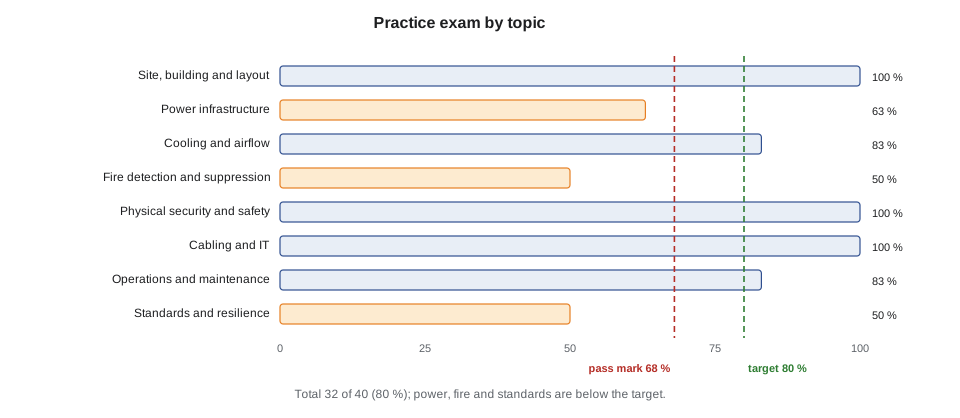
Thirty-two of 40 is 80 percent, comfortably above the 68 percent pass mark, and exactly at the 80 percent target from lesson 2. But the total hides the pattern. Power, fire and standards are below the target, and together they are a third of the exam. The error log tells Jamal why.
The error log
| Question | Topic | Cause | Action |
|---|---|---|---|
| 7 | Power | Did not know: difference between static and maintenance bypass | Flashcards; read UPS-A2 one-line on next shift |
| 9 | Power | Calculation slip: used √3 on a single-phase circuit | Rule: write single or three phase before the formula |
| 12 | Power | Fell for a distractor: N+1 modules sharing one output | Review lesson 3 redundancy table |
| 17 | Cooling | Misread: missed NOT in the stem | Rule: circle NOT, EXCEPT, FIRST |
| 22 | Fire | Did not know: double-interlock pre-action | Valve room visit with Ike |
| 23 | Fire | Did not know: inert gas oxygen level | Flashcards |
| 31 | Operations | Fell for a distractor: added availabilities of parallel paths | Redo lesson 8 example |
| 38 | Standards | Did not know: Tier III concurrently maintainable | Reread DCT-110 lesson 8 |
Four of eight errors are knowledge gaps, which flashcards and site visits will close. The other four are habits: the single-phase slip, the redundancy distractor, the parallel availability distractor and the misread. Each gets a one-line rule that Jamal writes at the top of his scratch paper on exam day. He spends the next week on power and fire, visits the valve room with Ike, reads the UPS-A2 one-line with Roz, and sits a second practice exam at the end of week 9. He scores 35 of 40, with every topic at 75 percent or more.
# Mini practice quiz: original questions, scored by topic
bank = [  # (topic, question, options, index of correct option)
    ("Power", "A 2N rack feed should be planned at no more than what share of its rating?",
     ["40 %", "80 %", "100 %", "60 %"], 0),
    ("Power", "Which bypass inside a UPS operates automatically in milliseconds?",
     ["Static bypass", "Maintenance bypass", "Generator bypass", "Tie breaker"], 0),
    ("Cooling", "How many BTU/h is 1 kW?", ["3,412", "12,000", "1,000", "3,517"], 0),
    ("Fire", "In a double-interlock pre-action system, what lets water in?",
     ["Detection and a head opening", "Detection only", "A head opening only", "A manual valve only"], 0),
    ("Operations", "Two parallel paths each 99.9 % available give about what availability?",
     ["99.9999 %", "99.8 %", "199.8 %", "99.9 %"], 0),
    ("Hardware", "Usable capacity of six 10 TB drives in RAID 6?",
     ["40 TB", "50 TB", "60 TB", "30 TB"], 0),
]
answers = [0, 1, 0, 1, 0, 0]   # one candidate's choices
by_topic = {}
for (topic, q, opts, right), pick in zip(bank, answers):
    got, total = by_topic.get(topic, (0, 0))
    by_topic[topic] = (got + (pick == right), total + 1)
    mark = "right" if pick == right else f"wrong (answer: {opts[right]})"
    print(f"[{topic}] {q} -> {mark}")
score = sum(g for g, _ in by_topic.values())
print(f"score {score} of {len(bank)} = {100 * score / len(bank):.0f} %")
for topic, (g, t) in by_topic.items():
print(f" {topic:<10} {g}/{t}")[Power] A 2N rack feed should be planned at no more than what share of its rating? -> right [Power] Which bypass inside a UPS operates automatically in milliseconds? -> wrong (answer: Static bypass) [Cooling] How many BTU/h is 1 kW? -> right [Fire] In a double-interlock pre-action system, what lets water in? -> wrong (answer: Detection and a head opening) [Operations] Two parallel paths each 99.9 % available give about what availability? -> right [Hardware] Usable capacity of six 10 TB drives in RAID 6? -> right score 4 of 6 = 67 % Power 1/2 Cooling 1/1 Fire 0/1 Operations 1/1 Hardware 1/1
Exam day and the result
Dmitri swapped shifts so Jamal had two days off before the exam. Jamal sat the CDCP at the training centre in Montréal, wrote his formula table and his four rules on the scratch paper, finished the first pass at minute 41 and used the review time on six flagged questions. He passed with 34 of 40, 85 percent. Anjali posted the result on the operations board, and the study group went for breakfast after their next night shift.
Passing changed one thing on the job immediately: Stonebridge's customer documentation lists the credentials of technicians who work in customer cages, and Corvid AI's contract asks for certified technicians in Hall D. It did not change Jamal's authorizations. He still needs sign-off on the practical checklist (lesson 10) for the leak response EOP before working alone in Hall D on nights.
Writing a career plan
A career plan is a short document with three parts: where you want to be in about five years, the experience and credentials that will get you there, and the steps for the next year. Anjali asks every technician to write one at the end of the program and reviews it with them once a year. She is clear that the plan will change; its value is that it makes the next year's choices deliberate rather than accidental.
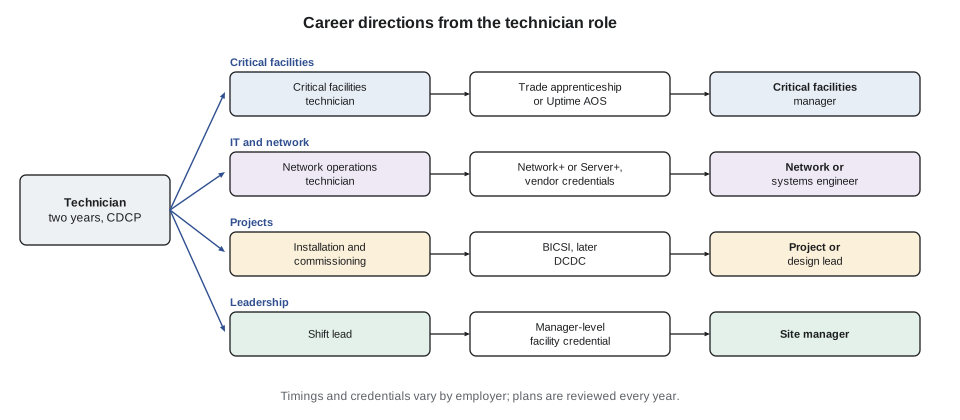
Lesson 1 described the main directions a career can take. Anjali sketched them for Jamal as a map.
| Direction | Typical next roles | Credentials and training along the way |
|---|---|---|
| Critical facilities | Critical facilities technician, facilities engineer | Trade apprenticeship (electrical or refrigeration), Uptime AOS, manager-level facility credential |
| IT and network operations | Network operations technician, systems engineer | CompTIA Network+ or Server+, vendor network and server credentials |
| Projects and commissioning | Installation lead, commissioning technician, project coordinator | BICSI Technician, later DCDC; commissioning training |
| Operations leadership | Shift lead, operations manager, site manager | Facility manager credential, Uptime AOS or AOP, leadership training |
Pay and the job market
Pay depends on region, employer, shift pattern and credentials, so treat any figure as a rough guide. In the US, the Bureau of Labor Statistics reported a median of about 76,220 USD a year in May 2025 for computer network support specialists, the occupation closest to many data centre technician roles, with little change projected in overall numbers; data centre roles in busy markets such as Northern Virginia often pay more, especially with shift premiums. In Canada, demand is growing in Quebec and Ontario as new capacity is built around Montréal and Toronto, and published pay for data centre technicians varies widely by employer. The code below compares paths with a simple illustrative pay index rather than real salaries.
# Illustrative five-year comparison of career directions (index: technician today = 100)
paths = {   # direction: (index after 5 years, years of study or apprenticeship needed)
    "Critical facilities (with trade ticket)": (150, 4),
    "IT and network operations":               (135, 1),
    "Projects and commissioning":              (140, 2),
    "Operations leadership":                   (145, 3),
}
for name, (index, study) in sorted(paths.items(), key=lambda kv: -kv[1][0]):
print(f"{name:<40} index {index} study {study} yr per study year {(index - 100) / study:5.1f}")Critical facilities (with trade ticket) index 150 study 4 yr per study year 12.5 Operations leadership index 145 study 3 yr per study year 15.0 Projects and commissioning index 140 study 2 yr per study year 20.0 IT and network operations index 135 study 1 yr per study year 35.0
The index numbers are invented for the course; real figures depend on the market. The point of the comparison is the shape: the critical facilities path pays well but needs a long trade apprenticeship, while the network path is quicker to enter.
Jamal's plan
Jamal enjoyed Hall D more than any other part of the program, especially the liquid cooling and the network. His five-year aim is a lead role in liquid-cooled AI halls, where facilities and IT meet. His plan:
- This year: finish practical sign-off in Hall D, including the leak response EOP; take Network+; join the commissioning team for the Hall E build as a technician.
- Years two and three: move to critical facilities technician on the Hall D and E team; begin the refrigeration or electrical apprenticeship that Stonebridge sponsors, or take the Uptime AOS if he stays on the operations side.
- Years four and five: apply for the Hall E operations lead role; consider a manager-level facility credential.
Roz's comment on the plan was one line: write down the dates your credentials expire next to the dates you want to take the next ones, so the renewals never surprise you.
# Credential and renewal tracker
from datetime import date
today = date(2027, 3, 8)
held = [  # (credential, earned, valid years or None for no expiry, renewal note)
    ("EPI CDCP", date(2027, 3, 5), 3, "check EPI or EXIN rules for renewal"),
    ("Electrical safety training (CSA Z462)", date(2026, 9, 14), 3, "site refresher course"),
    ("First aid and CPR", date(2025, 11, 2), 3, "full course"),
    ("Aerial lift ticket", date(2026, 4, 20), 3, "practical refresher"),
]
for name, earned, years, note in held:
    if years is None:
        print(f"{name:<38} no expiry")
        continue
    due = date(earned.year + years, earned.month, earned.day)
    left = (due - today).days
    flag = "renew soon" if left < 180 else "ok"
print(f"{name:<38} due {due} {left:>5} days {flag} ({note})")EPI CDCP due 2030-03-05 1093 days ok (check EPI or EXIN rules for renewal) Electrical safety training (CSA Z462) due 2029-09-14 921 days ok (site refresher course) First aid and CPR due 2028-11-02 605 days ok (full course) Aerial lift ticket due 2029-04-20 774 days ok (practical refresher)
The validity periods in the tracker are Stonebridge's internal refresh cycles and examples, not official rules; check each issuer's renewal policy and record it when you pass.
Closing the program
Jamal's first day at Stonebridge was a guided walk through a colocation facility (DCT-110 lesson 12). Two years later, he leads that walk for the next intake of technicians. He shows them the same entrance room, the same UPS rooms and the same hot aisles, and he tells them what Roz told him: the building is the textbook, every alarm is a lesson, and the best technicians never stop asking why.
Keeping knowledge current after the exam
Standards, equipment and practices keep changing after the certificate is framed. ASHRAE revises its thermal guidelines, NFPA and CSA codes are revised on regular cycles, new cooling methods arrive with each generation of hardware, and the AI halls of today will look dated within a few years. Roz's habits for staying current are modest: read the change summaries when a standard the site follows is revised, go to the vendor briefings that come with new equipment, join one local chapter of a professional association such as AFCOM or BICSI, and write one short lesson-learned note to the team after any unusual event. Over five years, those habits add up to more learning than the original credential.
Common mistakes
MistakeJudging readiness by the total practice score alone.
InsteadLook at topic scores and the error log; a good total can hide weak areas.
MistakeSitting the exam straight after a night shift.
InsteadArrange two days off and sleep before the exam.
MistakeTreating a certification as the end of learning.
InsteadPlan the next credential and the experience it needs, and track renewals.
MistakeWriting a career plan once and filing it.
InsteadReview it every year and change it as interests and the site change.
Summary and key terms
- A practice exam is sat like the real thing, scored by topic and followed by an error log.
- Knowledge gaps are fixed with flashcards and site visits; habit errors with one-line rules.
- Passing a credential adds evidence of knowledge but not authorization; practical sign-off still applies.
- Career directions include critical facilities, IT and network operations, projects and commissioning, and operations leadership.
- A career plan sets a five-year aim, the steps to it and the renewal dates of credentials held.
- Practice exam
- A full timed test sat under exam conditions to check readiness.
- Error log
- A record of each practice mistake, its cause and the action taken.
- Career plan
- A short written plan of career aims, steps and credentials, reviewed yearly.
- Renewal
- The process of keeping a credential valid, through study, exams or continuing education.
- Commissioning
- Testing new systems against their design before they enter service.
- Readiness
- The point at which practice results across all topics show the exam can be passed with margin.
Practice problems
Work each problem on paper first, then reveal the answer to check.
Jamal scored 32 of 40 with 8 errors: 4 did-not-know, 1 slip, 2 distractors, 1 misread. What share of errors were habit errors?
Show answer
4 of 8, or 50 percent.
Which three topics fell below his 80 percent target?
Show answer
Power, fire, and standards and resilience.
Did passing the CDCP let Jamal work alone in Hall D on nights?
Show answer
No. He still needed practical sign-off on the leak response EOP.
What did Roz suggest adding to the career plan?
Show answer
The expiry dates of credentials held, next to the dates for the next ones.
Lesson quiz · 5 questions
Score 60% or more to complete this lesson.
Create a free account to save your progress, take quizzes and earn a certificate.