
DCT-350 · Lesson 2 of 12 · 19 min
How certification exams work and how to study
Jamal's exam is booked for the first week of March, ten weeks away. He has never sat a professional exam, and the last test he wrote was in school. Roz has sat four, and Dmitri Volkov, the shift lead, has sat seven, including two he failed the first time. Between them they gave Jamal a short course on how these exams are built and how to prepare for them. This lesson passes that course on. It covers exam formats and scoring, the blueprint that tells you what is tested, how memory actually works, and a ten-week study plan built around shift work.
How professional exams are built
Certification exams are not written the way school tests are. A body such as EXIN, CompTIA or BICSI starts with a job task analysis: a survey of people who do the job, asking what tasks they perform and how important each one is. From that it builds a blueprint, sometimes called the exam objectives or domains, which lists the topics and the share of questions each one gets. Question writers then write items to the blueprint, and each item is reviewed, tried out on candidates as an unscored question, and kept only if it behaves well: people who know the topic get it right and people who do not, mostly get it wrong.
This matters to you in three ways. First, the blueprint is the most useful study document you can get, because it tells you where the marks are. Second, questions are written about real tasks, so they usually describe a situation and ask what you would do, not just what a word means. Third, some questions on your exam may be unscored trial items. You cannot tell which, so treat every question as if it counts.
Question formats
- Single best answer: four options, one correct. The other three, called distractors, are written to look right to someone with a partial understanding. This is the most common format by far.
- Multiple response: choose two or three correct options. Read the stem carefully for the number required.
- Scenario sets: a short case, such as an alarm list or a single-line diagram, followed by several questions.
- Performance-based items: a simulation in which you drag labels onto a diagram, order steps, or configure something. CompTIA exams use these, often at the start.
- Practical assessments: hands-on tasks marked by an assessor, such as terminating a fibre or completing a cable test. BICSI Installer and Technician exams include these (LVT-340).
Scoring
Some exams use a raw score and a fixed pass mark. The EXIN-published CDCP, for example, is described in study guides as 40 questions with a pass mark of 68 percent, which is 27 correct answers. Others use a scaled score, where your raw result is converted to a scale so that different versions of the exam are equally hard to pass. CompTIA reports scores from 100 to 900; its published passing scores are 675 and 700 for the two A+ exams and 720 for Network+. A scaled score is not a percentage, and there is no simple way to convert it to one, so do not try to work out how many questions you can miss.
Most exams give no penalty for wrong answers. If that is the case, never leave a question blank. Check the candidate handbook: it is the authority on scoring, timing, breaks, identification and what you may bring.
Worked problem
How many can you get wrong?
The CDCP has 40 questions and a 68 percent pass mark. How many questions can Jamal get wrong and still pass, and what percentage must he score on a practice test of 60 questions to be at the same standard?
Show solution
- Pass mark: 0.68 × 40 = 27.2, so he needs 27 or more correct (the published figure is 27).
- Wrong answers allowed: 40 − 27 = 13.
- On a 60-question practice test, the same standard is 0.68 × 60 = 40.8, so about 41 correct.
- Aim higher than the pass mark in practice: real exams feel harder than practice tests, so a practice score of 80 percent or more is a safer target.
Answer: He can miss 13 of 40. In practice he should aim for about 48 of 60 (80 percent), not 41.
The blueprint and your study plan
A blueprint gives each domain a weight. If a domain is 25 percent of the exam, it should get roughly a quarter of your study time, adjusted for how well you already know it. Jamal's study pack for the CDCP lists eight topic areas. He gave each a confidence rating from 1 (weak) to 5 (strong) after a first diagnostic test, then shared his study hours so that heavier and weaker areas get more time.
| Topic area | Weight | Jamal's confidence (1-5) |
|---|---|---|
| Site, building and layout | 10 % | 4 |
| Power infrastructure | 20 % | 2 |
| Cooling and airflow | 15 % | 3 |
| Fire detection and suppression | 10 % | 2 |
| Physical security and safety | 10 % | 3 |
| Cabling and IT infrastructure | 15 % | 5 |
| Operations and maintenance | 15 % | 4 |
| Standards and resilience | 5 % | 3 |
# Share study hours by blueprint weight, adjusted for confidence (1 weak - 5 strong)
topics = [  # (topic, weight %, confidence)
    ("Site and layout", 10, 4), ("Power", 20, 2), ("Cooling", 15, 3), ("Fire", 10, 2),
    ("Security and safety", 10, 3), ("Cabling and IT", 15, 5), ("Operations", 15, 4), ("Standards", 5, 3),
]
hours = 60   # ten weeks at six hours a week
need = {t: w * (6 - c) for t, w, c in topics}   # weaker topics get more weight
total = sum(need.values())
plan = {t: hours * n / total for t, n in need.items()}
for t, w, c in topics:
    print(f"{t:<20} weight {w:>2} %  conf {c}  ->  {plan[t]:4.1f} h")
print(f"{'Total':<20} {sum(plan.values()):.1f} h")Site and layout weight 10 % conf 4 -> 4.4 h Power weight 20 % conf 2 -> 17.5 h Cooling weight 15 % conf 3 -> 9.8 h Fire weight 10 % conf 2 -> 8.7 h Security and safety weight 10 % conf 3 -> 6.5 h Cabling and IT weight 15 % conf 5 -> 3.3 h Operations weight 15 % conf 4 -> 6.5 h Standards weight 5 % conf 3 -> 3.3 h Total 60.0 h
The plan gives power nearly 17 hours and cabling only 2.5. That feels uncomfortable for Jamal, who enjoys cabling, but it is the right answer: hours spent on what you already know raise your confidence without raising your score.
How memory works, and why rereading fails
Most people study by rereading notes and highlighting. It feels productive because the material becomes familiar, but familiarity is not the same as being able to recall something under pressure. Two findings from learning research are worth building your study around.
- Retrieval practice: trying to recall an answer, without looking, strengthens memory far more than reading it again. Practice questions, flashcards and explaining a topic out loud are all retrieval.
- Spacing: reviewing material at growing intervals, rather than all at once, makes it last. A fact reviewed after one day, then three, then a week, then two weeks is remembered much longer than the same fact reviewed four times in one evening.
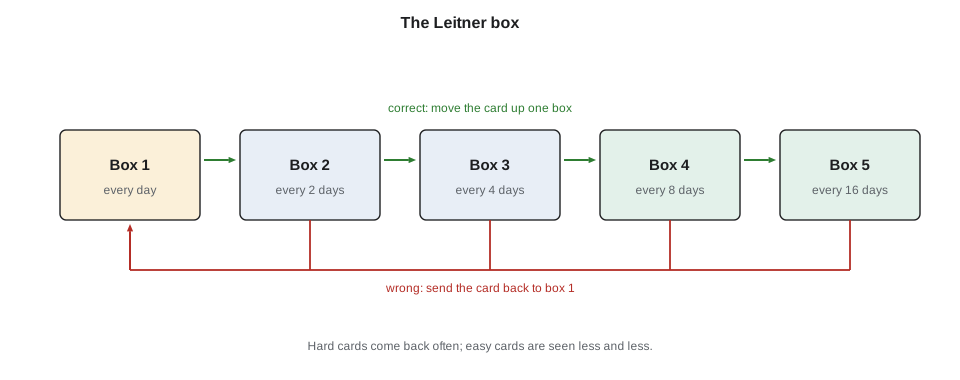
Together these give spaced repetition. One simple form is the Leitner box. Each flashcard starts in box 1. When you answer a card correctly it moves up a box; when you get it wrong it goes back to box 1. Box 1 is reviewed every day, box 2 every two days, box 3 every four days, and so on. Cards you know drift to the high boxes and stop taking your time; cards you struggle with keep coming back.
# Leitner spaced repetition: which cards are due on each study day?
intervals = {1: 1, 2: 2, 3: 4, 4: 8, 5: 16}      # box -> days between reviews
cards = {"UPS double conversion": 1, "N+1 meaning": 3, "BTU/h per kW": 2,
         "Pre-action types": 1, "OM4 jacket": 4, "Delta-T from airflow": 2}
last = {c: 0 for c in cards}                       # all last reviewed on day 0
results = {  # day -> cards answered wrongly that day (everything else is right)
    1: ["Pre-action types"], 2: ["BTU/h per kW"], 4: [], 8: ["N+1 meaning"]}
for day in range(1, 9):
    due = [c for c in cards if day - last[c] >= intervals[cards[c]]]
    if not due:
        continue
    for c in due:
        if c in results.get(day, []):
            cards[c] = 1
        else:
            cards[c] = min(cards[c] + 1, 5)
        last[c] = day
print(f"day {day}: reviewed {len(due)} -> " + ", ".join(f"{c} (box {cards[c]})" for c in due))day 1: reviewed 2 -> UPS double conversion (box 2), Pre-action types (box 1) day 2: reviewed 3 -> BTU/h per kW (box 1), Pre-action types (box 2), Delta-T from airflow (box 3) day 3: reviewed 2 -> UPS double conversion (box 3), BTU/h per kW (box 2) day 4: reviewed 2 -> N+1 meaning (box 4), Pre-action types (box 3) day 5: reviewed 1 -> BTU/h per kW (box 3) day 6: reviewed 1 -> Delta-T from airflow (box 4) day 7: reviewed 1 -> UPS double conversion (box 4) day 8: reviewed 2 -> Pre-action types (box 4), OM4 jacket (box 5)
Jamal keeps his cards in a free flashcard app that does the scheduling for him, but the idea is the same. He writes his own cards from his mistakes on practice questions, which keeps them about the things he actually gets wrong.
A ten-week plan around shifts
Shift work makes study harder: four days on, four days off, nights every third block. Dmitri's advice is to study little and often on shift days and longer on days off, and to protect sleep above all. A tired brain on a night shift does not remember what it reads.
- Weeks 1-2: diagnostic test, blueprint, study plan, and first pass through the weakest two areas.
- Weeks 3-7: one topic area per week or so, in plan order. Each session ends with practice questions on that topic. Flashcards every day, ten to fifteen minutes.
- Week 8: first full timed practice exam. Mark it, log every mistake by cause, and adjust the plan.
- Week 9: work on the weakest areas from the practice exam; second full practice exam at the end of the week.
- Week 10: light review only, flashcards, sleep, logistics. No new material in the last two days.
Studying in a small group helps. Six Stonebridge technicians are taking the CDCP this spring, and they meet on the operations floor for half an hour at shift change on Tuesdays to explain one topic each to the others. Explaining a topic is retrieval practice of the strongest kind, and it shows quickly who has understood it.
Using the job as a study tool
The best preparation a technician has is the site itself. When the study pack covers static bypass, Jamal asks to read the UPS-A2 one-line on his next shift. When it covers pre-action sprinklers, he asks Ike Adeyemi to show him the valve room and the panel. Every topic in the blueprint exists somewhere on the campus, and linking a fact to a place you have stood in makes it far easier to recall. The review lessons that follow do the same: each one points back to the DCT lesson where the topic was taught on the Stonebridge floor.
Study groups and accountability
Jamal did not study alone. Roz started a study group with Jamal, Tomás and Elif, who were preparing for different credentials but shared most of the facility content. They met for an hour after the Tuesday day shift in the Hall A training room. Each week one person taught a topic for fifteen minutes, using the site itself as the textbook, and the others asked questions. The rest of the hour went on a short quiz written by the person who taught, which forced everyone to turn their notes into questions.
Teaching a topic is one of the most effective ways to find the gaps in your own understanding, because you cannot explain what you do not understand. A group also keeps the plan on track: missing a week means letting three people down, not just yourself. Keep groups small, set an agenda, and stop the meeting from turning into a complaint session about the exam.
Common mistakes
MistakeRereading notes and highlighting as the main way to study.
InsteadUse retrieval: practice questions, flashcards and explaining aloud.
MistakeCramming in the last week.
InsteadSpace reviews over the whole period; the last two days should be light.
MistakeStudying the topics you enjoy most.
InsteadShare time by blueprint weight and weakness.
MistakeConverting a scaled score to a percentage to count allowed mistakes.
InsteadScaled scores are not percentages; aim well above the pass level in practice.
Summary and key terms
- Exams are built from a job task analysis and a blueprint that gives each domain a share of the questions.
- Formats include single best answer, multiple response, scenario sets, performance-based items and practical tasks.
- Scores may be raw with a fixed pass mark (CDCP 27 of 40) or scaled (CompTIA 100-900).
- Retrieval practice and spacing beat rereading; the Leitner box combines both.
- A study plan shares hours by blueprint weight and weakness, with timed practice exams near the end.
- Blueprint
- The published list of exam domains or objectives and the share of questions each receives.
- Distractor
- A wrong option written to look correct to someone with partial knowledge.
- Scaled score
- A score converted to a fixed scale so that different exam versions are equally hard to pass.
- Retrieval practice
- Learning by recalling information without looking at it.
- Spaced repetition
- Reviewing material at increasing intervals, such as with a Leitner box.
- Job task analysis
- A survey of practitioners used to decide what an exam should test.
Practice problems
Work each problem on paper first, then reveal the answer to check.
A 50-question exam has a 70 percent pass mark. How many questions may you get wrong?
Show answer
Pass needs 35 correct, so 15 may be wrong.
A topic has weight 20 and confidence 2 in Jamal's formula. What is its need score?
Show answer
20 × (6 − 2) = 80.
A card in box 3 is answered wrongly. Where does it go?
Show answer
Back to box 1, reviewed daily.
Why should the last two days before the exam have no new material?
Show answer
New material crowds out recall of what is already learned, and rest and sleep matter more.
Lesson quiz · 5 questions
Score 60% or more to complete this lesson.
Create a free account to save your progress, take quizzes and earn a certificate.