
DCT-350 · Lesson 11 of 12 · 24 min
Practice exam strategy
Two candidates with the same knowledge can score ten points apart because one of them handles the exam better: reads each question properly, manages time, does not get stuck, and avoids changing right answers to wrong ones. Dmitri, who failed his first Network+ attempt by a handful of points and passed easily the second time, puts it simply: the second time he knew a little more, but mostly he had learned how to sit the exam. This lesson covers that skill: reading questions, eliminating options, handling calculations, pacing, reviewing, and the practical side of exam day.
Read the stem first, and read all of it
The stem is the question part. Read it to the end before looking at the options, and pick out three things: the situation (where you are, what is happening), the constraint (what you may or may not do, what has already happened) and the actual question (what, why, which, first, best, most likely). Exam writers put the key word at the end of the stem more often than not.
Watch for words that change the meaning: NOT, EXCEPT, FIRST, NEXT, BEST, MOST LIKELY, LEAST. A question that asks what a technician should do first wants the safe first step, even if several options are things the technician would eventually do. A question that asks for the most likely cause wants the common cause, not the dramatic one.
Worked problem
Reading a first-step question
A leak sensor under rack D-3-14 alarms in Hall D. The CDU shows a small drop in loop pressure. What should the technician do first? (A) Replace the quick disconnect on the nearest server. (B) Tell the operations desk and follow the leak EOP's first steps. (C) Open the rack's branch valves fully to keep flow up. (D) Start writing the incident report.
Show solution
- The situation is an active alarm with evidence of a real leak.
- The constraint is the technician's role: they act under the EOP, not on their own judgement.
- The question is what to do first.
- A is a repair, done later under procedure. C would make a leak worse. D comes after the event is contained.
- B is the safe first step: communicate and follow the EOP, which starts with protecting people and load (DCT-120 lesson 10).
Answer: B.
Eliminate before you choose
Distractors are written to attract people with partial knowledge, so they often contain a real term used in the wrong place. Before choosing, strike out options that are clearly wrong. Common patterns of wrong options:
- Unsafe or outside the technician's role: operating switchgear, bypassing an interlock, skipping lockout.
- Absolute words where the truth is conditional: always, never, all, none. These are sometimes right in safety rules, so read carefully.
- A correct fact that does not answer the question asked.
- Two options that say the same thing in different words; if both cannot be right, neither probably is.
- A plausible term from the wrong system: a static bypass where the question is about generators, or a CRAC where the question is about chilled water.
Even if you cannot find the right answer, eliminating two options turns a one-in-four guess into a one-in-two guess. Over a 40-question exam that matters.
Calculations
Facility exams include short calculations: kW to BTU/h and tons, three-phase current, airflow from heat and ΔT, UPS runtime, PUE, availability, RAID capacity, loss budgets. Do them on the whiteboard or scratch paper you are given, write the formula first, keep units in every line, and check the answer for sense. A three-phase current of 9,000 A for a single rack, or a PUE below 1, is a sign of a slip.
Many calculation questions put the most common wrong answers in the options: the answer without √3, the answer in BTU/h when the question asked for tons, the answer for RAID 5 when the question said RAID 6. If your first answer matches an option instantly, it is still worth one second to check which mistake each other option represents.
| Quantity | Formula to write first |
|---|---|
| Heat to BTU/h and tons | BTU/h = kW × 3,412; tons = kW / 3.517 |
| Three-phase current | I = P / (√3 × V × PF) |
| Airflow | kW = 1.2 × m³/s × K (BTU/h = 1.08 × cfm × °F) |
| UPS runtime | hours = kWh / (load kW / efficiency) |
| PUE | total facility energy / IT energy |
| Availability | MTBF / (MTBF + MTTR); series multiply, parallel multiply unavailabilities |
| RAID 5, RAID 6 | (n − 1) × c, (n − 2) × c |
| Loss budget | length × dB/km + pairs × dB + splices × dB |
Some candidates write this table on their scratch paper in the first two minutes, from memory, so they never have to recall a formula under pressure. Check the exam's rules first; most allow it once the exam has started.
Pacing
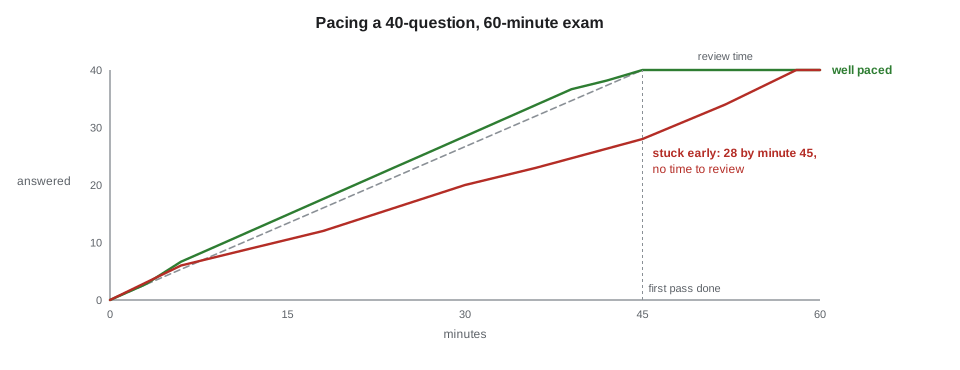
Work out your time per question before exam day. The CDCP's 40 questions in 60 minutes give 90 seconds each. A 90-question exam in 90 minutes gives 60 seconds each, minus time for any performance-based items. Plan two passes: a first pass answering everything you can in about 75 percent of the time, flagging questions you are unsure of, and a second pass on the flagged ones. Never leave a question blank on an exam with no penalty for wrong answers; guess and flag it.
# Pacing plan: time per question, checkpoints and first-pass target
def pacing(questions, minutes, first_pass_share=0.75, pbq=0, pbq_minutes=0):
    mcq = questions - pbq
    mcq_minutes = minutes - pbq_minutes
    per_q = mcq_minutes * 60 / mcq
    first = minutes * first_pass_share
    print(f"{questions} questions in {minutes} min: {per_q:.0f} s per multiple-choice question")
    print(f"  first pass done by minute {first:.0f}, leaving {minutes - first:.0f} min to review")
    for frac in (0.25, 0.5, 0.75):
        q = round(mcq * frac)
        t = pbq_minutes + q * per_q / 60 * first_pass_share / 1.0
        print(f"  checkpoint: question {q + pbq} by about minute {t:.0f}")
pacing(40, 60)
pacing(90, 90, pbq=4, pbq_minutes=16)40 questions in 60 min: 90 s per multiple-choice question first pass done by minute 45, leaving 15 min to review checkpoint: question 10 by about minute 11 checkpoint: question 20 by about minute 22 checkpoint: question 30 by about minute 34 90 questions in 90 min: 52 s per multiple-choice question first pass done by minute 68, leaving 22 min to review checkpoint: question 26 by about minute 30 checkpoint: question 47 by about minute 44 checkpoint: question 68 by about minute 57
The second example allows 16 minutes for four performance-based items. Many candidates skip performance-based items at the start, answer the multiple-choice questions, and come back to them, because a slow simulation at the start can wreck the whole exam's pacing. Check whether your exam lets you move back and forth before planning this.
Reviewing and changing answers
On the second pass, look only at flagged questions first, then at any others if time remains. Change an answer only if you find a definite reason: you misread the stem, you made an arithmetic slip, or a later question reminded you of a fact. Changing on a vague feeling tends to turn right answers into wrong ones.
The practice exam routine
Practice exams are only useful if they are treated like the real thing and then studied afterwards. Jamal's routine for each one:
- Sit it timed, in one go, without notes, at a desk, with the phone in another room.
- Mark it and record the score by topic.
- Go through every question you got wrong and every question you guessed right, and log the reason in one of four categories: did not know, misread the question, calculation slip, or fell for a distractor.
- Make a flashcard for every did-not-know item, and a one-line rule for every misread or distractor (for example: read to the end of the stem before the options).
- Adjust the study plan towards the weakest topics.
The error log is more useful than the score. In his first practice exam Jamal scored 31 of 40, and his log showed that four of his nine errors were misreads, mostly missing NOT and FIRST. Two practice exams later, after drilling stem reading, his misreads were down to one.
Exam day
- Know the rules: identification needed, what you may bring, arrival time, breaks, and for online exams the room and camera rules. Read the candidate handbook a week before.
- For an online proctored exam, test the computer, camera and connection the day before, clear the desk, and close every other program.
- Sleep properly the night before; avoid working a night shift before the exam. Dmitri swapped his shifts with Jamal's so Jamal had two days off before the exam.
- Eat beforehand and arrive early; rushing raises stress and lowers recall.
- If you feel panic, stop for a few slow breaths, then answer an easy question to get moving again.
Exam traps in strategy
- FIRST and NEXT questions want the safe step, usually communicate, protect people, or follow the procedure.
- The most dramatic option is rarely the most likely cause.
- An option that would be right on a different site or with a different role is still wrong for the question as written.
- Do not import facts from your own site that the question has not given; answer from the stem.
Worked elimination
Worked problem
Eliminating to two options
Which of these best explains rising inlet temperatures at the top of racks at the end of a cold aisle, while supply air temperature is normal? (A) The chiller has failed. (B) Hot exhaust air is recirculating over the tops of the racks because the aisle is short of airflow. (C) Humidity in the hall is too high. (D) The CRAH units are supplying too much air.
Show solution
- A: a failed chiller would raise supply air temperature everywhere, and supply is normal. Eliminate.
- C: humidity does not raise inlet temperature at one place. Eliminate.
- D: too much air would lower inlet temperatures, not raise them. Eliminate.
- B fits all the evidence: local, at the top, at the end of the aisle, with normal supply.
Answer: B. Each wrong option conflicts with one piece of evidence in the stem; finding that conflict is the elimination.
Calculation distractors
Worked problem
Matching each option to a mistake
A three-phase load draws 50 A at 600 V and a power factor of 0.9. What is its real power? (A) 46.8 kW (B) 27.0 kW (C) 30.0 kW (D) 52.0 kW
Show solution
- Correct: P = √3 × 600 × 50 × 0.9 = 46,765 W, about 46.8 kW. That is A.
- B is 600 × 50 × 0.9 = 27.0 kW: the single-phase formula, missing √3.
- C is 600 × 50 = 30.0 kW: missing both √3 and the power factor.
- D is √3 × 600 × 50 = 52.0 kVA: apparent power, not real power.
Answer: A. Every distractor is a predictable slip. If you can name the mistake behind each other option, you can be confident in your answer.
Long scenario questions
Some questions give a paragraph of detail, and not all of it matters. Read the question line first, at the end of the stem, then read the scenario looking for the facts that answer it. A long description of a hall's layout followed by a question about who approves a change needs only the risk score and the approval table; the layout is there to test whether you can ignore it. Underline or note the two or three facts that matter on your scratch paper.
When a question uses a term you do not recognize, do not panic. Often the term is a distractor or a brand-specific name, and the question can be answered from the other details. If you can reason out what the term probably means from its parts, such as a pre-action valve being something that acts before water flows, do so, and move on.
The arithmetic of guessing
On an exam with no penalty for wrong answers, a blind guess on a four-option question has a one-in-four chance. If you can eliminate one option, your chance becomes one in three; eliminating two makes it one in two. Suppose you are truly unsure of eight questions on a 40-question exam. Guessing blindly on all eight gives an expected two correct; eliminating two options on each gives an expected four. Two extra marks on the CDCP is five percent, often the difference between a narrow fail and a pass.
# Expected marks from guessing, with and without elimination
unsure = 8
for left in (4, 3, 2):
    expected = unsure / left
print(f"{left} options left on each of {unsure} questions: expect {expected:.1f} correct")4 options left on each of 8 questions: expect 2.0 correct 3 options left on each of 8 questions: expect 2.7 correct 2 options left on each of 8 questions: expect 4.0 correct
Performance-based items
Some exams include performance-based items: ordering the steps of a procedure, matching terms to definitions, dragging components onto a diagram, or working in a simulated interface. These often carry more marks than a single multiple-choice question and take longer. Read the instructions on each one carefully, because some allow partial credit and some do not. If your exam lets you move back and forth, it can make sense to note them, answer the multiple-choice questions first, and return with a known amount of time left. Try the item types with the exam provider's own sample items if they publish any.
When a question seems wrong
Occasionally a question looks wrong: two options seem correct, or none does. Choose the option that best fits the exam's body of knowledge rather than your own site's practice, flag it, and use the comment feature if the exam has one. Then let it go. Spending five minutes arguing with one question costs more marks than the question is worth.
Common mistakes
MistakeReading the options before finishing the stem.
InsteadRead the whole stem, find the question word, then read the options.
MistakeSpending five minutes on one hard question early on.
InsteadAnswer your best guess, flag it, and move on.
MistakeChanging answers on a feeling during review.
InsteadChange only for a definite reason.
MistakeUsing practice exams only for the score.
InsteadLog every error by cause and act on the pattern.
Summary and key terms
- Read the whole stem; find the situation, the constraint and the question word.
- Eliminate unsafe, out-of-role, absolute and irrelevant options before choosing.
- Write formulas first, keep units, and sense-check calculation answers.
- Plan time per question and two passes; never leave a question blank without a penalty.
- Treat practice exams like the real thing and log every error by cause.
- Stem
- The question part of a multiple-choice item, before the options.
- Elimination
- Removing options that are clearly wrong before choosing.
- First pass
- Going through every question once, answering and flagging, before reviewing.
- Flag
- A mark on a question to return to it during review.
- Error log
- A record of practice mistakes and their causes.
- Performance-based item
- A simulated task in an exam, such as ordering steps or dragging labels.
Practice problems
Work each problem on paper first, then reveal the answer to check.
How many seconds per question does a 60-question, 75-minute exam allow?
Show answer
75 × 60 / 60 = 75 seconds.
Name the four error categories in Jamal's log.
Show answer
Did not know, misread, calculation slip, fell for a distractor.
A question asks for the action a technician should take NEXT after acknowledging an alarm. What usually comes next?
Show answer
Assess: read the alarm, check related points and trends.
When is it right to change an answer on review?
Show answer
Only when you find a definite reason, such as a misread or an arithmetic slip.
Lesson quiz · 5 questions
Score 60% or more to complete this lesson.
Create a free account to save your progress, take quizzes and earn a certificate.