
DCT-350 · Lesson 10 of 12 · 20 min
Practical skills checklist
Written exams test what you know. Employers, customers and some certifications also want to see what you can do. CNet's CDCTP includes practical work in its five-day program, BICSI's Installer and Technician credentials include timed hands-on tasks (LVT-340), and Stonebridge signs off every technician against a practical checklist before they work alone in each hall. This lesson sets out that checklist, explains how practical assessments are run and marked, and shows Jamal using it to find the skills he still needs to practise before his two-year sign-off.
How practical assessments work
A practical assessment is a task done in front of an assessor, who marks it against written criteria. The criteria usually have three kinds of item:
- Critical items, which must all be done correctly to pass at all. Breaking a safety rule, working on the wrong equipment, or skipping verification are critical failures, no matter how well the rest of the task goes.
- Process items, which check that the task is done in the right order with the right tools: checking the ticket, inspecting before connecting, recording results.
- Quality items, which check the result: a tidy cord route, correct labels, a test result within limits.
Assessors watch for habits as much as results. A candidate who gets a fibre link working but forgets to inspect the connector first has shown that the link worked this time, not that it will next time. Rehearse the whole routine, including the boring parts, until it is automatic.
The Stonebridge technician checklist
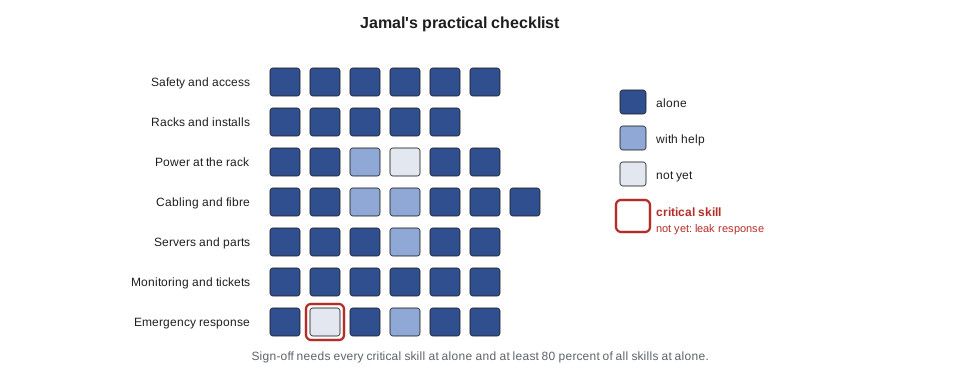
The checklist has seven groups. Each skill is marked not yet, with help, or alone. A technician needs every critical skill at alone, and at least 80 percent of all skills at alone, for sign-off in a hall.
| Group | Example skills (critical skills marked with *) | Taught in |
|---|---|---|
| Safety and access | Badge discipline*, escort duties*, arc flash label reading*, lockout as a worker*, tile handling, PPE selection | DCT-110, DCT-120 |
| Racks and installs | Rail and cage nut fitting, lifting with a server lift*, rack elevation reading, blanking, cabinet levelling | DCT-130 |
| Power at the rack | Reading PDU loads, A/B feed check*, 40 percent rule check, cord retention, branch circuit label reading | DCT-130, DCT-220 |
| Cabling and fibre | Inspect-clean-inspect*, polarity check, MPO handling, copper and fibre test, label against port map* | DCT-210, LVT-210 |
| Servers and parts | Locator light and serial check*, ESD protection*, drive swap with array check*, PSU and fan swap, RMA paperwork | DCT-310 |
| Monitoring and tickets | Alarm acknowledge-assess-act-escalate-record*, ticket updates, remote hands identity checks*, DCIM update | DCT-330 |
| Emergency response | EOP first steps*, leak response*, clean agent evacuation*, shift hand-off | DCT-120, DCT-340 |
Selected skills in detail
The critical skills are the ones where a single slip can drop a customer's load or hurt someone. Here is what the assessor looks for in five of them.
- A/B feed check: before closing an install or move ticket, trace each power supply of each server to its rack PDU, confirm one supply is on A and one on B, and confirm each PDU's side matches its label and the DCIM record. Failing to check, or finding both supplies on one side and closing anyway, is a critical failure.
- Inspect-clean-inspect: inspect every fibre end face with a scope before mating, clean if needed, inspect again, and only then connect. The assessor watches for new cords being connected straight from the bag.
- Locator light and serial check: before touching a server, light its locator from the BMC or the ticket tool, find it, and read the serial label against the ticket. Pulling a part from the wrong server is a critical failure even if the server survives.
- Drive swap with array check: confirm the array is healthy apart from the failed drive and not already rebuilding, confirm the failed drive's bay from the locator, swap it, and confirm the rebuild starts.
- Clean agent evacuation: on the pre-discharge alarm, stop work, leave by the nearest exit, close doors behind you, report to the assembly point, and do not re-enter until cleared.
Worked problem
Scoring Jamal's checklist
Jamal's checklist has 42 skills, 16 of them critical. He is at alone on 35 skills, with help on 5, and not yet on 2. One of the not-yet skills, the leak response EOP, is critical; the other, breaker label reading on a busway tap-off, is not. Is he ready for sign-off?
Show solution
- Share at alone: 35 / 42 = 83 percent, above the 80 percent requirement.
- Critical skills: the leak response EOP is critical and not yet at alone, so he fails the all-critical rule.
- Plan: a leak drill in Hall D with Roz, then the busway labels, then reassessment.
Answer: Not yet. He meets the 80 percent rule but not the every-critical-skill rule; one drill closes the gap.
# Practical checklist scorer: every critical skill at 'alone' and at least 80 % overall
skills = [  # (skill, critical, level)  level: 2 alone, 1 with help, 0 not yet
    ("Badge discipline", True, 2), ("Escort duties", True, 2), ("Arc flash label reading", True, 2),
    ("Lockout as a worker", True, 2), ("Server lift use", True, 2), ("A/B feed check", True, 2),
    ("Inspect-clean-inspect", True, 2), ("Label against port map", True, 2), ("Locator and serial check", True, 2),
    ("ESD protection", True, 2), ("Drive swap with array check", True, 2), ("Alarm response", True, 2),
    ("Remote hands identity checks", True, 2), ("EOP first steps", True, 2), ("Leak response", True, 0),
    ("Clean agent evacuation", True, 2),
] + [(f"Other skill {i}", False, 2) for i in range(1, 20)] + [
    ("Busway tap-off labels", False, 0), ("PDU load reading", False, 1), ("MPO handling", False, 1),
    ("Copper certification test", False, 1), ("RMA paperwork", False, 1), ("Shift hand-off", False, 1),
    ("Cabinet levelling", False, 2),
]
alone = sum(1 for _, _, lvl in skills if lvl == 2)
share = alone / len(skills)
missing = [s for s, crit, lvl in skills if crit and lvl < 2]
print(f"{len(skills)} skills, {alone} alone ({share * 100:.0f} %), critical skills {sum(c for _, c, _ in skills)}")
print("critical skills not yet alone:", ", ".join(missing) if missing else "none")
ready = share >= 0.80 and not missing
print("ready for sign-off" if ready else "not ready: close the gaps and reassess")42 skills, 35 alone (83 %), critical skills 16 critical skills not yet alone: Leak response not ready: close the gaps and reassess
Practising efficiently
Practical skills are learned by doing them correctly, many times, with feedback. Stonebridge keeps a training rack in the Hall A staging room with old servers, a pair of PDUs, patch panels, fibre trunks and a scope, so that technicians can practise without touching customer equipment. Roz's rules for practice are simple: say each step out loud the first few times; do the whole routine every time, including the paperwork; and get someone to watch and mark you against the checklist, because you will not notice your own shortcuts.
Drills cover the emergency skills that cannot be practised on live equipment. Stonebridge runs a tabletop exercise on each shift every month, where the shift lead describes an event and each person says what they would do, and a walk-through drill each quarter, where people go to the equipment and point to what they would operate or report. A real event is the worst time to read an EOP for the first time.
Professional habits
Some items on the checklist are not technical at all, and assessors weight them heavily because they predict how someone will behave when nobody is watching:
- Stopping work when unsure and asking, rather than guessing. Stonebridge calls this a stop-work right, and every person on site has it.
- Writing clear ticket updates: what was found, what was done, what was left, and what the next person needs to know.
- Leaving the work area as you found it or better: tiles closed, cords dressed, packaging removed, tools counted.
- Communicating with customers politely and accurately, without guessing causes or promising times you cannot keep.
- Respecting customer equipment and data: touching only what the ticket covers, and keeping what you see in a cage confidential.
Exam traps in practical assessments
- Skipping a critical item fails the task, however good the result.
- Verbal confirmation of steps is part of the method, not a sign of weakness.
- Assessors mark against the criteria, not against how quickly you finish.
- If the task tells you to do something unsafe, stop and say so; that is the correct answer.
- Tidy up and record before you say you have finished.
A marking sheet in detail
Stonebridge's marking sheet for a drive swap shows how the three kinds of item fit together. The assessor ticks each item as done, not done or done with a prompt, and writes a short note against anything not done.
| Item | Kind | What the assessor looks for |
|---|---|---|
| Ticket read and confirmed with the desk | Process | Ticket number, server, bay and part read back |
| Locator light and serial match | Critical | Serial label read against the ticket before touching the server |
| Array state checked | Critical | Degraded, not rebuilding, no other failed drives |
| ESD strap worn and connected | Critical | Strap on wrist and clipped to the chassis or rack before handling |
| Failed drive removed from the lit bay | Process | Correct bay, drive held by the carrier |
| Replacement part number checked | Process | Part number and firmware against the ticket |
| Rebuild confirmed started | Quality | Desk or customer confirms rebuild, or status light shows it |
| Failed drive bagged and logged for custody | Critical | Serial recorded, locked bin, chain of custody form |
| Ticket updated | Quality | Clear note of what was found, done and left |
The sheet looks long for a task that takes ten minutes, and that is the point: every line is something that has gone wrong at a real site. The serial check prevents pulling a drive from the wrong server; the array check prevents pulling a second drive from a degraded array; the custody record prevents a customer's data leaving the site in a technician's pocket.
Jamal's reassessment
A few weeks later, after the certification exam in lesson 12, Roz ran Jamal's leak response drill in Hall D. She described the scenario at the start of the night shift: a leak alarm under rack D-3-14 and a slow fall in CDU-D3A loop pressure. Jamal acknowledged the alarm on the desk, told the shift lead, and walked to the row with the leak kit. He stopped at the end of the aisle, looked for liquid on the floor before stepping in, found the sensor rope wet under the rack, and reported what he saw by radio.
He then followed the EOP: he confirmed the isolation valves for the rack against the drawing in the EOP, waited for the shift lead's go, and closed the rack's supply and return branch valves. He watched the CDU pressure stabilize, laid absorbent pads around the drip, kept clear of the power whips under the rack, and asked the desk to warn the customer that the rack's servers would throttle or shut down as their cold plates warmed. He did not try to find or fix the failing quick disconnect himself. Roz marked every critical item done, with one process note: he should have read the valve tag numbers aloud to the shift lead before closing them. Jamal's checklist reached every critical skill at alone, and Anjali signed him off for Hall D.
Feedback that sticks
Good assessors give feedback straight after the task, start with what was done well, name the specific item to improve and how, and ask the candidate to repeat the step correctly before leaving. Roz's note about reading the valve tags aloud was a single line, but Jamal practised it on the training rack the next day until it was automatic. Candidates should ask for that kind of specific note when an assessor says only well done or not quite.
Skills fade without use
Skills that are rarely used fade, sometimes within months. A technician who swaps drives every day keeps that skill sharp; the same technician may not have used the clean agent abort procedure in two years. Stonebridge therefore asks each technician to repeat the critical emergency skills in a drill at least once a year, and to be reassessed on any critical skill not used in that time. Sign-off is also hall-specific: a technician signed off in Hall A must be assessed again on the Hall D items, because the cooling, the EOPs and the risks differ.
For certification candidates, the lesson is the same as for exams: practise the routine regularly, not only the night before. A practical assessment that comes after weeks of practice feels like an ordinary shift.
Common mistakes
MistakeConnecting a fibre cord straight from the bag during an assessment to save time.
InsteadInspect and clean it first; that is a critical item.
MistakeTreating 80 percent overall as enough for sign-off.
InsteadEvery critical skill must also be at alone.
MistakePractising only the parts of a task you find hard.
InsteadRehearse the whole routine, including checks and paperwork.
MistakeReading the EOP for the first time during a real leak.
InsteadLearn EOPs in tabletop and walk-through drills.
Summary and key terms
- Practical assessments mark critical, process and quality items; a critical failure fails the task.
- Stonebridge's checklist has seven groups, from safety and access to emergency response.
- Sign-off needs every critical skill at alone and at least 80 percent of all skills at alone.
- Rehearse the whole routine with an observer, and use tabletop and walk-through drills for emergencies.
- Professional habits such as stopping when unsure and clear ticket updates are part of the checklist.
- Critical item
- An assessment item that must be done correctly to pass at all.
- Sign-off
- Formal confirmation that a person may do a task alone in a given area.
- Tabletop exercise
- A discussion-based drill in which people talk through their response to a scenario.
- Walk-through drill
- A drill in which people go to the equipment and show what they would do.
- Stop-work right
- The right of any person on site to stop work they believe is unsafe.
- Training rack
- Non-production equipment kept for practising tasks safely.
Practice problems
Work each problem on paper first, then reveal the answer to check.
A technician has 30 of 36 skills at alone, including all critical skills. Are they ready?
Show answer
30 / 36 = 83 percent, and all critical skills are done: yes.
Name the three kinds of item on a practical marking sheet.
Show answer
Critical, process and quality.
Why are emergency skills practised in drills rather than on the job?
Show answer
They cannot be practised on live equipment, and a real emergency is the worst time to learn them.
During an assessment you are told to remove a floor tile next to one that is already open. What should you do?
Show answer
Stop and say so: the rule is no more than two adjacent tiles open, with barriers, so close or barrier the area first as the procedure requires.
Lesson quiz · 5 questions
Score 60% or more to complete this lesson.
Create a free account to save your progress, take quizzes and earn a certificate.