
DCT-350 · Lesson 4 of 12 · 23 min
Facilities review: cooling and airflow
Every watt that goes into a data centre comes out as heat, and the cooling system's job is to carry that heat away without letting the IT equipment's inlet air or coolant get too warm. Cooling questions on facility exams are a mix of physics (heat, airflow, temperature difference), standards (the ASHRAE ranges), equipment (CRAC, CRAH, chillers, economizers, CDUs) and practice (containment, tiles, blanking). This review follows DCT-230 and gives you the conversions and formulas to have ready, worked the way exam questions ask for them.
Heat and the conversions you must know
One kilowatt of IT load produces one kilowatt of heat. Exams often switch units mid-question, so know these by heart: 1 kW = 3,412 BTU/h; 1 ton of refrigeration = 12,000 BTU/h = 3.517 kW; so 1 kW is about 0.284 tons. A 132 kW rack in Hall D therefore produces about 450,000 BTU/h, or about 37.5 tons of heat, which is why it needs liquid cooling (DCT-230 lesson 1).
Worked problem
Hall heat load in tons
Hall A carries about 1,200 kW of IT load plus about 6 percent for lighting, PDU losses and people. What cooling load is that in kW, BTU/h and tons?
Show solution
- Total heat = 1,200 × 1.06 = 1,272 kW.
- In BTU/h: 1,272 × 3,412 = 4,340,000 BTU/h.
- In tons: 1,272 / 3.517 = 362 tons.
Answer: About 1,272 kW, 4.34 million BTU/h or 362 tons, which matches the N = 9 CRAHs of 150 kW in DCT-230 (9 × 150 = 1,350 kW).
Airflow and temperature difference
Air carries heat in proportion to how much of it flows and how much it warms up. The working formulas are:
- SI: heat (kW) = 1.2 × airflow (m³/s) × ΔT (K), or about 1.2 × airflow (L/s) × ΔT / 1,000. The 1.2 comes from air density (about 1.2 kg/m³) times its specific heat (about 1.0 kJ/kg·K).
- US: heat (BTU/h) = 1.08 × airflow (cfm) × ΔT (°F).
Servers are designed to take a temperature rise of roughly 10 to 15 K (18 to 27 °F) from inlet to exhaust. For a given heat load, a smaller ΔT means more air is needed, and if the air supply cannot keep up, servers pull hot exhaust air back round to their inlets. That recirculation is the main cause of hot spots (DCT-230 lesson 7).
Worked problem
Airflow for a rack
A 6 kW cabinet in Hall A has a server temperature rise of 12 K. How much air must reach its front?
Show solution
- Airflow = heat / (1.2 × ΔT) = 6 / (1.2 × 12) = 0.417 m³/s = 417 L/s.
- One 25 percent perforated tile delivers about 340 L/s at Hall A's floor pressure, so the cabinet needs about 1.2 tiles; Hall A plans two per 6 kW cabinet to allow margin.
Answer: About 417 L/s, so one tile is not enough and two are planned.
The ASHRAE thermal guidelines
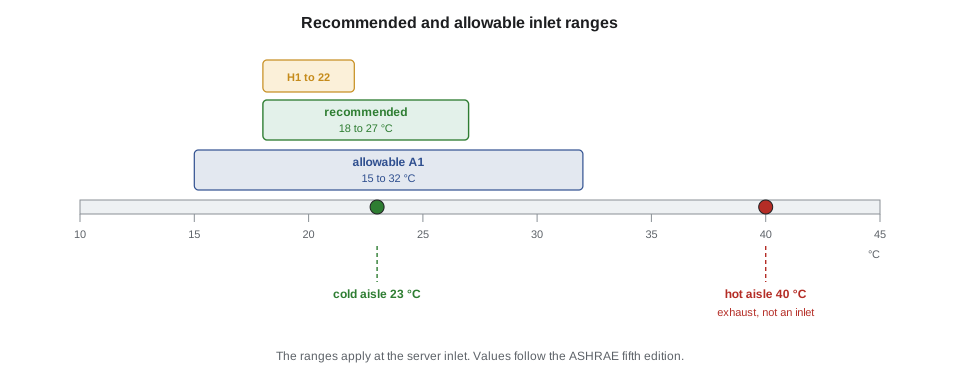
ASHRAE's Thermal Guidelines for Data Processing Environments (fifth edition, 2021) set the inlet conditions most sites work to. The recommended range for most classes is 18 to 27 °C (64.4 to 80.6 °F) at the server inlet, with humidity limits expressed through dew point and relative humidity. Allowable ranges are wider and vary by equipment class: class A1 allows 15 to 32 °C (59 to 89.6 °F). The fifth edition also added class H1 for high-density equipment, with a recommended upper limit of 22 °C (71.6 °F) (DCT-230 lesson 3).
Two common traps. The ranges apply at the server inlet, not at the CRAH return or in the hot aisle, where 35 to 45 °C (95 to 113 °F) is normal. And recommended is not the same as allowable: running in the allowable range is permitted for limited periods, but the site's target is the recommended range.
Equipment
- CRAC: computer room air conditioner, with its own compressor and refrigerant circuit.
- CRAH: computer room air handler, with a chilled water coil and fans but no compressor. Hall A has 12 CRAHs of 150 kW each, N+3.
- Chillers make chilled water; cooling towers or dry coolers reject the heat outdoors. YUL-2 uses dry coolers with adiabatic pads; IAD-3 uses cooling towers.
- Economizers use cold outdoor air or water to cool without running compressors. In Beauharnois's climate, about 95 percent of the year has full or partial free cooling (DCT-230 lesson 5).
- CDUs (coolant distribution units) in Hall D separate the facility water loop from the technology cooling loop that runs to the cold plates, and control its flow, pressure and supply temperature.
- Rear-door heat exchangers and in-row coolers bring liquid close to the rack without putting it inside the server.
Airflow management
Most hot spots are not caused by too little cooling capacity but by air going to the wrong place. Containment separates hot and cold air; Hall A uses cold-aisle containment and Halls B and C use hot-aisle containment. Blanking panels in empty rack spaces stop exhaust air from looping back to the front (DCT-130 lesson 9). Brush grommets seal cable openings in the floor. Perforated tiles belong only in cold aisles, and only in front of loaded cabinets. Exam questions often describe a symptom and ask which of these is the fix.
Bypass and recirculation are the two airflow faults. Bypass is cold air that returns to the CRAH without passing through any server, which shows up as a low ΔT across the CRAH (DCT-230, CRAH-A09). Recirculation is hot air reaching a server inlet, which shows up as high inlet temperatures at the top of racks or at row ends.
Liquid cooling numbers
For liquid, heat = mass flow × specific heat × ΔT. For PG25 (25 percent propylene glycol) the specific heat is about 3.9 kJ/kg·K and the density about 1.02 kg/L. In Hall D the coolant arrives at about 30 °C (86 °F) and leaves at about 40 °C (104 °F), and each rack takes about 167 L/min (44 gpm) (DCT-230 lesson 9).
# Cooling review calculator (SI)
KW_TO_BTUH, TON_KW = 3412, 3.517
def tons(kw): return kw / TON_KW
def air_ls(kw, dT_K): return kw / (1.2 * dT_K) * 1000          # litres per second
def liquid_kw(lpm, dT_K, cp=3.9, rho=1.02): return lpm / 60 * rho * cp * dT_K
def pue(total_kw, it_kw): return total_kw / it_kw
print(f"132 kW rack: {132 * KW_TO_BTUH:,.0f} BTU/h, {tons(132):.1f} tons")
print(f"Air for 6 kW at 12 K rise: {air_ls(6, 12):.0f} L/s")
print(f"Liquid heat at 167 L/min, 10 K rise: {liquid_kw(167, 10):.0f} kW")
print(f"PUE with 15,200 kW IT and 19,000 kW total: {pue(19000, 15200):.2f}")132 kW rack: 450,384 BTU/h, 37.5 tons Air for 6 kW at 12 K rise: 417 L/s Liquid heat at 167 L/min, 10 K rise: 111 kW PUE with 15,200 kW IT and 19,000 kW total: 1.25
The liquid result, about 110 kW, is close to the roughly 113 kW to liquid that DCT-230 measured on a 132 kW rack; the rest of the heat goes to the air through the rack's fans and power supplies.
PUE
Power usage effectiveness is total facility energy divided by IT energy, measured over a year. A PUE of 1.25 means 0.25 kW of cooling, power losses and lighting for every kilowatt of IT. Uptime Institute's 2025 survey put the industry average around 1.54; Stonebridge's annual figures are about 1.25 at YUL-2, the difference coming mostly from climate. Two traps: PUE is an annual energy ratio, not an instantaneous power reading, and lowering PUE by turning off IT is impossible because IT is the denominator. A more efficient server lowers IT energy and can even raise PUE slightly while saving energy overall.
Exam traps on cooling
- Inlet ranges apply at the server inlet, not at the CRAH return or the hot aisle.
- A low CRAH ΔT means bypass air, not too little cooling.
- More perforated tiles in the hot aisle make things worse.
- 1 ton = 12,000 BTU/h = 3.517 kW; a ton of cooling is a rate of heat removal, not a weight.
- Dew point, not relative humidity alone, tells you about condensation risk.
- For liquid loops, the CDU's approach temperature (facility water to coolant supply) rising over months means fouling, which DCT-230 fixed by cleaning.
Chilled water flow
Air carries heat from the servers to the cooling units; water carries it from the cooling units to the chillers. The water side follows the same rule as the air side: heat equals flow times specific heat times temperature difference. For plain water in SI units, kW = 4.19 × L/s × K. In US practice, the shortcut is tons = gpm × ΔT (°F) / 24, which comes from 500 × gpm × ΔT giving BTU/h and 12,000 BTU/h per ton (DCT-230 lesson 5).
Worked problem
Chilled water for a hall
A hall needs 500 kW of cooling from chilled water with a 5.6 K rise across the coils. What flow is needed?
Show solution
- Rearrange: L/s = kW / (4.19 × K).
- L/s = 500 / (4.19 × 5.6) = 500 / 23.5 = 21.3 L/s.
- Check: 21.3 L/s is about 1,280 L/min.
Answer: About 21 L/s. If the temperature rise falls to 4 K because coils are fouled or valves are wide open, the same heat needs 30 L/s, which is why a low ΔT is a classic sign of poor control.
The low-ΔT problem is a favourite exam point. When the return water comes back only slightly warmer than the supply, pumps work harder, chillers run inefficiently and the plant may run out of flow before it runs out of cooling capacity. Causes include bypass valves stuck open, three-way valves at units with no load, and dirty coils.
Airflow per kilowatt
A quick figure to remember: with a 12 K server temperature rise, each kilowatt needs about 1 / (1.2 × 12) = 0.07 m³/s, or about 250 m³/h, of air. A 10 kW rack therefore needs about 0.7 m³/s at its front. If the perforated tiles or grilles in front of it deliver half that, the servers make up the difference by pulling exhaust air round the sides and over the top.
A typical perforated tile with 25 percent open area delivers only about 200 to 300 L/s (400 to 600 cfm) at normal floor pressure, so high-density racks need high-flow grates, ducted returns, rear-door coolers or liquid cooling. Exams like to ask why adding more perforated tiles in a row can make cooling worse: each extra tile lowers the floor pressure, so the tiles that matter deliver less.
Humidity and dew point
Humidity limits protect equipment from two problems: condensation, if air reaches its dew point on a cold surface, and static discharge, if air is very dry. ASHRAE's recommended envelope controls moisture by dew point and relative humidity rather than relative humidity alone, because relative humidity changes with temperature even when the moisture in the air stays the same. The same air that reads 50 percent RH at the cold aisle reads about 25 percent RH in the hot aisle. An exam question that compares relative humidity readings taken at different temperatures is usually testing exactly this point.
Most modern sites humidify little or not at all, and they no longer fight between units, where one CRAH dehumidifies while the next one humidifies. That fighting wasted energy at older sites and is a known cause of high cooling costs.
Economizers and free cooling
Economizers use cool outside conditions to reduce or replace mechanical cooling. Air-side economizers bring filtered outside air into the hall; water-side economizers use cooling towers or dry coolers to chill the water without running the chiller compressors. Montréal's climate gives long free-cooling seasons, while Northern Virginia's humid summers give fewer free-cooling hours, which is one reason PUE varies between sites with similar equipment. Air-side economizers need careful filtration and humidity control, and some sites avoid them because of wildfire smoke and pollution.
Liquid cooling families
| Method | How it works | Technician concerns |
|---|---|---|
| Rear-door heat exchanger | A water coil in the rack's rear door cools exhaust air before it leaves the rack | Door hinges and hoses, condensation if water is too cold, airflow through the door |
| Direct-to-chip (cold plate) | Coolant flows through plates on CPUs and GPUs, fed by manifolds and a CDU | Quick disconnects, leak detection, coolant quality, filters |
| Immersion | Servers sit in a tank of dielectric fluid, single-phase or two-phase | Fluid handling, lifting servers out, fluid levels and compatibility |
Direct-to-chip cooling still leaves some heat in the air from memory, drives and power supplies, often a fifth to a third of the rack's load, so liquid-cooled halls still need air cooling. Hall D at Stonebridge is designed on that basis (DCT-230 lesson 9).
More exam traps on cooling
- CRAC units have their own compressors; CRAH units use chilled water. A question about a refrigerant leak points to a CRAC or chiller, not a CRAH.
- Supply air temperature at the unit is not the server inlet temperature; recirculation can raise inlet temperatures well above supply.
- A low chilled water ΔT means wasted flow, not extra cooling.
- PUE is measured over a period, usually a year; a single reading on a cold day flatters the site.
Common mistakes
MistakeMeasuring inlet temperature in the hot aisle.
InsteadMeasure at the server inlet, at the front of the rack.
MistakeAdding cooling units to fix a hot spot caused by missing blanking panels.
InsteadFix airflow first: blanking, tiles, containment and grommets.
MistakeTreating PUE as a real-time power ratio.
InsteadPUE is annual energy; instantaneous readings are only a trend.
MistakeForgetting the 1.2 or 1.08 factor in airflow sums.
InsteadUse heat = 1.2 × m³/s × K, or 1.08 × cfm × °F.
Summary and key terms
- 1 kW = 3,412 BTU/h; 1 ton = 12,000 BTU/h = 3.517 kW.
- Airflow: kW = 1.2 × m³/s × K, or BTU/h = 1.08 × cfm × °F.
- ASHRAE recommended inlet range is 18 to 27 °C (64.4 to 80.6 °F); allowable is wider and varies by class.
- CRAC has a compressor, CRAH a chilled water coil; economizers save compressor energy; CDUs serve liquid-cooled racks.
- Bypass shows as low CRAH ΔT; recirculation as high inlet temperatures; containment and blanking fix both.
- Ton of refrigeration
- A cooling rate of 12,000 BTU/h, or about 3.517 kW.
- ΔT
- Temperature difference, for example between a server inlet and its exhaust.
- Bypass air
- Cold air that returns to the cooling unit without passing through IT equipment.
- Recirculation
- Hot exhaust air that reaches equipment inlets.
- Economizer
- A mode or device that uses outdoor air or water to cool without compressors.
- PUE
- Power usage effectiveness: total facility energy divided by IT energy over a year.
Practice problems
Work each problem on paper first, then reveal the answer to check.
Convert 40 tons to kW.
Show answer
40 × 3.517 = 141 kW.
A CRAH moves 10 m³/s of air with a 9 K temperature drop. How much heat does it remove?
Show answer
1.2 × 10 × 9 = 108 kW.
A site uses 26,000 MWh a year in total and its IT uses 20,000 MWh. What is its PUE?
Show answer
26,000 / 20,000 = 1.30.
A CRAH shows supply and return air only 4 K apart while the hall is warm. What is the likely cause?
Show answer
Bypass air returning without passing through servers; check tiles, containment and blanking.
Lesson quiz · 5 questions
Score 60% or more to complete this lesson.
Create a free account to save your progress, take quizzes and earn a certificate.