
DCT-350 · Lesson 1 of 12 · 19 min
Certification paths for data centre technicians
Two years after his first day at Stonebridge Data, Jamal Pierce has worked a shift in every hall on the Beauharnois campus. He has installed racks in Hall D, swapped GPU trays under RMA, walked the generator yard on a storm night, read alarms on the operations desk and written his first method of procedure. Anjali Desai, the site manager, has told him that the next step is a certification. Stonebridge pays for one industry credential for every technician who finishes the two-year program, and Jamal has to choose which one. This last course of the program helps him, and you, make that choice and then pass the exam.
This lesson maps the certifications a data centre technician is likely to meet, explains what each one proves, and shows how to pick a sensible first credential and a path beyond it. Certification bodies change exam versions, names, prices and rules regularly, so every number in this lesson is a guide to look up and confirm on the body's own site before you book anything.
Why certify at all?
A certification does three things. It shows an employer or a customer that you have met a published standard of knowledge, set by someone other than your own manager. It gives you a structured reason to learn the parts of the job you have not yet met in your own hall. And it gives you a common vocabulary with people at other sites, other operators and other countries. Data centres are run by mixed teams of employees, contractors and vendors, and a credential is a quick way for a stranger to know roughly what you know.
A certification does not replace site training or authorization. Passing an exam on electrical systems does not authorize anyone to operate a switchboard at Stonebridge. Authorization comes from the site's own training, the site's procedures and, for electrical and mechanical trade work, the licence or certificate the law requires (DCT-120 lesson 4). Exam questions often test this exact point.
The main families of credentials
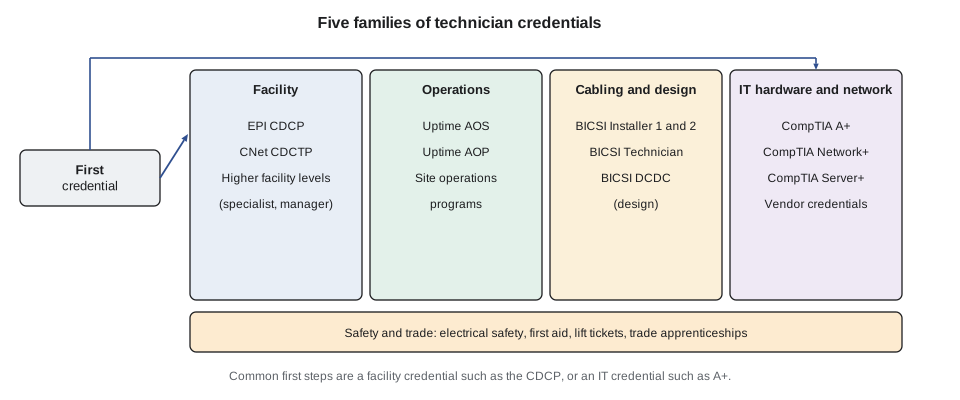
The credentials technicians meet fall into five families. Most people collect one or two from different families over a career rather than climbing a single ladder.
- Vendor-neutral data centre facility credentials, such as EPI's Certified Data Centre Professional (CDCP) and its higher levels, and CNet Training's Certified Data Centre Technician Professional (CDCTP). These cover the whole facility: power, cooling, fire, security, cabling and operations.
- Operations accreditations, such as Uptime Institute's Accredited Operations Specialist (AOS) and the higher Accredited Operations Professional (AOP). These focus on running a site against Uptime's operational sustainability ideas: staffing, maintenance, procedures and risk.
- Cabling and design credentials from BICSI, from the Installer and Technician levels you met in the low-voltage program (LVT-340) up to the Data Center Design Consultant (DCDC). The DCDC is a design credential with an experience requirement, so it is a later goal, not a first one.
- IT hardware and networking credentials, such as CompTIA A+, Network+ and Server+, and vendor credentials from switch, server and storage makers. These cover the equipment inside the racks rather than the building around them.
- Safety and trade qualifications: electrical safety training to CSA Z462 (NFPA 70E) (DCT-120), first aid, working at heights, fork lift or aerial lift tickets, and trade licences for electricians and refrigeration mechanics. These are often required before you may do certain work at all.
Vendor-neutral facility credentials
EPI, a data centre training company, publishes a framework of facility certifications that starts with the Certified Data Centre Professional (CDCP). The CDCP is usually taught as a two-day course and assessed by an exam published by EXIN, an independent exam institute, which also accredits it. Study guides describe the exam as 40 multiple-choice questions in 60 minutes, closed book, with a pass mark of 68 percent, or 27 correct answers. Above the CDCP, EPI offers a specialist level and manager-level credentials such as the Certified Data Centre Facilities Operations Manager (CDFOM), which suit shift leads and facility managers rather than new technicians.
CNet Training's Certified Data Centre Technician Professional (CDCTP) is a five-day program aimed directly at technicians. CNet describes it as about 50 learning hours covering installation planning, maintaining IT equipment, power and cooling availability, security procedures and uptime. Holders keep it current with further learning hours; CNet's badge page lists 10 learning hours for re-certification. Because the CDCTP is built around a longer program with assessed work, it suits people who want structured training as well as a credential.
Both are vendor-neutral, which means they do not teach one maker's UPS or one maker's switches. That is their strength for a technician at a colocation site like Stonebridge, where the equipment in Hall A is not the equipment in Hall D.
Operations accreditations
Uptime Institute is best known for its Tier Standard (DCT-110 lesson 8), but it also runs accreditation courses. The Accredited Operations Specialist (AOS) is a five-day course of about 28 hours with an exam at the end, aimed at people who operate and manage critical facilities. It has no formal prerequisite, but it assumes some experience of how a site runs. The Accredited Operations Professional (AOP) is the next level up. Uptime's design-side accreditation, the Accredited Tier Designer (ATD), is for engineers who design facilities to the Tier Standard and is not a technician credential.
Roz Kerr, Jamal's mentor, holds the AOS. She took it after eight years on the floor, when she started writing the site's maintenance procedures. Her advice to Jamal is that the AOS means much more once you have lived through a few outages and changes; taken too early, it is a list of ideas without the experience to hang them on.
BICSI credentials
BICSI's Installer and Technician credentials are cabling credentials, covered in detail in LVT-340. They are a good fit for technicians who spend much of their time on structured cabling, fibre trunks and cross-connects (DCT-210, LVT-210). The Data Center Design Consultant (DCDC) is different: it is a design credential. Study guides describe the current exam as 100 questions in two hours, with eligibility through an RCDD, through two years of data centre experience plus another BICSI credential or a related degree, or through three years of data centre design, construction or operations experience. Holders renew every three years with 36 continuing education credits, including an ethics course. A technician might aim for the DCDC five or more years into a career, after moving towards projects or design.
IT hardware and network credentials
CompTIA's A+ is a two-exam credential (Core 1 and Core 2, currently 220-1201 and 220-1202) that covers PC and mobile hardware, operating systems, troubleshooting and security basics. Network+ (currently N10-009) covers networking at roughly the level of DCT-320 and beyond. Server+ covers server hardware, storage and virtualization at roughly the level of DCT-310. CompTIA scores exams on a scale of 100 to 900; published passing scores are 675 and 700 for the two A+ exams and 720 for Network+. A+ and Network+ are valid for three years and are renewed through continuing education or a later exam, while Server+ has been described by CompTIA as good for life. Exam codes are revised every few years, so check the current code before you buy a voucher or a study book.
Vendor credentials from switch, server and storage makers are valuable when your site runs mostly one maker's equipment, or when a customer like Corvid AI asks for them. At a colocation site they are usually a second or third credential rather than a first.
Safety and trade qualifications
These are not optional extras. At Stonebridge, every technician completes electrical safety training before working alone in white space, and refreshes it on a fixed cycle. Aerial lift and fork lift work needs a ticket. Work on electrical equipment that is a licensed trade task needs a licensed electrician, certified under the Quebec construction trade rules, no matter what other certificates the person holds. A technician who wants to move into electrical or mechanical maintenance will eventually need a trade apprenticeship, which is a much longer path than any of the certifications in this lesson.
| Credential | Family | Typical format | Good first credential? |
|---|---|---|---|
| EPI CDCP | Facility | Two-day course, 40-question exam | Yes |
| CNet CDCTP | Facility, technician | Five-day program, about 50 hours | Yes |
| Uptime AOS | Operations | Five-day course and exam | After several years |
| BICSI Installer or Technician | Cabling | Written and hands-on exams | Yes, for cabling roles |
| BICSI DCDC | Design | 100-question exam, experience required | No, later |
| CompTIA A+ | IT hardware | Two exams | Yes, for IT-side roles |
| CompTIA Network+ or Server+ | IT network or server | One exam | Second credential |
Choosing a first credential
A good first credential matches the work you do now, fills the biggest gap in what you know, and is achievable in a few months of study alongside shifts. Jamal used three questions:
- What does my job description say I will do over the next two years? At Stonebridge, technicians do facility rounds, remote hands, installs and moves, and support maintenance.
- Which part of the facility do I understand least? Jamal is strong on racks, cabling and servers, and weaker on power distribution and fire systems.
- What does my employer or customer value? Stonebridge lists CDCP and CDCTP as preferred for technicians, and Corvid AI asks for a networking credential for staff working in its cages.
His answers pointed to a facility credential first, to fill the gap on power and fire, and Network+ second, for Hall D. He chose the CDCP because it fits around shifts and because Anjali can book an instructor for six technicians at once.
Worked problem
Scoring credentials against your needs
Jamal scores three candidates from 1 to 5 against four needs, with weights: matches current work (weight 3), fills knowledge gaps (weight 3), valued by employer (weight 2), time and cost (weight 2). CDCP scores 4, 5, 5, 4; CDCTP scores 5, 5, 5, 2; Network+ scores 3, 2, 4, 4.
Show solution
- CDCP: 3×4 + 3×5 + 2×5 + 2×4 = 12 + 15 + 10 + 8 = 45.
- CDCTP: 3×5 + 3×5 + 2×5 + 2×2 = 15 + 15 + 10 + 4 = 44.
- Network+: 3×3 + 3×2 + 2×4 + 2×4 = 9 + 6 + 8 + 8 = 31.
Answer: CDCP and CDCTP are nearly tied; the CDCTP's longer program costs it on time. Network+ is clearly a second credential.
# Weighted scoring of candidate credentials (scores 1-5; weights are Jamal's)
weights = {"matches work": 3, "fills gaps": 3, "employer values": 2, "time and cost": 2}
candidates = {
    "EPI CDCP":   {"matches work": 4, "fills gaps": 5, "employer values": 5, "time and cost": 4},
    "CNet CDCTP": {"matches work": 5, "fills gaps": 5, "employer values": 5, "time and cost": 2},
    "Network+":   {"matches work": 3, "fills gaps": 2, "employer values": 4, "time and cost": 4},
    "Uptime AOS": {"matches work": 3, "fills gaps": 4, "employer values": 4, "time and cost": 2},
}
best = max(sum(weights.values()) * 5, 1)
results = []
for name, s in candidates.items():
    total = sum(weights[k] * s[k] for k in weights)
    results.append((total, name))
for total, name in sorted(results, reverse=True):
print(f"{name:<11} {total:>3} of {best} ({100 * total / best:.0f} %)")EPI CDCP 45 of 50 (90 %) CNet CDCTP 44 of 50 (88 %) Uptime AOS 33 of 50 (66 %) Network+ 31 of 50 (62 %)
The weights are personal. A technician who works mostly in cages for a cloud tenant would weight employer and customer value differently, and a technician paying for their own exam would weight cost more heavily.
Beyond the first credential
Careers in data centres branch after the first few years. Some technicians move towards critical facilities, where an AOS or a manager-level facility credential and a trade apprenticeship make sense. Some move towards IT and network operations, where Network+, Server+ and vendor credentials matter more. Some move towards projects, design and commissioning, where BICSI and later the DCDC are the usual path. Some move towards operations management, shift leadership and site management. Lesson 12 returns to these paths in Jamal's career plan.
Whatever the path, credentials expire or need renewal. Keep a simple record of what you hold, when it expires and what continuing education it needs. The capstone code includes a tracker for this.
Common mistakes
MistakeAssuming a certification authorizes you to do work on site.
InsteadAuthorization comes from site training, procedures and, for trade work, the legal licence; a certification shows knowledge only.
MistakePicking the most advanced credential first because it looks impressive.
InsteadPick one you can pass now that matches your current work and fills your largest gap.
MistakeRelying on the exam details in a study book.
InsteadExam codes, lengths and pass marks change; confirm them on the issuer's site before booking.
MistakeIgnoring renewal.
InsteadRecord expiry dates and continuing education needs when you pass, not when the credential lapses.
Summary and key terms
- Technician credentials fall into facility, operations, cabling and design, IT hardware and network, and safety and trade families.
- EPI CDCP and CNet CDCTP are common first facility credentials; Uptime AOS suits experienced operators; BICSI DCDC is a later design credential.
- CompTIA A+, Network+ and Server+ cover the IT equipment in the racks.
- A credential shows knowledge; site authorization and trade licences are separate.
- Choose a first credential by matching current work, knowledge gaps, employer value, time and cost.
- CDCP
- Certified Data Centre Professional, EPI's entry-level vendor-neutral facility certification, examined by EXIN.
- CDCTP
- Certified Data Centre Technician Professional, a CNet Training program and credential for technicians.
- AOS
- Accredited Operations Specialist, an Uptime Institute operations accreditation.
- DCDC
- Data Center Design Consultant, a BICSI design credential with an experience requirement.
- Vendor-neutral
- Not tied to one manufacturer's equipment.
- Authorization
- Permission from the site to do a specific task, based on site training and competence.
Practice problems
Work each problem on paper first, then reveal the answer to check.
Name the five families of credentials in this lesson.
Show answer
Facility, operations, cabling and design, IT hardware and network, and safety and trade.
Why is the BICSI DCDC a poor first credential for a new technician?
Show answer
It is a design credential with an experience requirement of two or three years in data centre design, construction or operations.
A technician with a CDCP is asked to rack out a breaker. What decides whether they may do it?
Show answer
The site's authorization and procedures, and any trade licence the law requires, not the CDCP.
Using the weights in the worked example, a credential scores 5, 3, 3, 5. What is its total?
Show answer
3×5 + 3×3 + 2×3 + 2×5 = 15 + 9 + 6 + 10 = 40.
Lesson quiz · 5 questions
Score 60% or more to complete this lesson.
Create a free account to save your progress, take quizzes and earn a certificate.