
DCE-320 · Lesson 11 of 12 · 34 min
Outside plant, diverse routes and carrier entrances
A data centre is only as reliable as its connections to the outside world. The fibres that join it to carriers, internet exchanges, other data centres on the campus and the operator's other regions run through the outside plant (OSP): duct banks, maintenance holes, poles, bridges and road crossings that the operator often does not own and cannot fully see. Most serious connectivity outages are caused not by equipment but by cable cuts, typically by excavation, and the defence against them is physical diversity: more than one route, entering the building at more than one point, with nothing shared between them.
This lesson covers OSP construction, high-count fibre cables and splicing, long-link loss budgets, how to design and verify diverse routes, building entrance facilities and the code rules that apply to them, and the commercial arrangements for carrier connectivity.
Outside plant construction
Fibre between buildings and to carriers is placed in one of three ways:
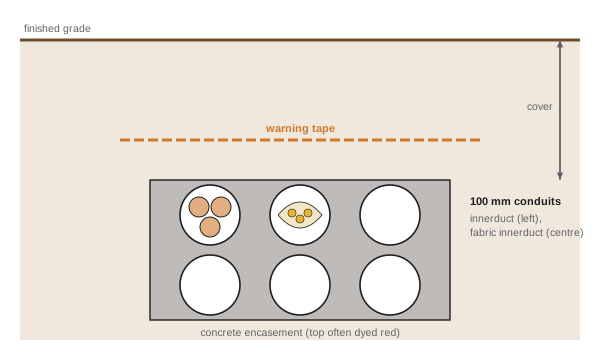
- Underground in duct banks: groups of conduits, typically 100 mm (4 in) in diameter, laid in a trench and often encased in concrete, with maintenance holes (manholes) or handholes at intervals for pulling, splicing and storing slack. This is the standard for campuses and for the routes immediately around a data centre.
- Directly buried: armoured cable placed in a trench or ploughed in without conduit. Cheaper, but the cable cannot be replaced or added to without digging again.
- Aerial: cable lashed to a steel strand on utility poles. Quick and cheap where poles exist, but exposed to storms, vehicle strikes, ice and fire.
Inside each conduit, innerduct (smaller plastic ducts, often three per 100 mm conduit) or fabric innerduct (flexible textile sleeves that pack more cables into a conduit) subdivides the space, so that each new cable can be pulled without disturbing the others. Microduct bundles allow fibre cables to be blown in with compressed air, a method called air-blown fibre or jetting, which places cable over long distances with little pulling tension and allows capacity to be added later.
Trenchless methods avoid open excavation where it is impractical. Horizontal directional drilling (HDD) bores under roads, railways and rivers by steering a drill head along a planned path and pulling conduit back through the hole. Micro-trenching cuts a narrow slot in the road surface for microduct, which is fast but shallow and therefore easier to damage later.
Maintenance holes are placed at changes of direction, at splice points and at intervals set by the cable's allowable pulling tension and by the number of bends; for fibre pulled in conduit, spacing is commonly a few hundred metres, and longer where cable is blown in. At each maintenance hole, a slack loop (commonly 15 to 30 m) is stored on racks so that the cable can be pulled out for splicing or repairs without adding a new splice.
OSP depth and routing are set by the owner's standards and by the authority granting the right of way. Telecommunications ducts are commonly buried with about 750 mm to 1 m of cover. Before any excavation, the contractor must request locates from the provincial one-call service (such as Ontario One Call, Info-Excavation in Quebec or BC 1 Call), which notifies the owners of buried facilities so they can mark them.
High fibre-count cables and splicing
Campus and inter-building cables have grown enormously with AI clusters and multi-building campuses. Cables of 864, 1728 and 3456 fibres are common, and 6912-fibre cables are used between large buildings. These cables use ribbon fibre: 12 fibres bonded side by side, so that a whole ribbon can be spliced in one operation with a mass fusion splicer. Rollable ribbon, in which the fibres are joined only at intermittent points, can be rolled into a compact bundle, putting many more fibres into a given duct than flat ribbons.
Worked problem
Splicing time for a high-count cable
A 3456-fibre cable must be spliced to two 1728-fibre cables at a maintenance hole. Mass fusion splicing takes about 3 minutes per 12-fibre ribbon including preparation and protection, and single-fibre splicing about 2 minutes per fibre. Compare the splicing time.
Show solution
- Ribbons: \(3456 / 12 = 288\). Mass fusion time: \(288 \times 3 = 864\) min = 14.4 h.
- Single fibre: \(3456 \times 2 = 6912\) min = 115 h.
Answer: About 14 hours with mass fusion splicing against about 115 hours one fibre at a time. Ribbon cable is what makes very high fibre counts practical to install and repair, which matters greatly when a cut cable must be restored.
Splices are housed in sealed splice closures in maintenance holes or vaults, organized in trays with each fibre identified by its colour code. Standard fibre colours repeat in a 12-colour sequence: blue, orange, green, brown, slate, white, red, black, yellow, violet, rose and aqua, with tubes or ribbons identified by the same sequence.
Long-link loss budgets
Loss budgets for OSP links follow the same method as in Lesson 6, but the fibre attenuation and splices become significant, and an allowance is added for future repairs: each time a cable is cut and repaired, at least one or two splices are added.
Worked problem
Campus link between buildings
Two buildings on a campus are 6.5 km apart along the duct route. A 100GBASE-LR4 link (6.3 dB channel budget, 1310 nm) will use the OSP cable. The cable is installed in three reel lengths, so there are two OSP splices, plus a splice at each building entrance between the OSP cable and indoor pigtails. There are four mated LC pairs at 0.5 dB. Use 0.4 dB/km and 0.1 dB per splice.
Show solution
- Fibre: \(0.4 \times 6.5 = 2.60\) dB.
- Splices: 4 × 0.1 = 0.40 dB.
- Connectors: 4 × 0.5 = 2.00 dB.
- Total: 5.00 dB. Margin: 6.3 − 5.0 = 1.3 dB.
Answer: The link fits with 1.3 dB of margin, enough for a few repair splices (0.1 to 0.2 dB each) but not for another cross-connect. If the campus will grow beyond about 8 km of route, or the design adds patching points, a longer-reach optic would be needed.
Worked problem
Metro link to a carrier hotel
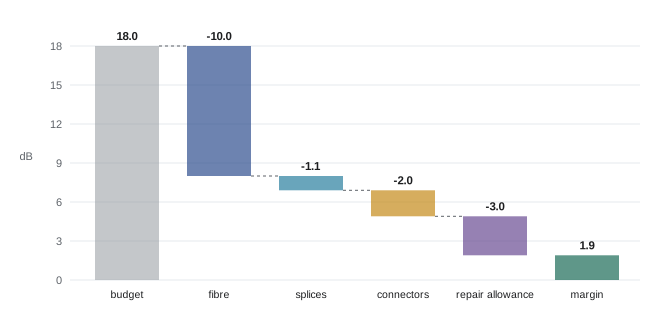
A 40 km route at 1550 nm uses fibre at 0.25 dB/km, has splices every 4 km (including both ends, 11 splices) at 0.1 dB, four connector pairs at 0.5 dB, and a 3 dB allowance for repairs and ageing. Will an optic with an 18 dB loss budget work?
Show solution
- Fibre: \(0.25 \times 40 = 10.0\) dB.
- Splices: \(11 \times 0.1 = 1.1\) dB. Connectors: \(4 \times 0.5 = 2.0\) dB.
- Calculated loss: 13.1 dB. With the repair allowance: 16.1 dB.
Answer: Yes, with 1.9 dB to spare after the allowance. Over these distances fibre attenuation dominates. Longer data centre interconnect links, beyond about 80 km, use coherent optics and optical amplifiers, which are planned with optical signal-to-noise ratio as well as loss (DCE-210).
Route diversity
Two routes are diverse only if no single event can cut both. Shared risks are often hidden:
- Two carriers may lease fibre in the same duct bank, or in the same conduit of a third party, for part of their routes.
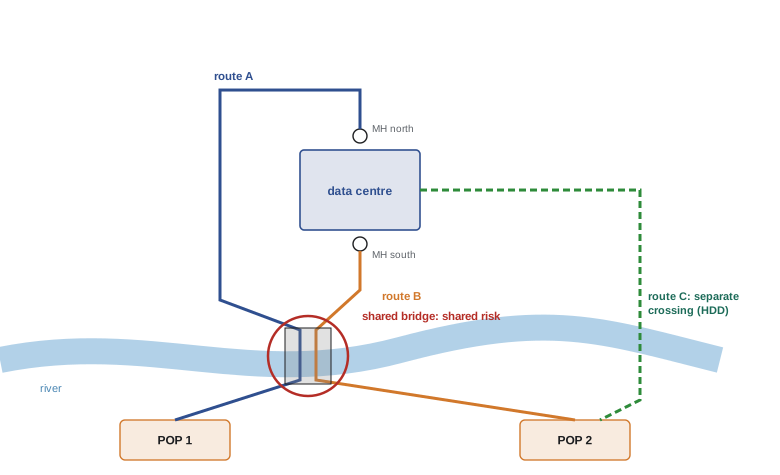
- Different routes often converge at bridges, railway and highway corridors, river crossings and the last few hundred metres before a building.
- Two "diverse" entrances may join inside the building in the same entrance room or the same tray.
- Two carriers may both rely on the same upstream exchange, central office or power supply.
Network engineers call each such shared element a shared risk link group (SRLG). The designer verifies diversity by obtaining route maps (usually as geographic files) from each carrier, overlaying them, and identifying every point where the routes come within a set distance of each other, often a few tens of metres. The contracts should then commit the carriers to maintaining the separation and to notifying the operator before any re-route. Diversity is not permanent: carriers re-route fibre during road works and network changes, so it must be re-checked periodically.
TIA-942 calls for diverse entrance pathways for higher rating levels, with maintenance holes on separate sides of the building and recommends that they be separated by at least 20 m. Within the building, each entrance should lead to its own entrance room or to a separate area, and backbone cabling from each to the MDAs should follow separate pathways.
Worked problem
Availability of diverse routes
Records show that a metro fibre route of this length suffers about 2 cuts per year, each taking 8 hours to repair. Estimate the annual hours of outage with one route and with two fully diverse routes. Then estimate it if the two routes share a bridge section that is cut 0.1 times per year with a 12 hour repair.
Show solution
- One route: \(2 \times 8 = 16\) h per year. Unavailability \(U = 16/8760 = 0.00183\).
- Two fully independent routes: both are down only if they fail at the same time. \(U^2 = 0.00183^2 = 3.3 \times 10^{-6}\), or about 0.03 h (2 minutes) per year.
- Shared bridge: adds \(0.1 \times 12 = 1.2\) h per year in which both routes are down together.
- Total with the shared section: about 1.2 h per year.
Answer: Diversity reduces expected outage from 16 hours a year to about 2 minutes, but a single shared section rare enough to be overlooked raises it to about 1.2 hours, 40 times worse. Removing shared risks matters more than adding more routes.
Building entrance facilities
Where the OSP cables enter the building, the design must keep out water and gas, protect the cables and the people working on them, and meet code rules for outside plant cable inside a building:
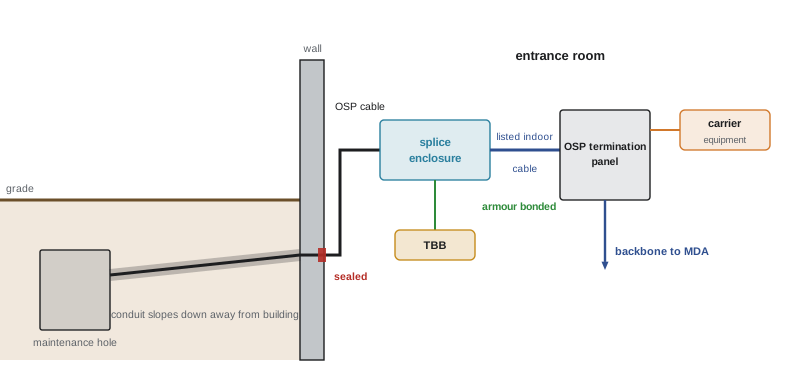
- Entrance conduits slope down away from the building so water drains outward, and every conduit, including spares, is sealed with duct plugs or an expanding sealant.
- OSP cables are designed for water resistance and strength, not for fire performance, and are usually not listed for indoor use. They are therefore spliced to listed indoor cable, or enclosed in a suitable raceway, close to the entrance point.
- Metallic members in OSP cables (armour, strength members) must be bonded to the building's telecommunications bonding system at the entrance, and copper circuits from outside need primary protectors that limit lightning and power-cross voltages.
The Canadian Electrical Code (Sections 56 and 60) sets these entrance requirements in Canada, including bonding of conductive members and protection of communication circuits that enter the building, and limits how far outside plant cable may run inside a building before it must be terminated or enclosed in a suitable raceway.
The entrance room then holds the splice enclosures or OSP termination panels, carrier equipment and the patch panels that connect to the building backbone. In multi-tenant and colocation buildings, carriers often have their own locked cages or cabinets in the entrance room, and the operator's staff make the cross-connects between them.
Carrier connectivity
A data centre connects to the outside world through several kinds of service and arrangement:
- Lit services: a carrier provides bandwidth, such as an Ethernet circuit or a wavelength at a given speed, over its own equipment. The carrier manages the optics and the network.
- Dark fibre: the operator leases fibres with no equipment and lights them with its own optics, gaining capacity limited only by its equipment. Long-term dark fibre is often acquired as an indefeasible right of use (IRU), a prepaid lease of typically 15 to 25 years.
- Internet exchange points and peering: the operator connects to networks at an exchange or in a carrier hotel (a building where many carriers interconnect) to exchange traffic directly (DCE-210).
- Cross-connects in colocation: in a colocation facility, the customer pays the operator a monthly fee for each cross-connect from its cage to a carrier in the meet-me room. A carrier-neutral facility, with many competing carriers present, is valuable to tenants.
Building routes in public rights of way requires consent from the road authority. In Canada, telecommunications carriers have rights under the federal Telecommunications Act to construct on highways and public places with the consent of the municipality, and disputes over the terms can be taken to the CRTC. Attachments to utility poles are governed by agreements with the pole owner, and, depending on the owner, by provincial regulators or the CRTC. Data centre developers who are not carriers usually contract with a carrier or a fibre builder to construct and own the off-site routes.
The schedule for OSP is often longer than for the building cabling: permits, road crossings and a single uncooperative landowner can add months. As noted in DCE-200, diverse fibre routes into a site must be planned with the site selection, not after the building is designed.
Lesson 12 draws the course together in a complete project, including the diverse entrances and routes covered here.
Common mistakes
MistakeAccepting two carriers as diverse because they are different companies.
InsteadOverlay their route maps; carriers often share ducts, bridges and corridors.
MistakeBringing two entrance conduits into the building side by side.
InsteadEnter on separate sides with separate maintenance holes, ideally at least 20 m apart, and keep the routes separate inside.
MistakeRunning unlisted OSP cable through the building to the MDA.
InsteadTransition to listed indoor cable (or a suitable raceway) close to the entrance point, as the electrical code requires.
MistakeDesigning long links with no allowance for repairs.
InsteadAdd margin for repair splices and ageing; each cable cut adds at least one splice.
MistakeLeaving entrance conduits unsealed.
InsteadSeal every conduit, including spares, against water and gas, and slope conduits away from the building.
MistakeExcavating near fibre routes without locates.
InsteadRequest locates through the provincial one-call service before any digging.
Summary and key terms
- Most connectivity outages are cable cuts; diversity of routes and entrances is the main defence.
- OSP is built as concrete-encased duct banks with innerduct and maintenance holes, direct-buried cable, or aerial cable; HDD and micro-trenching avoid open trenches.
- High-count ribbon cables (up to 6912 fibres) are mass-fusion spliced 12 fibres at a time; rollable ribbon packs more fibre per duct.
- Long-link budgets include fibre attenuation, splices, connectors and a repair allowance; fibre loss dominates at tens of kilometres.
- Diverse routes must share no duct, bridge, corridor or entrance; verify by overlaying route maps and re-check periodically.
- Two independent routes reduce outage roughly from U to U²; a single shared section can dominate the result.
- Entrances: slope and seal conduits, bond metallic members, protect copper circuits, and transition OSP cable to listed indoor cable close to the entrance.
- Connectivity: lit services, dark fibre (often IRUs), peering at exchanges, and cross-connects in carrier-neutral meet-me rooms.
- Outside plant (OSP)
- Cabling and pathways outside buildings, including duct banks, maintenance holes, poles and buried cable.
- Duct bank
- A group of underground conduits, often encased in concrete.
- Innerduct
- Smaller ducts installed inside a conduit to subdivide it for separate cables.
- Maintenance hole
- An underground vault used for pulling, splicing and storing slack cable.
- Horizontal directional drilling (HDD)
- A steerable trenchless method of installing conduit under obstacles.
- Air-blown fibre
- Fibre cable installed in microducts by compressed air.
- Ribbon fibre
- Fibres bonded side by side in groups (usually 12) for mass fusion splicing.
- Mass fusion splicing
- Splicing all fibres of a ribbon in one operation.
- Shared risk link group (SRLG)
- A set of links that share a physical element and can fail together.
- Dark fibre
- Leased fibre with no carrier equipment, lit by the customer.
- Indefeasible right of use (IRU)
- A long-term, prepaid right to use specific fibres.
- Carrier-neutral
- A facility open to any carrier, giving tenants a choice of connectivity.
- Primary protector
- A device at the building entrance that limits lightning and power-cross voltages on copper circuits.
Practice problems
Work each problem on paper first, then reveal the answer to check.
Why is direct-buried cable cheaper than duct bank construction, and what is its main drawback?
Show answer
It needs no conduit or concrete; but adding or replacing cable requires digging again.
How many 12-fibre ribbons are in a 1728-fibre cable?
Show answer
1728 / 12 = 144 ribbons.
Calculate the loss of a 12 km link at 1310 nm with 0.35 dB/km, five splices at 0.1 dB and two connector pairs at 0.5 dB.
Show answer
4.2 + 0.5 + 1.0 = 5.7 dB.
Will the previous link meet a 6.3 dB budget with a 1 dB repair allowance?
Show answer
5.7 + 1.0 = 6.7 dB, which exceeds 6.3 dB; a longer-reach optic or fewer connections is needed.
A route has an unavailability of 0.002. Estimate the unavailability of two independent such routes.
Show answer
0.002² = 4 × 10⁻⁶, about 2 minutes per year.
Name three places where two apparently diverse routes often share risk.
Show answer
Bridges and river crossings; road or rail corridors; the same third-party duct bank; the building entrance or entrance room; a shared central office.
Why are entrance conduits sloped away from the building?
Show answer
So that water entering the duct system drains outward rather than into the building.
What must be done with the armour of an OSP cable at the building entrance?
Show answer
Bond it to the telecommunications bonding system (or interrupt it as the code permits), so that lightning and fault currents are safely conducted.
What is the difference between a lit service and dark fibre?
Show answer
A lit service is bandwidth provided over the carrier's equipment; dark fibre is bare fibre that the customer lights with its own optics.
Why is a carrier-neutral meet-me room valuable to colocation tenants?
Show answer
Tenants can choose among competing carriers, connect to several for diversity, and switch carriers with a cross-connect rather than new construction.
Lesson quiz · 5 questions
Score 60% or more to complete this lesson.
Create a free account to save your progress, take quizzes and earn a certificate.