
BLR-320 · Lesson 9 of 12 · 20 min
Repairs and alterations
Most of the pressure work a boilermaker does over a career is not new construction. It is repair: cutting out cracked welds, replacing tubes, putting in new nozzles, patching corroded shells, rebuilding exchanger channels. Ruth Ambrose, Northgate's fixed equipment engineer, comes to class with a list of six jobs Northgate wants done in the June turnaround and asks the apprentices to sort them. "Half of these are repairs and half are alterations," she says, "and if you get that wrong the paperwork is wrong, the inspector won't sign it, and the vessel can't go back into service." This lesson covers the difference between a repair and an alteration, who may do each, the repair plan and the inspector's acceptance, how welding, heat treatment, examination and testing work on a repair, and how the work is reported and stamped.
Repairs and alterations
The repair rules, in CSA B51, ABSA's requirements and the NBIC where they call for it, draw a sharp line between two kinds of work. A repair is work needed to restore a boiler or pressure vessel to a safe and satisfactory operating condition, with the item still meeting its original design: replacing like for like, weld repairing a crack and restoring the original shape, replacing tubes with tubes of the same specification and size. An alteration is a change to the item as described on its original data report that affects its ability to hold pressure: raising the MAWP or design temperature, lowering the minimum design metal temperature, adding a nozzle that needs reinforcement, changing the dimensions or the materials, or changing the design in other ways.
Re-rating is a kind of alteration. Raising a vessel's pressure needs a new calculation, sometimes a new pressure test and always a new report and a new nameplate or stamping, even if not a single weld is made. Lowering the pressure because the wall has thinned is also a re-rating, and is handled through an engineering assessment and the authority's acceptance.
| Work | Repair or alteration? | Why |
|---|---|---|
| Weld repair of a crack at a nozzle, restoring the original design | Repair | Restores the original condition |
| Replace exchanger tubes with the same specification and size | Repair | Like for like |
| Replace a corroded shell section with the same material and thickness | Repair | Like for like |
| Raise the MAWP | Alteration (re-rating) | Changes the design pressure |
| Add a new nozzle | Alteration | A new opening changes the design and needs reinforcement checked |
| Lower the minimum design metal temperature | Alteration (re-rating) | Changes a design condition and may need impact tests |
Worked problem
Sorting Northgate's six jobs
Ruth's list has six items. Sort each into repair or alteration, and say what report each needs.
Show solution
- Anything that changes pressure, temperature, openings or design is an alteration.
- Anything that restores the original design, like for like, is a repair.
- Anything unclear goes to the inspector.
Answer: The program below makes the first sort. Three jobs are repairs and three are alterations; the alterations need a design registration with ABSA in addition to the repair paperwork.
# Repair or alteration? A first sort of proposed work (illustrative; the inspector decides)
ALTERATION_SIGNS = ("raise MAWP", "raise temperature", "lower minimum temperature",
                    "new nozzle", "larger nozzle", "change design")

def classify(work):
    w = work.lower()
    for sign in ALTERATION_SIGNS:
        if sign.lower() in w:
            return "alteration (design registration and a new data report)"
    if "like for like" in w or "restore" in w or "weld repair" in w or "replace" in w:
        return "repair (under the accepted quality program)"
    return "ask the inspector"

for job in ["weld repair of a crack at a nozzle, restore original design", "replace 40 exchanger tubes like for like", "raise MAWP of V-412 from 1,700 to 2,000 kPa", "add a new nozzle for a level bridle", "replace a corroded shell section like for like", "lower minimum temperature for winter startups"]:
print(f"{job:58} -> {classify(job)}")weld repair of a crack at a nozzle, restore original design -> repair (under the accepted quality program) replace 40 exchanger tubes like for like -> repair (under the accepted quality program) raise MAWP of V-412 from 1,700 to 2,000 kPa -> alteration (design registration and a new data report) add a new nozzle for a level bridle -> alteration (design registration and a new data report) replace a corroded shell section like for like -> repair (under the accepted quality program) lower minimum temperature for winter startups -> alteration (design registration and a new data report)
The program is only a first sort, and Ruth stresses it. Some jobs sit on the line: replacing a nozzle with one of the same size but a heavier neck may or may not be an alteration depending on whether the reinforcement calculation changes. The repair organization proposes, and the inspector decides.
Who may repair
In Alberta, repairs and alterations to registered pressure equipment are made by organizations that hold an ABSA certificate of authorization permit for that scope of work, under a quality management system ABSA has accepted. Ironbridge holds such a permit for repairs and alterations to boilers, pressure vessels and piping, as well as for construction. An owner-user can also hold a permit for its own repairs. Alterations also need the altered design to be registered with ABSA before the work is done.
Holding the certificate is not enough by itself. The organization must follow its own quality manual on every job: qualified procedures and welders, traceable materials, calibrated equipment, an accepted repair plan, inspection at hold points and a completed report. A shop that holds a certificate but takes a shortcut on one job has broken the conditions of the certificate.
The repair plan and the inspector's acceptance
Before any repair work begins, the repair organization prepares a plan and the inspector accepts it. The plan says what is wrong, how it was found and sized, how the defect will be removed and how the removal will be confirmed, what welding procedure and filler metal will be used, what preheat and post-weld heat treatment or alternative will apply, what examination will be done during and after welding, and what pressure test or alternative will close out the repair. For an alteration, the plan also includes the design calculations and, the ABSA design registration.
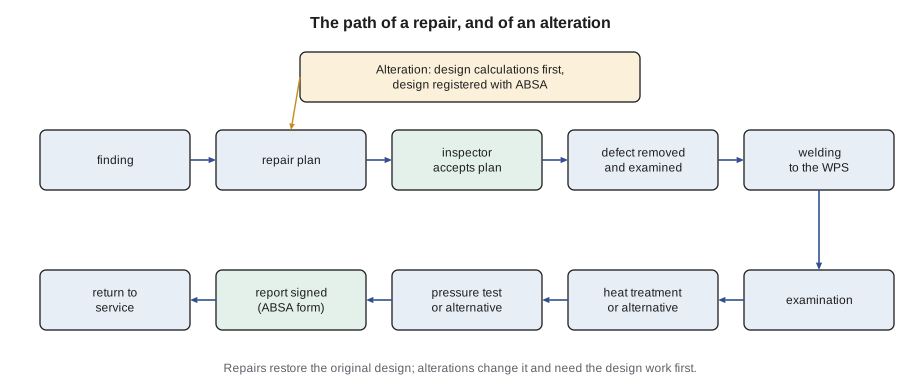
The inspector also sets the hold points: the stages where work must stop until the inspector has seen it. On a crack repair the usual hold points are after the excavation has been examined and shown to be clear, after the root and before the final layers in a deep repair, and at the final examination and test. If the crew finds something during the work that the plan did not expect, such as the crack running further than thought or a lamination in the plate, work stops and the plan is revised with the inspector.
Some small repairs are treated as routine repairs, which the repair rules allow to proceed without the inspector accepting the plan beforehand, as long as the organization's quality system covers them and the inspector is told and later accepts the work. Typical examples are small welds that do not need post-weld heat treatment, such as seal welding of tube ends. Whether a particular job counts as routine is set by the rules and the jurisdiction, not by the crew.
Welding, heat treatment and examination on a repair
Repair welding is done to Section IX qualified procedures by qualified welders, exactly as for new construction. The original construction code still sets the requirements for preheat, post-weld heat treatment and examination, as far as they can be applied. When post-weld heat treatment would be impractical, for example on a large vessel in a refinery, the repair rules allow alternatives, such as controlled-deposition or temper-bead welding methods, in specified materials and under strict conditions, with the inspector's acceptance and, where the vessel's service requires it, the owner's agreement.
Examination is chosen to find the kind of flaw the repair is meant to remove. A crack repair is usually examined by magnetic particle or penetrant testing after the excavation to show the crack has gone, then by the same method and by ultrasonics or radiography after welding. A replaced shell section is examined like the original seams it replaces. Tube repairs on boilers are usually radiographed.
Pressure testing after a repair
A repaired item is pressure tested, or the test is replaced by examination when the repair rules and the inspector allow. For many weld repairs the test pressure is set by the inspector, not lower than the MAWP and not higher than the original test pressure. For alterations, the test is usually the one the construction code would require for the altered part. Where a test cannot be done, for example because water cannot be put into a vessel that has a catalyst bed or a refractory lining, the inspector may accept additional volumetric examination instead.
Boilermakers do the practical work of the test: installing blinds, filling and venting, setting up calibrated gauges, raising the pressure in steps and holding it while the inspector examines every weld. A leak during the test means the repair failed; the item is drained, the leak is found and repaired under the same plan, and the test is done again.
Reporting and stamping
When the work is finished, the repair organization completes the repair or alteration report, using ABSA's form, and the inspector signs it. The report records the organization and its permit number, the owner, the item and its registration numbers, a description of the work, the materials, the welding procedures and welders, the examination, the heat treatment, the test and the inspector's acceptance. For an alteration the nameplate is changed or a new one added to show the new rating. The report goes to the owner, to ABSA and into the item's records.
Harjit holds up two nameplates from his coffee can: one an original ASME nameplate from an old receiver, the other a small repair nameplate that was riveted beside it years later. "The original stays forever," he says. "Never grind it off, never paint over it, never move it without permission. If the vessel is altered, the new nameplate tells the next inspector what changed and who did it."
Repairs to boilers
Boiler repairs follow the same principles, with some differences that matter on an outage. Tube replacements are the most common repair, and the replacement tube must be the same specification, size and wall, or a substitute the engineer has accepted. Butt welds in tubes are usually radiographed. Window welds and pad welds on tubes, covered in BLR-210, are accepted by the inspector case by case. Seal welding and some small attachment welds may be routine repairs. Repairs to drums and headers, or to the welds attaching nozzles to them, are major repairs that often need post-weld heat treatment or an accepted alternative and a hydrostatic test.
Safety valve repairs are a separate field. A safety valve may be repaired only by an organization accredited for valve repair, which resets, tests and seals it and attaches a repair nameplate. Boilermakers remove and reinstall valves under the owner's instructions, but never adjust or repair them.
| Boiler repair | Usual examination | Usual test |
|---|---|---|
| Tube butt weld replacement | Radiography | Hydrostatic test or accepted alternative |
| Seal weld | Visual, sometimes MT or PT | Often none beyond the next start-up leak check |
| Header nozzle weld repair | MT or PT and volumetric | Hydrostatic test |
| Drum weld repair | Volumetric and surface examination | Hydrostatic test |
When the repair rules and the construction code differ, the repair rules govern how the repair is managed and reported, while the construction code, usually in the edition the item was built to or a later one, governs the technical details such as materials, joint design and examination. Where the original edition is unknown, the inspector and the engineer agree which edition to use, and that decision is recorded on the plan.
Common mistakes
MistakeTreating a re-rating as a paperwork change.
InsteadRaising or lowering a rating is an alteration and needs calculations, acceptance and a new report and nameplate.
MistakeStarting to grind out a crack before the plan is accepted.
InsteadThe inspector accepts the plan first, except for routine repairs the rules allow.
MistakeCarrying on when the defect turns out larger than planned.
InsteadStop and revise the plan with the inspector.
MistakeRemoving or covering the original nameplate during a repair.
InsteadThe original nameplate stays; repair and alteration nameplates are added beside it.
Summary and key terms
- A repair restores the original design; an alteration changes it, including any re-rating.
- Repairs and alterations are made by organizations with an ABSA permit for that scope; alterations also need design registration.
- The inspector accepts the repair plan and sets hold points before work starts.
- Repairs use qualified procedures and welders; alternatives to heat treatment need acceptance and conditions.
- A pressure test, or accepted examination in its place, closes out the repair.
- The repair or alteration is reported on ABSA's form and signed by the inspector.
- Repair
- Work that restores an item to a safe condition within its original design.
- Alteration
- A change to the item as described on its data report that affects its pressure-containing capability.
- Re-rating
- An alteration that changes the MAWP, design temperature or minimum design metal temperature.
- Repair plan
- The written method for a repair, accepted by the inspector before work starts.
- Hold point
- A stage at which work stops until the inspector has examined it.
- Routine repair
- A small repair the rules allow to proceed without prior acceptance, under the quality system.
Practice problems
Work each problem on paper first, then reveal the answer to check.
Northgate wants to raise a drum's MAWP with no welding. Is this a repair or an alteration?
Show answer
An alteration, because it is a re-rating.
During a crack repair the crack runs past the end of the planned excavation. What happens?
Show answer
Work stops and the plan is revised with the inspector.
What closes out a repair if a hydrostatic test is impossible?
Show answer
Additional examination accepted by the inspector.
May the original nameplate be removed when a repair nameplate is added?
Show answer
No; it stays, and the repair nameplate goes beside it.
Lesson quiz · 5 questions
Score 60% or more to complete this lesson.
Create a free account to save your progress, take quizzes and earn a certificate.