
BLR-320 · Lesson 3 of 12 · 20 min
Section I: power boilers
Two years ago Kiera helped cut out and replace a section of waterwall tube on Riverbend Unit 2. Now Harjit hands her the paperwork from that job: the repair plan, the material test reports for the tube, the weld map, the radiographs, the test record and the repair report, all signed. "You did the work," he says. "Tonight you find out what rules it was done under." Section I governs power boilers, from small packaged steam boilers like the one at Larkspur Greenhouses to the utility boilers at Riverbend. This lesson covers what Section I includes, the parts of a boiler it governs, its thickness rules for tubes and drums, the safety devices it requires, how boilers are assembled in the field under the code, and how they are tested.
What Section I covers
Section I covers power boilers, which make steam or hot water above the heating boiler limits, along with electric boilers, miniature boilers and high-temperature water boilers. It also covers some unfired steam generators that recover heat from a process, depending on how the owner and the jurisdiction classify them. Within a power boiler, Section I covers the boiler proper, meaning the drums, headers, tubes, superheaters, reheaters, economizers and the pressure parts that connect them, and the boiler external piping out to the stop valves.
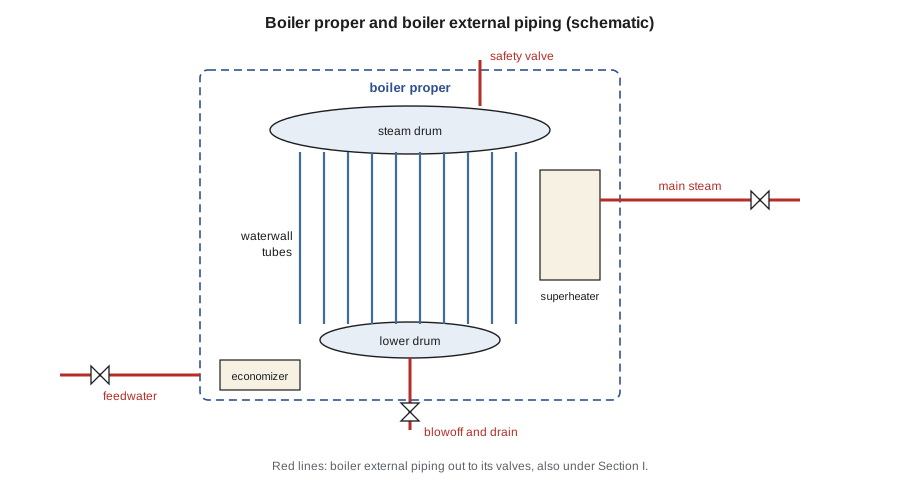
The boundary matters on every job. A weld on a waterwall tube is a Section I weld and must be made by a welder qualified for Section I work, under a procedure qualified to Section IX, by an organization authorized to work on power boilers. A weld on a line beyond the boiler external piping may be governed by B31.1 or another piping code, with different rules for examination and testing. When Riverbend's maintenance planner wrote the scope for the tube repair, the first line on the plan named the code: Section I, with the repair rules of CSA B51, the NBIC and ABSA's requirements.
How Section I is organized
Section I opens with general requirements for all power boilers, in paragraphs beginning with PG. These cover materials, design for internal pressure, openings and compensation, boiler external piping, safety devices, gauges and controls, fabrication, inspection, testing and the data reports. Then come parts for particular kinds of construction: PW for boilers made by welding, PR for riveted construction, which survives only in old boilers, PWT for watertube boilers, PFT for firetube boilers, PEB for electric boilers and PMB for miniature boilers, with further parts for special types.
| Part | Covers | Example of what is in it |
|---|---|---|
| PG | General requirements | Tube and drum thickness, openings, hydrostatic test, data reports |
| PW | Welded boilers | Preheat, post-weld heat treatment, radiography of butt welds |
| PWT | Watertube boilers | Tube attachment, headers, drums |
| PFT | Firetube boilers | Furnaces, tube sheets, stays |
| PEB | Electric boilers | Elements, controls |
| PMB | Miniature boilers | Size limits and simplified rules |
Thickness of tubes and drums
Section I gives formulas for the minimum thickness of each pressure part. For a tube or pipe under internal pressure, the PG-27 formula takes the maximum allowable working pressure, the outside diameter and the allowable stress of the material at the design metal temperature, and adds a small allowance that depends on the tube's diameter and, for tubes that are rolled into drums, an allowance for the expanded section. Drums and headers have a similar formula based on their outside or inside diameter and the efficiency of their longitudinal welds.
In the formula, t is the minimum required thickness, P the maximum allowable working pressure, D the outside diameter, S the allowable stress from Section II, Part D, E the efficiency of any weld or ligament, and e an allowance for threading or for the expanded section of a rolled tube. The allowable stress drops as temperature rises, so the same tube is good for a lower pressure in a superheater than in a waterwall.
For a boilermaker the formula matters most when material is substituted. If the replacement tube on hand is a different grade or a thinner wall than the drawing calls for, nobody on the floor can decide that it will do. The engineer or the quality control manager checks it against the formula and the original design, and the change is recorded before the tube goes in.
Worked problem
Checking a replacement waterwall tube
Riverbend's waterwall tubes are 63.5 mm (2 1/2 in) outside diameter, with a boiler maximum allowable working pressure of 11,700 kPa (1,700 psi). The replacement tube on the rack has a minimum wall of 6.4 mm (0.250 in), and the allowable stress of its grade at the design metal temperature is taken here as 110,000 kPa (16,000 psi). Is it thick enough, and what would the new-construction hydrostatic test be?
Show solution
- Apply the tube formula with E = 1 for seamless tube and e = 0 for a welded-in tube.
- Compare the required thickness with the supplied minimum wall.
- Multiply the maximum allowable working pressure by 1.5 for the Section I hydrostatic test of new construction.
Answer: The required wall is about 3.5 mm (0.14 in), well below the 6.4 mm (0.250 in) supplied, so the tube is acceptable; the new-construction test would be 1.5 times the MAWP.
# Section I check on a replacement boiler tube (metric, illustrative values)
# Tube formula of the PG-27 type: t = P*D/(2*S*E + P) + 0.005*D + e
P, D, S, E, e = 11700, 63.5, 110000, 1.0, 0.0     # MAWP, outside diameter, allowable stress, weld efficiency, expanded-tube allowance
t_req = P * D / (2 * S * E + P) + 0.005 * D + e
supplied = 6.4
print(f"required minimum wall {t_req:.2f} mm, supplied minimum wall {supplied:.2f} mm")
print("tube is acceptable" if supplied >= t_req else "tube is too thin for this MAWP")
# hydrostatic test of the boiler after the repair: new construction is tested at 1.5 x MAWP;
# a repair test is set by the inspector and is not higher than that
mawp = 11700
print(f"new-construction test pressure 1.5 x {mawp:,} = {1.5 * mawp:,.0f} kPa")
print(f"a repair test at the MAWP would be {mawp:,} kPa, held while the welds are examined")required minimum wall 3.52 mm, supplied minimum wall 6.40 mm tube is acceptable new-construction test pressure 1.5 x 11,700 = 17,550 kPa a repair test at the MAWP would be 11,700 kPa, held while the welds are examined
Waterwall tubes are usually much thicker than the pressure formula needs, because they must also resist erosion, corrosion and the heat flux of the furnace. That margin is used up over the life of the boiler, which is why Peg Lindqvist, Riverbend's owner's inspector, measures tube thickness at every outage and replaces tubes when they approach the minimum.
Safety devices, gauges and controls
A power boiler must carry safety valves with enough relieving capacity to discharge all the steam the boiler can make without the pressure rising more than a small amount above its maximum allowable working pressure. Boilers above a certain heating surface need at least two valves. The valves are now covered by Section XIII, but Section I still says how many are needed, where they go and how they are connected. A safety valve must be connected directly to the boiler with no valve between, and its discharge must be piped so that it cannot scald anyone.
Every power boiler also needs at least one water gauge glass, and larger high-pressure boilers need two independent means of reading the water level. It needs a pressure gauge, a feedwater supply that can feed the boiler at its maximum pressure, blowoff and drain connections and, depending on the fuel and the jurisdiction, controls such as a low-water fuel cutoff. These devices are not decoration. Many of the explosions that led to the code began when a gauge glass was blocked or a safety valve was wired shut.
Boilermakers rarely set safety valves, which is specialist work, but they install them and they must never be the reason one is isolated. When a boiler is under test or in service, nothing is welded to or near a safety valve's inlet without the owner's permission and an engineer's review.
Building and assembling a boiler under the code
Large boilers are too big to build in one shop. The drums, headers, panels of tubes and superheater sections are made in several shops, each under its own certificate, and shipped to site. Each shop that makes a part certifies it on a partial data report, and the parts are then assembled in the field by an organization holding the certificate for boiler assembly. The organization that completes the boiler and certifies it to Section I takes responsibility for the whole, including the parts made by others.
| Document | Who completes it | What it records |
|---|---|---|
| Partial data report for parts | Each shop that makes a pressure part | The part, its materials, examination and the shop's certification |
| Field assembly records | The assembling organization | Field welds, examination, the hydrostatic test |
| Manufacturer's data report | The organization that certifies the completed boiler | The whole boiler, with the partial reports attached |
| Inspector's signature | The inspector at each stage | That the work was examined and meets the code |
On the Riverbend repair, the replacement tube panel was made in a shop and the field welds were made by Ironbridge. Because it was a repair rather than new construction, it was documented on a repair report rather than a manufacturer's data report, but the same idea applied: every pressure weld had a qualified welder and procedure, every piece of material was traceable, and the inspector saw the work before it was covered.
Preheat, heat treatment and examination
Section I's welding part sets preheat and post-weld heat treatment by material group and thickness, in tables of the PW-38 and PW-39 kind. Low-alloy tube steels used in superheaters need more preheat and higher heat treatment temperatures than carbon steel, and some modern creep-strength-enhanced steels, such as Grade 91, must be heat treated within a narrow window. Section I also requires volumetric examination, usually radiography or ultrasonics, of butt welds in boiler parts, with some exemptions for small-diameter tube and pipe.
BLR-210 covered how these rules play out on a tube repair. The point here is that they come from the code, not from shop habit, and that the tables have conditions in their notes that change the answer. The welder reads the procedure, and the procedure was written from the code by someone who read the notes.
The hydrostatic test
A new power boiler is given a hydrostatic test at 1.5 times its maximum allowable working pressure, held while the inspector examines it, with the pressure kept below the level that would overstress any part. The water must be at a temperature that keeps the steel well above the temperature at which it could fracture in a brittle way, but not so hot that it is unsafe to handle. Every leak is a failure; the boiler is drained, repaired and tested again.
Repairs are tested according to the repair rules. For many repairs the inspector accepts a test at or near the maximum allowable working pressure, and for some, a test is replaced by additional examination. The inspector decides, and the decision is written on the repair report.
Boilers in the field: what a boilermaker sees
On a utility boiler outage, the Section I boundary decides how almost every job is planned. Tube replacements, header repairs, drum internals that are welded to the drum, attachments welded to pressure parts and replacement superheater sections are pressure work, and go through the repair organization's quality system with a plan accepted by the inspector. Work on non-pressure parts, such as casing, buckstays, ductwork and refractory, is ordinary structural or mechanical work, even when it is right beside a tube. The boundary runs through the middle of some jobs: a seal plate welded to a tube is an attachment to a pressure part, so the weld to the tube is pressure work while the rest of the seal is not.
Peg Lindqvist's outage plans mark every job as pressure or non-pressure in the first column, and Ironbridge's foremen are trained to stop and ask when a job seems to cross the line. Welding a temporary scaffold clip to a waterwall tube, for example, is an attachment weld to a pressure part and is not allowed without a procedure, an accepted plan and the owner's permission.
Common mistakes
MistakeTreating a weld just outside the boiler drum as ordinary piping.
InsteadCheck whether it is in the boiler proper or the boiler external piping; both are under Section I.
MistakeSubstituting a different tube grade or wall because it is on the rack.
InsteadMaterial substitutions need a check against the design and must be recorded.
MistakeWelding near a safety valve inlet without permission.
InsteadSafety valves are never isolated or disturbed without the owner's approval and an engineer's review.
MistakeAssuming a repair is tested at 1.5 times MAWP like new construction.
InsteadThe repair rules and the inspector set the test.
Summary and key terms
- Section I covers power boilers: the boiler proper and the boiler external piping out to the stop valves.
- Its general rules are in PG paragraphs, with parts such as PW for welded boilers and PWT for watertube boilers.
- Tube thickness follows a PG-27 type formula based on pressure, diameter and allowable stress.
- Power boilers need safety valves, water level gauges, pressure gauges and feedwater controls.
- Large boilers are assembled in the field from parts certified on partial data reports.
- New boilers are hydrostatically tested at 1.5 times the MAWP; repairs follow the repair rules.
- Power boiler
- A boiler that makes steam or hot water above the heating boiler limits.
- Boiler proper
- The drums, headers, tubes and other pressure parts of the boiler itself.
- MAWP
- Maximum allowable working pressure: the highest pressure the item is permitted to run at.
- Allowable stress
- The highest design stress permitted for a material at a given temperature, from Section II, Part D.
- Partial data report
- A report certifying a pressure part made by one organization for use in an item completed by another.
- Safety valve
- A spring-loaded valve that pops fully open to relieve steam pressure.
Practice problems
Work each problem on paper first, then reveal the answer to check.
Why is a waterwall tube usually much thicker than the pressure formula requires?
Show answer
To allow for erosion, corrosion and the furnace's heat flux over its life.
What test pressure applies to a new power boiler with an MAWP of 4,000 kPa (580 psi)?
Show answer
1.5 times the MAWP, 6,000 kPa (870 psi).
Who certifies a field-assembled boiler as a whole?
Show answer
The organization that completes and certifies the boiler, using the partial data reports for parts made by others.
Can a valve be placed between a boiler and its safety valve?
Show answer
No; safety valves are connected directly to the boiler.
Lesson quiz · 5 questions
Score 60% or more to complete this lesson.
Create a free account to save your progress, take quizzes and earn a certificate.