
BLR-320 · Lesson 8 of 12 · 19 min
ABSA, safety codes officers and in-service inspection
When Kiera started her apprenticeship, the inspector was the person who turned up at a hold point and looked at her fit-up. In the code block she learns that the same people, and others she has never met, follow every boiler and vessel for its whole working life. In May, Peg Lindqvist, Riverbend's owner's inspector, comes to class with her inspection schedule on a laptop. "You build it once," she says. "I look after it for forty years. Every time I open it up, I'm asking the same question: is it still fit for the pressure on its nameplate?" This lesson covers who inspects pressure equipment once it is in service, what the owner must do, how inspection intervals are set, what an inspector looks for, and what happens when an inspection finds a problem.
The owner's duties
Once a boiler or vessel is installed, the owner is responsible for it. The owner must make sure it is registered, operated within the limits on its nameplate, protected by working safety devices, inspected at the required intervals and repaired only by authorized organizations. The owner must keep the records: the data report, the drawings and calculations, the inspection reports, and the repair and alteration reports. When an item is sold, moved or retired, the records go with it or are reported to the authority.
In Alberta, the Pressure Equipment Safety Regulation puts these duties on the owner and requires most owners of boilers and pressure vessels to have their equipment inspected at set intervals. ABSA's requirements for inspection and servicing are set out in its document AB-506, which gives intervals for different kinds of equipment, the kinds of inspection, and the conditions under which intervals may be changed.
Who inspects in service
In Alberta, in-service inspections are done by ABSA safety codes officers or, for owners with an accepted integrity management program, by the owner's own certified in-service inspectors. ABSA certifies in-service inspectors under its requirements in AB-526, and owner-users who run their own program do so under a pressure equipment integrity management system that meets AB-512 and holds an ABSA certificate of authorization permit. Large plants such as Riverbend and Northgate are owner-users: Peg and her team do most of the inspections, and ABSA audits the program and the records.
| Who | What they do in service | Where their authority comes from |
|---|---|---|
| Owner's inspector | Plans and carries out most inspections, keeps records | The owner's accepted integrity management program |
| ABSA safety codes officer | Inspects boilers and other equipment, audits the owner's program | The Safety Codes Act and ABSA's designation |
| Repair organization's inspector | Accepts repair plans and signs repair reports | CSA B51 and ABSA requirements |
| Boilermaker | Opens, cleans, prepares and repairs equipment for inspection | The repair organization's quality control system |
Kinds of inspection
An external inspection is made with the equipment in service, or at least closed up. The inspector looks at the outside of the shell and heads, supports, insulation, nozzles, flanges and gaskets for leaks, safety devices and their seals, gauges and controls, and the condition of the surroundings. For a boiler in service, the inspector also checks that the water level controls, low-water cutoffs and safety valves are working, and that the operators know how to use them.
An internal inspection is made with the equipment shut down, isolated, drained, cleaned and open. The inspector looks at the inside surfaces for corrosion, erosion, cracking, pitting, deposits and damage to internals, and measures thickness where metal loss is expected. In a boiler, the inspector looks at the drums, tube ends, headers and the fireside of the tubes. This is where boilermakers come in: before Peg can see anything, the equipment has to be blinded, vented, opened, cleaned and made safe to enter, and scaffold built inside it, all under the confined space and isolation rules of BLR-110.
Not every inspection needs the vessel opened. Thickness can often be measured from the outside with ultrasonics, and other methods, such as phased-array ultrasonics, radiography of nozzles and acoustic emission, can sometimes replace part of an internal inspection when the owner's program and the authority allow it. An inspector chooses methods according to the ways the equipment is expected to deteriorate: thinning, cracking from stress corrosion or fatigue, creep in hot parts, or damage from fire or upset conditions.
Setting the interval
AB-506 sets maximum intervals for equipment that is not under an owner's program, such as annual inspection for most power boilers. An owner-user with an accepted integrity management program can set intervals for each item from its condition, its corrosion rate and the consequences of failure, within limits, and must show ABSA how the intervals were set.
Corrosion rate and remaining life are simple ideas. If a shell has lost 2 mm (0.08 in) over 10 years, its long-term corrosion rate is 0.2 mm (0.008 in) a year. If it has 4 mm (0.16 in) of metal left above its required thickness, its remaining life is about 20 years, and an interval of half that, or less, means the inspector will see it again well before it gets near its limit.
Worked problem
Which inspections are due?
On 1 May 2029, Peg's schedule lists five items with the date of their last inspection and their interval. Which are overdue, and which are due within 60 days?
Show solution
- Add the interval to the last inspection date to get the next due date.
- Compare the due date with today.
- Flag anything past due and anything due within 60 days.
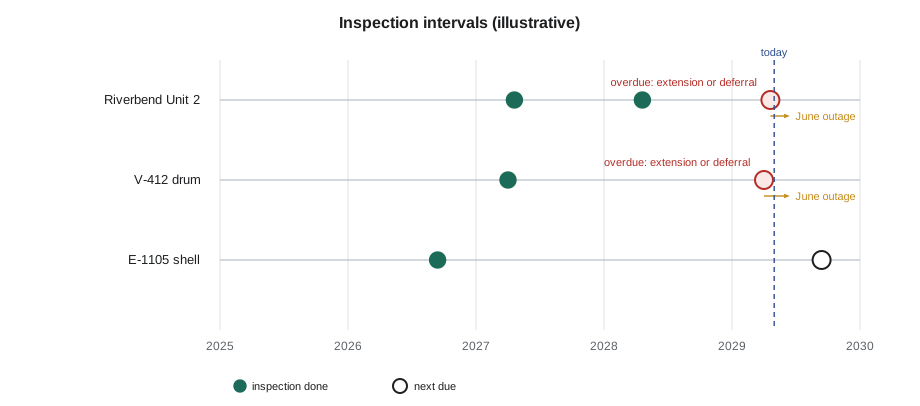
Answer: The program shows the Riverbend Unit 2 internal inspection and the V-412 internal inspection are overdue. Both were deferred: Riverbend Unit 2's outage moved to June because of a grid demand forecast, and V-412's turnaround was pushed back.
# When is each item due for inspection? (metric; intervals from the owner's integrity program, illustrative)
from datetime import date

def add_months(d, m):
    y, mo = divmod(d.month - 1 + m, 12)
    return date(d.year + y, mo + 1, min(d.day, 28))

today = date(2029, 5, 1)
items = [("Riverbend Unit 2 boiler", "internal", date(2028, 4, 20), 12), ("Riverbend deaerator", "internal", date(2025, 6, 2), 48), ("V-412 knockout drum", "internal", date(2027, 3, 30), 24), ("E-1105 exchanger shell", "external", date(2026, 9, 10), 36), ("Larkspur greenhouse boiler", "internal", date(2028, 5, 15), 12)]          # (item, kind of inspection, last done, interval in months)
for name, kind, last, months in items:
    due = add_months(last, months)
    days = (due - today).days
    flag = "OVERDUE" if days < 0 else ("due within 60 days" if days <= 60 else "")
print(f"{name:26} {kind:9} last {last.isoformat()} next {due.isoformat()} {flag}")Riverbend Unit 2 boiler internal last 2028-04-20 next 2029-04-20 OVERDUE Riverbend deaerator internal last 2025-06-02 next 2029-06-02 due within 60 days V-412 knockout drum internal last 2027-03-30 next 2029-03-28 OVERDUE E-1105 exchanger shell external last 2026-09-10 next 2029-09-10 Larkspur greenhouse boiler internal last 2028-05-15 next 2029-05-15 due within 60 days
An overdue inspection is not something an owner can just accept. Peg's team applied to ABSA for an extension for Riverbend Unit 2 before the due date, with the reasons, the boiler's recent operating and water chemistry records and the results of an external inspection done in April, and ABSA granted a short extension to the June outage. V-412, under Northgate's own program, needed a documented deferral approved by the program's responsible engineer, with a note in the records.
What the inspector looks for
Peg tells the class that most of what she finds is ordinary: thinning where flow is fast or turns a corner, pitting under deposits, cracking at nozzle welds where the vessel breathes with pressure and temperature, corrosion under insulation where rain gets in, and damage from overheating in boiler tubes. Her job is to measure how bad it is, compare it with what the vessel needs and decide whether it can run, can run with a lower pressure, needs a repair, or needs more examination before anyone can say.
| Finding | Typical response |
|---|---|
| Wall thinning still above the required thickness | Record, calculate the remaining life, set the next interval |
| Wall thinning below the required thickness | Repair, or re-rate the vessel to a lower pressure through an engineering assessment |
| Cracking | Find its extent with examination, remove it and repair, then examine again |
| Damaged or missing safety device seal | Have the device tested or replaced before return to service |
| Corrosion under insulation | Strip, inspect, repair the coating and insulation |
| Bulged or overheated tubes | Measure, replace tubes, find the cause |
When a finding needs a repair, the work goes to an authorized repair organization, which is where Ironbridge comes in. The owner's inspector writes the finding and the requirement, the repair organization writes a repair plan, the inspector accepts the plan, and only then does the boilermaker pick up a grinder. Lesson 9 covers repairs and alterations, and the capstone follows one through.
When an inspector says stop
A safety codes officer has the power to issue an order, for example to stop using a boiler that is unsafe until it is repaired. Orders are rare, because most problems are fixed when the inspector points them out, but they are enforceable, and operating equipment in breach of an order is an offence. ABSA has described its approach as instructive: the officer explains the problem and expects it to be fixed.
For a boilermaker the lesson is simple. If an inspector, an owner's inspector or a repair organization's inspector says a piece of equipment is not to be returned to service, nobody on the crew argues the point or works around it. The decision is recorded, the reasons are investigated and the equipment stays out of service until the inspector says otherwise.
Preparing equipment for the inspector
Peg's internal inspections depend on the crews who open the equipment. Before an inspector can enter a drum, it must be isolated from every source of pressure and process fluid by blinds or by removing spool pieces, drained, steamed or washed out, ventilated, tested for oxygen and toxic or flammable gases, and covered by a confined space entry permit with a trained attendant outside. Internals such as trays, demister pads or baffles may have to be removed so the shell can be seen. Scale and deposits are cleaned off the areas the inspector wants to examine, by hydroblasting, scraping or abrasive blasting, and lights and scaffold are set up. A poorly cleaned vessel wastes an inspector's day and can hide the very cracking she is looking for.
Boilermakers also make the inspection openings: removing manway covers, cutting inspection windows in tubes where the plan calls for it, and drilling small holes for internal cameras. Each of these is work on a pressure part and is restored afterwards under the repair rules, with the inspector's knowledge.
| Before entry | Who does it |
|---|---|
| Isolation and blinding | Operations and the boilermaker crew under the isolation permit |
| Draining, cleaning, venting | Operations, cleaning contractor, boilermakers |
| Gas testing and entry permit | Permit issuer and safety advisor |
| Removal of internals and covers | Boilermakers |
| Access and lighting | Scaffold crew and boilermakers |
| Inspection | Owner's inspector or the authority's inspector |
When the inspection is finished, the inspector releases the equipment for closing. The boilermakers reinstall internals, fit new gaskets, close manways with the correct bolting procedure from BLR-230 and remove blinds, and the owner returns the equipment to service only after any required pressure test or leak test.
Peg has one more point for the class. Inspectors rely on what the crew tells them. If a boilermaker sees something during cleaning that looks wrong, such as a crack, a bulge, a pit that goes deeper than the others, or a weld that looks unlike its neighbours, the right thing is to stop and show the inspector, not to clean it off and carry on. Some of the most serious findings she has made were pointed out to her by the crew that opened the vessel.
Common mistakes
MistakeThinking inspection ends when a vessel leaves the shop.
InsteadEquipment is inspected for its whole life by the owner and the authority.
MistakeLetting an inspection go overdue because the unit is running well.
InsteadApply for an extension or deferral before the due date, with reasons and records.
MistakeStarting a repair as soon as a defect is found.
InsteadThe inspector must accept a repair plan first.
MistakeTreating an inspector's stop as advice.
InsteadIt is binding; the equipment stays out of service until released.
Summary and key terms
- The owner is responsible for registration, safe operation, inspection, authorized repairs and records.
- In Alberta, ABSA safety codes officers and certified owner's inspectors inspect equipment in service.
- External inspections are made in service; internal inspections need the equipment open and made safe.
- Intervals come from AB-506 or from the owner's accepted program.
- Overdue inspections need an approved extension or deferral, made before the due date.
- Findings lead to repair, re-rating or more examination; repairs need an accepted plan first.
- Owner-user
- An owner that runs its own accepted inspection program.
- External inspection
- An inspection of the outside of the equipment, usually in service.
- Internal inspection
- An inspection of the inside of the equipment, with it shut down and open.
- Corrosion rate
- The rate at which metal is being lost, usually in thickness per year.
- Remaining life
- The time until the wall reaches its required thickness at the current corrosion rate.
- Re-rating
- Lowering or changing the allowed pressure or temperature after an engineering assessment.
Practice problems
Work each problem on paper first, then reveal the answer to check.
A shell lost 1.5 mm (0.06 in) in 6 years and has 3 mm (0.12 in) left above its required thickness. What is its remaining life?
Show answer
Rate 0.25 mm (0.01 in) a year, so about 12 years.
What must happen before a boilermaker starts a repair on an inspector's finding?
Show answer
The repair organization's plan must be accepted by the inspector.
Why are boilermakers needed for internal inspections?
Show answer
To isolate, open, clean and make the equipment safe to enter and to build access inside it.
A boiler's internal inspection will be late because the outage moved. What should the owner do?
Show answer
Ask the authority for an extension before the due date, with reasons and records.
Lesson quiz · 5 questions
Score 60% or more to complete this lesson.
Create a free account to save your progress, take quizzes and earn a certificate.