
BLR-320 · Lesson 2 of 12 · 19 min
The ASME Boiler and Pressure Vessel Code
Harjit opens the second evening by setting the code books on the lunchroom table one at a time. Section I, a thick blue binder. Section VIII, Division 1, thicker. Section IX. Section II in four parts, the thickest of all. Section V. "Nobody reads this front to back," he says. "You learn the map. When you know which book a question belongs in, and how a paragraph number is built, you can find the answer in five minutes. When you don't, you can spend a day in the wrong book." This lesson is that map: the sections of the Boiler and Pressure Vessel Code and what each one covers, how a section is organized and numbered, how interpretations and code cases work, and how to decide whether a given piece of equipment belongs to Section I, Section IV, Section VIII or a piping code.
The sections
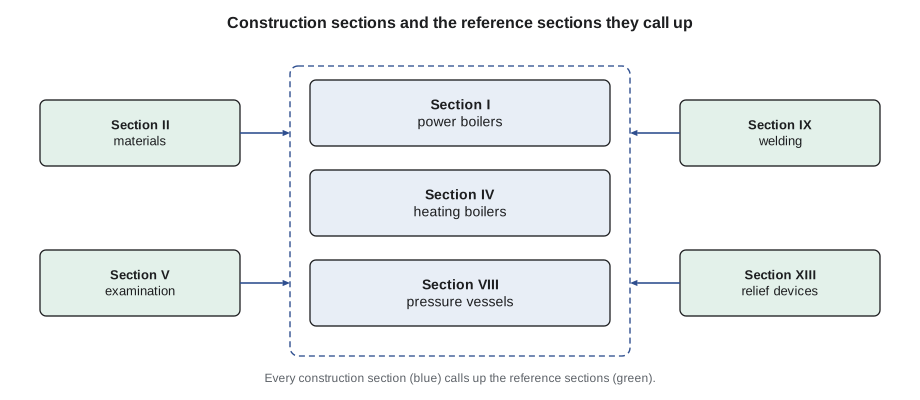
The Boiler and Pressure Vessel Code, usually shortened to the BPVC or just "the code", is published as a set of sections. Some are construction codes, which say how to design, build, examine and test a new item. Others are reference sections that the construction codes call up for materials, examination methods and welding. A few give recommended rules for operating and caring for boilers. A boilermaker deals most with Sections I, II, V, VIII and IX, and needs to know what the rest are so that a question can be sent to the right book.
| Section | Title (shortened) | Kind | Where a boilermaker meets it |
|---|---|---|---|
| I | Power boilers | Construction | Utility and industrial boilers, steam drums, superheaters |
| II | Materials (Parts A, B, C and D) | Reference | Plate, pipe, tube, filler metal and allowable stresses |
| III | Nuclear facility components | Construction | Nuclear plant work, under its own programs |
| IV | Heating boilers | Construction | Low-pressure steam and hot water boilers in buildings |
| V | Nondestructive examination | Reference | How radiography, ultrasonics and other methods are done |
| VI and VII | Care of heating and power boilers | Recommended rules | Operation and maintenance |
| VIII | Pressure vessels (Divisions 1, 2 and 3) | Construction | Drums, separators, exchangers, receivers |
| IX | Welding, brazing and fusing qualifications | Reference | Procedure and welder qualification |
| X | Fibre-reinforced plastic pressure vessels | Construction | Rarely, in chemical service |
| XI | In-service inspection of nuclear components | In-service | Nuclear plant outages |
| XII | Transport tanks | Construction | Road and rail pressure tanks |
| XIII | Overpressure protection | Reference | Safety and relief valves, rupture disks |
Section VIII has three divisions. Division 1 is the one most shops build to: it uses design formulas and design rules, with fairly conservative allowable stresses. Division 2 gives alternative rules, with higher allowable stresses in exchange for more detailed design analysis and more examination, and is used for large or heavy vessels where the saving in steel pays for the extra engineering. Division 3 covers very high pressures, roughly above 70 MPa (10,000 psi). Ironbridge's vessels, such as V-412 and V-414, are Division 1.
Section XIII is a newer section. Until the 2021 edition, each construction section carried its own rules for safety and relief valves; those rules were gathered into Section XIII, and the construction sections now refer to it for the devices that protect a boiler or vessel from overpressure.
How a section is organized
Each construction section is divided into parts or subsections, and each paragraph has a code made of letters and a number. In Section VIII, Division 1, paragraphs that apply to every vessel start with UG, for general requirements: UG-27 is the thickness of shells under internal pressure, UG-99 the hydrostatic test, UG-116 the marking on the nameplate. Paragraphs for welded vessels start with UW: UW-11 for radiography and UW-12 for joint efficiencies. Paragraphs for carbon and low-alloy steel start with UCS, and UCS-56 is the post-weld heat treatment table. Section I uses PG for general rules and PW for welded boilers: PG-27 is the thickness of tubes and pipe, PW-38 preheat and PW-39 post-weld heat treatment. Section IX uses QW for welding and QB for brazing.
| Prefix | Section | What the paragraphs cover |
|---|---|---|
| UG | VIII-1 | General requirements for all vessels |
| UW | VIII-1 | Vessels made by welding |
| UCS | VIII-1 | Carbon and low-alloy steel |
| UHA | VIII-1 | High-alloy (stainless) steel |
| PG | I | General requirements for power boilers |
| PW | I | Boilers made by welding |
| QW | IX | Welding procedure and performance qualification |
Besides the numbered paragraphs, each section has mandatory appendices, which are part of the rules, and nonmandatory appendices, which give guidance and examples. Section VIII, Division 1, for example, puts its quality control system requirements in a mandatory appendix and gives sample data reports and worked examples in nonmandatory ones. When Harjit sends a question to the floor he always writes the paragraph number with it, and when Kiera asks a question he asks her to find the paragraph first.
Interpretations and code cases
The code is written by volunteer committees of engineers, inspectors, manufacturers and users. When someone does not understand what a paragraph requires, they can send a question to the committee. The committee answers with an interpretation, a formal yes or no to a question about the existing rules, and publishes it. Interpretations do not change the rules; they explain them. Shops keep the ones that apply to their work, because an inspector may refer to one when deciding whether a detail is acceptable.
A code case is different. It gives permission to do something the rules do not yet cover, such as use a new material or a new method, under stated conditions. Code cases are published separately and are often written into a later edition once the committee is satisfied. A code case may be used only if the jurisdiction accepts it and the data report records it. When an engineer specifies a code case on a drawing, the shop's quality control system must make sure every condition of the case is met and recorded.
Which code does this item belong to?
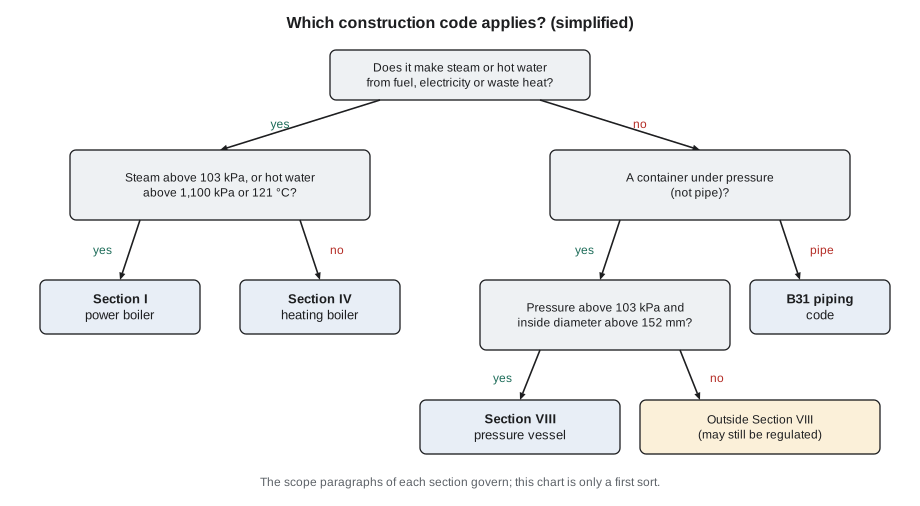
One of the first questions on any job is which construction code applies. The answer depends on what the item is, what it holds and how hot and how high its pressure is. A boiler, in the code's sense, is equipment in which steam or hot water is generated by heat from combustion, electricity or waste heat. A power boiler, built to Section I, is a steam boiler working above 103 kPa (15 psi), or a hot water boiler working above 1,100 kPa (160 psi) or 121 °C (250 °F). A heating boiler below those limits, of the kind that heats a school or an apartment building, is built to Section IV.
A pressure vessel is a container for pressure that is not a boiler. Section VIII, Division 1 excludes vessels whose internal or external pressure does not exceed 103 kPa (15 psi), and vessels with an inside diameter, width, height or cross-section diagonal of 152 mm (6 in) or less, along with some other classes such as some water heaters and piping components. Pipe that carries fluid from one place to another is built to one of the B31 piping codes: B31.1 for power piping and B31.3 for process piping. Where a boiler connects to its piping, Section I covers the boiler proper and the boiler external piping up to and including specified valves, and B31.1 sets the construction rules for that external piping.
Worked problem
Sorting Ironbridge's spring work
Seven items are on the shop board: the Riverbend Unit 2 boiler, the Larkspur greenhouse boiler, a school heating boiler, V-414, a small instrument air filter housing, a vented condensate receiver and the Riverbend main steam line. Which code covers each?
Show solution
- Boilers: compare the steam pressure, or the hot water pressure and temperature, with the heating boiler limits.
- Vessels: check the pressure and the inside diameter against the Section VIII exclusions.
- Pipe: send it to the B31 code for its service.
Answer: The program below sorts them. Both steam boilers are Section I, even the small greenhouse boiler, because its steam pressure is above the limit; the school boiler is Section IV; V-414 is Section VIII, Division 1; the filter housing and the vented receiver fall outside Section VIII; and the steam line is B31.1.
# Which part of the code covers this item? A first sort (metric, illustrative scope rules)
UNIT = "kPa"
STEAM_LIMIT, WATER_P, WATER_T = 103, 1100, 121     # heating boiler limits
VESSEL_P, VESSEL_D = 103, 152                      # below these, Section VIII does not apply

def which(item):
    kind, p, t, d = item["kind"], item["p"], item.get("t", 0), item.get("d", 0)
    if kind == "steam boiler":
        return "Section IV (heating boiler)" if p <= STEAM_LIMIT else "Section I (power boiler)"
    if kind == "hot water boiler":
        return "Section IV (heating boiler)" if p <= WATER_P and t <= WATER_T else "Section I (power boiler)"
    if kind == "vessel":
        if p <= VESSEL_P:
            return "outside Section VIII (pressure too low)"
        if d <= VESSEL_D:
            return "outside Section VIII (diameter too small)"
        return "Section VIII, Division 1 (unless the designer chooses Division 2)"
    if kind == "piping":
        return "ASME B31 piping code (B31.1 power, B31.3 process)"
    return "check with the inspector"

for item in [{"name": "Riverbend Unit 2 boiler", "kind": "steam boiler", "p": 11700}, {"name": "Larkspur greenhouse boiler", "kind": "steam boiler", "p": 860}, {"name": "school heating boiler", "kind": "hot water boiler", "p": 550, "t": 82}, {"name": "V-414 knockout drum", "kind": "vessel", "p": 1700, "d": 1800}, {"name": "instrument air filter housing", "kind": "vessel", "p": 1000, "d": 100}, {"name": "condensate receiver (vented)", "kind": "vessel", "p": 70, "d": 900}, {"name": "Riverbend main steam line", "kind": "piping", "p": 11100}]:
print(f"{item['name']:30} {item['p']:>6} {UNIT:4} -> {which(item)}")Riverbend Unit 2 boiler 11700 kPa -> Section I (power boiler) Larkspur greenhouse boiler 860 kPa -> Section I (power boiler) school heating boiler 550 kPa -> Section IV (heating boiler) V-414 knockout drum 1700 kPa -> Section VIII, Division 1 (unless the designer chooses Division 2) instrument air filter housing 1000 kPa -> outside Section VIII (diameter too small) condensate receiver (vented) 70 kPa -> outside Section VIII (pressure too low) Riverbend main steam line 11100 kPa -> ASME B31 piping code (B31.1 power, B31.3 process)
Falling outside Section VIII does not mean an item is unregulated. In Alberta, the Pressure Equipment Safety Regulation and CSA B51 set their own exemption limits, and some small items still need a registered design.
The program is only a first sort. The scope paragraphs of each section have more exclusions and conditions than a short program can hold, and Harjit makes the class read them. Kiera notices that the greenhouse boiler surprises most of the room: it is small enough to fit in a garage, but because it makes steam above the heating boiler limit, it is a power boiler with all the rules that go with one.
Reading a paragraph
Code paragraphs are written in a compact style that rewards slow reading. A paragraph usually states a requirement, then gives exceptions, then refers to other paragraphs, tables or appendices, and footnotes and notes to tables often carry conditions that change the answer. Words such as shall, may and should have exact meanings: shall is mandatory, may is permissive, and should is a recommendation. Harjit has the class read UG-99 aloud, one sentence at a time, and stop at every cross-reference to look it up. It takes twenty minutes to read a paragraph that fits on half a page, and by the end everybody understands why a quick glance at a code book is how mistakes are made.
The front matter of each section is worth reading once. It explains the section's scope, the units it uses, how tolerances on numbers are to be read, how to submit a question to the committee and which edition the book is. The summary of changes at the front of a new edition lists every paragraph that was revised, which is how a quality control manager knows what to update in the shop's procedures when an edition becomes mandatory.
| Word in the code | Meaning |
|---|---|
| shall | A requirement that must be met |
| may | Permission; an option the user can choose |
| should | A recommendation, not required unless adopted |
| Manufacturer | The organization that holds the certificate and certifies the item |
| Inspector | The safety codes officer or authorized inspector who examines the work and signs the data report |
Common mistakes
MistakeLooking for a vessel rule in Section I or a boiler rule in Section VIII.
InsteadSort the item to its code first, then find the paragraph.
MistakeTreating an interpretation as a change to the rules.
InsteadInterpretations explain the existing rules; code cases give conditional permission for something new.
MistakeUsing a code case without recording it.
InsteadThe jurisdiction must accept it and the data report must record it.
MistakeAssuming a small boiler is a heating boiler.
InsteadThe pressure and temperature, not the size, decide Section I or Section IV.
Summary and key terms
- The BPVC is a set of sections: construction sections such as I, IV and VIII and reference sections such as II, V, IX and XIII.
- Section VIII has three divisions; Division 1 uses design formulas and is the most common.
- Paragraphs carry prefixes such as UG, UW and UCS in Section VIII and PG and PW in Section I.
- Interpretations explain the rules; code cases permit new materials or methods under conditions.
- Steam above 103 kPa (15 psi), or hot water above 1,100 kPa (160 psi) or 121 °C (250 °F), makes a power boiler.
- Small or very low-pressure vessels fall outside Section VIII but may still be regulated.
- BPVC
- The ASME Boiler and Pressure Vessel Code.
- Construction code
- A code section that gives rules for designing, building, examining and testing new equipment.
- Mandatory appendix
- An appendix that is part of the code rules.
- Interpretation
- A committee's formal answer to a question about what the existing rules mean.
- Code case
- A published permission to use a new material or method under stated conditions.
- Boiler external piping
- Piping attached to a power boiler that falls under Section I jurisdiction but is built to B31.1 rules.
Practice problems
Work each problem on paper first, then reveal the answer to check.
A hot water boiler runs at 900 kPa (130 psi) and 110 °C (230 °F). Which section applies?
Show answer
Section IV, because both are below the power boiler limits.
Where would you look for the post-weld heat treatment rules for a carbon steel vessel?
Show answer
In Section VIII, Division 1, paragraph UCS-56.
What is the difference between an interpretation and a code case?
Show answer
An interpretation explains the existing rules; a code case permits something the rules do not yet cover, under conditions.
Which section holds the allowable stress tables?
Show answer
Section II, Part D.
Lesson quiz · 5 questions
Score 60% or more to complete this lesson.
Create a free account to save your progress, take quizzes and earn a certificate.