
BLR-320 · Lesson 1 of 12 · 19 min
Why pressure equipment is regulated
In April, with the winter's fabrication work shipped, Kiera starts the code block of her technical training. Harjit Gill, Ironbridge's quality control manager, teaches it two evenings a week in the shop lunchroom, with the code books stacked on the table and a coffee can of old stamping dies beside them. On the first night he puts a photograph on the screen: a brick factory with its roof gone and its walls pushed out, firefighters picking through the wreck. "This is why there is a code," he says. "Everything you do with a pressure part from here on is written down because somebody, somewhere, got hurt when it wasn't." Grant Mahler, the ABSA safety codes officer who signs off Ironbridge's pressure work, sits at the back. "And I'm the one who makes sure it's written down," he adds. This lesson explains why boilers and pressure vessels are regulated when most shop work is not, how laws, regulations, codes and standards fit together, and who answers for what when a pressure part is built or repaired.
Stored energy
A pressure vessel holds energy the way a drawn bow does. The fluid inside is compressed, and if the shell gives way that energy is released in a fraction of a second. For a liquid such as water the stored energy is small, because water hardly compresses, which is why vessels are tested with water rather than air. For a gas the stored energy is large, and for water that is hot enough to flash into steam when the pressure drops it is enormous: every kilogram of water above its atmospheric boiling point turns partly into steam the instant the shell opens, and the steam expands to more than a thousand times the volume of the water it came from.
That is why a boiler failure is so much worse than a leak. A ruptured boiler drum does not drain; it explodes. The water inside flashes, the drum and the setting are thrown apart, and the people nearby are scalded or struck by the pieces. Boilermakers work around equipment like this every day, often inside it, and the rules in this course exist so that what goes back into service after their work will hold its pressure for the rest of its life.
| Contents of a 1 m³ (35 ft³) vessel at 1,000 kPa (145 psi) gauge | Rough stored energy | What happens if the shell fails |
|---|---|---|
| Cold water | Very small | A spray and a puddle; this is why hydrostatic tests use water |
| Compressed air | Large, on the order of a few kilograms of explosive | A blast that throws fragments |
| Saturated water at about 180 °C (356 °F) | Very large, many times the air case | Flashing steam, a violent explosion and scalding |
The explosions that made the rules
In the nineteenth century boilers exploded in North America at a rate that is hard to imagine now: on steamboats, on locomotives, in sawmills and in factories. Each one was investigated, and the causes were the same again and again. Plate was too thin or of poor quality, riveted seams were badly designed, safety valves were too small or tied down, water levels were allowed to fall and boilers were run long after corrosion had eaten into them. There was no common rule for how to build a boiler, and no one whose job it was to check.
The turning point most often cited is the explosion at the Grover Shoe Factory in Brockton, Massachusetts, in March 1905, which destroyed the building and killed 58 people. Massachusetts passed rules for boiler construction soon afterwards, and other states began to follow, each with rules of its own. Manufacturers who sold boilers in several states found themselves building to different rules in each, and in 1911 the American Society of Mechanical Engineers formed a committee to write one set of rules that every jurisdiction could adopt. Its first boiler code was issued in 1914 and published in 1915. Canadian provinces built their own boiler laws over the same years and came to adopt the same ASME rules for construction. Over the following century the code grew from a slim book on power boilers to a library covering vessels, materials, welding, inspection and nuclear plant, and boiler explosions went from a weekly event to a rare one.
Harjit's point in telling the story is a practical one. "Every rule in the book has a reason," he says. "If you don't know the reason, ask, because the day you skip a rule that you think is just paperwork is the day you find out what it was for."
Laws, regulations, codes and standards
Pressure equipment is controlled by a chain of documents, and a boilermaker needs to know which link a requirement comes from. At the top is a law passed by a legislature: Alberta's Safety Codes Act. A law sets out the purpose and gives powers, but it says little about how to build anything. Under the law sits a regulation, which turns the law's general powers into specific duties: the Pressure Equipment Safety Regulation says which equipment must be registered, inspected and certificated, who may build and repair it, and which codes apply.
The regulation then adopts codes by reference. A code is a set of rules written by a standards body so that it can be made law: the ASME Boiler and Pressure Vessel Code for construction, CSA B51 for registration, repair and in-service rules, and the piping codes for the pipe that connects it all. Once a regulation adopts a code, following the code is no longer good practice but a legal requirement. Codes in turn refer to standards, such as material specifications and test methods, and those become requirements through the code.
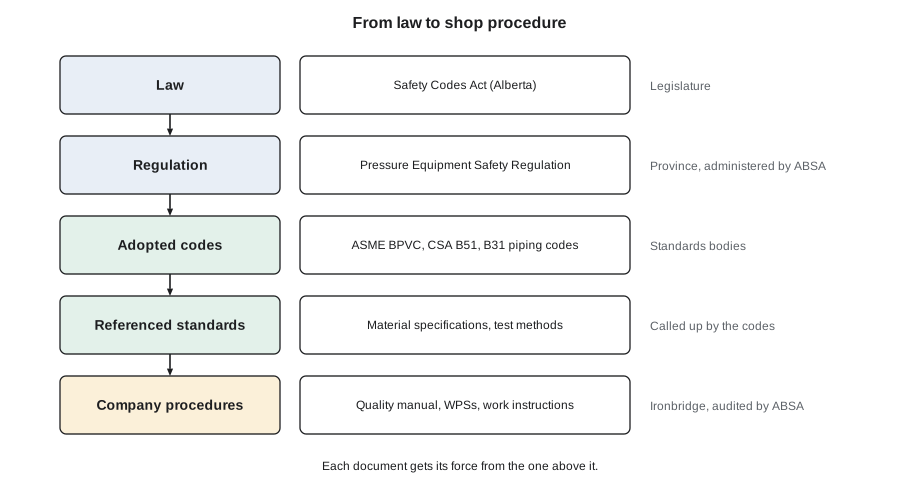
At the bottom of the chain are documents a company writes for itself: its quality control manual, its welding procedures and its work instructions. These are not law, but the code requires a company to have them and to follow them, so a shop that ignores its own manual is breaking the code as surely as one that welds with the wrong electrode.
| Document | Who writes it | Example | What it does |
|---|---|---|---|
| Law (act) | The legislature | Safety Codes Act | Creates the system and its powers |
| Regulation | The government | Pressure Equipment Safety Regulation | Sets duties and adopts codes |
| Code | A standards body | ASME BPVC, CSA B51 | Rules for construction, repair and inspection |
| Standard | A standards body | Material specifications, test methods | Detailed requirements the codes call up |
| Company procedures | The manufacturer or repairer | Quality control manual, WPS | How this shop meets the code |
Code, standard, specification and guideline
The words are used loosely on job sites, but they mean different things. A code is written in mandatory language, with "shall", so that it can be enforced. A standard sets out a method or a property, such as how to test a weld or what a steel grade must contain. A specification is a document for a particular purchase: the owner's specification for a vessel may demand more than the code, such as full radiography or a lower hardness, and the fabricator must meet both. A guideline or recommended practice uses "should" and gives advice; it becomes mandatory only if a code, a regulation or a contract makes it so.
When documents disagree, the stricter requirement usually governs, but the order of precedence is set by the contract and the regulation, not by preference. Harjit's rule for the shop is simple: when two documents seem to disagree, stop and ask quality control before cutting or welding anything.
Which edition applies?
ASME issues a new edition of the Boiler and Pressure Vessel Code every two years, in odd-numbered years, with the 2025 edition the latest at the time of this course. Between editions the committees publish interpretations and code cases. Which edition governs a job depends on the jurisdiction and on the contract. As a working rule, a new edition may be used from the day it is issued and becomes mandatory for new work six months later, and the edition in force on the contract date then applies for the life of that job. Jurisdictions can lag behind: ABSA and CSA B51 may call for a particular edition or allow a later one, so the shop checks before quoting.
Worked problem
Choosing the edition for four jobs
Ironbridge has four vessels on its books with different contract dates. Which edition must each be built to, using the working rule above?
Show solution
- List the editions with their issue dates (taken here as July of each odd year).
- An edition is mandatory if the contract was signed at least six months after it was issued.
- If a newer edition has been issued but is not yet mandatory, it may be used by agreement.
Answer: The program below works through the four jobs. The Larkspur receiver, signed in September 2025, must meet the 2023 edition but may use the 2025 edition if the owner agrees.
# Which edition of the ASME code applies to a new job? (illustrative rule of thumb)
# The code is published every two years; a new edition may be used once it is issued
# and must be used for contracts signed six months or more after it is issued.
from datetime import date

editions = {2019: date(2019, 7, 1), 2021: date(2021, 7, 1), 2023: date(2023, 7, 1), 2025: date(2025, 7, 1)}

def months_after(d, m):
    y, mo = divmod(d.month - 1 + m, 12)
    return date(d.year + y, mo + 1, 1)

def editions_for(contract):
    allowed = [e for e, issued in editions.items() if issued <= contract]
    required = [e for e, issued in editions.items() if months_after(issued, 6) <= contract]
    return max(required), max(allowed)

for job, signed in [("V-412 knockout drum", date(2026, 8, 10)), ("Larkspur receiver tank", date(2025, 9, 15)), ("Northgate air receiver", date(2024, 11, 4)), ("E-1105 replacement shell", date(2026, 1, 12))]:
    must, may = editions_for(signed)
    note = "" if must == may else f" (the {may} edition may be used by agreement)"
print(f"{job:28} signed {signed.isoformat()}: build to the {must} edition{note}")V-412 knockout drum signed 2026-08-10: build to the 2025 edition Larkspur receiver tank signed 2025-09-15: build to the 2023 edition (the 2025 edition may be used by agreement) Northgate air receiver signed 2024-11-04: build to the 2023 edition E-1105 replacement shell signed 2026-01-12: build to the 2025 edition
Repairs follow a different rule. A repair restores the original construction, so the repair organization uses the repair code in force today, CSA B51 and the NBIC as ABSA requires, together with the construction code edition the item was built to, or a later one, for design details. That is why the data report for an old vessel matters: it says which rules it was built under.
Who answers for what
Several parties share responsibility for a pressure part, and the code is written so that no one of them can sign everything alone. The owner decides what equipment is needed, keeps it registered, operates it within its limits and arranges inspection. The designer, often a professional engineer, works out the thicknesses, openings and loads. The manufacturer or repair organization holds a certificate for its quality control system, builds or repairs to the code and certifies the result on a data report. The inspector, a safety codes officer for ABSA, checks the work at hold points and signs the data report. ABSA registers designs and items, issues certificates and has the power to stop unsafe equipment.
Boilermakers fit into the manufacturer's or repairer's part of that chain. Their work is controlled by the company's quality manual, and their signatures appear on travellers, weld maps and fit-up records that the inspector reviews. "You don't need to memorize the code," Grant tells the class. "You need to know where your work shows up in it, and you need to know when to stop and call somebody."
Common mistakes
MistakeTreating the quality control manual as paperwork that doesn't apply on the floor.
InsteadThe code requires the company to follow its manual; ignoring it breaks the code.
MistakeAssuming the newest code edition always applies.
InsteadThe contract date and the jurisdiction decide the edition; check before starting.
MistakeThinking a recommended practice is optional because it says should.
InsteadIt is advice unless a code, regulation or contract makes it mandatory, and then it must be followed.
MistakeUsing air to pressure test because water is inconvenient.
InsteadGas stores far more energy; pneumatic tests need special approval and precautions.
Summary and key terms
- A pressure vessel stores energy, and hot water that flashes to steam stores the most.
- Boiler explosions in the nineteenth and early twentieth centuries led to state and provincial laws and to the ASME code, first issued in 1914.
- A law creates the system, a regulation sets duties and adopts codes, codes refer to standards, and companies write procedures to meet the codes.
- Codes use mandatory language; specifications add contract requirements; guidelines are advice unless adopted.
- ASME issues a new edition every two years; the contract date and the jurisdiction decide which edition governs.
- Owner, designer, manufacturer or repairer, inspector and ABSA each have their own responsibilities.
- Pressure equipment
- Boilers, pressure vessels, pressure piping and fittings that contain fluid above atmospheric pressure.
- Regulation
- Rules made under a law that set specific duties and adopt codes by reference.
- Code
- A set of mandatory rules written by a standards body so that it can be adopted into law.
- Edition
- A complete issue of a code; ASME issues a new one every two years.
- Jurisdiction
- The government authority that enforces pressure equipment law in a province or state.
- Inspector
- The person authorized to examine pressure work and sign its data report.
Practice problems
Work each problem on paper first, then reveal the answer to check.
Why are new vessels tested with water rather than air?
Show answer
Water hardly compresses, so it stores very little energy; a failure during the test releases a spray rather than a blast.
A guideline says welds should be ground flush. When must Ironbridge do it?
Show answer
When a code, regulation or the purchaser's specification makes it a requirement.
A contract was signed in May 2026. Which ASME edition applies under the working rule?
Show answer
The 2025 edition, issued in July 2025, became mandatory about January 2026, so it governs.
Who signs a data report besides the manufacturer?
Show answer
The inspector who examined the work.
Lesson quiz · 5 questions
Score 60% or more to complete this lesson.
Create a free account to save your progress, take quizzes and earn a certificate.