
BLR-320 · Lesson 5 of 12 · 19 min
Section IX: welding qualifications
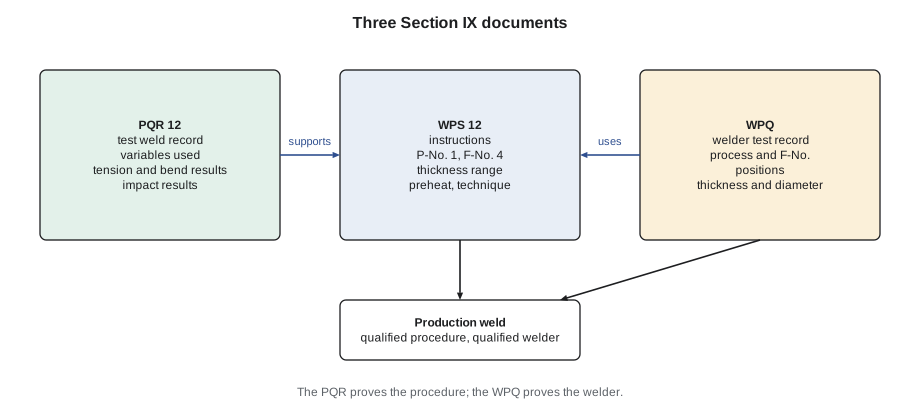
Every pressure weld Kiera has made at Ironbridge has been made to a welding procedure specification pinned to the welding machine, and every time, someone in quality control checked that her name was on the list of welders qualified to use it. Tonight Harjit puts three documents side by side on the screen: WPS 12, the procedure Ironbridge uses for SMAW on carbon steel vessel plate; PQR 12, the record of the test that qualified it; and a welder's performance qualification record. "Three pieces of paper," he says. "One tells the welder what to do, one proves the procedure works, and one proves the welder can do it. Section IX is the rulebook for all three." This lesson covers the purpose of Section IX, the difference between a procedure and a performance qualification, how essential variables decide what a test qualifies, how base metals and filler metals are grouped, how thickness and position ranges work, and how welder continuity is kept.
What Section IX does
Section IX does not say how to design a weld joint or which welds need examining. Those rules are in the construction codes, such as Sections I and VIII and the B31 piping codes. Section IX says how to prove two things before production welding starts: that a welding procedure will produce a weld with the required properties, and that a welder or welding operator can deposit sound weld metal following that procedure. The construction codes then require that every pressure weld be made with a qualified procedure by a qualified welder, and the organization doing the work is responsible for both.
Section IX is divided into parts: QW for welding, QB for brazing and QF for plastic fusing. Within QW, the articles cover general requirements, procedure qualification, performance qualification, the data tables that list the variables for each process, and the forms. The forms in the nonmandatory appendix are examples; a shop may use its own layout as long as every required item is recorded.
WPS, PQR and WPQ
A welding procedure specification, or WPS, is the instruction to the welder. It lists the process, the joint design, the base metals, the filler metals, the thickness range, the positions, preheat and interpass temperatures, post-weld heat treatment, shielding gas, electrical characteristics and technique, each either as a fixed value or as a range.
A procedure qualification record, or PQR, is the record of a test weld. The shop welds a test coupon using particular values of every variable, records what was actually used, and then cuts and tests specimens: tension tests to show the joint is as strong as the base metal, bend tests to show it is sound and ductile, and impact tests when toughness is required. The PQR records the results. It is a record of what happened, and it is never changed afterwards except to correct an error or add information.
A welder performance qualification, often called a WPQ, is the record of a welder's test. The welder welds a test coupon following a qualified WPS, and the coupon is bend tested or, for some processes and joints, radiographed. The WPQ records the variables used and the ranges the welder is qualified for.
| Document | Question it answers | Who signs it | Can it be revised? |
|---|---|---|---|
| WPS | How must this weld be made? | The organization | Yes, within what its PQRs support |
| PQR | Did a test weld made this way pass? | The organization, certifying the test | Only to correct errors or add data |
| WPQ | Can this welder make this weld? | The organization, certifying the test | No; a new test gives a new record |
One WPS may be supported by more than one PQR, and one PQR may support several WPSs. Ironbridge's WPS 12 is supported by PQR 12, which was welded on 19 mm (3/4 in) SA-516 Grade 70 plate with E7018 electrodes and impact tested. The organization is responsible for its procedures and its welders; it cannot borrow another company's PQR, with the exception that Section IX accepts certain published standard welding procedure specifications, which a shop may adopt under stated conditions.
Essential, supplementary essential and nonessential variables
Not every change to a procedure matters equally, and Section IX sorts the variables into three kinds for each process. An essential variable is one that, if changed beyond its limit, affects the mechanical properties of the weld, so a change needs a new PQR. Examples are a change in the base metal group, the filler metal group, the thickness beyond the qualified range, the preheat temperature dropping more than a set amount, or adding or removing post-weld heat treatment. A supplementary essential variable matters only when impact testing is required; when toughness is specified, changes such as a higher heat input become essential too. A nonessential variable, such as the joint design or the method of cleaning, can be changed by revising the WPS without a new test.
| Kind of variable | When a change needs a new PQR | Examples for SMAW |
|---|---|---|
| Essential | Always | P-Number, F-Number, thickness range, preheat decrease, PWHT added or removed |
| Supplementary essential | Only when impact tests are required | Heat input increase, electrode size increase, change in position to vertical up |
| Nonessential | Never; revise the WPS | Groove design, cleaning, technique details |
For performance qualification there is a separate list of essential variables, chosen for what affects a welder's skill rather than the weld's properties: the process, the filler metal F-Number, the position, removing backing, and the thickness and diameter ranges. A welder qualified in the 3G and 4G positions on plate with backing, for example, is not qualified for open-root pipe.
P-Numbers, F-Numbers and A-Numbers
If every steel needed its own procedure test, a shop would need hundreds. Section IX groups base metals with similar welding behaviour under P-Numbers, and within some P-Numbers, Group Numbers for impact-tested work. Carbon steels such as SA-516 Grade 70, SA-106 Grade B and SA-105 are all P-No. 1. Low-alloy steels with chromium and molybdenum fall in P-No. 4 or 5A, and austenitic stainless steels in P-No. 8. A procedure qualified on one P-No. 1 steel covers the others in that group, and qualifying on certain combinations covers joints between groups.
Filler metals are grouped by F-Number, according to their usability: the low-hydrogen carbon steel electrodes such as E7018 are F-No. 4, the cellulosic electrodes such as E6010 are F-No. 3, and solid wires for GMAW and GTAW are F-No. 6. A-Numbers group weld metals by chemical composition. For welder qualification, the F-Number matters most, because it reflects how hard the electrode is to handle.
Thickness, diameter and position ranges
A procedure test qualifies a range of thicknesses based on the thickness of the test coupon. For most groove welds, a coupon between 10 mm (3/8 in) and 19 mm (3/4 in) thick qualifies base metal from 5 mm (3/16 in) up to twice the coupon thickness, and a coupon of 38 mm (1 1/2 in) or more qualifies from 5 mm (3/16 in) up to 200 mm (8 in). PQR 12, on 19 mm (3/4 in) plate, therefore supports WPS 12 for 5 to 38 mm (3/16 to 1 1/2 in). Welder tests have their own thickness and diameter ranges, and a welder tested on pipe below a certain diameter is limited in the smallest diameter he or she may weld.
Positions are qualified by test position. In general, a groove procedure qualified in any position qualifies all positions unless impact testing makes vertical-up a supplementary variable, but a welder's position is an essential performance variable: a welder tested in the 2G and 5G positions on pipe, or in 6G, is qualified for all positions, while a welder tested in 1G only is limited to flat welding.
Worked problem
Is WPS 12 good for a V-414 nozzle weld, and who may weld it?
A V-414 nozzle weld joins 16 mm (5/8 in) SA-516 Grade 70 shell to an SA-106 Grade B neck, with E7018 and a preheat of 10 °C (50 °F). WPS 12 covers SMAW, P-No. 1 to P-No. 1, F-No. 4, 5 to 38 mm (3/16 to 1 1/2 in), minimum preheat 10 °C (50 °F) and no PWHT. Four welders are on the list; today is 16 April 2029.
Show solution
- Compare each essential variable of the job with the WPS ranges.
- Check that each welder's qualification covers the process and that it is current.
- A welder's qualification for a process lapses after six months without using it.
Answer: The program below finds the WPS covers the weld, and that one welder's SMAW qualification has lapsed and must be renewed before he welds on V-414.
# Does this welder and procedure cover the job? (illustrative essential-variable check)
from datetime import date
wps = {"process": "SMAW", "P-No": 1, "F-No": 4, "thickness": (5, 38), "preheat_min": 10, "PWHT": False}
job = {"process": "SMAW", "P-No": 1, "F-No": 4, "thickness": 16, "preheat": 10, "PWHT": False}
problems = []
for k in ("process", "P-No", "F-No", "PWHT"):
    if wps[k] != job[k]:
        problems.append(f"{k} differs")
lo, hi = wps["thickness"]
if not lo <= job["thickness"] <= hi:
    problems.append("thickness outside the qualified range")
if job["preheat"] < wps["preheat_min"]:
    problems.append("preheat below the procedure minimum")
print("WPS check:", "covered" if not problems else "; ".join(problems))
# welder continuity: a qualification lapses after six months without using the process
today = date(2029, 4, 16)
log = [("J. Okeke", date(2029, 3, 28)), ("M. Beaudry", date(2029, 1, 9)), ("S. Nakamura", date(2028, 9, 30)), ("R. Haldane", date(2028, 10, 17))]
for welder, last_used in log:
    months = (today.year - last_used.year) * 12 + today.month - last_used.month - (today.day < last_used.day)
    status = "current" if months < 6 else "LAPSED - requalify before welding"
print(f"{welder:14} last SMAW weld {last_used.isoformat()} ({months} months): {status}")WPS check: covered J. Okeke last SMAW weld 2029-03-28 (0 months): current M. Beaudry last SMAW weld 2029-01-09 (3 months): current S. Nakamura last SMAW weld 2028-09-30 (6 months): LAPSED - requalify before welding R. Haldane last SMAW weld 2028-10-17 (5 months): current
Continuity and renewal
A welder's qualification does not expire on a calendar date as long as it is used. Under QW-322, it lapses if the welder has not welded with that process for six months, and it can be revoked at any time if there is a specific reason to question the welder's ability, such as repeated rejected welds. The organization keeps a continuity record for each welder and process, signed off regularly, usually from the weld maps and production records. A lapsed qualification is renewed by a new test, which may be a single test coupon in any position.
S. Nakamura's name shows up as lapsed in the program because he has spent the winter on GTAW tube work and has not run SMAW on a code job since September. He is a good welder, and nobody doubts he can still do it, but the code does not care what anybody thinks: until a new test is welded and passed, he may not make SMAW pressure welds. Harjit books the test booth for the next morning.
In Alberta, a welder making welds on pressure equipment must also hold a pressure welder certificate issued by ABSA, and the performance qualification card records the welder's qualified ranges; the employer's Section IX records and the ABSA certificate are both needed.
Reading a WPS at the machine
Kiera practises reading WPS 12 the way a welder should before starting work. The heading gives the WPS number, its revision and the PQRs that support it. The joints section shows the groove details allowed and whether backing is used. The base metals section gives the P-Numbers and thickness ranges. The filler metals section gives the specification, classification, F-Number and A-Number, and the size range. Then come positions, preheat and interpass limits, post-weld heat treatment, gas if any, the electrical characteristics with current and polarity, and the technique: stringer or weave, cleaning between passes, and any limits on bead width. A welder who reads only the electrode type and the amperage has missed half of what the procedure requires.
When something on the job does not fit the WPS, such as plate thicker than the range or a joint the WPS does not show, the welder stops and calls quality control. The answer may be that another WPS covers it, or that a new procedure must be qualified before the weld can be made, but it is never to weld it anyway and sort it out later.
Common mistakes
MistakeChanging a PQR to match a revised WPS.
InsteadA PQR records a test that happened; a change beyond its ranges needs a new test.
MistakeAssuming a welder qualified in 1G on plate can weld a vertical nozzle.
InsteadPosition is an essential performance variable; check the WPQ's range.
MistakeIgnoring supplementary essential variables on an impact-tested vessel.
InsteadWhen impact tests are required, they become essential.
MistakeLetting a welder weld because he was qualified once.
InsteadCheck continuity: six months without the process and the qualification lapses.
Summary and key terms
- Section IX qualifies procedures and welders; the construction codes say where qualified welds are needed.
- The WPS instructs, the PQR records the procedure test, and the WPQ records the welder's test.
- Essential variables need a new PQR when changed; supplementary essential ones matter when impact testing is required.
- P-Numbers group base metals, F-Numbers group filler metals by usability, and A-Numbers group weld metal chemistry.
- Coupon thickness sets the qualified thickness range, and test position sets the welder's positions.
- A welder's qualification lapses after six months without using the process.
- WPS
- Welding procedure specification: the written instructions for making a weld.
- PQR
- Procedure qualification record: the record of the test weld and its results.
- WPQ
- Welder performance qualification: the record of a welder's test and qualified ranges.
- Essential variable
- A variable whose change beyond its limit requires requalification.
- P-Number
- A grouping of base metals with similar welding characteristics.
- Continuity
- The record showing that a welder has used a process within the last six months.
Practice problems
Work each problem on paper first, then reveal the answer to check.
PQR 12 was welded on 19 mm (3/4 in) plate. What thickness range does it support for groove welds?
Show answer
5 to 38 mm (3/16 to 1 1/2 in), twice the coupon thickness.
A WPS is changed to a different groove angle. Is a new PQR needed?
Show answer
No; groove design is nonessential for the procedure, so the WPS is revised.
Which F-Number is E7018?
Show answer
F-No. 4.
A welder last used GTAW on a code job seven months ago. Can he weld a GTAW root today?
Show answer
No; the qualification has lapsed and must be renewed by a test.
Lesson quiz · 5 questions
Score 60% or more to complete this lesson.
Create a free account to save your progress, take quizzes and earn a certificate.