
BLR-320 · Lesson 11 of 12 · 19 min
Data reports, nameplates and the certification mark
V-414's nameplate was the last thing fitted before it shipped: a stainless steel plate on a bracket, stamped with the ASME certification mark, the letter U, and a dozen lines of data. Two weeks later, while the data report was being prepared for ABSA, Kiera was asked to compare the report with a photograph of the nameplate, line by line. One line did not match. "That's why we check," Harjit says. "The nameplate and the data report are the vessel's birth certificate. They have to tell the same story for the next fifty years, because nobody will ever see the inside of that shop again." This lesson covers the ASME certification mark and its designators, what a nameplate must show, the data reports for vessels, boilers and parts, the order in which certification happens, and how errors are caught and corrected.
The certification mark
ASME work used to be marked with a set of separate code symbol stamps: a U in a clover-leaf for vessels, an S for power boilers, and so on. Since the early 2010s, ASME has used a single certification mark, a shield-shaped symbol, together with a designator that shows the kind of work: U, U2, S, H, PP, A and others. The mark may be applied only by a holder of a current certificate of authorization for that designator, only to items built under the certificate's quality control system, and only after the inspector has completed the final inspection and test and authorized it. Misusing the mark, or applying it to an item that was not built under the system, is grounds for losing the certificate.
The mark is applied with the shop's own stamp, which is kept under the control of quality control and logged in and out. Harjit's stamp set lives in a locked box in his office, and the log shows every time it has been used, on what, and who witnessed it.
What the nameplate shows
Section VIII, Division 1 sets out the required markings in UG-116, and Section I has similar rules. The markings go either directly on the vessel or, more usually, on a nameplate permanently attached to the vessel, and they must be legible for its life. For a Division 1 vessel the required markings include the certification mark with the U designator, the manufacturer's name, the maximum allowable working pressure at its temperature, the minimum design metal temperature at its pressure, the manufacturer's serial number and the year built. Other markings are added when they apply: the extent of radiography, shown as RT 1, RT 2, RT 3 or RT 4; HT when the vessel has been post-weld heat treated, or PHT when only part of it has; and letters for special service or construction.
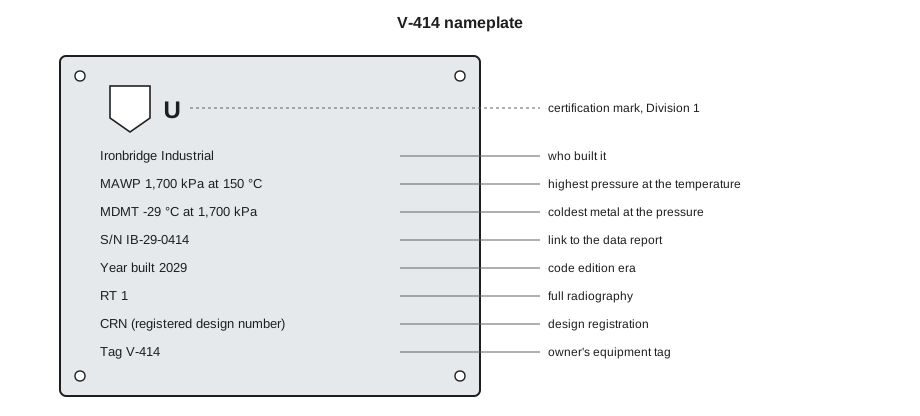
| Marking | What it tells an inspector |
|---|---|
| Certification mark with U | Built to Section VIII, Division 1 by a certificate holder |
| Manufacturer | Who built it and holds the data report |
| MAWP at temperature | The highest pressure allowed at the stated metal temperature |
| MDMT at pressure | The coldest metal temperature allowed at the stated pressure |
| Serial number | The link to the data report and the manufacturer's records |
| Year built | Which code edition and which era of practice applied |
| RT 1 to RT 4 | How much of the vessel was radiographed |
| HT or PHT | Whether the vessel was post-weld heat treated, fully or partly |
| CRN and ABSA number | The registered design and the item's registration |
The nameplate is the only part of the vessel's paperwork that travels with the vessel. When Peg opens a forty-year-old vessel at Riverbend, the nameplate tells her the rating, the year and the serial number, and with the serial number and the registration number she can get the data report, which tells her everything else. That is why grinding a nameplate off, painting it over or insulating it in so it cannot be found are all treated as serious faults. Insulated vessels usually have the nameplate on a standoff bracket so that it stays visible.
Data reports
The manufacturer's data report is the formal record that an item has been built to the code. For Section VIII, Division 1 vessels, the common forms are the U-1 and the shorter U-1A, which give the owner and location, the manufacturer and certificate, the serial number, the shell and heads with their materials, thicknesses and corrosion allowance, the joints with their types and radiography, the nozzles and openings, the heat treatment, the design and test pressures and temperatures, the impact tests, the code edition and any code cases, and the signatures of the manufacturer and the inspector. Section I has its own set of forms for boilers, boiler parts and piping.
Parts made by one manufacturer for an item completed by another, such as heads bought from a head maker or a tube panel made in another shop, are certified on partial data reports. Section VIII uses the U-2 and U-2A forms for parts. The partial data reports are attached to the completed item's data report, so the chain of certification is unbroken.
| Form | Used for |
|---|---|
| U-1 or U-1A | A completed Section VIII, Division 1 vessel |
| U-2 or U-2A | Parts of a Division 1 vessel made by another manufacturer |
| Section I P-forms | Power boilers, boiler parts and boiler external piping |
| ABSA repair and alteration report | Repairs and alterations |
A data report is a legal document. The manufacturer's signature certifies that the statements on it are correct and that the item was built to the code; the inspector's signature certifies that he inspected it and that, to the best of his knowledge, it meets the code. Neither signs until the item is finished, examined and tested, and neither signs a report that has errors in it.
The order of certification
Certification follows a set order. The design is completed and reviewed, and registered with ABSA before any work starts. The item is built, with material control, welding, examination and heat treatment recorded as they happen. The inspector witnesses the hold points and the pressure test. Only then is the data report completed and signed by the manufacturer, reviewed and signed by the inspector, and the certification mark applied to the nameplate with the inspector's authorization. Finally the item is registered with ABSA as an installed item when it reaches its site.
Applying the mark before the inspector has authorized it, or attaching a stamped nameplate before the test, breaks that order and can cost the shop its certificate. Harjit tells the class about a shop that stamped nameplates in advance to save time and was found out when a vessel failed its test with a stamped nameplate already on it.
Checking the nameplate against the report
Worked problem
Comparing V-414's nameplate with its data report
Kiera has the nameplate photograph and the draft data report. Compare each line.
Show solution
- List each item on the nameplate.
- List the same item from the data report.
- Flag anything that differs.
Answer: The program below finds that the serial number on the draft report has two digits swapped: IB-29-0441 instead of IB-29-0414. Every other line matches.
# Nameplate and data report cross-check for V-414 (metric)
nameplate = {"designator": "U", "manufacturer": "Ironbridge Industrial", "serial number": "IB-29-0414", "year built": 2029, "MAWP": "1,700 kPa at 150 C", "MDMT": "-29 C at 1,700 kPa", "radiography": "RT 1", "registration": "CRN shown"}
report = {"designator": "U", "manufacturer": "Ironbridge Industrial", "serial number": "IB-29-0441", "year built": 2029, "MAWP": "1,700 kPa at 150 C", "MDMT": "-29 C at 1,700 kPa", "radiography": "RT 1", "registration": "CRN shown"}
for k in nameplate:
    a, b = nameplate[k], report.get(k)
print(f"{k:28} nameplate {str(a):22} report {str(b):22} {'ok' if a == b else 'MISMATCH'}")designator nameplate U report U ok manufacturer nameplate Ironbridge Industrial report Ironbridge Industrial ok serial number nameplate IB-29-0414 report IB-29-0441 MISMATCH year built nameplate 2029 report 2029 ok MAWP nameplate 1,700 kPa at 150 C report 1,700 kPa at 150 C ok MDMT nameplate -29 C at 1,700 kPa report -29 C at 1,700 kPa ok radiography nameplate RT 1 report RT 1 ok registration nameplate CRN shown report CRN shown ok
The fix depends on which is wrong. Harjit checks the traveller, the stamping log and the shop's serial number register: the vessel is IB-29-0414, and the draft report was typed with two digits transposed. Because the report has not yet been signed, it is simply corrected and re-checked. If it had already been signed and registered, the correction would have needed the inspector's agreement and a corrected report filed with ABSA. If the nameplate had been wrong, the correction would have been much harder, because a stamped nameplate cannot just be altered; the inspector and the authority would decide how to correct it.
Kiera's check took twenty minutes. A transposed serial number on a registered data report could have taken months to untangle years later, when somebody tried to find V-414's records and found V-441 instead.
Old nameplates and missing data reports
In service, inspectors sometimes meet equipment whose nameplate is damaged, painted over or missing, or whose data report cannot be found. A nameplate that is still attached but hard to read can often be cleaned and read, or its stamping recovered by a rubbing. If the nameplate is lost, the owner can ask the manufacturer or the National Board for a copy of the data report using the serial number or registration number from the owner's records. Replacing a nameplate is controlled: it needs the inspector's and the authority's agreement and, under the NBIC, a documented procedure, so that a vessel cannot be given a new identity casually.
Equipment with no nameplate and no data report is the hardest case. Without them, nobody can be sure what code it was built to, what materials it contains or what its rating should be. The authority may require it to be taken out of pressure service, or may accept it only after an engineering assessment that establishes its materials, thicknesses and welds, and a new rating, which is an expensive way to recover what a few lines of stamping would have told everyone.
| Situation | Usual approach |
|---|---|
| Nameplate legible | Record the data; keep it visible |
| Nameplate painted or dirty | Clean carefully; take a rubbing |
| Nameplate lost, data report available | Replace under a controlled procedure with the inspector's agreement |
| No nameplate and no data report | Remove from pressure service or assess and re-rate under the authority's direction |
Electronic records
More and more data reports and supporting records are now kept electronically, and the National Board accepts electronic submission of reports for registration. Electronic records must meet the same rules as paper ones: they must be complete, legible, controlled, signed in a way the authority accepts and protected from loss. A scanned report is only as good as the original it came from, so the shop still checks every line before anything is signed.
Boiler and parts nameplates
Section I boilers carry similar markings, stamped on the boiler or on a nameplate: the certification mark with the S designator, the manufacturer, the serial number, the year built, the maximum allowable working pressure, the steam capacity or heating surface, and other data depending on the type. Superheaters, economizers and other parts that are certified separately carry their own marking, and a field-assembled boiler may carry several nameplates for its parts in addition to the main boiler nameplate. When Riverbend replaced a superheater section in BLR-210's outage, the new section arrived with its own stamped data and partial data report, and both were added to Unit 2's records.
Kiera notices during the class that everything on a nameplate is something an inspector would otherwise have to work out from scratch. The pressure and temperature tell her how hard the vessel may be pushed; the serial number and registration tell her where to find the rest; and the RT and HT markings tell her what examination and heat treatment it has already had, which shapes how a future repair must be done.
Common mistakes
MistakeApplying the certification mark before the final inspection and test.
InsteadThe mark is applied only after the inspector authorizes it.
MistakePainting or insulating over a nameplate.
InsteadNameplates must stay legible and visible for the life of the item.
MistakeSigning a data report with a known error to keep a shipment moving.
InsteadCorrect the report first; a signature certifies it is correct.
MistakeForgetting the partial data reports for purchased parts.
InsteadAttach them to the completed item's data report.
Summary and key terms
- ASME uses a single certification mark with a designator such as U or S.
- Only a certificate holder may apply it, to items built under its system, after the inspector authorizes it.
- Nameplates show the mark, manufacturer, MAWP, MDMT, serial number, year built and markings such as RT and HT.
- Data reports such as the U-1 and U-1A certify a completed vessel; partial data reports certify parts.
- Certification follows a set order: design, construction, inspection and test, data report, then marking.
- Nameplates and data reports are checked against each other before signing.
- Certification mark
- ASME's symbol, applied with a designator, showing an item was built to the code.
- Nameplate
- The permanently attached plate carrying the code markings.
- Data report
- The manufacturer's certified record of how an item was built.
- Partial data report
- A data report for a part made for an item completed by another manufacturer.
- RT marking
- The nameplate marking showing the extent of radiography.
- HT marking
- The nameplate marking showing the vessel was post-weld heat treated.
Practice problems
Work each problem on paper first, then reveal the answer to check.
When may the certification mark be applied?
Show answer
After the final inspection and test, with the inspector's authorization.
A vessel's nameplate says RT 1. What does that mean?
Show answer
The vessel was fully radiographed.
Which form certifies heads bought from a head maker for a Division 1 vessel?
Show answer
A partial data report, such as the U-2 or U-2A.
Why is the nameplate so important in service?
Show answer
It travels with the vessel and links it to its data report and registration.
Lesson quiz · 5 questions
Score 60% or more to complete this lesson.
Create a free account to save your progress, take quizzes and earn a certificate.