
BIOL-367 · Lesson 9 of 12 · 27 min
Conservation law and policy in Canada
Science can show that a species is declining and why, but protecting it usually requires law: rules that restrict harmful activities, require recovery planning and allocate responsibility among governments. This lesson examines the legal framework for conservation in Canada, centred on the federal Species at Risk Act, together with the international agreements Canada has joined, provincial laws, and other federal statutes that protect fish, migratory birds and parks. It also compares Canadian law briefly with the United States Endangered Species Act, which is often held up as a model or a warning in Canadian debates. Law changes frequently; the details here are current as of October 2026, and you should check official sources before relying on them.
International agreements
Conservation law operates at several levels. At the international level, countries make commitments through treaties, which they then implement through their own legislation. Four agreements are especially important for North American wildlife. The Convention on International Trade in Endangered Species of Wild Fauna and Flora (CITES), in force since 1975, regulates international trade in about 40,000 species listed in three appendices: Appendix I species, such as tigers and most great apes, may not be traded commercially; Appendix II species, such as many corals, orchids and polar bears, may be traded with permits showing the trade is legal and not detrimental to the species' survival; and Appendix III species are listed by individual countries seeking cooperation. The Ramsar Convention on Wetlands, signed in 1971, encourages the wise use of wetlands and the designation of wetlands of international importance. The Migratory Birds Convention of 1916 between the United States and Great Britain, on behalf of Canada, was one of the first international wildlife treaties and still underpins protection of migratory birds in both countries. The Convention on Biological Diversity (CBD), opened for signature at the Earth Summit in Rio de Janeiro in 1992, commits its parties to conserve biodiversity, use it sustainably and share the benefits of genetic resources fairly.
Canada was the first industrialized country to ratify the CBD, in 1992, and the convention's secretariat is based in Montreal. Canada implements CITES through the Wild Animal and Plant Protection and Regulation of International and Interprovincial Trade Act (WAPPRIITA), and the Migratory Birds Convention through the Migratory Birds Convention Act, 1994, which protects most migratory bird species, their eggs and, under regulations updated in 2022, their nests at least while in use and, for some species, year-round. Canada has also designated dozens of Ramsar sites, from the Peace–Athabasca Delta to the Point Pelee marshes.
Canada's constitutional setting
Conservation law in Canada is shaped by the division of powers in the Constitution Act, 1867. The federal government has authority over fisheries, navigation, federal lands such as national parks, criminal law and, through treaties, migratory birds. The provinces own most public land and natural resources within their borders and therefore have the primary authority over most terrestrial wildlife, forests, mining and land use. In the three territories, many responsibilities have been devolved from the federal government, and modern land claim agreements establish co-management boards with Indigenous governments. As a result, a species at risk in Canada may fall under federal law, provincial law or both, depending on what it is and where it lives. Section 35 of the Constitution Act, 1982 recognizes and affirms existing Aboriginal and treaty rights, which governments must respect and consult on when making conservation decisions, and the United Nations Declaration on the Rights of Indigenous Peoples Act of 2021 commits the federal government to align its laws with the declaration.
The Species at Risk Act
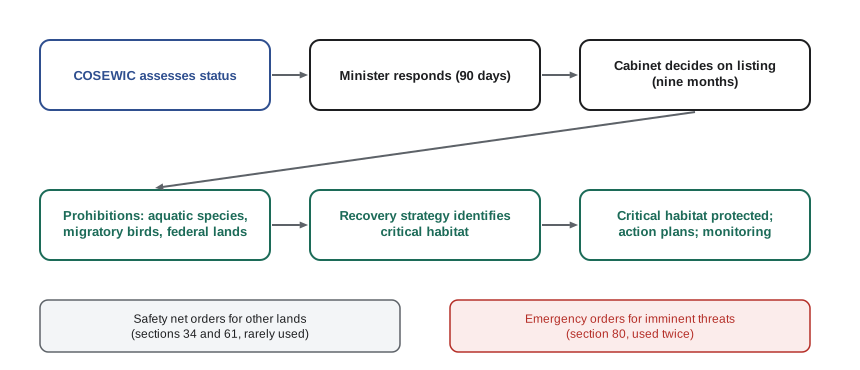
The Species at Risk Act (SARA), passed in 2002 and fully in force by 2004, is Canada's main federal law for protecting wildlife species at risk. Its purposes are to prevent wildlife species from being extirpated or becoming extinct, to provide for the recovery of species that are extirpated, endangered or threatened as a result of human activity, and to manage species of special concern to prevent them from becoming endangered or threatened. SARA works in several steps: independent scientific assessment, a political listing decision, automatic or discretionary prohibitions, recovery planning, and protection of critical habitat.
Assessment is carried out by the Committee on the Status of Endangered Wildlife in Canada (COSEWIC), an independent body of experts established in 1977 and given legal status under SARA. COSEWIC assesses species using criteria adapted from the IUCN Red List, described in lesson 3, and draws on scientific, community and Indigenous knowledge through species specialist subcommittees and its Indigenous Knowledge Subcommittee. It classifies species as extinct, extirpated, endangered, threatened, of special concern, data deficient or not at risk. COSEWIC can assess species, subspecies and designatable units, such as distinct populations, that are discrete and evolutionarily significant.
Listing is a political decision. After COSEWIC submits an assessment, the minister of environment has 90 days to say how the government will respond, and the Governor in Council, in practice the federal cabinet, then has nine months to decide whether to add the species to Schedule 1, the legal list of wildlife species at risk, to decline to list it, or to refer the assessment back to COSEWIC; if it does not act within nine months, the minister must list the species as assessed. Economic and social considerations, consultations with Indigenous peoples and stakeholders, and wildlife management boards in the North all play a role in listing decisions. Critics have pointed out that commercially harvested marine fishes, such as several populations of Atlantic cod, have frequently been assessed by COSEWIC as endangered but not listed. More than 600 species are now on Schedule 1.
Prohibitions and the federal–provincial divide
Once a species is listed as extirpated, endangered or threatened, SARA's general prohibitions make it an offence to kill, harm, harass, capture or take an individual (section 32) and to damage or destroy its residence, such as a den, nest or other dwelling place (section 33). But these prohibitions apply automatically only to aquatic species, to migratory birds protected under the Migratory Birds Convention Act, and to other species on federal lands, which make up a small part of the area of the provinces. For other species on provincial and private lands, protection depends on provincial law. SARA includes a safety net: if the minister forms the opinion that the laws of a province do not effectively protect a species or its residence, the minister must recommend that cabinet make an order applying the prohibitions to provincial lands (section 34 for individuals and residences, and section 61 for critical habitat). These safety net powers have rarely been used, which critics argue makes protection of many terrestrial species dependent on the willingness of provinces.
Provincial and territorial laws vary greatly. Ontario's Endangered Species Act, 2007 was long considered the strongest provincial species law, with automatic habitat protection for listed species. In 2025 Ontario passed legislation replacing it with the Species Conservation Act, 2025, which came into effect in early 2026 with regulations released in March 2026; it narrows habitat protection to areas such as dens and nests, relies on online registration rather than government review for many activities and removes the requirement for recovery strategies, changes that the province argues reduce duplication and speed up development but that environmental lawyers and many scientists have criticized as a major weakening. Quebec, New Brunswick, Nova Scotia, Manitoba and Newfoundland and Labrador have stand-alone species laws, while British Columbia and Alberta, which hold many species at risk, have relied mainly on wildlife and forest legislation and policy and have never enacted a dedicated species-at-risk act.
Recovery planning and critical habitat
SARA requires a recovery strategy for every extirpated, endangered or threatened species, within one year of listing for endangered species and two years for threatened and extirpated species, followed by one or more action plans, and a management plan within three years for species of special concern. Recovery strategies must identify threats, set population and distribution objectives and, to the extent possible based on the best available information, identify critical habitat, the habitat necessary for the survival or recovery of the species. Once critical habitat is identified, it must be legally protected within 180 days, through protection statements, other federal laws or a protection order. For much of SARA's first decade, many recovery strategies were years overdue and some omitted critical habitat, and environmental groups won a series of Federal Court cases, involving species such as the Nooksack dace, southern resident killer whales and sage-grouse, that required the government to identify and protect critical habitat as the act required. Backlogs have been reduced but persist.
Emergency orders
Section 80 of SARA allows cabinet, on the recommendation of the minister, to make an emergency order to protect a listed species if the minister is of the opinion that the species faces imminent threats to its survival or recovery. Emergency orders can apply on provincial and private land. The federal government has issued them only twice: in 2013 for the greater sage-grouse in southern Alberta and Saskatchewan, where fewer than 150 males were counted on breeding grounds, and in 2016 for the western chorus frog in a suburban area of La Prairie, Quebec, where housing development threatened one of the last populations of the Great Lakes–St. Lawrence and Canadian Shield population. Both orders were controversial, and the La Prairie order led to litigation by the developer.
The emergency order process has been tested repeatedly in recent years. In 2024 the Federal Court ruled that the former environment minister had acted unreasonably by delaying for eight months a recommendation to cabinet on an emergency order for the northern spotted owl in British Columbia, where only a few wild owls remained. Also in 2024, the minister formed the opinion that boreal caribou in Quebec faced imminent threats to their recovery, and the government consulted publicly from June to September 2024 on a possible emergency order; on 30 June 2026, the government announced that it would pursue a collaborative approach with Quebec and First Nations, including funding for caribou stewardship, rather than issue an order at that time. In June 2026 the Syilx Okanagan Nation petitioned the federal government for an emergency order to protect three deep-snow southern mountain caribou herds in British Columbia. These cases illustrate both the legal force of the emergency power and the political reluctance to use it.
Other federal laws
Several other federal statutes protect biodiversity. The Fisheries Act prohibits the harmful alteration, disruption or destruction of fish habitat without authorization; amendments in 2012 narrowed this protection to fish that are part of commercial, recreational or Aboriginal fisheries, and amendments in 2019 restored broader protection for all fish and fish habitat and added provisions for rebuilding depleted fish stocks. The Canada National Parks Act, revised in 2000, makes the maintenance or restoration of ecological integrity the first priority of the minister in managing parks. The Canada Wildlife Act allows the creation of national wildlife areas and, in marine waters, marine wildlife areas, and the Oceans Act and the Canada National Marine Conservation Areas Act provide for marine protected areas. The Impact Assessment Act of 2019 requires assessment of designated major projects; in 2023 the Supreme Court of Canada found parts of it unconstitutional as an intrusion on provincial jurisdiction, and Parliament amended it in 2024. In June 2025 Parliament passed the Building Canada Act, which allows cabinet to designate projects of national interest and to issue a single document representing the federal authorizations they need under a schedule of laws that includes the Species at Risk Act; supporters argue this speeds up nation-building projects, while environmental groups and many First Nations have criticized it as weakening oversight.
Indigenous rights and co-management
SARA recognizes the role of Indigenous peoples in conservation in several ways. Its preamble acknowledges the role of Aboriginal peoples in the conservation of wildlife and the importance of their traditional knowledge. The National Aboriginal Council on Species at Risk advises the minister, and recovery strategies must be prepared in cooperation with affected Indigenous organizations and wildlife management boards. In the North, wildlife management boards created under land claim agreements, such as the Nunavut Wildlife Management Board, have decision-making roles in listing and harvest. Courts have held that governments have a duty to consult and, where appropriate, accommodate Indigenous peoples when conservation decisions may affect their rights; at the same time, conservation measures can restrict harvesting only where justified under the framework the Supreme Court of Canada set out in R. v. Sparrow in 1990, which gave conservation priority but placed Aboriginal food, social and ceremonial fishing ahead of commercial and recreational fishing.
A brief comparison
| Feature | Canada: Species at Risk Act | United States: Endangered Species Act |
|---|---|---|
| Year enacted | 2002 | 1973 |
| Scientific assessment | COSEWIC, an independent committee | FWS or NMFS staff, based on best available data |
| Listing decision | Cabinet, which may consider economic and social factors | Agency, solely on scientific and commercial data |
| Prohibitions on non-federal land | Mainly through provincial law; federal safety net rarely used | Section 9 take prohibition applies on private land for endangered animals |
| Habitat protection | Critical habitat identified in recovery strategies and protected by order or other law | Critical habitat designated; habitat-based harm definition rescinded effective September 2026 |
| Federal actions | No direct equivalent of section 7; impact assessment and permits under other laws | Section 7 consultation and jeopardy standard |
| Citizen enforcement | Judicial review of government decisions | Citizen suits to enforce the act |
| Emergency tools | Section 80 emergency orders (used twice) | Emergency listing for 240 days |
The comparison shows that SARA relies more on cooperation and political discretion and less on automatic prohibitions than the ESA. Supporters of SARA's approach argue that cooperation with provinces, landowners and Indigenous peoples produces better long-term outcomes than litigation and regulation, and that the ESA's strict prohibitions can give landowners an incentive to destroy habitat before listed species appear, a problem sometimes summarized as shoot, shovel and shut up. Critics argue that SARA's discretion has allowed governments to delay listing, recovery strategies and habitat protection, and that many species continue to decline under it. Both countries face the same underlying problem: laws designed to stop harm to individual species struggle to address diffuse, landscape-scale threats such as habitat conversion, climate change and invasive species.
Worked problem
Who protects this species?
A threatened songbird nests in privately owned forest in Ontario and also in a national park in the same province. A threatened freshwater mussel lives in a river crossing the same private land. Which SARA prohibitions apply automatically to each?
Show solution
- The songbird, if it is a migratory bird protected under the Migratory Birds Convention Act, is covered by SARA's automatic prohibitions on all lands; if it is not, the prohibitions apply automatically only in the national park.
- On private land, a non-migratory songbird depends on provincial law, now the Species Conservation Act, 2025, unless the federal minister uses the safety net.
- The mussel is an aquatic species, so SARA's prohibitions apply to it wherever it occurs, including on private land.
- Critical habitat for both species would be identified in recovery strategies and must be protected within 180 days by the means the act provides.
Answer: The mussel is protected everywhere by SARA; the songbird is protected everywhere only if it is a federally protected migratory bird, and otherwise mainly by provincial law on private land.
Common mistakes
MistakeAssuming SARA protects all listed species on all lands.
InsteadIts automatic prohibitions cover aquatic species, migratory birds and federal lands; other species depend largely on provincial law.
MistakeTreating a COSEWIC assessment as a listing.
InsteadCOSEWIC assesses; cabinet decides whether to list on Schedule 1.
MistakeThinking emergency orders are routine.
InsteadThey have been issued only twice since 2002.
MistakeAssuming provincial species laws are uniform.
InsteadThey vary widely, and some provinces have no dedicated act; Ontario replaced its law in 2025.
MistakeIgnoring Indigenous rights in conservation decisions.
InsteadSection 35 rights, the duty to consult and co-management boards shape how conservation laws apply.
Summary and key terms
- Canada implements CITES, Ramsar, the Migratory Birds Convention and the CBD through federal law; it was the first industrialized country to ratify the CBD.
- Federal authority covers fisheries, migratory birds and federal lands; provinces control most land and wildlife.
- Under SARA, COSEWIC assesses species and cabinet decides on listing on Schedule 1.
- SARA prohibitions apply automatically to aquatic species, migratory birds and federal lands; a safety net is rarely used.
- Recovery strategies must identify critical habitat, which must be protected; courts have enforced these duties.
- Emergency orders have been issued only twice; a 2026 decision on Quebec caribou chose collaboration instead.
- Ontario replaced its Endangered Species Act in 2025, and the 2025 Building Canada Act allows streamlined authorizations for national-interest projects.
- COSEWIC
- The Committee on the Status of Endangered Wildlife in Canada, which assesses species.
- Schedule 1
- The legal list of wildlife species at risk under SARA.
- residence
- Under SARA, a dwelling place such as a den or nest occupied by an individual.
- critical habitat
- Habitat necessary for the survival or recovery of a listed species, identified in a recovery strategy.
- safety net
- SARA provisions allowing federal protection on provincial lands where provincial law is not effective.
- emergency order
- A cabinet order under section 80 to protect a species facing imminent threats.
- designatable unit
- A discrete and evolutionarily significant population that COSEWIC can assess separately.
- recovery strategy
- A SARA document setting objectives, threats and critical habitat for a listed species.
- ecological integrity
- The condition of a park ecosystem characteristic of its natural region, the first priority under the Canada National Parks Act.
- CITES
- The convention regulating international trade in endangered species.
Practice problems
Work each problem on paper first, then reveal the answer to check.
Who assesses species under SARA, and who decides whether to list them?
Show answer
COSEWIC assesses; cabinet decides.
How long does cabinet have to decide on listing after receiving an assessment?
Show answer
Nine months, after which the minister must list the species as assessed.
To which species do SARA's prohibitions apply automatically?
Show answer
Aquatic species, migratory birds under the MBCA, and other species on federal lands.
What must a recovery strategy identify, and what then happens?
Show answer
Critical habitat to the extent possible, which must be legally protected within 180 days.
Name the two species that have received SARA emergency orders.
Show answer
Greater sage-grouse (2013) and western chorus frog (2016).
What did the 2019 Fisheries Act amendments do?
Show answer
Restored protection for all fish and fish habitat and added stock rebuilding provisions.
What principle did R. v. Sparrow set for conservation and Aboriginal fishing?
Show answer
Conservation comes first, then Aboriginal food, social and ceremonial fishing ahead of other users.
How did Ontario's 2025 law change species protection?
Show answer
It replaced the ESA 2007, narrowing habitat protection and relying on registration rather than review.
Lesson quiz · 5 questions
Score 60% or more to complete this lesson.
Create a free account to save your progress, take quizzes and earn a certificate.