
BIOL-367 · Lesson 10 of 12 · 30 min
Recovering species: ex situ conservation, reintroduction and restoration
Protecting habitat and stopping harm are not always enough. When a species has been reduced to a handful of individuals, has disappeared from much of its range or depends on habitats that have been destroyed, recovery requires active intervention: breeding animals in captivity, storing seeds, moving individuals to new places, and rebuilding the ecosystems they need. This lesson examines ex situ conservation, the conservation of species outside their natural habitats; reintroduction, translocation and assisted migration; the controversial idea of de-extinction; and restoration ecology, which aims to repair degraded ecosystems. Throughout, North American recovery programs provide examples of what has worked, what has not, and why.
Ex situ conservation
In situ conservation protects species in their natural habitats, which is always the ultimate goal, because only there can species continue to evolve and play their ecological roles. Ex situ conservation maintains populations in zoos, aquariums, botanical gardens, seed banks and gene banks. The IUCN recommends that ex situ programs be integrated with in situ efforts, an approach called the One Plan approach, so that captive populations serve recovery in the wild rather than becoming ends in themselves. Ex situ conservation can provide insurance against extinction when wild populations are critically small, produce animals for release, support research on biology and husbandry, and engage the public.
Captive breeding has saved several North American species from extinction. The California condor declined to 22 birds by 1982, threatened mainly by lead poisoning from bullet fragments in carcasses, as lesson 5 described. In 1987, after heated debate, the last wild condor was captured, and the entire species was held in captive breeding programs at the San Diego and Los Angeles zoos. Releases began in 1992 in California and later in Arizona, Utah and Baja California, and the total population has since grown to more than 500 birds, over half of them flying free. But the wild population still depends on intensive management, including regular trapping to test for and treat lead poisoning, because the original threat has not been removed.
The black-footed ferret, a predator of prairie dogs, was thought to be extinct until a ranch dog brought a dead one home near Meeteetse, Wyoming, in 1981. That population collapsed from canine distemper and sylvatic plague, and the last 18 animals were taken into captivity in 1985 to 1987. Seven of them founded the entire captive population, which has produced thousands of kits; reintroductions began in Wyoming in 1991 and have since occurred at dozens of sites in the United States, Mexico and Canada, where ferrets were released in Grasslands National Park in Saskatchewan in 2009. Because the species descends from so few founders, its genetic diversity is very low. In 2020 scientists produced a clone, named Elizabeth Ann, from cells of a female that had been frozen in 1988 and had no living descendants, adding new genetic variation; another clone later produced offspring. The ferret's recovery remains limited by plague, the decline of prairie dog colonies and the loss of grassland.
In Canada, the Vancouver Island marmot, found only in the subalpine meadows of Vancouver Island, fell to fewer than 30 animals in the wild in the early 2000s, largely because clear-cut logging created habitat that attracted marmots to places where they were exposed to predators. A captive breeding program at the Toronto Zoo, the Calgary Zoo, a breeding centre on Mount Washington and formerly the Mountain View Conservation Centre produced hundreds of marmots for release, and the wild population has grown to a few hundred. The Wilder Institute at the Calgary Zoo also breeds whooping cranes and has helped restore northern leopard frogs in British Columbia, and zoos and aquariums in the Lower Mainland of British Columbia have head-started tadpoles of the Oregon spotted frog, one of Canada's most endangered amphibians.
The problems of captivity
Captive breeding has costs and pitfalls. Populations in captivity are small, so they lose genetic variation by drift and are vulnerable to inbreeding, problems that BIOL-322 examined. Breeding programs manage this by keeping studbooks, recording the ancestry of every animal, and pairing animals to minimize mean kinship, the average relatedness of each animal to the rest of the population, which retains genetic diversity most efficiently. A second problem is adaptation to captivity: in only a few generations, animals in captivity can evolve traits that improve their success in the zoo but reduce their fitness in the wild, such as tameness or reduced fear of predators, and they may lose learned behaviours such as migration routes, foraging skills or predator avoidance. Fish hatcheries provide clear evidence: studies of steelhead trout in Oregon found that fish from hatchery lines had substantially lower reproductive success in the wild than wild fish, and that the difference arose within one or two generations of captive rearing. Programs reduce these risks by keeping the number of generations in captivity small, by rearing animals in naturalistic conditions and with minimal contact with people, and by training animals to avoid predators before release.
Ex situ programs are also expensive, and space in zoos is limited. Estimates suggest that zoos worldwide could maintain genetically and demographically viable populations of only a few hundred vertebrate species at a time. For this reason captive breeding is generally a last resort, used when wild populations cannot be secured in time.
Seed banks and gene banks
For plants, seed banks offer an efficient form of ex situ conservation. The seeds of many species, called orthodox seeds, can survive for decades or centuries when dried and frozen. The Millennium Seed Bank at Kew in the United Kingdom holds seeds of tens of thousands of wild plant species, and the Svalbard Global Seed Vault, opened in Norway in 2008, stores backup copies of the seed collections of gene banks around the world. In Canada, Plant Gene Resources of Canada in Saskatoon conserves crop and wild relative seeds, and in the United States the National Laboratory for Genetic Resources Preservation in Fort Collins, Colorado, holds the backup collection of the national system. Some seeds, called recalcitrant seeds, such as those of oaks, chestnuts and many tropical trees, cannot survive drying and must be conserved in living collections or by cryopreservation of tissues. For animals, gene banks store frozen sperm, eggs, embryos and cell lines, such as the Frozen Zoo at San Diego, begun in 1975, which supplied the cells used to clone the black-footed ferret.
Reintroduction and translocation
Translocation is the deliberate movement of organisms from one place to another for conservation. The IUCN's 2013 Guidelines for Reintroductions and Other Conservation Translocations distinguish several types. A reintroduction releases a species into part of its native range from which it has disappeared. A reinforcement, or population supplementation, adds individuals to an existing population to increase its size or genetic diversity, as in the genetic rescue of the Florida panther. Conservation introductions move a species outside its native range, either as assisted colonization, to save the species from threats in its native range, or as ecological replacement, to fill a role left by an extinct species. The guidelines emphasize that the original causes of decline must have been addressed, that the habitat must be suitable and large enough, that release sites and source populations must be chosen carefully, that risks such as disease transmission must be assessed, and that the outcome must be monitored.
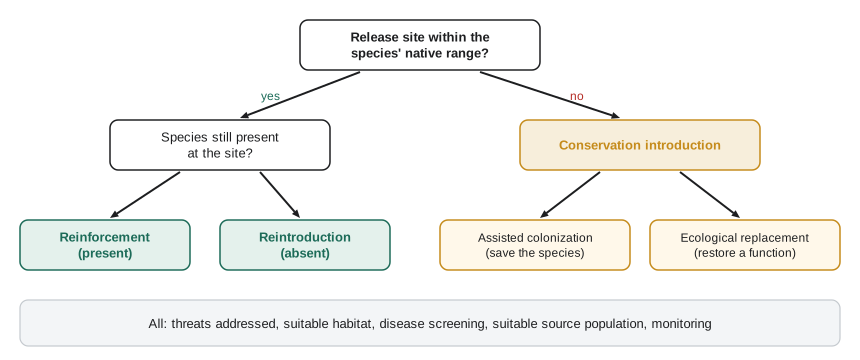
Reintroductions have a mixed record. Reviews have found that many early projects failed, often because the causes of decline had not been removed, too few animals were released, captive-bred animals lacked survival skills, or monitoring was too short to judge success. Releasing wild-caught animals usually works better than releasing captive-bred ones, and releasing more animals, in several groups, generally increases the chance that a population establishes. Soft release, in which animals are held in enclosures at the release site for a time to acclimatize, can improve survival for some species, as can supplementary feeding after release.
import numpy as np
rng = np.random.default_rng(367)
# Establishment probability of a reintroduced population as a function of the number released
# and the origin of the animals (invented parameters for a medium-sized mammal).
def establish(n_release, first_year_survival, years=20, runs=2000):
    successes = 0
    for _ in range(runs):
        n = rng.binomial(n_release, first_year_survival)    # post-release losses in year 1
        for _ in range(years):
            if n < 2:
                break
            females = rng.binomial(n, 0.5)
            births = rng.poisson(0.8 * females * (1 - n / 400))     # density-dependent recruitment
            n = rng.binomial(n, rng.uniform(0.62, 0.86)) + births   # variable adult survival
        successes += n >= 50
    return successes / runs
print("animals released   wild-caught (60% survive yr 1)   captive-bred (35% survive yr 1)")
for k in (10, 20, 40, 80):
print(f"{k:16d} {establish(k, 0.60):30.2f} {establish(k, 0.35):30.2f}")animals released wild-caught (60% survive yr 1) captive-bred (35% survive yr 1)
10 0.43 0.23
20 0.75 0.51
40 0.94 0.79
80 0.99 0.97In this invented example, captive-bred animals survive their first year in the wild less well than wild-caught animals, as is common, and the effect on establishment is large when few animals are released. Releasing more animals compensates partly, because more of them survive the first year and the population escapes the small-population risks of lesson 6 sooner. The model ignores many real complications, such as dispersal away from the release site and the possibility that survival improves in later generations born in the wild, but it captures two well-established lessons: release enough animals, and give them the best possible chance of surviving the first year.
Successes in North America
Several reintroductions in Canada and the United States have restored species to large parts of their former ranges. Gray wolves were reintroduced to Yellowstone National Park and central Idaho in 1995 and 1996, using 66 wolves captured in Alberta and British Columbia. The populations grew rapidly, and wolves now number in the thousands across the northern Rocky Mountains. Some studies attributed changes in elk behaviour and the recovery of willows and aspens along streams to the return of wolves, a trophic cascade, but later research has suggested that the effects were smaller and more variable than early reports claimed, with drought, bears, cougars, human hunting and beavers also playing roles. In 2023 Colorado began releasing wolves captured in Oregon, under a ballot measure approved by voters in 2020.
Plains bison, reduced to fewer than a thousand by the 1880s, now number in the hundreds of thousands, but almost all are in commercial herds managed as livestock. Conservation herds that are free-ranging and genetically wild are much rarer. Elk Island National Park in Alberta, home to herds of both plains and wood bison, has supplied animals for many restoration projects. In 2017 Parks Canada reintroduced 16 bison to the backcountry of Banff National Park, the first wild bison there in over a century, and in 2016 the Blackfeet Nation in Montana received bison from Elk Island, part of a broader effort by Indigenous nations to restore bison as part of their cultures and economies. Swift foxes, extirpated from the Canadian prairies by the late 1930s, were reintroduced from 1983 onward, and a population now persists across the Alberta–Saskatchewan–Montana border. Sea otters, eliminated from British Columbia by the fur trade, were reintroduced from Alaska in 1969 to 1972 and have spread along much of the coast, with large effects on kelp forests through their predation on sea urchins.
Assisted migration
As climate change shifts suitable conditions, some species may be unable to move fast enough, especially plants, species with poor dispersal and those whose movement is blocked by fragmentation. Assisted migration, or assisted colonization, moves species to areas outside their current range where conditions are expected to become suitable. It is controversial: the history of invasive species shows that introduced organisms can cause severe harm, and predictions of future climate suitability are uncertain. Supporters argue that for some species, assisted migration may be the only alternative to extinction, and that risks can be minimized by moving species short distances, to places with similar communities, after careful assessment. A citizen group has planted the endangered Florida torreya, a conifer restricted to a small area along the Apalachicola River, in the southern Appalachians far to the north. In forestry, assisted migration within species is already practised: British Columbia adopted climate-based seed transfer rules in the early 2020s that guide foresters to plant seedlings from seed sources expected to be adapted to the future climate of a site.
De-extinction
Advances in genomics and cloning have revived the idea of bringing back extinct species, or at least animals that resemble them. In April 2025 the company Colossal Biosciences announced the birth of three animals it called dire wolves, gray wolves whose genomes had been edited at a small number of genes to reproduce traits inferred from ancient dire wolf DNA, such as a pale coat and larger size. The IUCN Species Survival Commission's Canid Specialist Group responded in a statement later that month that the animals were not dire wolves but genetically modified gray wolves, that dire wolves and gray wolves differ at a very large number of genes, that the ecological niche of the dire wolf, a predator of large Ice Age mammals, no longer exists, and that such proxies do not change the conservation status of the dire wolf; it also warned against diverting attention and resources from protecting living canids. Similar projects aim to produce mammoth-like elephants and passenger pigeon-like band-tailed pigeons.
Supporters argue that de-extinction research can produce tools useful for conservation of living species, such as cloning to restore lost genetic diversity, as with the black-footed ferret, and gene editing to confer resistance to disease. Critics argue that resurrected proxies would lack the behaviour, microbiomes and ecological context of the original species, that money would be better spent on species that still exist, and that the promise of de-extinction could weaken the urgency of preventing extinction. The IUCN published guiding principles on creating proxies of extinct species in 2016, which emphasize clear conservation benefits and careful risk assessment.
Restoration ecology
Restoration ecology is the science of assisting the recovery of ecosystems that have been degraded, damaged or destroyed. The Society for Ecological Restoration's international principles and standards describe restoration as aiming toward a reference ecosystem, a model based on the native ecosystem that would be on the site if not for degradation, adjusted for expected environmental change. Restoration can range from removing a stressor and letting the ecosystem recover on its own, called natural regeneration or passive restoration, to intensive reconstruction of soils, hydrology and plant communities. The Kunming–Montreal framework's Target 2 calls for 30 per cent of degraded ecosystems to be under effective restoration by 2030, and the United Nations declared 2021 to 2030 the Decade on Ecosystem Restoration.
River restoration provides some of the most dramatic examples. The removal of the Elwha and Glines Canyon dams on the Elwha River in Washington between 2011 and 2014, then the largest dam removal in history, released millions of cubic metres of trapped sediment, rebuilt the river mouth and beaches, and allowed salmon, steelhead and lamprey to return to more than 100 kilometres of river and tributaries within the Olympic National Park, as the Lower Elwha Klallam Tribe had long advocated. The removal of four dams on the Klamath River in Oregon and California, completed in 2024, was even larger, and salmon were recorded upstream of the former dam sites within weeks. In Canada, prairie restoration projects reseed cropland with native grasses and wildflowers, wetland restoration programs led by organizations such as Ducks Unlimited Canada restore drained potholes, and seismic line restoration in Alberta aims to recover caribou habitat, as discussed in lesson 4.
Rewilding is a related but broader approach that emphasizes restoring natural processes, such as predation, grazing, flooding and fire, and reducing ongoing human management, often by reintroducing large animals. It ranges from the restoration of wolves and bison in North America to the controversial idea of introducing elephants and other large mammals as ecological replacements for extinct Ice Age megafauna. Rewilding projects raise questions about how much management is appropriate and how restored landscapes will coexist with people who live and work in them, themes taken up in lesson 11.
Worked problem
Choosing a translocation strategy
A small, isolated population of a frog has declined to 40 adults in a single wetland, and genetic analysis shows high inbreeding. A larger population of the same species lives in a similar wetland 200 kilometres away. Habitat at a third wetland within the species' former range has been restored, and the cause of the original extirpation there, an introduced predatory fish, has been removed. What translocation options are available, and what should be considered?
Show solution
- A reinforcement could move frogs from the large population to the small one to increase genetic diversity and numbers, a form of genetic rescue.
- A reintroduction could establish a new population at the restored wetland within the native range, adding redundancy against catastrophes.
- Before either, disease screening is essential, especially for chytrid fungus, and the genetic similarity and local adaptation of the source population should be assessed.
- Enough frogs should be released, possibly as eggs or tadpoles reared in protected enclosures, and the populations monitored for several years to measure survival, breeding and establishment.
Answer: Both a reinforcement and a reintroduction are justified, provided disease and genetic risks are managed and monitoring is planned. Together they address inbreeding, small population size and the lack of redundancy.
Common mistakes
MistakeTreating captive breeding as a substitute for protecting habitat.
InsteadEx situ programs are insurance and a source of animals for release; recovery depends on removing threats in the wild.
MistakeReleasing a few captive-bred animals and expecting success.
InsteadEstablishment improves with larger releases, wild-caught or well-prepared animals and good first-year survival.
MistakeIgnoring genetic change in captivity.
InsteadSmall captive populations lose diversity and adapt to captivity within a few generations.
MistakeCalling edited proxies resurrected species.
InsteadGene-edited animals resembling extinct species are proxies, not the original species.
MistakeAssuming restoration means recreating the past exactly.
InsteadRestoration aims toward a reference ecosystem adjusted for current and future conditions.
Summary and key terms
- Ex situ conservation in zoos, gardens, seed banks and gene banks provides insurance and source animals, ideally integrated with in situ work.
- The California condor, black-footed ferret and other species were saved by captive breeding but still depend on management.
- Captive populations lose genetic diversity and adapt to captivity; studbooks and mean kinship management reduce the risk.
- The IUCN distinguishes reintroduction, reinforcement and conservation introductions, all requiring threats to be addressed and outcomes monitored.
- Larger releases of well-prepared animals have higher establishment success; wolves, bison, swift foxes and sea otters show successes.
- Assisted migration and de-extinction are controversial; the IUCN regards edited dire wolves as modified gray wolves.
- Restoration ecology aims toward reference ecosystems; dam removals on the Elwha and Klamath rivers show rapid recovery.
- in situ conservation
- Conservation of species in their natural habitats.
- ex situ conservation
- Conservation of species outside their natural habitats, as in zoos and seed banks.
- studbook
- A record of the ancestry of every animal in a managed captive population.
- mean kinship
- The average relatedness of an individual to all members of a population.
- adaptation to captivity
- Genetic change in captive populations that reduces fitness in the wild.
- orthodox seed
- A seed that tolerates drying and freezing and can be stored long term.
- recalcitrant seed
- A seed that cannot survive drying and freezing.
- reintroduction
- Release of a species into part of its native range from which it has disappeared.
- reinforcement
- Addition of individuals to an existing population.
- assisted colonization
- Movement of a species outside its native range to save it from threats.
- soft release
- Holding animals at a release site before freeing them, to help them acclimatize.
- reference ecosystem
- The model of the native ecosystem that guides a restoration project.
- rewilding
- Restoration focused on natural processes and reduced human management, often by returning large animals.
Practice problems
Work each problem on paper first, then reveal the answer to check.
Why was the entire wild population of California condors captured in 1987?
Show answer
Numbers had fallen to a critically low level, mainly due to lead poisoning, and captive breeding was the only way to prevent extinction.
How did cloning help the black-footed ferret?
Show answer
A clone from cells frozen in 1988 added genetic variation absent from the living population.
What is mean kinship, and why is it used?
Show answer
An individual's average relatedness to the population; pairing low-kinship animals retains genetic diversity.
Give two ways captive animals can become less fit for the wild.
Show answer
Genetic adaptation to captivity, such as tameness, and loss of learned behaviours such as predator avoidance.
Distinguish orthodox and recalcitrant seeds.
Show answer
Orthodox seeds survive drying and freezing; recalcitrant seeds do not.
What are the main types of conservation translocation in the IUCN guidelines?
Show answer
Reintroduction, reinforcement and conservation introduction (assisted colonization and ecological replacement).
Why are the effects of wolves on Yellowstone vegetation debated?
Show answer
Later studies found smaller, more variable effects, with other factors such as drought, other predators, hunting and beavers involved.
What happened after the Elwha River dams were removed?
Show answer
Sediment rebuilt the river mouth, and salmon and other fish returned to tens of kilometres of river.
Lesson quiz · 5 questions
Score 60% or more to complete this lesson.
Create a free account to save your progress, take quizzes and earn a certificate.