
BIOL-367 · Lesson 8 of 12 · 27 min
Protected areas and conservation planning
Protected areas are the cornerstone of most national conservation strategies. National parks, wildlife refuges, ecological reserves and marine protected areas set aside places where the destruction and exploitation that drive biodiversity loss are limited by law or agreement. But protected areas vary enormously in what they protect, how well they are managed and how they relate to the people who live in and around them. This lesson examines the types of protected areas, the long debate over how they should be designed, the methods of systematic conservation planning used to choose them, and the global and national targets that now drive their expansion, including the commitment to conserve 30 per cent of land and sea by 2030.
What counts as a protected area
The IUCN defines a protected area as a clearly defined geographical space, recognized, dedicated and managed, through legal or other effective means, to achieve the long-term conservation of nature with associated ecosystem services and cultural values. The definition emphasizes that conservation of nature must be the primary purpose. The IUCN recognizes six management categories, which describe what a protected area is managed for rather than how strictly it is protected.
| Category | Name | Primary objective | North American examples |
|---|---|---|---|
| Ia | Strict nature reserve | Protect biodiversity and geological features; human visitation strictly controlled | Some provincial ecological reserves |
| Ib | Wilderness area | Protect large, unmodified areas without permanent habitation | Designated wilderness areas in the United States |
| II | National park | Protect large ecosystems while allowing compatible recreation and education | Banff, Jasper, Yellowstone, Yosemite |
| III | Natural monument or feature | Protect a specific natural feature | Some national monuments and provincial natural areas |
| IV | Habitat or species management area | Protect particular species or habitats, often with active management | National wildlife areas, many wildlife refuges |
| V | Protected landscape or seascape | Protect landscapes shaped by long interaction of people and nature | Some working landscapes with conservation designations |
| VI | Protected area with sustainable use | Conserve ecosystems together with sustainable use of natural resources | Some marine protected areas allowing certain fisheries |
Since 2018 the Convention on Biological Diversity has also recognized other effective area-based conservation measures (OECMs): areas that are not designated as protected areas but are governed and managed in ways that achieve positive long-term outcomes for biodiversity, such as some military lands, watershed protection areas, sacred sites or fishery closures that protect sensitive seabed habitats. OECMs can count toward national targets if they meet agreed criteria.
Do protected areas work?
A protected area can fail in several ways. Paper parks exist in law but receive little management, enforcement or funding, so poaching, logging and encroachment continue. Protected areas are often located where land is cheap and unproductive, at high elevations or far from roads, rather than where biodiversity is most threatened, so they may protect places that would not have been developed anyway. Evaluating protected areas therefore requires a counterfactual: what would have happened without protection? Studies using matching methods, which compare protected sites with similar unprotected sites, have found that protected areas do reduce deforestation on average, though by less than simple comparisons suggest, and that their effects are largest where pressure is high. Effectiveness also depends on management capacity, funding and the support of local people.
SLOSS: single large or several small?
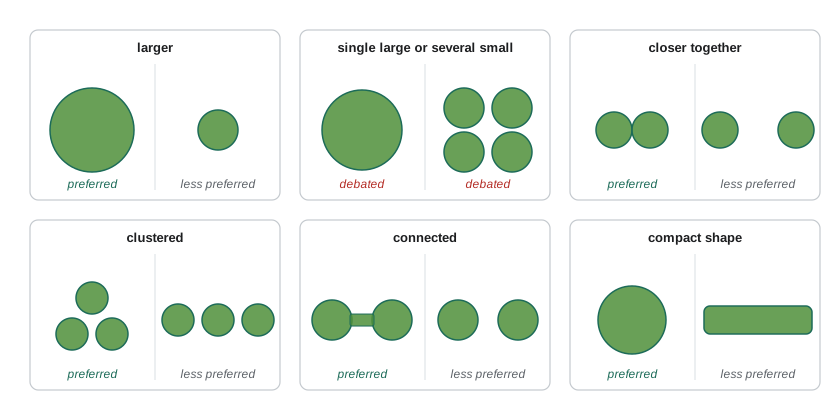
In the 1970s, ecologists began applying the theory of island biogeography to reserve design. Jared Diamond proposed in 1975 a set of geometric principles: a large reserve is better than a small one; a single large reserve is better than several small ones of the same total area; reserves close together are better than reserves far apart; reserves clustered together are better than reserves in a line; reserves connected by corridors are better than unconnected ones; and round reserves are better than elongated ones, because they have less edge. Daniel Simberloff and Lawrence Abele challenged the second principle in 1976, arguing that island biogeography theory did not imply that one large reserve would hold more species than several small ones of the same total area. The resulting debate, known as SLOSS, for single large or several small, ran through the late 1970s and 1980s.
The debate was not resolved in favour of either side, but it clarified the trade-offs. A single large reserve supports larger populations, which are less vulnerable to the small-population processes of lesson 6, holds species that need large areas such as wolves and grizzly bears, and has less edge. Several small reserves may include a greater variety of habitats, spread the risk of catastrophes such as fire or disease, and, if species composition differs among them, contain more species in total. Which matters more depends on the species and the landscape. A 2020 review by Lenore Fahrig reported that in most empirical comparisons, several small patches held at least as many species as a single large patch of the same total area, a result that strengthens the case for protecting small remnants in heavily converted landscapes. The practical consensus is that both large core areas and networks of smaller sites are needed.
Other design principles have been added since. Buffer zones around core protected areas can reduce edge effects and pressure from surrounding land use. The UNESCO biosphere reserve model, used in places such as the Southwest Nova Biosphere Reserve in Nova Scotia and the Everglades and Dry Tortugas in Florida, combines a strictly protected core, a buffer zone where compatible activities occur, and a transition zone of sustainable development. Protected areas must also be large enough to contain natural disturbance regimes; a forest reserve smaller than the area typically burned by a single large fire may be entirely reset by one event, so reserves in fire-prone ecosystems should be several times larger than the largest expected fire, an idea called the minimum dynamic area.
Systematic conservation planning
Historically, many protected areas were chosen opportunistically, for their scenery, their recreation value or because land happened to be available. In 2000 Chris Margules and Bob Pressey published an influential framework for systematic conservation planning, which approaches the problem as a sequence of explicit steps: compile data on biodiversity in the region; set explicit conservation goals and quantitative targets, such as protecting at least 30 per cent of the range of each species; review how well existing reserves already meet the targets, a step called gap analysis; select additional areas to meet the targets efficiently; implement conservation actions; and maintain and monitor the results.
Three principles guide the selection of areas. Complementarity means choosing each new site for what it adds to those already chosen, not for its own richness alone; a species-poor site that holds species missing from the network can be more valuable than a rich site whose species are already protected. Irreplaceability measures how essential a site is to meeting the targets: a site containing the only population of an endemic species is completely irreplaceable. Efficiency means meeting the targets at the lowest cost, in area, money or forgone economic opportunity. Because thousands of candidate sites are usually involved, the selection is carried out by computer algorithms. The most widely used program, Marxan, developed by Ian Ball and Hugh Possingham in Australia around 2000, uses simulated annealing, an optimization method, to find networks of sites that meet all targets while minimizing a combination of cost and boundary length, so that the selected sites are compact rather than scattered. Marxan has been used in hundreds of planning exercises, including the rezoning of Australia's Great Barrier Reef Marine Park in 2004 and marine planning on Canada's Pacific coast.
# Reserve selection on an invented matrix of 8 candidate sites x 10 species (1 = present).
sites = {
    "S1": [1, 1, 1, 1, 1, 1, 0, 0, 0, 0],
    "S2": [1, 1, 1, 1, 1, 0, 0, 0, 0, 0],
    "S3": [1, 1, 1, 1, 0, 1, 0, 0, 0, 0],
    "S4": [0, 0, 0, 0, 0, 0, 1, 1, 0, 0],
    "S5": [0, 0, 0, 0, 0, 0, 0, 0, 1, 0],
    "S6": [0, 0, 0, 0, 0, 0, 0, 0, 0, 1],
    "S7": [1, 0, 0, 0, 0, 0, 1, 0, 0, 1],
    "S8": [0, 1, 1, 0, 0, 0, 0, 1, 0, 0],
}
cost = {"S1": 5, "S2": 4, "S3": 4, "S4": 2, "S5": 1, "S6": 1, "S7": 3, "S8": 2}
n_sp = 10
def covered(chosen):
    return {j for s in chosen for j in range(n_sp) if sites[s][j]}
# Approach 1: pick the richest sites first (scoring), until all species are covered
by_richness = sorted(sites, key=lambda s: -sum(sites[s]))
chosen = []
for s in by_richness:
    if len(covered(chosen)) == n_sp: break
    chosen.append(s)
print("richness ranking:", chosen, "cost", sum(cost[s] for s in chosen))
# Approach 2: greedy complementarity, choosing the site adding most new species per unit cost
chosen = []
while len(covered(chosen)) < n_sp:
    best = max((s for s in sites if s not in chosen),
               key=lambda s: len(covered(chosen + [s]) - covered(chosen)) / cost[s])
    chosen.append(best)
print("complementarity:  ", chosen, "cost", sum(cost[s] for s in chosen))
# Irreplaceability: species found at only one site make that site essential
for j in range(n_sp):
    holders = [s for s in sites if sites[s][j]]
    if len(holders) == 1:
print(f"species {j + 1} occurs only at {holders[0]}")richness ranking: ['S1', 'S2', 'S3', 'S7', 'S8', 'S4', 'S5'] cost 21 complementarity: ['S8', 'S5', 'S6', 'S1', 'S4'] cost 11 species 9 occurs only at S5
Ranking sites by richness picks the three richest sites first, but they hold largely the same widespread species, so the network must keep adding sites until the rare species are covered, at higher total cost. Complementarity picks sites for the new species each adds per unit of cost and covers all ten species for about half the cost. Species 9 occurs only at site S5, so S5 is irreplaceable: every solution that meets the targets must include it, however poor it looks on its own. The example is tiny, but the same logic scales up: in real planning problems, complementarity-based selection typically meets targets with far less area than ranking by richness or choosing hotspots alone.
Global targets: from Aichi to 30 by 30
In 2010 the parties to the Convention on Biological Diversity (CBD) adopted the Aichi Biodiversity Targets, including Target 11, to conserve at least 17 per cent of land and inland waters and 10 per cent of coastal and marine areas by 2020 through well-connected, effectively managed and representative protected areas. The area targets were nearly met on land and partly met at sea, but most of the qualitative elements, such as effective management and representativeness, were not, and none of the twenty Aichi targets was fully achieved. In December 2022, at the CBD's fifteenth Conference of the Parties, held in Montreal under the presidency of China, 196 parties adopted the Kunming–Montreal Global Biodiversity Framework, with four goals for 2050 and 23 targets for 2030. Target 3, widely called 30 by 30, commits parties to ensure that by 2030 at least 30 per cent of terrestrial and inland water areas and of marine and coastal areas are effectively conserved and managed through ecologically representative, well-connected and equitably governed systems of protected areas and OECMs, recognizing Indigenous and traditional territories. The framework also includes Target 2, to have at least 30 per cent of degraded ecosystems under effective restoration by 2030.
According to the Protected Planet Report 2024, about 17.6 per cent of land and inland waters and about 8.4 per cent of the ocean were covered by protected areas and OECMs, so reaching 30 per cent requires a large expansion, especially at sea. The sixteenth Conference of the Parties met in Cali, Colombia, in 2024, and the seventeenth was under way in Yerevan, Armenia, in late October 2026 as this lesson was written, with progress toward the 2030 targets on its agenda. Critics of 30 by 30 caution that area targets can encourage protecting cheap, remote places rather than the most important ones, and that expansion must respect the rights of Indigenous peoples and local communities; supporters respond that the framework explicitly addresses both concerns.
Canada committed to the 30 by 30 target and earlier set an interim target of 25 per cent by 2025, which it did not meet. As of 31 December 2025, according to the federal government's conserved areas indicator, Canada had conserved 14.0 per cent of its land and freshwater, of which 12.9 per cent was in protected areas and the rest in OECMs, and 15.5 per cent of its marine territory. Canada's 2030 Nature Strategy, released in 2024, set out how the country would implement the Kunming–Montreal framework, and a bill for a Nature Accountability Act, introduced the same year to make the government report on progress, died when Parliament was prorogued in January 2025 and had not been passed as of October 2026. On 31 March 2026 the government announced a new national strategy to protect nature with an investment of 3.8 billion dollars, including new and expanded protected areas. Much of the growth in conserved areas since 2015 has come through Indigenous Protected and Conserved Areas and through large agreements with Indigenous nations and provinces known as Project Finance for Permanence initiatives, discussed in lesson 11.
Marine protected areas
Marine protected areas (MPAs) range from no-take reserves, where all extraction is banned, to multiple-use areas where some fishing continues. A global analysis led by Graham Edgar in 2014 found that MPAs deliver their largest benefits when they have five features: no take, good enforcement, age of more than ten years, large size of more than 100 square kilometres, and isolation by deep water or sand. Effective no-take reserves typically contain much higher biomass of fish than surrounding fished areas, and larger fish produce disproportionately more eggs, so reserves can export larvae and adult fish to surrounding fisheries. Large MPAs have been established in remote waters, such as the Papahānaumokuākea Marine National Monument in Hawaii, but critics note that many large MPAs protect areas with little fishing pressure. In Canada, minimum protection standards adopted in 2019 prohibit oil and gas activities, mining, dumping and bottom trawling in new federal MPAs.
Worked problem
A simple gap analysis
A province has six grassland bird species of concern. The target is to protect at least 20 per cent of the breeding range of each species. Current protected areas cover these shares of each range: species A 32 per cent, B 18 per cent, C 4 per cent, D 22 per cent, E 0 per cent, F 11 per cent. Which species are gaps, and how should new sites be prioritized?
Show solution
- Species meeting the target: A (32 per cent) and D (22 per cent).
- Partial gaps: B (18 per cent) and F (11 per cent) need 2 and 9 more percentage points of their ranges protected.
- Major gaps: C (4 per cent) and E (0 per cent) need 16 and 20 percentage points, and E is entirely unprotected.
- Using complementarity, new sites should be chosen first where E and C occur, ideally places where several gap species overlap, and weighted by cost and irreplaceability.
Answer: Species B, C, E and F are gaps, with E and C the highest priorities. Gap analysis tells planners where existing reserves fall short; complementarity tells them which new sites fill the gaps most efficiently.
Common mistakes
MistakeEquating protected area coverage with conservation success.
InsteadEffectiveness depends on location, management, funding and support; paper parks protect little.
MistakeAssuming SLOSS has a single correct answer.
InsteadLarge reserves support large populations and wide-ranging species; small ones can add habitat variety and spread risk.
MistakeChoosing reserves by ranking sites on species richness.
InsteadComplementarity selects sites for what they add to the network and is usually far more efficient.
MistakeJudging protected areas by simple comparison with unprotected land.
InsteadA counterfactual is needed because protected areas are often in places with low pressure.
MistakeCounting any area-based measure toward targets.
InsteadOECMs must deliver positive long-term outcomes for biodiversity and meet agreed criteria.
Summary and key terms
- The IUCN recognizes six protected area categories by management objective; OECMs can also count toward targets.
- Protected areas reduce habitat loss on average, but their effectiveness depends on location, management and support.
- Diamond's design principles favour large, close, connected and compact reserves; SLOSS showed the trade-offs between large and small.
- Systematic conservation planning uses explicit targets, gap analysis, complementarity, irreplaceability and efficiency, often with Marxan.
- The Kunming–Montreal framework's Target 3 aims to conserve 30 per cent of land and sea by 2030.
- Globally about 17.6 per cent of land and 8.4 per cent of the ocean were protected in 2024; national progress varies.
- No-take, enforced, old, large and isolated marine reserves deliver the largest benefits.
- protected area
- A defined space managed primarily for the long-term conservation of nature.
- OECM
- Other effective area-based conservation measure: an area outside the protected area system that achieves lasting biodiversity outcomes.
- paper park
- A protected area that exists in law but is not effectively managed.
- SLOSS
- The debate over whether a single large or several small reserves best conserve biodiversity.
- buffer zone
- An area around a core reserve where activities are managed to reduce external pressures.
- minimum dynamic area
- The smallest reserve that can contain the natural disturbance regime of an ecosystem.
- gap analysis
- An assessment of how well existing protected areas represent biodiversity targets.
- complementarity
- Choosing sites for the biodiversity they add to sites already selected.
- irreplaceability
- The degree to which a site is essential for meeting conservation targets.
- Marxan
- Software that selects networks of sites meeting targets at minimum cost and boundary length.
- 30 by 30
- The global target to conserve at least 30 per cent of land and sea by 2030.
- marine protected area
- A protected area in marine or coastal waters, ranging from no-take reserves to multiple-use zones.
Practice problems
Work each problem on paper first, then reveal the answer to check.
What distinguishes IUCN category II from category IV?
Show answer
Category II protects large ecosystems with compatible recreation; category IV targets particular species or habitats, often with active management.
Why are counterfactuals needed to evaluate protected areas?
Show answer
Protected areas are often in places that would not have been developed anyway, so simple comparisons overstate their effect.
Give one argument for a single large reserve and one for several small reserves.
Show answer
Large: supports large populations and wide-ranging species. Small: includes more habitat types and spreads catastrophe risk.
Define complementarity.
Show answer
Selecting each new site for the biodiversity it adds to sites already in the network.
What does Marxan minimize?
Show answer
A combination of the cost of selected sites and the length of their boundaries, subject to meeting targets.
What is Target 3 of the Kunming–Montreal framework?
Show answer
Effectively conserve at least 30 per cent of land, inland waters and marine areas by 2030.
Name the five features of the most effective marine protected areas identified by Edgar and colleagues.
Show answer
No take, well enforced, old, large and isolated.
What is the minimum dynamic area?
Show answer
The smallest area that can absorb the natural disturbance regime, such as large fires, without losing its character.
Lesson quiz · 5 questions
Score 60% or more to complete this lesson.
Create a free account to save your progress, take quizzes and earn a certificate.