
BIOL-367 · Lesson 9 of 12 · 29 min
Conservation law and policy in the United States
Science can show that a species is declining and why, but protecting it usually requires law: rules that restrict harmful activities, require recovery planning and allocate responsibility among governments. This lesson examines the legal framework for conservation in the United States, centered on the Endangered Species Act of 1973, together with the international agreements the United States has joined, other federal wildlife statutes, state laws and the role of tribal nations. It also compares US law briefly with Canada's Species at Risk Act, which shares many species with the United States. Law and regulations change frequently, and several major changes took effect in 2025 and 2026; the details here are current as of October 2026, and you should check official sources before relying on them.
International agreements
Conservation law operates at several levels. At the international level, countries make commitments through treaties, which they then implement through their own legislation. Four agreements are especially important for North American wildlife. The Convention on International Trade in Endangered Species of Wild Fauna and Flora (CITES), in force since 1975, regulates international trade in about 40,000 species listed in three appendices: Appendix I species, such as tigers and most great apes, may not be traded commercially; Appendix II species, such as many corals, orchids and polar bears, may be traded with permits showing the trade is legal and not detrimental to the species' survival; and Appendix III species are listed by individual countries seeking cooperation. The Ramsar Convention on Wetlands, signed in 1971, encourages the wise use of wetlands and the designation of wetlands of international importance. The Migratory Birds Convention of 1916 between the United States and Great Britain, on behalf of Canada, was one of the first international wildlife treaties and still underpins protection of migratory birds in both countries. The Convention on Biological Diversity (CBD), opened for signature at the Earth Summit in Rio de Janeiro in 1992, commits its parties to conserve biodiversity, use it sustainably and share the benefits of genetic resources fairly.
The United States signed the CBD in 1993 but the Senate has never ratified it, so the United States is one of very few countries that are not parties to the convention, although it participates in meetings as an observer. The United States implements CITES largely through the Endangered Species Act, and it was the first country to ratify the convention. The Migratory Bird Treaty Act of 1918 implements the Migratory Birds Convention and later treaties with Mexico, Japan and Russia, making it illegal to kill, capture or sell migratory birds without a permit; whether it also prohibits incidental killing, for example by oil pits or power lines, has changed with successive administrations and court decisions. The United States has designated dozens of Ramsar sites, including the Everglades and Chesapeake Bay.
The Endangered Species Act: purposes and structure
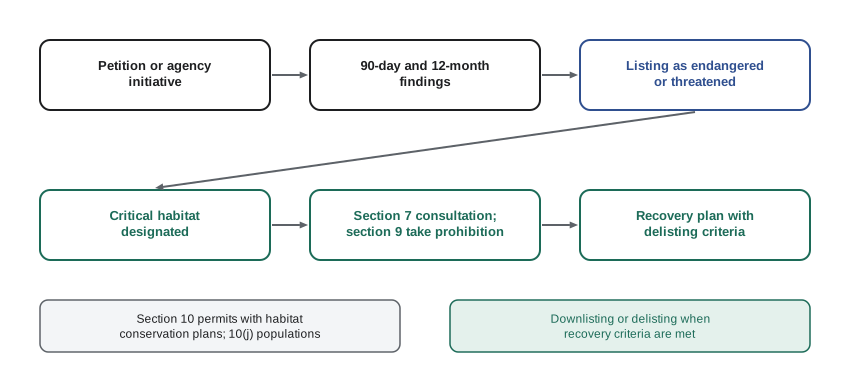
The Endangered Species Act (ESA), signed by President Richard Nixon in December 1973 after passing Congress nearly unanimously, is one of the strongest biodiversity laws in the world. Its stated purposes are to provide a means whereby the ecosystems upon which endangered and threatened species depend may be conserved, and to provide a program for the conservation of such species. Two agencies administer it: the US Fish and Wildlife Service (FWS), in the Department of the Interior, is responsible for terrestrial and freshwater species, and the National Marine Fisheries Service (NMFS), part of the National Oceanic and Atmospheric Administration in the Department of Commerce, is responsible for most marine species and anadromous fish such as salmon. The act has several key sections. Section 4 governs listing, critical habitat and recovery plans. Section 7 requires federal agencies to ensure that their actions do not jeopardize listed species. Section 9 prohibits take. Section 10 provides permits and agreements that allow some take under conditions. Section 11 provides for enforcement, including citizen suits, which allow any person to sue to enforce the act and have been a major driver of its implementation.
Listing under section 4
A species, subspecies or, for vertebrates, a distinct population segment can be listed as endangered, meaning in danger of extinction throughout all or a significant portion of its range, or threatened, meaning likely to become endangered within the foreseeable future. Listing can begin with the agency itself or with a petition from any person. Within 90 days, if practicable, the agency must decide whether the petition presents substantial information; within 12 months it must find that listing is warranted, not warranted, or warranted but precluded by higher-priority actions. Warranted-but-precluded species become candidates. Listing decisions must be made solely on the basis of the best scientific and commercial data available, without consideration of economic costs. This provision, unusual among environmental laws, means that the question of whether a species is endangered is treated as a scientific question, while economic considerations enter later, in decisions about critical habitat and permits. About 1,700 species found in the United States, and several hundred foreign species, are listed. Studies have found long delays in listing, during which some species went extinct, and much of the listing workload has been driven by deadlines set in court settlements.
Critical habitat, the specific areas essential to the conservation of a listed species, must be designated at the time of listing to the maximum extent prudent and determinable. Unlike listing, critical habitat decisions may take economic impacts and other relevant effects into account, and areas may be excluded if the benefits of exclusion outweigh the benefits of inclusion, unless exclusion would cause extinction. Critical habitat affects mainly federal actions, through the section 7 prohibition on destroying or adversely modifying it; it does not by itself restrict private landowners who do not need federal permits or funding. In 2018 the Supreme Court in Weyerhaeuser v. US Fish and Wildlife Service, a case about dusky gopher frog habitat in Louisiana, held that critical habitat must at least be habitat for the species, and that decisions not to exclude areas are reviewable by courts.
Recovery plans must be developed for listed species unless a plan would not promote conservation. Under section 4(f), each plan must include site-specific management actions, objective and measurable criteria which, when met, would result in delisting, and estimates of the time and cost required. Recovery plans are guidance documents and are not legally binding. Species may be reclassified from endangered to threatened, downlisted, or removed from the list, delisted, when they have recovered or gone extinct, or when the original listing was in error. Well-known recoveries include the bald eagle, delisted in 2007, the American alligator, the peregrine falcon and the Louisiana black bear. Analyses of the act's record show that most listed species have avoided extinction, but relatively few have recovered fully, partly because many were listed only after they had become extremely rare and because recovery funding has been far below the estimated costs in recovery plans.
Section 7: federal agencies and consultation
Section 7 requires every federal agency to ensure, in consultation with FWS or NMFS, that any action it authorizes, funds or carries out is not likely to jeopardize the continued existence of a listed species or destroy or adversely modify its critical habitat. Because federal permits, funding or land are involved in a vast range of activities, from dams and highways to grazing on federal land, timber sales, oil and gas leasing and wetland fill permits under the Clean Water Act, section 7 has broad reach. If an action may affect a listed species, the agency must consult; if it is likely to adversely affect the species, formal consultation ends with a biological opinion stating whether the action is likely to cause jeopardy. If it is, the opinion suggests reasonable and prudent alternatives. Even when there is no jeopardy, the opinion includes an incidental take statement that exempts a specified amount of take from the section 9 prohibition, with measures to minimize it. Most consultations conclude that the action can proceed, often with modifications.
In 1978 the Supreme Court in Tennessee Valley Authority v. Hill halted the nearly completed Tellico Dam in Tennessee because it would jeopardize the snail darter, a small fish then known only from that stretch of the Little Tennessee River. The court held that Congress had intended endangered species to be afforded the highest of priorities, whatever the cost. Congress responded later that year by creating the Endangered Species Committee, nicknamed the God Squad, a cabinet-level panel that can exempt a federal action from section 7 if it finds there are no reasonable alternatives and the benefits clearly outweigh those of alternatives that would conserve the species. The committee has been convened only a few times; it declined to exempt the Tellico Dam, which Congress then exempted by separate legislation, and it granted exemptions in only a handful of cases. The snail darter was later found in other rivers and was delisted as recovered in 2022.
Section 9: the prohibition on take and the meaning of harm
Section 9 makes it unlawful for any person to take an endangered fish or wildlife species within the United States or its territorial seas. Take is defined in the statute to mean to harass, harm, pursue, hunt, shoot, wound, kill, trap, capture or collect, or to attempt any of these. The prohibitions apply on private land as well as public land, which makes the ESA unusually powerful. For threatened species, protections are set by rules under section 4(d); FWS has alternated between a blanket rule extending endangered-species protections to all threatened species unless a species-specific rule says otherwise and an approach requiring species-specific rules, depending on the administration. Plants receive more limited protection, mainly on federal land.
In 1981 FWS defined harm by regulation to include significant habitat modification or degradation that actually kills or injures wildlife by significantly impairing essential behavioral patterns such as breeding, feeding or sheltering. In Babbitt v. Sweet Home Chapter of Communities for a Great Oregon (1995), a case arising from timber harvest in northern spotted owl habitat, the Supreme Court upheld this definition by a vote of six to three; Justice Antonin Scalia wrote a dissent arguing that harm should be limited to direct, affirmative acts against particular animals. In April 2025 FWS and NMFS proposed to rescind the regulatory definition of harm, citing the 2024 Supreme Court decision in Loper Bright Enterprises v. Raimondo, which ended judicial deference to agency interpretations of ambiguous statutes. The final rule, published on 14 July 2026 and effective on 12 September 2026, rescinded the definition without replacing it; the agencies stated that they would rely on the statutory text as read in Justice Scalia's dissent, so that habitat modification that indirectly kills or injures wildlife is no longer treated as prohibited take. The rule applies prospectively. Legal challenges were expected, and commentators noted that citizen suits may still argue that Sweet Home remains binding. Section 7 consultation is less affected, because federal agencies must still avoid jeopardy and adverse modification of critical habitat.
Section 10: permits, habitat conservation plans and experimental populations
Section 10 allows FWS and NMFS to issue incidental take permits for take that is incidental to an otherwise lawful activity, such as building a subdivision, if the applicant prepares a habitat conservation plan (HCP) that minimizes and mitigates the impacts to the maximum extent practicable and the take will not appreciably reduce the likelihood of survival and recovery. Added by Congress in 1982, HCPs range from small plans for single lots to regional plans covering hundreds of thousands of hectares and dozens of species, such as the multiple species conservation programs of San Diego County. The No Surprises policy assures landowners that they will not be required to provide more land or money if circumstances change, which encourages participation but limits flexibility. Safe harbor agreements encourage landowners to improve habitat voluntarily by assuring them that they will not face new restrictions if listed species move onto their land, and candidate conservation agreements encourage action for species before they are listed. Section 10(j) allows the release of experimental populations outside a species' current range under special rules that relax some protections; it was used to reintroduce gray wolves to Yellowstone and central Idaho in 1995 and 1996, and for black-footed ferrets, California condors and red wolves.
Other federal wildlife laws
Several other federal laws protect wildlife. The Lacey Act of 1900, the oldest federal wildlife law, prohibits trade in wildlife, fish and plants taken in violation of any state, federal, tribal or foreign law, and is a key tool against wildlife trafficking and illegal logging. The Bald and Golden Eagle Protection Act of 1940 protects eagles. The Marine Mammal Protection Act of 1972 establishes a moratorium on the take of marine mammals, with exceptions such as subsistence hunting by Alaska Natives and permits for incidental take in fisheries. The Clean Water Act's section 404 program regulates the filling of wetlands and other waters, although the Supreme Court's 2023 decision in Sackett v. Environmental Protection Agency narrowed the wetlands it covers to those with a continuous surface connection to larger regulated waters. The National Environmental Policy Act of 1969 requires federal agencies to assess the environmental effects of major actions; in 2025 the Council on Environmental Quality rescinded its long-standing NEPA regulations and agencies adopted their own procedures. The National Wildlife Refuge System Improvement Act of 1997 makes wildlife conservation the mission of the refuge system, and the Wilderness Act of 1964 protects designated wilderness.
State and tribal roles
States have primary authority over most wildlife within their borders, including hunting, fishing and non-listed species, and many have their own endangered species laws. The California Endangered Species Act, for example, protects state-listed species, including some not listed federally, and requires permits for take. Section 6 of the ESA provides funding and cooperative agreements with states, which carry out much on-the-ground recovery work. Tribal nations, as sovereign governments, manage wildlife on reservation lands and exercise treaty rights to hunt, fish and gather, which in some cases extend off reservation; the 1974 Boldt decision affirmed that treaty tribes in western Washington were entitled to up to half of the harvestable salmon and made them co-managers of the fishery. Secretarial Order 3206, issued in 1997, directs FWS and NMFS to consult with tribes on ESA actions, to recognize tribal management and to avoid imposing conservation restrictions on tribal harvest unless necessary. Tribes lead or co-lead recovery work for species including black-footed ferrets, bison, Pacific lamprey, salmon and gray wolves.
A brief comparison
| Feature | Canada: Species at Risk Act | United States: Endangered Species Act |
|---|---|---|
| Year enacted | 2002 | 1973 |
| Scientific assessment | COSEWIC, an independent committee | FWS or NMFS staff, based on best available data |
| Listing decision | Cabinet, which may consider economic and social factors | Agency, solely on scientific and commercial data |
| Prohibitions on non-federal land | Mainly through provincial law; federal safety net rarely used | Section 9 take prohibition applies on private land for endangered animals |
| Habitat protection | Critical habitat identified in recovery strategies and protected by order or other law | Critical habitat designated; habitat-based harm definition rescinded effective September 2026 |
| Federal actions | No direct equivalent of section 7; impact assessment and permits under other laws | Section 7 consultation and jeopardy standard |
| Citizen enforcement | Judicial review of government decisions | Citizen suits to enforce the act |
| Emergency tools | Section 80 emergency orders (used twice) | Emergency listing for 240 days |
The comparison shows that the ESA relies more on automatic prohibitions, scientific listing and citizen enforcement than Canada's Species at Risk Act, which leaves listing to cabinet and relies heavily on provincial law and cooperation. Supporters of the ESA credit its strength with preventing the extinction of most listed species. Critics argue that its prohibitions can give landowners an incentive to destroy habitat before listed species appear, a problem sometimes summarized as shoot, shovel and shut up, and that it has generated costly conflict; voluntary tools such as safe harbor agreements and HCPs were developed partly in response. The 2026 rescission of the habitat-based definition of harm is the most significant narrowing of the act's reach in decades, and its effects will depend on how courts respond. Both countries face the same underlying problem: laws designed to stop harm to individual species struggle to address diffuse, landscape-scale threats such as habitat conversion, climate change and invasive species.
Worked problem
Does this project need ESA review?
A private developer plans a housing project on land in Texas that contains habitat of an endangered salamander. The project needs a Clean Water Act section 404 permit to fill a small wetland. Which ESA provisions apply?
Show solution
- Because a federal permit is needed, the Army Corps of Engineers must consult FWS under section 7 if the project may affect the salamander or its critical habitat.
- FWS will issue a biological opinion; if there is no jeopardy, an incidental take statement will exempt a specified amount of take.
- Without the federal permit, the developer would instead need a section 10 incidental take permit and a habitat conservation plan if the project would take salamanders.
- After September 2026, habitat modification that only indirectly harms salamanders is no longer treated as take under the rescinded harm definition, but section 7 still requires avoiding jeopardy and adverse modification of designated critical habitat.
Answer: Section 7 consultation through the federal permit is the main route of review; section 10 would apply only if no federal nexus existed and take were likely.
Common mistakes
MistakeThinking economic costs can be considered in listing decisions.
InsteadListing is based solely on the best scientific and commercial data; economics enter critical habitat and permits.
MistakeAssuming critical habitat restricts all landowners.
InsteadIt mainly affects actions with federal involvement through section 7.
MistakeBelieving the ESA protects plants on private land as it does animals.
InsteadPlant protections are much more limited and apply mainly on federal land.
MistakeAssuming habitat destruction is still take after September 2026.
InsteadThe regulatory harm definition was rescinded prospectively; litigation may change this.
MistakeTreating the United States as a party to the CBD.
InsteadIt signed but never ratified the convention.
Summary and key terms
- The United States implements CITES, Ramsar and migratory bird treaties but has not ratified the CBD.
- The ESA is administered by FWS and NMFS; listing is based solely on scientific and commercial data.
- Critical habitat may consider economics and mainly constrains federal actions.
- Section 7 requires federal agencies to avoid jeopardy and adverse modification through consultation.
- Section 9 prohibits take; the 1981 harm definition upheld in Sweet Home was rescinded by a rule effective 12 September 2026.
- Section 10 provides incidental take permits with HCPs, safe harbor agreements and experimental populations.
- States and sovereign tribal nations share authority over wildlife and lead much recovery work.
- endangered species
- A species in danger of extinction throughout all or a significant portion of its range.
- threatened species
- A species likely to become endangered in the foreseeable future.
- distinct population segment
- A vertebrate population that can be listed separately under the ESA.
- critical habitat
- Specific areas essential to the conservation of a listed species, designated under section 4.
- jeopardy
- An action that would appreciably reduce the likelihood of a species' survival and recovery.
- biological opinion
- The document concluding formal section 7 consultation.
- take
- To harass, harm, pursue, hunt, shoot, wound, kill, trap, capture or collect, or attempt to.
- habitat conservation plan
- A plan that minimizes and mitigates take to obtain a section 10 permit.
- experimental population
- A population released under section 10(j) with special protective rules.
- citizen suit
- A lawsuit by any person to enforce the ESA.
Practice problems
Work each problem on paper first, then reveal the answer to check.
Which agency handles listing for salmon, and which for grizzly bears?
Show answer
NMFS for salmon; FWS for grizzly bears.
What are the three possible 12-month findings on a listing petition?
Show answer
Warranted, not warranted, or warranted but precluded.
Can economic costs be considered in designating critical habitat?
Show answer
Yes; areas can be excluded if benefits of exclusion outweigh inclusion, unless exclusion causes extinction.
What does section 7 require?
Show answer
Federal agencies must ensure their actions do not jeopardize listed species or adversely modify critical habitat, in consultation with FWS or NMFS.
What did the Supreme Court decide in TVA v. Hill?
Show answer
The ESA required halting the Tellico Dam to protect the snail darter, whatever the cost.
What did the July 2026 rule change?
Show answer
It rescinded the regulatory definition of harm, so indirect habitat modification is no longer treated as take.
What is a safe harbor agreement?
Show answer
An agreement assuring landowners who improve habitat that they will not face new restrictions if listed species arrive.
Give an example of a section 10(j) experimental population.
Show answer
Gray wolves reintroduced to Yellowstone in 1995 and 1996.
Lesson quiz · 5 questions
Score 60% or more to complete this lesson.
Create a free account to save your progress, take quizzes and earn a certificate.