
BIOL-367 · Lesson 11 of 12 · 27 min
People and conservation: Indigenous-led conservation, working landscapes and justice
Conservation is ultimately about people: their choices drive biodiversity loss, their institutions decide what is protected, and their lives and livelihoods are affected by conservation decisions. A conservation plan that ignores the people who live in a landscape is unlikely to succeed and may cause real harm. This lesson examines the human dimensions of conservation: the history of exclusion that shaped many protected areas, the growth of Indigenous-led conservation, the role of farms, ranches, forests and fisheries as working landscapes, economic tools such as payments for ecosystem services, conservation easements and offsets, conflicts between people and wildlife, and the principles of environmental justice.
Fortress conservation and its legacy
Many of the world's early national parks were created on a model later called fortress conservation: nature was to be protected by excluding people. Yellowstone, established in 1872, was presented as a pristine wilderness, but it had long been used by Shoshone, Bannock, Crow, Blackfeet and other nations, who were subsequently excluded. In Canada, the creation of Banff and Jasper national parks in the late nineteenth and early twentieth centuries restricted the hunting and travel of Stoney Nakoda and other peoples, and in Jasper, Métis and First Nations families who lived in the Athabasca valley were evicted soon after the park was created in 1907. Similar histories occurred around the world, and international research has estimated that millions of people have been displaced by protected areas.
Fortress conservation rested on a misunderstanding as well as an injustice. Many landscapes that Europeans perceived as wild had been shaped for thousands of years by Indigenous burning, harvesting and management. Removing people and suppressing their practices sometimes harmed the biodiversity that parks were meant to protect, as when the end of cultural burning allowed shrubs and trees to invade meadows and prairies. Today, the IUCN and the Convention on Biological Diversity recognize the rights of Indigenous peoples and local communities in conservation, and studies have found that lands managed by Indigenous peoples often have biodiversity comparable to or higher than that of protected areas. A frequently cited estimate holds that Indigenous peoples manage or have tenure rights over at least a quarter of the world's land surface, which intersects with about 40 per cent of terrestrial protected areas and ecologically intact landscapes.
Indigenous-led conservation
Canada has become a leader in Indigenous-led conservation. In 2018 the Indigenous Circle of Experts, convened as part of the Pathway to Canada Target 1, published a report titled We Rise Together, which recommended that governments support Indigenous Protected and Conserved Areas (IPCAs): lands and waters where Indigenous governments have the primary role in protecting and conserving ecosystems through Indigenous laws, governance and knowledge systems. IPCAs are Indigenous-led, represent a long-term commitment to conservation and elevate Indigenous rights and responsibilities. Notable examples include Edéhzhíe, established in the Dehcho region of the Northwest Territories in 2018 as an IPCA and national wildlife area, and Thaidene Nëné, an area of about 26,000 square kilometres east of Great Slave Lake established in 2019 through agreements between the Łutsël K'é Dene First Nation, the federal government and the territorial government. Indigenous Guardians, introduced in lesson 1, act as the eyes and ears on the land in many IPCAs.
A newer mechanism, called Project Finance for Permanence (PFP), brings together Indigenous nations, federal and provincial or territorial governments and private philanthropy to fund large networks of conservation areas and long-term stewardship at once, with funds released only when all the conditions are met. The approach was used for the Great Bear Rainforest agreements on the central and northern coast of British Columbia, completed in 2016, and has since been applied to the Northwest Territories in 2023 through an agreement called Our Land for the Future, to the Qikiqtani region of Nunavut in 2024 and to the Great Bear Sea marine network in 2024. PFPs have contributed substantially to Canada's conserved area totals and to Indigenous employment and governance, though some observers have raised questions about long-term funding and the balance between conservation and development.
Indigenous-led conservation is not simply a means for governments to reach area targets. It rests on the recognition that Indigenous peoples have their own laws and governance systems, and that conservation on their territories should advance their self-determination. Tensions can arise when conservation goals conflict with Indigenous economic development, or when governments seek Indigenous support for protected areas while denying broader rights. Good practice, reflected in the United Nations Declaration on the Rights of Indigenous Peoples, centres free, prior and informed consent.
Working landscapes
Most biodiversity exists outside protected areas, on farms, ranches, private forests and in fished waters. Even if the 30 by 30 target is met, 70 per cent of land and sea will be used for other purposes, and the fate of many species depends on how those lands are managed. Conservation in working landscapes takes many forms: maintaining hedgerows, wetlands and native vegetation on farms; managing grazing to sustain grassland birds; retaining old trees and dead wood in harvested forests; and designing fisheries to minimize bycatch and habitat damage.
Grasslands provide a clear example. In both countries, many of the largest remaining native grasslands are privately owned ranches, and well-managed grazing by cattle can maintain habitat for grassland birds that evolved with bison grazing. The greater sage-grouse depends on sagebrush landscapes that are mostly in private and public grazing lands in the western United States and southern Alberta and Saskatchewan. In the United States, the Sage Grouse Initiative of the Natural Resources Conservation Service, launched in 2010, has worked with thousands of ranchers to conserve millions of acres of habitat through easements and improved grazing, and was cited when the Fish and Wildlife Service decided in 2015 that listing the bird was not warranted.
Land sparing versus land sharing
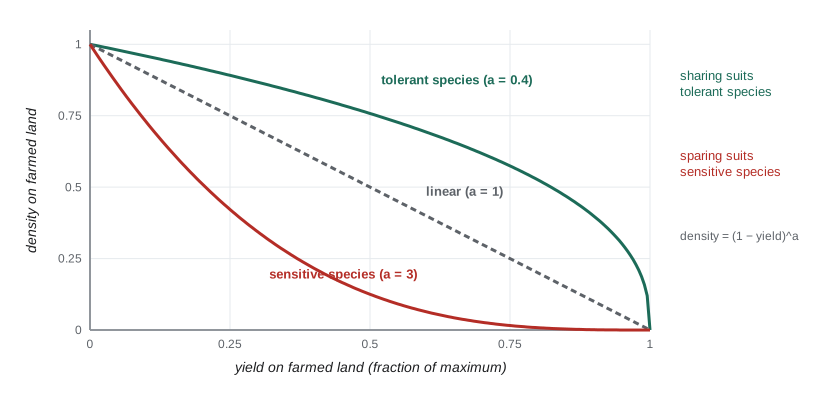
A central debate about working landscapes concerns how to reconcile agricultural production with biodiversity. Land sharing integrates conservation and production on the same land, through low-intensity, wildlife-friendly farming that yields less per hectare. Land sparing intensifies production on some land to achieve high yields while setting aside other land for nature. Which approach supports more biodiversity for a given level of production depends on how species respond to yield. In 2011 Ben Phalan and colleagues measured the densities of birds and trees across a range of farming intensities in Ghana and India and found that most species declined steeply even under low-intensity farming, so land sparing would support larger populations of most species; similar results have been found in other regions. Species that thrive in farmland, however, do better under sharing, and the benefits of sparing depend on whether intensification actually leads to land being spared rather than to further expansion, which is not guaranteed.
# Land sparing versus land sharing: a species' density as a function of agricultural yield.
# A region of 100 units must produce 50 units of food. Maximum yield per unit area = 1.
# Density on farmed land = (1 - y) ** a, where y is yield (0 to 1); density in natural habitat = 1.
def population(a, yield_level, area=100.0, target=50.0):
    farmed = target / yield_level                 # area needed at this yield
    if farmed > area: return None
    natural = area - farmed
    return natural * 1.0 + farmed * (1 - yield_level) ** a
for a, kind in ((0.4, "tolerant of low-intensity farming (convex)"), (1.0, "linear decline"), (3.0, "sensitive to any farming (concave)")):
    results = {y: population(a, y) for y in (0.5, 0.625, 0.75, 1.0)}
    best = max(results, key=results.get)
    spread = max(results.values()) - min(results.values())
    row = "  ".join(f"y={y:.3f}: {p:5.1f}" for y, p in results.items())
    verdict = ("no difference" if spread < 1e-9 else "sharing (low yield everywhere)" if best == 0.5
               else "sparing (high yield, more land spared)" if best == 1.0 else "intermediate")
print(f"a = {a}: {kind}\n {row}\n best strategy: {verdict}")a = 0.4: tolerant of low-intensity farming (convex) y=0.500: 75.8 y=0.625: 74.0 y=0.750: 71.6 y=1.000: 50.0 best strategy: sharing (low yield everywhere) a = 1.0: linear decline y=0.500: 50.0 y=0.625: 50.0 y=0.750: 50.0 y=1.000: 50.0 best strategy: no difference a = 3.0: sensitive to any farming (concave) y=0.500: 12.5 y=0.625: 24.2 y=0.750: 34.4 y=1.000: 50.0 best strategy: sparing (high yield, more land spared)
The model shows why the shape of the density–yield curve decides the answer. For a species that tolerates low-intensity farming, so that its density falls only slowly at first as yield rises, land sharing supports more individuals. For a species whose density falls in direct proportion to yield, the two strategies give the same total. For a species whose density drops sharply with any farming, land sparing does better, because it keeps more land in natural habitat. Field studies suggest that many species of conservation concern, especially forest specialists, fall into the second group, but the best real-world strategies often combine both: high-yield farming in some places, protected habitat in others, and wildlife-friendly features such as hedgerows and wetlands within farmland.
Forests and fisheries
Forestry and fisheries are major working landscapes and seascapes. Sustainable forest management aims to maintain the ecological, economic and social values of forests while harvesting timber. Practices include retaining patches of trees and dead wood within cutblocks, emulating natural disturbance patterns such as fire, protecting riparian buffers along streams, and planning harvests over large landscapes to maintain habitat for species such as caribou and woodpeckers. Certification schemes such as those of the Forest Stewardship Council allow consumers to choose wood from forests managed to defined standards. In fisheries, ecosystem-based management considers the effects of fishing on habitats, predators and bycatch species, and the precautionary approach discussed in lesson 5 aims to avoid depleting stocks. Canada's amended Fisheries Act now requires plans to rebuild depleted major fish stocks, and in the United States the Magnuson–Stevens Fishery Conservation and Management Act, as amended in 1996 and 2007, requires annual catch limits and the rebuilding of overfished stocks, which has helped many US fish stocks recover.
Paying for conservation
Economic tools can align private incentives with conservation. Payments for ecosystem services pay landowners for managing land in ways that provide public benefits, such as clean water or carbon storage. Costa Rica's national program, begun in 1997, is a well-known example; in North America, programs such as the US Conservation Reserve Program pay farmers to take environmentally sensitive cropland out of production and plant cover, and the Alternative Land Use Services program in Canada, begun in Manitoba and now operating in several provinces, pays farmers for conserving wetlands and grasslands. Conservation easements are legal agreements in which landowners give up certain rights, such as the right to subdivide or plough, permanently or for a long term, while retaining ownership; land trusts and governments hold the easements. Tax benefits encourage donations of land and easements, through the federal Ecological Gifts Program in Canada and federal tax deductions in the United States. The Nature Conservancy of Canada and The Nature Conservancy in the United States are among the largest private landholders for conservation in their countries.
Biodiversity offsets attempt to compensate for unavoidable damage from development by creating, restoring or protecting equivalent habitat elsewhere, aiming for no net loss or a net gain of biodiversity. Offsets are supposed to be the last step in the mitigation hierarchy: first avoid impacts, then minimize them, then restore damaged areas on site, and only then offset residual impacts. In the United States, wetland mitigation banking under the Clean Water Act allows developers to buy credits from restored wetlands, and conservation banking provides credits for endangered species habitat. Offsets are controversial because ecosystems are hard to recreate, restored habitat may take decades to mature, and offsets can make destructive projects easier to approve. Studies of offsets have found that many fail to achieve no net loss, especially when restoration is uncertain or poorly monitored.
Human–wildlife conflict and coexistence
Conflicts between people and wildlife arise when animals damage crops, kill livestock, threaten human safety or compete for resources. As some large carnivores recover in North America, such as wolves, grizzly bears and cougars, conflicts have increased in places where people had grown used to their absence. Wolves kill a small fraction of livestock in the northern Rockies but losses are concentrated on some ranches, and conflict can lead to lethal control or illegal killing. Approaches to coexistence include compensation programs that pay for losses, range riders and guardian dogs that reduce predation, electric fencing and bear-resistant garbage containers, and community programs such as Bear Smart in British Columbia, which reduce the attractants that draw bears into towns. Research consistently shows that tolerance depends as much on trust, fairness and the involvement of local people in decisions as on the actual size of losses.
Environmental justice
Environmental justice is concerned with the fair distribution of environmental benefits and burdens and with the fair participation of all people in environmental decisions. In conservation, justice concerns arise in several ways. Protected areas can restrict the livelihoods of local people, as fortress conservation did. Access to nature is unequal: urban neighbourhoods with lower incomes and more racialized residents often have less tree cover and green space, a pattern linked in the United States to the historical practice of redlining. The costs of conservation, such as restrictions on land use, may fall on rural communities while the benefits are enjoyed by distant urban residents. Approaches to more just conservation include recognizing the rights of Indigenous peoples and local communities, ensuring fair participation in decision making, sharing benefits, and attending to the distribution of costs. The Kunming–Montreal framework includes targets on equitable governance and the rights of Indigenous peoples, and many conservation organizations now assess the social impacts of their work.
Worked problem
Designing a coexistence program
Wolves have recolonized a ranching valley. Over a year, 12 calves out of 6,000 grazed in the valley are confirmed killed by wolves, but the losses are concentrated on three ranches near a wolf denning area. Ranchers are calling for wolves to be removed. Outline a coexistence approach.
Show solution
- Quantify the losses: 12 of 6,000 is 0.2 per cent valley-wide, but concentrated losses on three ranches may be several per cent of their herds, a real economic hardship.
- Provide timely, fair compensation for confirmed losses, and consider paying for probable losses that cannot be confirmed.
- Fund preventive measures on the affected ranches: range riders, guardian dogs, carcass removal and adjusting calving times or locations away from the den area.
- Involve ranchers, Indigenous communities, wildlife agencies and conservation groups in a local working group, and agree in advance on when targeted removal of problem wolves would be considered.
Answer: A combination of compensation, prevention and inclusive local decision making, with clear rules for exceptional cases, is more likely to sustain both the wolf population and the ranching community than either full protection without support or general removal.
Common mistakes
MistakeAssuming protected areas were created on empty land.
InsteadMany were created by excluding Indigenous peoples who had shaped those landscapes for millennia.
MistakeTreating Indigenous-led conservation as a tool for meeting area targets.
InsteadIt rests on Indigenous governance, rights and self-determination.
MistakeAssuming land sharing is always better for biodiversity.
InsteadMany species decline sharply with any farming, so sparing can support more of them; the answer depends on species responses.
MistakeTreating offsets as a first resort.
InsteadOffsets come last in the mitigation hierarchy, after avoiding, minimizing and restoring.
MistakeAssuming conflict depends only on the size of wildlife damage.
InsteadTolerance also depends on trust, fairness and local participation.
Summary and key terms
- Fortress conservation excluded Indigenous peoples from many protected areas, causing injustice and sometimes ecological harm.
- Lands managed by Indigenous peoples hold much of the world's remaining biodiversity.
- Indigenous-led conservation includes IPCAs, Guardians and PFP agreements in Canada and tribal co-management in the United States.
- Most biodiversity lies in working landscapes; grazing, forestry and fisheries management strongly affect it.
- Whether land sparing or sharing is better depends on how species' densities change with yield.
- Payments for ecosystem services, easements and offsets align incentives, but offsets are often unsuccessful.
- Coexistence with wildlife and environmental justice require fair participation and distribution of costs and benefits.
- fortress conservation
- Protecting nature by excluding people from protected areas.
- Indigenous Protected and Conserved Area
- Lands and waters where Indigenous governments lead conservation through their own laws and knowledge.
- Project Finance for Permanence
- A funding model that secures conservation areas and long-term stewardship through a single joint agreement.
- co-management
- Shared authority over resources between governments and Indigenous or local communities.
- working landscape
- Land used for production, such as farming, ranching or forestry, that also supports biodiversity.
- land sharing
- Integrating biodiversity and production on the same land through low-intensity use.
- land sparing
- Intensifying production on some land so that other land can be left for nature.
- payments for ecosystem services
- Payments to landowners for managing land to provide public environmental benefits.
- conservation easement
- A legal agreement restricting development of land to protect its conservation values.
- biodiversity offset
- Conservation action elsewhere to compensate for residual damage from development.
- mitigation hierarchy
- The sequence avoid, minimize, restore and offset.
- environmental justice
- The fair distribution of environmental benefits and burdens and fair participation in decisions.
Practice problems
Work each problem on paper first, then reveal the answer to check.
What was fortress conservation, and what were its consequences?
Show answer
Excluding people from protected areas; it displaced Indigenous peoples and sometimes harmed biodiversity by ending traditional management.
What are the defining features of an IPCA?
Show answer
Indigenous-led, long-term commitment to conservation and elevation of Indigenous rights and responsibilities.
Why are working landscapes important even if 30 by 30 is achieved?
Show answer
Most land and sea will remain in other uses, and many species depend on how they are managed.
Under what condition does land sparing support more individuals than land sharing?
Show answer
When a species' density falls steeply even at low farming intensity.
List the steps of the mitigation hierarchy in order.
Show answer
Avoid, minimize, restore on site, then offset.
Name two tools that reduce livestock losses to wolves.
Show answer
Range riders and guardian dogs (also fencing and carcass removal).
What is a conservation easement?
Show answer
A legal agreement in which a landowner gives up some development rights to protect conservation values.
Give one example of an environmental justice issue in conservation.
Show answer
Unequal access to green space in lower-income urban neighbourhoods, or conservation costs falling on rural communities.
Lesson quiz · 5 questions
Score 60% or more to complete this lesson.
Create a free account to save your progress, take quizzes and earn a certificate.