
BIOL-214 · Lesson 7 of 12 · 32 min
Membrane transport and membrane potential
Every cell maintains an inside very different from its outside. The cytosol of a typical mammalian cell holds potassium at about 140 mM and sodium at about 12 mM, while the fluid around it has nearly the reverse; free calcium inside is ten thousand times lower than outside; and the inside of the cell is electrically negative. These differences store energy, carry signals and drive the uptake of nutrients. BIOL-107 introduced diffusion, osmosis, channels, carriers and the sodium–potassium pump. This lesson goes further: it shows how ion gradients and selective permeability generate a membrane potential, how to calculate equilibrium and resting potentials with the Nernst and Goldman–Hodgkin–Katz equations, how channels achieve their remarkable selectivity and gating, how transporters behave kinetically, and how cells harness one gradient to build another. These principles underlie nerve impulses (BIOL-420), kidney function, nutrient absorption and the action of many drugs.
Ion concentrations inside and outside
| Ion | Cytosol (mM) | Extracellular fluid (mM) | Ratio outside : inside |
|---|---|---|---|
| K⁺ | 140 | 5 | 1 : 28 |
| Na⁺ | 12 | 145 | 12 : 1 |
| Cl⁻ | 7 (varies widely, 5–40) | 110 | about 16 : 1 |
| Ca²⁺ (free) | 0.0001 | 1.2 (free) | about 12,000 : 1 |
| Fixed anions (proteins, nucleic acids, metabolites) | High | Low | Balance the positive charge inside |
These differences are maintained by pumps, chiefly the Na⁺/K⁺-ATPase, discovered by Jens Christian Skou in 1957 (Nobel Prize 1997), which uses about a quarter of a resting person’s ATP and up to two-thirds in neurons. Each cycle exports three Na⁺ and imports two K⁺ for one ATP, so the pump is electrogenic, generating a small current that makes the inside slightly more negative. Its larger contribution, however, is indirect: by building the potassium gradient, it sets the stage for the main source of the membrane potential.
Where membrane potential comes from
Imagine a membrane permeable only to K⁺, with more K⁺ inside than outside. K⁺ ions diffuse out down their concentration gradient, leaving behind unbalanced negative charges on proteins and other impermeable anions. The inside becomes negative, and this electrical field pulls K⁺ back. Very quickly, an equilibrium is reached at which the electrical force exactly balances the concentration gradient and there is no net movement. The voltage at which this happens is the equilibrium potential for that ion, given by the Nernst equation.
Here z is the charge on the ion, R the gas constant, T the absolute temperature and F the Faraday constant. Remarkably few ions need to cross to set up the potential: the charge separation lives in a thin layer at the membrane, which behaves as a capacitor. The bulk concentrations hardly change.
Worked problem
How many ions must move to charge the membrane?
A spherical cell 20 µm in diameter has a membrane capacitance of about 1 µF/cm². How many K⁺ ions must leave the cell to charge the membrane to −70 mV, and what fraction of its K⁺ is this, if the cytosol contains 140 mM K⁺?
Show solution
- Surface area = 4πr² = 4π × (10 × 10⁻⁴ cm)² ≈ 1.26 × 10⁻⁵ cm².
- Capacitance C = 1 × 10⁻⁶ F/cm² × 1.26 × 10⁻⁵ cm² = 1.26 × 10⁻¹¹ F.
- Charge Q = CV = 1.26 × 10⁻¹¹ × 0.070 ≈ 8.8 × 10⁻¹³ C.
- Ions = Q / e = 8.8 × 10⁻¹³ / 1.6 × 10⁻¹⁹ ≈ 5.5 × 10⁶ ions.
- Volume = (4/3)πr³ ≈ 4.2 × 10⁻¹² L, so K⁺ inside = 0.140 × 4.2 × 10⁻¹² × 6.02 × 10²³ ≈ 3.5 × 10¹¹ ions.
- Fraction = 5.5 × 10⁶ / 3.5 × 10¹¹ ≈ 1.6 × 10⁻⁵.
Answer: About 5 million ions, roughly 16 per million of the cell’s potassium: membrane potential barely changes concentrations.
Resting potential: the Goldman–Hodgkin–Katz equation
Real membranes are permeable to several ions at once, though not equally. At rest, most cells have many open K⁺ leak channels, fewer pathways for Na⁺ and variable permeability to Cl⁻. The resting potential lies between the equilibrium potentials, weighted by the permeability to each ion. The Goldman–Hodgkin–Katz (GHK) voltage equation expresses this.
Note that the chloride terms are inverted, because chloride is negatively charged. Because P_K dominates at rest, the resting potential lies close to E_K but is pulled a little toward E_Na by the small sodium permeability.
import math
R, F, T = 8.314, 96485.0, 310.0
k = R * T / F * 1000                       # mV

conc = {"K": (140, 5), "Na": (12, 145), "Cl": (7, 110), "Ca": (0.0001, 1.2)}   # (inside, outside) mM
charge = {"K": 1, "Na": 1, "Cl": -1, "Ca": 2}
print("Equilibrium (Nernst) potentials at 37 C:")
for ion, (cin, cout) in conc.items():
    E = k / charge[ion] * math.log(cout / cin)
    print(f"  E_{ion:2s} = {E:+7.1f} mV")

def ghk(pK, pNa, pCl):
    num = pK*conc["K"][1] + pNa*conc["Na"][1] + pCl*conc["Cl"][0]
    den = pK*conc["K"][0] + pNa*conc["Na"][0] + pCl*conc["Cl"][1]
    return k * math.log(num / den)

print("\nResting and active membrane potentials (GHK):")
for label, p in [("rest, pK:pNa:pCl = 1 : 0.04 : 0.45", (1, 0.04, 0.45)),
                 ("rest, without chloride permeability", (1, 0.04, 0)),
                 ("peak of action potential, 1 : 20 : 0.45", (1, 20, 0.45)),
                 ("extracellular K+ raised to 15 mM", None)]:
    if p is None:
        conc["K"] = (140, 15); v = ghk(1, 0.04, 0.45)
    else:
        v = ghk(*p)
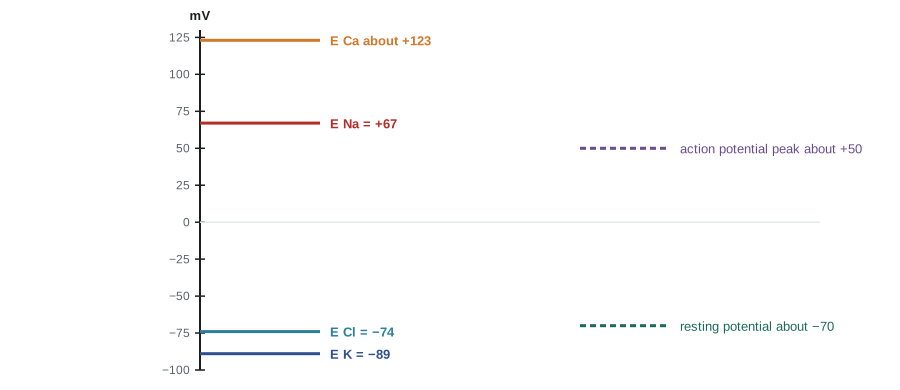
print(f" {label:42s} {v:+6.1f} mV")Equilibrium (Nernst) potentials at 37 C: E_K = -89.0 mV E_Na = +66.6 mV E_Cl = -73.6 mV E_Ca = +125.4 mV Resting and active membrane potentials (GHK): rest, pK:pNa:pCl = 1 : 0.04 : 0.45 -69.8 mV rest, without chloride permeability -68.5 mV peak of action potential, 1 : 20 : 0.45 +51.1 mV extracellular K+ raised to 15 mM -55.3 mV
The calculation gives a resting potential of about −70 mV, close to the measured value for many neurons, and shows three important points. First, when sodium permeability increases twentyfold, as when voltage-gated sodium channels open at the start of an action potential, the membrane swings toward E_Na, becoming positive inside. Second, raising extracellular potassium depolarizes the membrane, because E_K becomes less negative. This is why high blood potassium (hyperkalemia) is dangerous: it depolarizes heart muscle cells, inactivating their sodium channels and disturbing the heart’s rhythm. Third, chloride permeability has only a modest effect here because E_Cl is close to the resting potential; in many neurons, opening chloride channels holds the membrane near rest, which is how inhibitory synapses work.
Ion channels: fast and selective
Ion channels are proteins that form water-filled pores through which specific ions flow passively, down their electrochemical gradients, at rates of up to about 10⁸ ions per second per channel, close to the limit set by diffusion. Their activity can be recorded one molecule at a time by the patch-clamp technique, developed by Erwin Neher and Bert Sakmann (Nobel Prize 1991), in which a glass pipette seals onto a tiny patch of membrane. Single channels open and close abruptly, producing rectangular pulses of current of a few picoamperes.
How can a K⁺ channel pass potassium 10,000 times better than sodium, which is a smaller ion? Roderick MacKinnon’s crystal structure of a bacterial potassium channel in 1998 (Nobel Prize in Chemistry 2003) answered the question. The narrowest part of the pore, the selectivity filter, is lined by backbone carbonyl oxygens from a conserved sequence, TVGYG. These oxygens are spaced exactly to replace the shell of water molecules that surrounds a dehydrated K⁺ ion, so K⁺ can shed its water at little energetic cost. Na⁺ is too small to contact all the oxygens at once, so losing its water shell is energetically unfavourable, and it is excluded. Several K⁺ ions line up in single file in the filter, and their mutual repulsion helps push them through rapidly.
| Gating type | What opens the channel | Examples |
|---|---|---|
| Voltage-gated | Change in membrane potential sensed by charged S4 helices | Na⁺, K⁺ and Ca²⁺ channels of nerve and muscle |
| Ligand-gated (extracellular) | Binding of a neurotransmitter | Nicotinic acetylcholine receptor, GABA-A and glutamate receptors |
| Ligand-gated (intracellular) | Binding of Ca²⁺, cyclic nucleotides or IP₃ | IP₃ receptor (lesson 3), CNG channels in photoreceptors |
| Mechanosensitive | Membrane stretch or force | Piezo1 and Piezo2 (touch, blood pressure sensing) |
| Temperature-sensitive | Heat or cold | TRPV1 (activated by heat and capsaicin), TRPM8 (cold, menthol) |
The 2021 Nobel Prize in Physiology or Medicine went to David Julius, who identified TRPV1 by searching for the receptor for capsaicin, the hot compound in chili peppers, and to Ardem Patapoutian, who discovered the Piezo channels that sense mechanical force. Water itself crosses membranes much faster than through the lipid bilayer alone through aquaporins, discovered by Peter Agre (Nobel Prize in Chemistry 2003); aquaporin-2, inserted into kidney collecting duct cells in response to antidiuretic hormone, controls how concentrated urine becomes, and mutations in it cause a form of diabetes insipidus.
Channel defects, or channelopathies, cause a wide range of diseases: cystic fibrosis (the CFTR chloride channel), some forms of epilepsy, long QT syndrome of the heart, periodic paralyses and congenital insensitivity to pain, caused by loss of the sodium channel NaV1.7. That last condition has made NaV1.7 a target for new painkillers; suzetrigine, which blocks a related sodium channel found in pain-sensing neurons, NaV1.8, was approved in the United States in January 2025 as the first new class of non-opioid pain medicine in decades.
Transporters: carriers that change shape
Transporters bind their substrate on one side of the membrane, change conformation and release it on the other, an alternating-access mechanism. Because each cycle involves a conformational change, they are much slower than channels, typically 10 to 10,000 molecules per second, and they saturate: like enzymes, their rate levels off at high substrate concentration. The kinetics follow the Michaelis–Menten equation, with a maximum rate V_max and a K_m equal to the substrate concentration at half-maximal rate.
import numpy as np
from scipy.optimize import curve_fit
rng = np.random.default_rng(214)

# Glucose uptake by red blood cells (GLUT1-like transporter): simulated data
S = np.array([0.5, 1, 2, 3, 5, 8, 12, 20, 30])            # mM glucose
Vmax_true, Km_true = 100.0, 3.0                            # arbitrary rate units, mM
v = Vmax_true * S / (Km_true + S) * (1 + rng.normal(0, 0.04, S.size))

mm = lambda S, Vmax, Km: Vmax * S / (Km + S)
(Vmax, Km), cov = curve_fit(mm, S, v, p0=[80, 2])
err = np.sqrt(np.diag(cov))
print(f"fitted Vmax = {Vmax:.0f} +/- {err[0]:.0f}, Km = {Km:.1f} +/- {err[1]:.1f} mM")
for s in (1, 5, 25):
    print(f"at {s:2d} mM glucose: rate = {mm(s, Vmax, Km):5.1f} ({mm(s, Vmax, Km)/Vmax:.0%} of Vmax)")
# Compare: free diffusion would increase linearly without saturating
print("unlike diffusion, uptake approaches Vmax and does not keep rising")fitted Vmax = 102 +/- 1, Km = 3.1 +/- 0.1 mM at 1 mM glucose: rate = 25.0 (25% of Vmax) at 5 mM glucose: rate = 63.1 (62% of Vmax) at 25 mM glucose: rate = 90.7 (89% of Vmax) unlike diffusion, uptake approaches Vmax and does not keep rising
GLUT1, the glucose transporter of red blood cells and the blood–brain barrier, has a K_m for glucose of a few millimolar, close to the normal blood glucose concentration of about 5 mM, so its rate responds to changes in glucose. GLUT2 in liver and pancreatic β cells has a much higher K_m, about 15 to 20 mM, which lets these cells sense blood glucose over a wide range. GLUT4, in muscle and fat, is stored in intracellular vesicles and moved to the plasma membrane in response to insulin, a striking example of regulating transport by membrane traffic (lesson 4); failure of this response is part of insulin resistance in type 2 diabetes.
Coupling one gradient to another
Transporters can harness the energy stored in one gradient to move another substance uphill. In symport, both move in the same direction; in antiport, they move in opposite directions. The sodium–glucose cotransporters of the intestine and kidney (SGLT1 and SGLT2) move one glucose into the cell together with one or two Na⁺ ions down the steep sodium gradient, allowing glucose to be absorbed even when its concentration in the gut or tubule is lower than in the cell. Glucose then leaves on the other side of the epithelial cell through GLUT2. Drugs that block SGLT2, such as empagliflozin and dapagliflozin, cause glucose to be lost in the urine and are used to treat type 2 diabetes; large trials found that they also protect the heart and kidneys.
How steep a glucose gradient can SGLT1 build? At equilibrium, the free energy gained from the sodium moving in equals that spent moving glucose up its gradient.
import math
R, F, T = 8.314, 96485.0, 310.0
Na_out, Na_in, Vm = 145.0, 12.0, -0.070       # mM, mM, volts
per_Na = math.log(Na_out / Na_in) - F * Vm / (R * T)
dG_Na = R * T * per_Na / 1000                  # kJ/mol released per Na+ entering
print(f"energy released per Na+ entering = {dG_Na:.1f} kJ/mol")
for n in (1, 2):
    ratio = math.exp(n * per_Na)
print(f"{n} Na+ per glucose: maximum glucose ratio inside/outside = {ratio:,.0f}")energy released per Na+ entering = 13.2 kJ/mol 1 Na+ per glucose: maximum glucose ratio inside/outside = 166 2 Na+ per glucose: maximum glucose ratio inside/outside = 27,575
With two sodium ions per glucose, as in SGLT1, the theoretical maximum is a gradient of tens of thousands to one; in practice gradients are much smaller because glucose also leaks out through GLUT2. The calculation shows that sodium entry is powered by both the concentration gradient and the negative membrane potential, which together supply about 13 kJ/mol per ion. Antiporters work the same way: the Na⁺/Ca²⁺ exchanger of heart muscle uses three Na⁺ entering to expel one Ca²⁺, which is why drugs that slow the Na⁺/K⁺ pump, such as digoxin, raise intracellular calcium and strengthen heart contraction.
Pumps: primary active transport
| Pump family | Energy source | Examples |
|---|---|---|
| P-type ATPases | ATP; a phosphorylated intermediate | Na⁺/K⁺-ATPase, SERCA and plasma membrane Ca²⁺ pumps, gastric H⁺/K⁺-ATPase, lipid flippases |
| V-type ATPases | ATP; rotary mechanism | Acidify lysosomes, endosomes and secretory granules (lesson 5) |
| F-type ATPases | Run in reverse as ATP synthases | Mitochondrial and chloroplast ATP synthase (lesson 6) |
| ABC transporters | ATP binding and hydrolysis by two nucleotide-binding domains | MDR1 (P-glycoprotein) exporting drugs; CFTR (an ABC protein that became a channel) |
ABC transporters are among the largest families of membrane proteins. In cancer cells, overproduction of MDR1 pumps chemotherapy drugs out, causing multidrug resistance; at the blood–brain barrier, the same transporter keeps many drugs out of the brain. Proton-pump inhibitors such as omeprazole, among the most widely used drugs, block the gastric H⁺/K⁺-ATPase that acidifies the stomach.
Worked problem
Energy cost of pumping
The Na⁺/K⁺-ATPase moves 3 Na⁺ out and 2 K⁺ in per ATP. Using the concentrations in the table and a membrane potential of −70 mV, calculate the free energy needed per cycle and compare it with the roughly 55 kJ/mol available from ATP hydrolysis in a cell.
Show solution
- Moving one Na⁺ out against its gradient and the potential costs RT ln(145/12) + F × 0.070 = 6.4 + 6.8 ≈ 13.2 kJ/mol, so three cost about 39.6 kJ/mol.
- Moving one K⁺ in: RT ln(140/5) − F × 0.070 = 8.6 − 6.8 ≈ 1.8 kJ/mol (the potential helps), so two cost about 3.6 kJ/mol.
- Total ≈ 43 kJ/mol per cycle.
- ATP provides about 55 kJ/mol, enough with some margin.
Answer: About 43 kJ/mol per cycle, within the roughly 55 kJ/mol released by ATP hydrolysis under cellular conditions.
Common mistakes
MistakeThe membrane potential arises because large amounts of ions move.
InsteadOnly a tiny fraction of ions crosses; the charge separation sits at the membrane like a capacitor.
MistakeThe Na⁺/K⁺ pump directly generates most of the resting potential.
InsteadIt contributes a few millivolts; mainly it builds the K⁺ gradient, and K⁺ leak through channels sets the potential.
MistakeSmaller ions always pass through channels more easily.
InsteadThe K⁺ selectivity filter excludes smaller Na⁺ because Na⁺ cannot shed its water shell favourably.
MistakeTransporters and channels work at similar speeds.
InsteadChannels pass up to about 10⁸ ions per second; transporters move 10–10⁴ per second because they change conformation.
MistakeSGLT transporters use ATP directly.
InsteadThey use the Na⁺ gradient made by the Na⁺/K⁺ pump: secondary active transport.
Summary and key terms
- Cells keep high K⁺ and low Na⁺, Cl⁻ and Ca²⁺ inside; the Na⁺/K⁺-ATPase maintains these gradients.
- The Nernst equation gives each ion’s equilibrium potential; very few ions cross to charge the membrane.
- The GHK equation weights potentials by permeability, giving resting potentials near −70 mV, close to E_K.
- Channels conduct up to about 10⁸ ions per second; the K⁺ filter (TVGYG) selects by replacing water around K⁺.
- Channels are gated by voltage, ligands, force (Piezo) or temperature (TRP channels); channelopathies cause disease.
- Transporters follow Michaelis–Menten kinetics; GLUT isoforms differ in K_m and regulation by insulin.
- Symporters and antiporters such as SGLT and the Na⁺/Ca²⁺ exchanger harness ion gradients; P-type, V-type and ABC pumps use ATP.
- equilibrium potential
- The membrane voltage at which an ion has no net movement across the membrane.
- Nernst equation
- The equation giving an ion’s equilibrium potential from its concentrations and charge.
- resting potential
- The steady membrane voltage of an unstimulated cell, usually about −60 to −80 mV.
- Goldman–Hodgkin–Katz equation
- An equation for membrane potential based on several ions and their permeabilities.
- selectivity filter
- The narrowest region of a channel pore that discriminates between ions.
- patch clamp
- A technique for recording currents through single ion channels.
- alternating access
- The mechanism by which a transporter exposes its binding site to one side, then the other.
- symport
- Cotransport of two substances in the same direction across a membrane.
- antiport
- Exchange of two substances in opposite directions across a membrane.
- ABC transporter
- An ATP-binding cassette pump, such as MDR1, that moves substrates using ATP.
Practice problems
Work each problem on paper first, then reveal the answer to check.
Calculate E_K at 37 °C for 150 mM inside and 4 mM outside.
Show answer
61.5 × log(4/150) ≈ 61.5 × (−1.57) ≈ −97 mV.
Calculate E_Na for 15 mM inside and 145 mM outside.
Show answer
61.5 × log(145/15) ≈ +61 mV.
Why is the chloride term inverted in the GHK equation?
Show answer
Because chloride carries a negative charge, so its inside concentration appears in the numerator.
What happens to the resting potential if extracellular K⁺ rises, and why does it matter clinically?
Show answer
The membrane depolarizes; in hyperkalemia this disturbs heart rhythm.
How does the K⁺ channel exclude Na⁺?
Show answer
Its filter oxygens fit dehydrated K⁺ but are too far apart to stabilize smaller Na⁺, so Na⁺ keeps its water shell and cannot enter.
What did David Julius discover?
Show answer
TRPV1, the heat-sensitive ion channel activated by capsaicin.
A transporter has K_m = 2 mM. At what fraction of V_max does it work at 6 mM substrate?
Show answer
6 / (2 + 6) = 75 per cent.
How does insulin increase glucose uptake by muscle?
Show answer
It triggers fusion of GLUT4-containing vesicles with the plasma membrane.
Why do SGLT2 inhibitors lower blood glucose?
Show answer
They block glucose reabsorption in the kidney, so glucose is lost in the urine.
How does digoxin strengthen heart contraction?
Show answer
It inhibits the Na⁺/K⁺ pump, raising intracellular Na⁺; the Na⁺/Ca²⁺ exchanger then removes less Ca²⁺, so Ca²⁺ rises.
Lesson quiz · 5 questions
Score 60% or more to complete this lesson.
Create a free account to save your progress, take quizzes and earn a certificate.