
BIOL-214 · Lesson 11 of 12 · 29 min
Cell signalling: receptors, second messengers and pathways
Cells constantly respond to their surroundings. A liver cell releases glucose when adrenaline rises, a fibroblast divides when it receives a growth factor, a neuron fires when a neurotransmitter binds, and an immune cell migrates toward a chemical trail. Each response begins when a signal molecule meets a receptor and ends with a change in the cell’s enzymes, cytoskeleton or genes. BIOL-107 introduced the idea of signal reception, transduction and response, receptor occupancy and amplification. This lesson goes deeper into the machinery: the main classes of receptors, the second messengers and protein kinases that carry their messages, the pathways that developmental biologists and cancer researchers study every day, and the network properties, such as switch-like responses, feedback and crosstalk, that let cells make decisions. Many of the most successful modern drugs act on exactly these molecules.
Forms of signalling
Signals travel different distances. In endocrine signalling, hormones such as insulin travel through the blood to distant targets. In paracrine signalling, a molecule acts on nearby cells, as growth factors do in wound healing; autocrine signals act back on the cell that released them, a feature of some cancer cells that make their own growth factors. Synaptic signalling is a specialized short-range form in which neurotransmitters cross a narrow gap. Finally, contact-dependent signalling, such as the Notch pathway described below, requires the signalling and responding cells to touch. Most signal molecules are hydrophilic and cannot cross the membrane, so they bind cell-surface receptors. Small hydrophobic signals, such as steroid hormones, thyroid hormone and retinoic acid, cross the membrane and bind intracellular nuclear receptors that act directly as transcription factors.
| Receptor class | How it transmits the signal | Examples of signals |
|---|---|---|
| Ion-channel-coupled | Ligand binding opens a channel; ions flow and change membrane potential | Acetylcholine at nicotinic receptors, GABA, glutamate |
| G-protein-coupled (GPCR) | Seven-pass receptor activates a trimeric G protein | Adrenaline, light, odours, many neurotransmitters and hormones |
| Enzyme-coupled: receptor tyrosine kinases | Ligand-induced dimerization; receptors phosphorylate each other on tyrosines | EGF, insulin, PDGF, VEGF |
| Enzyme-coupled: other | Receptor recruits a kinase (JAK) or is a serine/threonine kinase | Cytokines and interferons; TGF-β and BMPs |
| Nuclear receptors | Ligand-bound receptor binds DNA and regulates transcription | Cortisol, estrogen, testosterone, thyroid hormone |
G-protein-coupled receptors
GPCRs form the largest family of membrane receptors, with about 800 genes in humans, around half of them for smell and taste. Each receptor crosses the membrane seven times. When a ligand binds, the receptor changes shape and acts as a guanine nucleotide exchange factor for a trimeric G protein made of α, β and γ subunits on the inner surface of the membrane. The α subunit releases GDP and binds GTP, then separates from the βγ pair. Both α-GTP and βγ can activate target proteins. The α subunit is a GTPase, so after seconds it hydrolyses its GTP to GDP and rejoins βγ, ending the signal. Proteins called regulators of G-protein signalling (RGS) speed this hydrolysis and so make signals briefer. Robert Lefkowitz and Brian Kobilka shared the 2012 Nobel Prize in Chemistry for revealing how GPCRs work, including the first structure of a GPCR caught in the act of activating its G protein.
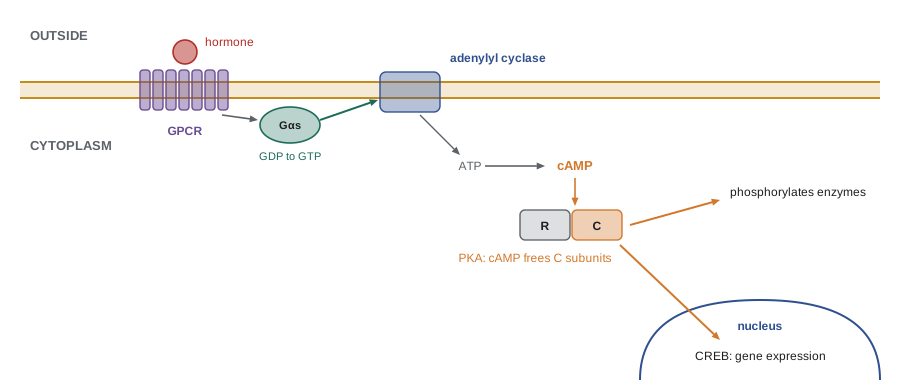
Different G proteins couple to different effectors. Gs stimulates adenylyl cyclase, which makes cyclic AMP (cAMP) from ATP; Gi inhibits it; Gq activates phospholipase C-β; and G12/13 activate the Rho pathway (lesson 8). Bacterial toxins show the importance of the switch. Cholera toxin modifies Gαs so that it cannot hydrolyse GTP; cAMP stays high in intestinal cells, which open the CFTR chloride channel (lesson 7) and pour out salt and water, causing severe diarrhoea. Pertussis toxin, from the bacterium that causes whooping cough, modifies Gαi and stops it from being activated.
Second messengers
Second messengers are small molecules or ions whose concentrations change rapidly in response to a signal, spreading it through the cell. Cyclic AMP binds the regulatory subunits of protein kinase A (PKA), releasing the active catalytic subunits. In a liver cell responding to adrenaline or glucagon, PKA phosphorylates enzymes that break down glycogen and inhibit its synthesis, the pathway in which Earl Sutherland discovered cAMP in the 1950s. PKA also enters the nucleus and phosphorylates CREB, a transcription factor that switches on genes over hours. Phosphodiesterases destroy cAMP; caffeine inhibits some of them, and sildenafil inhibits the phosphodiesterase PDE5, which breaks down the related messenger cyclic GMP.
Phospholipase C-β, activated by Gq, cleaves the membrane lipid PIP₂ into two messengers. Inositol 1,4,5-trisphosphate (IP₃) diffuses to the ER and opens IP₃ receptor channels, releasing calcium from the ER lumen (lesson 3). Diacylglycerol (DAG) stays in the membrane and, with calcium, activates protein kinase C. Calcium is a versatile messenger because the cytosol keeps it very low, about 100 nM, against roughly 1 mM outside and in the ER, so opening channels raises it ten-fold in a fraction of a second. Calcium acts through binding proteins, especially calmodulin, which changes shape when it binds four calcium ions and activates many targets, including calmodulin-dependent kinases. In many cells, calcium rises in repeated spikes, and the frequency of oscillations, not just their size, carries information.
Measuring dose–response curves
Cells often respond to a signal over a narrow range of concentrations. The response to increasing doses is usually summarized with the Hill equation, which has three parameters: the maximum response, the EC50 (the concentration giving half the maximum response) and the Hill coefficient n_H, which describes how steep the curve is.
A Hill coefficient of 1 gives a gradual, hyperbolic response: going from 10 to 90 per cent of the maximum requires an 81-fold rise in concentration. A larger Hill coefficient gives a steeper, more switch-like response, which is called ultrasensitivity. Taking logarithms, the ratio of the concentrations giving 90 and 10 per cent responses is 81 raised to the power 1/n_H.
import numpy as np
from scipy.optimize import curve_fit
rng = np.random.default_rng(214)

def hill(L, Rmax, EC50, n):
    return Rmax * L**n / (EC50**n + L**n)

# Simulated CREB-reporter responses to a hormone (triplicate wells, % of maximum)
dose_nM = np.array([0.1, 0.3, 1, 3, 10, 30, 100, 300, 1000])
true = hill(dose_nM, 100, 12.0, 1.0)
resp = true[:, None] + rng.normal(0, 4, (dose_nM.size, 3))
mean = resp.mean(axis=1)

p, cov = curve_fit(hill, np.repeat(dose_nM, 3), resp.ravel(), p0=[100, 10, 1])
se = np.sqrt(np.diag(cov))
print(f"Rmax = {p[0]:.0f} +/- {se[0]:.0f} %, EC50 = {p[1]:.1f} +/- {se[1]:.1f} nM, "
      f"nH = {p[2]:.2f} +/- {se[2]:.2f}")

def ec(frac, EC50, n):        # concentration giving a fractional response
    return EC50 * (frac/(1-frac))**(1/n)
print(f"EC10 = {ec(0.1, p[1], p[2]):.2f} nM, EC90 = {ec(0.9, p[1], p[2]):.0f} nM, "
f"ratio {ec(0.9, p[1], p[2])/ec(0.1, p[1], p[2]):.0f}-fold")Rmax = 99 +/- 2 %, EC50 = 10.3 +/- 0.7 nM, nH = 1.09 +/- 0.07 EC10 = 1.38 nM, EC90 = 78 nM, ratio 56-fold
The fitted Hill coefficient is close to 1, so the response is graded: the hormone must rise about 60-fold (81-fold for a Hill coefficient of exactly 1) to take the cell from a weak to a nearly full response. Such curves are standard in pharmacology, where the EC50 measures a drug’s potency and Rmax its efficacy. But many cell decisions, such as whether to divide, differentiate or die, need to be more like switches.
Receptor tyrosine kinases and the Ras–MAPK pathway
Receptor tyrosine kinases (RTKs) are single-pass receptors with a tyrosine kinase domain inside the cell. Humans have about 58. When a growth factor such as epidermal growth factor (EGF) binds, two receptors come together and phosphorylate tyrosines on each other’s tails. The phosphotyrosines are docking sites for proteins carrying SH2 domains, such as the adaptor Grb2, which recruits Sos, an exchange factor for the small GTPase Ras. Ras-GTP then activates a three-kinase cascade: Raf phosphorylates and activates MEK, which phosphorylates and activates ERK, a mitogen-activated protein kinase (MAPK). Active ERK enters the nucleus and phosphorylates transcription factors that switch on genes needed for cell proliferation, such as those for the cyclin D that starts the cell cycle (lesson 12).
Each step of the cascade contributes to the shape of the response. Because MEK must phosphorylate ERK on two sites, and Raf must phosphorylate MEK on two sites, the response at each level can be steeper than at the level above it. In a classic 1996 study, Chi-Ying Huang and James Ferrell found that the MAPK cascade in frog oocyte extracts responded as steeply as a protein with a Hill coefficient of about 5, turning a graded input into an almost all-or-none output.
import numpy as np

# A three-tier cascade; each kinase is activated by dual phosphorylation (steady state)
def dual_phos(upstream, K):
    # distributive two-site phosphorylation opposed by a phosphatase:
    # fractions unphosphorylated : single : double = 1 : a : a^2, with a = upstream/K
    a = upstream / K
    return a*a / (1 + a + a*a)

def cascade(signal, K_raf=1.0, K_mek=0.1, K_erk=0.1):
    raf = signal / (K_raf + signal)              # Raf: graded activation
    mek = dual_phos(raf, K_mek)
    erk = dual_phos(mek, K_erk)
    return raf, mek, erk

def ratio_90_10(levels, out):
    out = out / out.max()
    return np.interp(0.9, out, levels) / np.interp(0.1, out, levels)

levels = np.logspace(-4, 3, 20000)
raf, mek, erk = cascade(levels)
for name, out in [("Raf", raf), ("MEK", mek), ("ERK", erk)]:
    r = ratio_90_10(levels, out)
print(f"{name}: EC90/EC10 = {r:7.1f}-fold, effective nH = {np.log10(81)/np.log10(r):.2f}")Raf: EC90/EC10 = 80.3-fold, effective nH = 1.00 MEK: EC90/EC10 = 27.5-fold, effective nH = 1.33 ERK: EC90/EC10 = 8.4-fold, effective nH = 2.07
The simple model shows the response becoming steeper at each step: the effective Hill coefficient rises from 1 for Raf to about 1.3 for MEK and about 2 for ERK, so the input range needed to go from 10 to 90 per cent shrinks from about 80-fold to under 10-fold. The experiments in oocyte extracts were steeper still, because MEK and ERK were present at high concentrations relative to their activators. Real cascades gain further steepness from scaffold proteins, positive feedback and competition between kinases and phosphatases. A positive feedback loop can also make a switch irreversible, so that a brief signal produces a lasting change, as when a frog oocyte commits to maturation. In contrast, negative feedback, such as ERK phosphorylating and inhibiting Sos, limits the duration of signalling and can produce pulses. The difference matters: in rat PC12 cells, brief ERK activation by EGF leads to proliferation, while sustained activation by NGF leads to differentiation into neuron-like cells.
Ras is mutated in about a fifth of all human cancers, most often at glycine 12 in KRAS. The mutant protein cannot hydrolyse GTP and stays switched on. For decades, Ras was considered undruggable. Kevan Shokat’s laboratory discovered a pocket next to the cysteine in the G12C mutant, which led to sotorasib (approved in 2021) and adagrasib (2022), drugs that bind covalently to KRAS G12C and lock it in the inactive state. Inhibitors of the downstream kinases BRAF and MEK are used together against melanomas with BRAF mutations. BIOL-450 discusses how signalling pathways are rewired in cancer and how tumours become resistant to targeted drugs.
The PI3K–Akt pathway
Activated RTKs also recruit phosphoinositide 3-kinase (PI3K), which adds a phosphate to PIP₂ to make PIP₃. This lipid recruits proteins with PH domains, including the kinases PDK1 and Akt, to the membrane, where Akt is activated. Akt promotes cell survival by inhibiting pro-apoptotic proteins (lesson 12), stimulates glucose uptake in response to insulin by moving GLUT4 transporters to the plasma membrane, and activates the mTOR pathway that drives cell growth. The lipid phosphatase PTEN removes the phosphate from PIP₃ and opposes the pathway; PTEN is one of the most frequently lost tumour suppressors.
Pathways that work through transcription
Several pathways carry signals straight to the nucleus and are used over and over during development to decide cell fates.
| Pathway | Key steps | Examples of roles |
|---|---|---|
| JAK–STAT | Cytokine receptors activate associated JAK kinases, which phosphorylate STATs; STAT dimers enter the nucleus | Responses to interferons and interleukins; blood cell production |
| TGF-β/Smad | Serine/threonine kinase receptors phosphorylate Smads, which join Smad4 and enter the nucleus | Growth inhibition, fibrosis, EMT (lesson 10) |
| Wnt/β-catenin | Wnt inhibits a destruction complex (with APC and GSK3), so β-catenin accumulates and activates TCF target genes | Stem cell maintenance in the gut; body axis formation |
| Notch | Contact with a Delta-bearing cell triggers cleavage of Notch; its intracellular domain enters the nucleus | Lateral inhibition; choosing between neighbouring fates |
| Hedgehog | Hedgehog binds Patched, relieving inhibition of Smoothened in the primary cilium; Gli factors activate genes | Patterning of limbs and neural tube |
| NF-κB | Signals trigger destruction of IκB, freeing NF-κB to enter the nucleus | Inflammation and immune responses |
These pathways are frequently disrupted in disease. Loss of APC, which keeps β-catenin low in the absence of Wnt, is the first step in most colorectal cancers. A mutated JAK2 kinase that is active without a ligand causes most cases of polycythemia vera, in which the bone marrow makes too many red blood cells, and JAK inhibitors such as ruxolitinib treat it. Vismodegib, which inhibits Smoothened, treats advanced basal cell carcinoma of the skin, a tumour driven by excessive Hedgehog signalling. The inflammatory roles of JAK–STAT and NF-κB are covered in BIOL-380, and the patterning roles of Wnt, Notch and Hedgehog in BIOL-360.
Switching signals off
A signal is useful only if it stops. Cells end signalling at every level. Ligands are degraded or taken back up. G proteins and Ras hydrolyse their GTP. Phosphatases remove the phosphates that kinases add, and second messengers are destroyed or pumped away. Receptors themselves are desensitized: after a GPCR is activated, G-protein-coupled receptor kinases phosphorylate its tail, and arrestin proteins bind, blocking further G-protein activation and targeting the receptor for endocytosis (lesson 5). Activated RTKs are similarly internalized and sent to lysosomes for degradation. Desensitization explains why the effect of some drugs, such as asthma inhalers that activate β2-adrenergic receptors, wanes with frequent use.
Worked problem
Reading a signalling experiment
Cells expressing a reporter gene driven by CREB-binding sites are treated with a hormone. The reporter rises 20-fold. With cholera toxin alone, it rises 18-fold; with pertussis toxin alone, there is no change; and with a PKA inhibitor plus hormone, the rise is only 1.5-fold. Which pathway carries the signal?
Show solution
- Cholera toxin locks Gαs on; it reproduces the hormone effect, so raising cAMP via Gs is sufficient.
- Pertussis toxin blocks Gi; no effect means Gi is not tonically limiting the reporter in these cells.
- The PKA inhibitor nearly abolishes the hormone response, so PKA is required.
- The hormone therefore acts through a Gs-coupled receptor, adenylyl cyclase, cAMP, PKA and CREB.
Answer: A Gs–cAMP–PKA–CREB pathway (illustrative data).
Drugs that target signalling
About a third of all approved drugs act on GPCRs, from β-blockers for heart disease and antihistamines for allergies to opioid painkillers and the GLP-1 receptor agonists, such as semaglutide, now widely used for type 2 diabetes and obesity. Protein kinase inhibitors are the second great class. The first, imatinib, approved in 2001, blocks the BCR–ABL kinase produced by a chromosomal translocation in chronic myeloid leukaemia and transformed a fatal disease into a manageable one. Since then, the United States has approved over 80 small-molecule kinase inhibitors, and therapeutic antibodies such as trastuzumab, which targets the RTK HER2 in breast cancer, block receptors from the outside. Understanding cell signalling at the molecular level is one of the clearest routes from basic cell biology to medicine.
Common mistakes
MistakeThe G protein activated by a GPCR stays on until the receptor is removed.
InsteadGα is a GTPase; it switches itself off by hydrolysing GTP, helped by RGS proteins.
MistakeA Hill coefficient of 1 means the response is switch-like.
Insteadn_H = 1 is graded (81-fold range from 10 to 90 per cent); larger n_H is ultrasensitive.
MistakeCholera toxin causes diarrhoea by blocking the CFTR channel.
InsteadIt keeps Gαs active, raising cAMP and opening CFTR excessively.
MistakeSteroid hormones bind cell-surface receptors.
InsteadThey cross the membrane and bind intracellular nuclear receptors.
MistakeOncogenic Ras is overactive because it binds GTP more tightly.
InsteadMutations such as G12 substitutions block GTP hydrolysis, so Ras stays in the GTP-bound state.
Summary and key terms
- Signals act at different ranges and bind cell-surface or intracellular receptors.
- GPCRs activate trimeric G proteins; Gs, Gi, Gq and G12/13 couple to different effectors and switch off by GTP hydrolysis.
- Second messengers such as cAMP, IP₃, DAG and calcium spread and amplify signals through kinases and calmodulin.
- The Hill equation describes dose–response curves; ultrasensitive responses have n_H well above 1.
- RTKs signal through Ras and the Raf–MEK–ERK cascade, which can sharpen responses, and through PI3K–Akt.
- JAK–STAT, Smad, Wnt, Notch, Hedgehog and NF-κB pathways regulate transcription and cell fate.
- Signals are ended by GTP hydrolysis, phosphatases and receptor desensitization; signalling proteins are major drug targets.
- GPCR
- A seven-pass receptor that activates trimeric G proteins.
- trimeric G protein
- An αβγ complex whose α subunit is a GTP-regulated switch.
- second messenger
- A small intracellular molecule or ion, such as cAMP or calcium, that relays a signal.
- protein kinase A
- A cAMP-activated serine/threonine kinase.
- calmodulin
- A calcium-binding protein that activates many target enzymes.
- receptor tyrosine kinase
- A single-pass receptor that phosphorylates tyrosines after ligand-induced dimerization.
- Ras
- A small GTPase that relays signals from RTKs to the MAPK cascade.
- MAPK cascade
- A three-tier kinase relay, such as Raf–MEK–ERK.
- ultrasensitivity
- A dose–response that is steeper than a simple hyperbola, giving switch-like behaviour.
- desensitization
- Reduction of a response during continued stimulation, often by receptor phosphorylation and arrestin binding.
Practice problems
Work each problem on paper first, then reveal the answer to check.
What makes Gα switch itself off?
Show answer
Its intrinsic GTPase activity, accelerated by RGS proteins.
Which enzyme does Gq activate, and what messengers result?
Show answer
Phospholipase C-β, producing IP₃ and DAG.
Why is calcium an effective second messenger?
Show answer
Cytosolic calcium is kept very low, so opening channels raises it quickly and many-fold.
For n_H = 2, what is the ratio EC90/EC10?
Show answer
81^(1/2) = 9-fold.
A response has EC10 = 2 nM and EC90 = 18 nM. Estimate n_H.
Show answer
log 81 / log 9 = 2.
Which adaptor links phosphorylated RTKs to Sos?
Show answer
Grb2, through its SH2 domain.
What does PTEN do?
Show answer
It removes the 3-phosphate from PIP₃, opposing PI3K–Akt signalling.
How does Wnt signalling raise β-catenin?
Show answer
It inhibits the destruction complex, so β-catenin is no longer degraded.
What is the role of arrestin?
Show answer
It binds phosphorylated GPCRs, blocking G-protein coupling and promoting endocytosis.
Which drug targets the BCR–ABL kinase?
Show answer
Imatinib.
Lesson quiz · 5 questions
Score 60% or more to complete this lesson.
Create a free account to save your progress, take quizzes and earn a certificate.