
BAS-440 · Lesson 7 of 12 · 20 min
Manufacturer and industry certifications
▶ Video coming soon A video version of this lesson is on the way.
Margit and Sophie shared the certifications session, because between them they had paid for, sat, renewed or let lapse most of the certificates a controls company deals with. Margit had a folder for each employee's training records; Sophie had three manufacturer certificates on her wall and a networking certificate she admitted she had let lapse. "Certificates don't make anyone good," Margit said. "But customers, engineers and manufacturers use them to decide who they'll trust before they've seen the work. So we need to know which ones matter, and why."
This lesson sorts the certificates and credentials a controls technician meets into groups: manufacturer training, protocol and product listings, professional certifications in commissioning, energy and building operation, networking and security certificates, safety training, and professional designations. It ends with how to choose, plan and keep certifications.
Manufacturer training and authorization
Most controllers and front ends can only be configured with the manufacturer's software, and manufacturers control who gets that software. An independent contractor becomes an authorized dealer or partner by agreeing to sell and support the products, and usually by having a minimum number of staff trained and certified on them. The training covers the hardware, the programming and configuration tools, the front end, licensing and the manufacturer's support process. Certification usually ends with a practical test or exam.
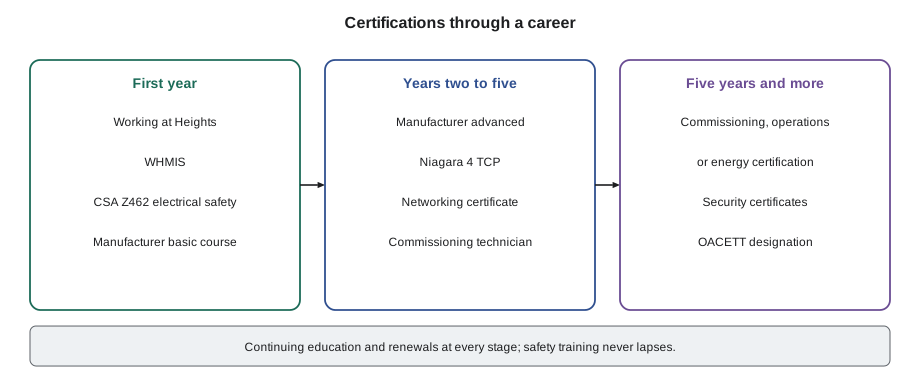
Quillon is an authorized dealer for one main controller line and installs others when specifications require. Every technician who programs that line attends the manufacturer's course within the first two years, and Sophie's programmers hold the advanced level. Manufacturer certifications are valuable because they are specific: a certified technician has used the actual tools on the actual products. They are limited for the same reason, since they say little about anything outside that product line.
One certification crosses many manufacturers. The Niagara Framework from Tridium is used by many controller and front-end makers as the base of their supervisory products, and Tridium's Niagara 4 Technical Certification Program (TCP) is the standard course for technicians who configure it. It is usually taught over about five days by authorized training providers, in person or online, and intermediate courses follow it. Sophie took the TCP years ago and said it was the best single week of training she had done, because it taught how a supervisory platform is put together rather than only which buttons to press.
Product and protocol listings
Some certifications apply to products, not people, and a technician needs to know the difference. BACnet Testing Laboratories (BTL), run by BACnet International, tests and lists products that conform to the BACnet standard for a given device profile. A BTL listing is what Marlow Lane's submittal comment S-1 asked for in lesson 3. It tells the engineer that the controller has been tested to work with other BACnet devices in the ways its profile requires; it does not certify the person who installs it. BACnet International also offers training courses on the protocol, which are useful background for anyone who integrates systems.
Similar listings apply in other areas: products may be listed by testing laboratories for electrical safety, certified to ISA/IEC 62443-4-2 for security capabilities, or certified under lighting and other protocol programs. When a specification asks for a listed or certified product, the submittal must show the listing for the exact model and version, not just the product family.
Professional certifications
Professional certifications show broader knowledge and experience, usually through an application, an experience requirement and an exam. Most are aimed at people with several years in the industry, so for a new technician they are goals rather than starting points.
| Body | Certifications | Relevance to controls |
|---|---|---|
| ASHRAE | Building Commissioning Professional (BCxP); Operations and Performance Management Professional (OPMP); Building Energy Assessment Professional (BEAP); Building Energy Modeling Professional (BEMP); Certified Decarbonization Professional (CDP); Certified HVAC Designer (CHD); High-Performance Building Design Professional (HBDP); Healthcare Facility Design Professional (HFDP) | BCxP and OPMP are closest to controls work; BEAP and CDP to energy and decarbonization projects |
| AABC Commissioning Group (ACG) | Certified Commissioning Authority (CxA); Commissioning Technician (CxT) | CxT is an entry-level commissioning credential; CxA for experienced, independent providers |
| Association of Energy Engineers (AEE) | Certified Building Commissioning Professional (CBCP); Certified Energy Manager (CEM) | Commissioning and energy management |
| University of Wisconsin | Qualified Commissioning Process Provider (QCxP) | Commissioning process |
| NEBB | Certification for firms and professionals in testing and balancing and in building systems commissioning | Common on projects with NEBB-certified balancers |
ASHRAE's certifications are a useful example of how such programs work. A candidate applies, attesting to the program's eligibility requirements, and if approved sits a multiple-choice exam within 90 days. Most of the exams have 115 questions, of which 100 are scored; the BCxP exam is longer. Certification is renewed every three years with professional development hours: 45 for most programs, 50 for BCxP. Other bodies follow broadly similar patterns, with experience requirements, exams and continuing education.
Philippa Quaid, who commissioned Marlow Lane, held a commissioning certification, and Halvern's specification had required a certified commissioning provider. That is the most direct way certifications affect a controls contractor's work: specifications and owners require them, for the commissioning provider, for the balancer and sometimes for the contractor's own staff.
Networking and security certificates
Because building systems now run on IP networks, many controls technicians take vendor-neutral IT certificates. CompTIA Network+, whose current exam version (N10-009) was introduced in 2024, covers networking fundamentals: addressing, switching, routing, wireless, troubleshooting and basic security. CompTIA Security+ covers security fundamentals. Both are widely recognized by IT departments, which helps when a controls technician has to agree network changes with an owner's IT staff, as Callie would at Sandmere and Ninefield.
For security in industrial and building control systems specifically, ISA offers a certificate program built on the ISA/IEC 62443 series that BAS-430 introduced, from fundamentals to design, assessment and maintenance. Quillon used 62443-2-4 in 2025 to check its own practice as a service provider, and Margit expected more owners to ask about it. Network vendors also offer their own certificates on their equipment, which are useful for specialists rather than for most technicians.
Safety training
Some training is not optional at all. Safety training is required by law or by the employer's safety program, and site owners and general contractors often check for it at the gate.
In Ontario, workers on construction projects who may use fall protection must complete an approved Working at Heights training program, with a refresher every three years; every worker who handles hazardous products needs WHMIS training; and work near energized electrical equipment needs training to CSA Z462, the Canadian workplace electrical safety standard. Quillon adds its own training on lockout, ladders, elevating work platforms, confined spaces and roof work, and keeps a record for every employee.
Prakash's view was that safety certificates are the ones never to let lapse. A lapsed networking certificate means a technician cannot show what they know; a lapsed safety card can mean a technician is turned away from a site on the morning of a job, or worse, works without knowing what has changed in the rules.
Professional designations
Some technicians also apply for a professional designation. In Ontario, OACETT certifies engineering technicians and technologists (C.Tech. and C.E.T.) on the basis of an accredited or assessed education, experience and a professional practice exam. The designation is voluntary for building automation work, but it signals education and professional standards to employers and clients, and some public sector employers prefer it. Professional engineers sit above this, and only a licensed engineer can stamp designs where the law requires it, which is why Coralie Vantreight, not Callie, would stamp the Sandmere sequence.
Choosing what to pursue
Certificates cost money and time: course fees, exam fees, travel, time off work and study in the evenings, plus renewal fees and continuing education. Margit's advice was to choose each one by asking four questions.
- Does my current or next job need it? Manufacturer training for the products I program, safety training for the sites I work on.
- Does a customer, specification or employer ask for it? Commissioning and balancing certifications are often required by name.
- Will it teach me something I will use, or only prove something I already know?
- Can I keep it? A certificate that lapses after three years because the renewal hours were never logged is money spent twice.
Worked problem
Planning renewal hours
Sophie plans to earn an ASHRAE certification that needs 45 professional development hours every three years, and a networking certificate that needs 30 continuing education units over three years. If one hour counts as one unit for both and 15 of her hours can count toward both, how many separate training hours does she need each year, on average?
Show solution
- Total needed over three years without overlap: 45 + 30 = 75 h.
- Hours that count toward both: 15 h, taken once instead of twice.
- Separate hours over three years: 75 − 15 = 60 h.
- Per year: 60 ÷ 3 = 20 h.
Answer: About 20 hours of training a year, logged as she goes. The real answer depends on each body's rules for what counts, which she checks before relying on any overlap; the point is that renewals need planning from the day a certificate is earned.
Keeping records
Margit keeps a training record for every Quillon employee: courses, dates, certificates, expiry dates and renewal requirements. The record serves the employee, who can see what needs renewing; the company, which must show manufacturers and customers its certified staff; and the safety program, which must prove that workers were trained. Technicians are expected to keep their own copy, because certifications belong to the person, not the company, and go with them if they move on.
| Certificate | Holder | Earned | Renewal | Next action |
|---|---|---|---|---|
| Working at Heights training | Callie | Before starting, 2026 | Refresher per the rules | Note the date in the record |
| Manufacturer basic course | Callie | Planned 2027 | Per manufacturer | Book after the diploma |
| Niagara 4 TCP | Sophie, Ivo | Earlier years | Per Tridium | Check current status |
| Networking certificate | Sophie | Lapsed | Every three years | Decide whether to re-certify |
| Commissioning credential | Ivo (planned) | Planned | Per body | Collect experience records from Marlow Lane |
Studying for a certification exam
Most certification exams are multiple choice, timed and based on a published outline of topics. Margit's advice came from watching dozens of Quillon staff sit them. Start from the outline, not the textbook: list every topic, rate your knowledge of each, and spend most of the study time on the weakest. Use the body's own reference list, because questions are written from it. Practise with timed questions to learn the pace, and read every option before choosing, because the best answer is often the second one that seems right.
For technical exams, she recommended working real examples rather than memorizing facts: sizing a transformer, scaling a signal, reading a priority array, calculating a reset. The four review lessons in this course are built that way for the same reason. For process exams, such as commissioning certifications, she recommended walking through a real project file, as Ivo had done with Marlow Lane, and matching each document to the stage it belongs to.
Exams also reward calm. Read the question twice, mark the ones you are unsure of and come back to them, and do not change an answer without a reason. Sophie admitted that she had failed one manufacturer exam the first time by rushing the last twenty questions, and passed it easily a month later by pacing herself.
Learning that certificates do not show
Much of what makes a good technician is learned on the job and never certified: the order Prakash checks things in on a service call, Sophie's habit of reading programs written by others before changing them, Declan's way of reading a specification, Ivo's minutes with one name and one date per action. Quillon pairs new technicians with experienced ones for their first year for that reason, and asks experienced ones to explain why, not just what.
Teaching is the last step of that learning. Margit's change to Callie's development plan in lesson 1, adding "teach someone else", was deliberate. A technician who can teach a task to the next new person understands it well enough to do it under pressure, and the company gains a second person who can do it.
Margit also asked each senior person to record one thing a year that they had learned without a course: a fault they had never seen, a customer problem they had solved, a tool they had found. The list went into the training record beside the certificates, because it showed what the certificates could not.
Callie's first entry was the 41 Ω reading on the seventh floor: she now knew that a trunk can be measured with a meter before anyone touches the front end, and that the number tells you how many terminators are on it.
Common mistakes
MistakeCollecting certificates without a plan.
InsteadChoose by job need, customer requirement, learning value and the ability to renew.
MistakeConfusing product listings with personal certifications.
InsteadA BTL listing certifies a product's protocol support, not the installer's skill.
MistakeLetting safety training lapse.
InsteadTrack expiry dates and renew safety training first.
MistakeLeaving renewal hours until the last year.
InsteadLog continuing education as it happens and spread it over the renewal period.
MistakeRelying on the employer's records alone.
InsteadKeep your own copies; certifications belong to the person.
Summary and key terms
- Manufacturer training gives access to products and software, and authorized dealers need certified staff.
- Niagara 4 TCP is a widely used certification for a supervisory platform shared by many manufacturers.
- BTL listings and similar programs certify products, not people.
- Professional certifications from ASHRAE, ACG, AEE and others cover commissioning, operations and energy, usually with experience requirements, exams and renewals.
- Networking and security certificates help controls technicians work with IT departments and meet security expectations.
- Safety training is required by law or contract and must never lapse.
- Choose certifications deliberately, plan renewal hours and keep personal records.
- Authorized dealer
- A contractor approved by a manufacturer to sell, install and support its products, usually with certified staff.
- BTL listing
- A BACnet Testing Laboratories record that a product conforms to a BACnet device profile.
- Professional development hours
- Hours of training or education counted toward renewing a certification.
- Continuing education
- Ongoing learning required to keep a certification current.
- Training record
- A record of an employee's courses, certificates, expiry dates and renewals.
Practice problems
Work each problem on paper first, then reveal the answer to check.
What does a BTL listing certify?
Show answer
That a product conforms to a BACnet device profile; it does not certify the installer.
How often are ASHRAE certifications renewed, and with how many hours for most programs?
Show answer
Every three years, with 45 professional development hours (50 for BCxP).
Name an entry-level commissioning credential for technicians.
Show answer
ACG's Commissioning Technician (CxT).
Why did Prakash say safety certificates must never lapse?
Show answer
A worker can be turned away from site, or work without knowing changed rules.
Lesson quiz · 5 questions
Score 60% or more to complete this lesson.
Create a free account to save your progress, take quizzes and earn a certificate.