
BAS-440 · Lesson 11 of 12 · 22 min
Review: commissioning and troubleshooting
▶ Video coming soon A video version of this lesson is on the way.
The last review brought Ivo and Prakash to the same table, which Callie thought was fitting: Ivo's commissioning binder from 17 Marlow Lane and Prakash's trouble file. "Commissioning proves a system works before the owner takes it," Ivo said. "Troubleshooting finds out why it stopped working afterwards. They use the same skills in a different order." This lesson reviews BAS-410 and BAS-420 together, using the cases Callie had studied.
What commissioning is
Commissioning is a quality process that checks a building's systems meet the owner's project requirements, from design through occupancy. It is not the same as start-up or checkout: those are the contractor's own work, which commissioning verifies. The commissioning provider is independent of the designers and installers. On Marlow Lane, Philippa Quaid worked in a commissioning group in the consulting engineer's office, separate from the engineers who wrote the design, which Halvern accepted because the job was small.
ASHRAE Guideline 0 and Standard 202 describe the commissioning process, Guideline 1.1 applies it to HVAC&R and Guideline 1.2 to existing systems; in Canada CSA Z320 covers building commissioning. Specifications and energy codes set how much commissioning a project needs.
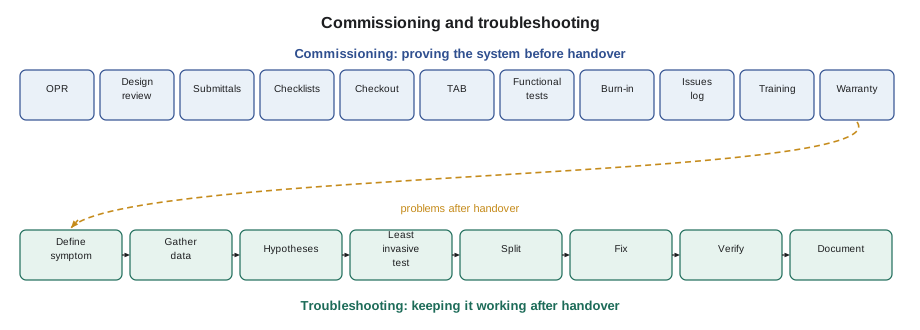
The commissioning documents
Every commissioning test traces back to the owner's project requirements (OPR), a short document in the owner's words. Marlow Lane's OPR had nine lines, written in a two-hour workshop in March 2026. Line 3 set setpoints of 21 °C (70 °F) heating and 24 °C (75 °F) cooling, held within 1 K (2 °F), which a test can check; line 6 asked for no nuisance alarms, which is why the burn-in week's alarm count was reviewed. The basis of design (BOD) explains how the design meets the OPR; the commissioning plan says who does what; the specification writes the commissioning work into the contracts.
| Stage | What happens | Marlow Lane |
|---|---|---|
| Design review | The provider checks the design against the OPR | 9 comments, including restart after fire alarm reset by operator only and discharge air sensors on all 36 boxes |
| Submittal review | The provider and engineer check what will be supplied | 7 comments; reviewed as noted |
| Pre-functional checklists | Installation checked line by line before testing | AHU-1: 64 lines, 58 yes, 4 no, 2 not applicable on Monday, October 5 |
| Point-to-point checkout | Every point checked from device to front end | About 22 hours; 11 deficiencies |
| Testing, adjusting and balancing | Airflows and water flows measured and set | October 14 to 20; six first-floor boxes on October 30 |
| Functional performance tests | Sequences tested under real and simulated conditions | VAV sample October 22 and 23; AHU-1 October 26 and 27 |
| Burn-in | Trends reviewed over a set period of normal operation | October 29 to November 4; 180 points at 1 minute |
| Issues log | Every problem recorded, assigned and closed | 58 at handover, 51 closed, 7 open, none serious |
| Handover and training | Documents, training and warranty start | Handover Thursday, November 5; training Tuesday, November 24 (plan) |
Checkout and functional testing
Point-to-point checkout proves each point is wired, scaled and named correctly: the device in the field, the value at the controller and the value at the front end all agree, and outputs move the right device in the right direction. Marlow Lane's 11 deficiencies were typical: two boxes' sensors swapped, a zone sensor reading 0.7 K (1.3 °F) high from a draft in its back box, reheat actuators reversed, a damper rotating the wrong way, a return fan speed scaled for 50 Hz, boiler enables swapped, a current switch set wrong and a humidity sensor's 0-5 V output on a 0-10 V input.
Functional tests prove the sequences. They are written in advance with expected results, run with the controls contractor operating the system and the provider witnessing, and recorded step by step as pass or fail. A failure is not a disaster; it is the reason for testing. At Marlow Lane, VAV-3-04 failed step 3 of its test because its discharge air limit was linked to a constant: the third floor had been loaded from a template made before the design review added discharge air sensors. The template was fixed, all twelve third-floor boxes were reloaded, and a second, larger sample of 15 boxes passed.
Worked problem
Reading a test record
AHU-1's functional test had 42 steps in seven sections; 39 passed the first time. Step B4 failed with static pressure hunting at the bottom of its reset and was retuned and retested; step E2 failed because the freeze response did not open the heating valve; step D7, the economizer high limit with cooling at high outdoor temperature, could not be tested in October. What fraction passed first time, and what happened to D7?
Show solution
- First-time passes: 39 ÷ 42 ≈ 0.93, or about 93 in 100.
- B4 and E2 were fixed and passed on retest.
- D7 was deferred to June 2027, when outdoor conditions allow it, and recorded as a deferred test.
Answer: About 93 in 100 passed first time. E2 had a lesson for every future job: the loop disable from BAS-130 (fan off, output to zero) had outranked the freeze response, so the master template was updated.
Burn-in is the step most often skipped and most often revealing. Seven days of one-minute trends on 180 points showed AHU-1's supply air temperature in band for 3,207 of 3,300 occupied samples, about 97 in 100, and found two second-floor boxes hunting with a period of about 230 seconds, which a 10-second fast trend confirmed and Sophie retuned.
The troubleshooting method
Prakash's trouble file opened with one page: an eight-step method. He asked Callie to recite it and then apply it to a case.
- Define the symptom precisely: what, where, when, since when, and who noticed.
- Gather data: trends, alarms, the audit trail, the change log, and the space itself.
- Form hypotheses: list the possible causes, from field devices to programs to networks to the mechanical system.
- Test the least invasive first: read before writing, observe before changing.
- Split the problem: find the half of the system where the fault lies, then halve again.
- Fix the cause, not the symptom.
- Verify that the fix worked, under the conditions that caused the symptom.
- Document what was found and done, so the next person does not start again.
Callie chose room 108. The symptom was a room too hot on cold mornings. The data showed discharge air at 34 °C (93 °F) with reheat commanded to zero, and a box maximum raised from 150 L/s (320 cfm) to 200 L/s (425 cfm) on Wednesday, November 11. Her hypotheses were a leaking or stuck valve, a failed actuator, a program fault and a wrong airflow setting. The least invasive test was to command the valve while watching the actuator and the stem, which showed the stem not moving because the coupling had slipped. Prakash fixed it on Friday, November 13 and added a witness mark; the box maximum went back to design; verification was discharge air following supply air with reheat at zero, and a trend left for the next cold morning; Callie's report documented it, with a recommendation for a fault rule that would catch it automatically.
| Fault area | Typical symptoms | Case |
|---|---|---|
| Field device | Reading wrong, stuck, or out of range | Type III thermistor on a Type II input; filter switch tubes swapped |
| Wiring and power | Intermittent readings, devices resetting, low voltage | West stair transformer at 64 VA on 50 VA |
| Program | Correct devices but wrong behaviour | AHU-1 integral windup; VAV-3-04 linked to a constant |
| Network | Devices offline, stale values | Seventh-floor duplicate MAC and extra terminator |
| Operator settings | Equipment held in one state | Fourteen overrides at priority 8 |
| Mechanical | Controls doing the right thing, result still wrong | EF-3 broken belts; Ninefield low delta-T |
Reading trends
BAS-420 spent a lesson on reading symptoms from trends, because trends show what happened when nobody was watching. Prakash's three questions for any trend were: is the measurement believable, is the controller doing what its sequence says, and is the equipment responding to the controller? A loop hunting with a steady period suggests tuning or a measurement problem; a value stuck exactly at a limit suggests an override or a clamp; a slow drift suggests a sensor; and a sudden change at the same time every day suggests a schedule.
Trend intervals matter. A 5-minute trend shows a day's behaviour but hides a loop hunting every 96 seconds; a 10-second fast trend shows the hunting but fills a buffer quickly. Sophie's trend set-up in BAS-220 used 5 minutes for most points and a fast trend on the AHU-2 discharge air loop, which later revealed the hunting in the lecture wing.
From the issues log to the trouble file
The issues log of a commissioned project and a technician's trouble file are the same kind of document: a list of problems, each with a cause, a fix and a verification. Ivo's Marlow Lane log had 58 issues at handover from design (9), submittals (7), checklists and site work (14), point-to-point checkout (11), balancing (5), functional tests (6) and burn-in (6). Callie's four write-ups for BAS-420, on the lecture wing, the seventh-floor trunk, the west stair and EF-3, started her own trouble file.
Worked problem
Issues log progress
Marlow Lane's log had 58 issues at handover, with 51 closed and 7 open, none serious. What fraction was closed, and what should happen to the open items?
Show solution
- Closed: 51 ÷ 58 ≈ 0.88, or about 88 in 100.
- Open: 7, each with an owner and a target date in the log.
Answer: About 88 in 100 closed at handover. The open items stay on the log until closed, are reviewed at the warranty review planned for early September 2027, and none should be allowed to quietly disappear.
Prakash ended the review with his favourite point. Most of the faults in the trouble file had been made by someone, not by the equipment: a default address, a wrong configuration, a changed setting, a template loaded from an old version. Commissioning finds them before handover; good documentation, change logs and service practice stop new ones being made after it.
Training at handover
Commissioning ends with people, not tests. Operator training is planned like a test: who needs to learn what, with an agenda, materials, a record of attendance and a check of understanding. Marlow Lane's training on Tuesday, November 24 is planned as 5 hours of modules from 8:30 to 14:00, with time at the equipment as well as at the front end, and follow-up sessions in January and May 2027, because operators learn more once they have used the system for a few months. Ivo's rule for training was to teach the tasks the operators will actually do, in the order they will meet them, and to leave out anything they will never touch.
The commissioning provider's systems manual and final report complete the record. They explain how the systems work together, what was tested, what was deferred and what remains open, so that the owner can hold everyone to the results during the warranty year.
Commissioning existing buildings
Commissioning is not only for new work. Retro-commissioning applies the same process to an existing building: find out what the systems are actually doing, compare it with what the owner needs, fix the gaps and prove the savings. Ninefield's plan for spring 2027, from BAS-330, is a retro-commissioning project of eight measures, from valve conversions and differential pressure reset to schedule repairs and a lower base load, with an estimated saving of 245,800 kWh a year, about 8.8 in 100 of the building's electricity. Its tests will look like Marlow Lane's, and its measurement and verification plan will show whether the savings appear in the utility data.
Ongoing commissioning keeps the results. Weekly fault rule reviews, monthly trend checks and an annual review of sequences against the building's use catch drift before it becomes a complaint. That is where commissioning and troubleshooting finally meet: the same skills, applied every week rather than once.
Seasonal and deferred testing
Some tests can only be run in the right weather. Economizer high limits, cooling capacity and chiller staging need warm days; freeze protection, boiler staging and heating capacity need cold ones. A project finished in the fall defers its cooling tests to the following summer, as Marlow Lane's D7 test was deferred to June 2027, and a project finished in spring defers its heating tests. Each deferred test is entered in the issues log with a date and an owner, so that it is not forgotten when the project team has moved on.
Ivo's last word on the review was that a deferred test is still a test owed to the owner. Writing it down with a date is what turns a promise into a plan that someone else could carry out if he were not there.
Common mistakes
MistakeTreating commissioning as the contractor's own checkout.
InsteadCommissioning independently verifies the contractor's work against the owner's requirements.
MistakeSkipping burn-in because the functional tests passed.
InsteadReview trends over normal operation; it finds faults tests cannot.
MistakeChanging things before gathering data.
InsteadRead trends, alarms, the audit trail and the change log first.
MistakeVerifying a fix under easy conditions.
InsteadVerify under the conditions that caused the symptom, such as the next cold morning.
MistakeClosing an issue without a verification.
InsteadRecord how each fix was verified before closing it.
Summary and key terms
- Commissioning verifies that systems meet the owner's project requirements, independently of designers and installers.
- Its stages run from OPR and design review through checklists, checkout, balancing, functional tests, burn-in, issues log, training and warranty review.
- Point-to-point checkout proves wiring, scaling, naming and direction; functional tests prove sequences with expected results.
- Failures are recorded, fixed and retested; deferred tests are scheduled for the right season.
- The eight-step troubleshooting method moves from symptom and data to hypotheses, least invasive tests, splitting, fixing, verifying and documenting.
- Trends answer whether the measurement, the controller and the equipment are each doing their part.
- Issues logs and trouble files record cause, fix and verification so problems are not solved twice.
- Owner's project requirements (OPR)
- A document stating what the owner needs a project to achieve.
- Pre-functional checklist
- A line-by-line check of installation before functional testing.
- Functional performance test
- A written test of a sequence with expected results, witnessed and recorded.
- Deferred test
- A test postponed until conditions, such as the season, allow it.
- Issues log
- A record of every problem found, its owner, its fix and its verification.
Practice problems
Work each problem on paper first, then reveal the answer to check.
What fraction of AHU-1's 42 test steps passed first time?
Show answer
39 ÷ 42, about 93 in 100.
Why did VAV-3-04 fail its test?
Show answer
Its discharge air limit was linked to a constant because the third floor was loaded from an old template.
What is the least invasive test for a suspected stuck valve?
Show answer
Command it while watching the actuator and the stem.
A trend shows a value stuck exactly at a limit. What does that suggest?
Show answer
An override or a clamp.
Lesson quiz · 5 questions
Score 60% or more to complete this lesson.
Create a free account to save your progress, take quizzes and earn a certificate.