
BAS-440 · Lesson 4 of 12 · 20 min
Project coordination with other trades
▶ Video coming soon A video version of this lesson is on the way.
Ivo Bartek said that on most jobs he spent more time talking to other trades than to controllers. For his session he brought Marlow Lane's coordination file: meeting minutes, the responsibility matrix, the requests for information, two change orders and a printed lookahead schedule covered in his handwriting. Declan joined for the second half, with the notes from the Thistledown Analytics kickoff at Ninefield on Wednesday, November 4. Between them they covered a finished job and one that had barely started.
Controls touch almost every other system in a building. The controls contractor depends on the mechanical contractor to install valves and wells, on the electrical contractor for power, on the balancer to set airflows, on the fire alarm contractor for interface signals, on the general contractor for access and ceilings, and on the owner's IT staff for network connections. Most of the delays and disputes on controls jobs come from the gaps between these trades, not from the controls themselves.
The responsibility matrix
The first coordination document on any controls job is a responsibility matrix, sometimes called a division of responsibility. It lists every item that crosses a boundary between trades and says who furnishes it (buys and delivers it), who installs it, who wires it and who programs or tests it. Specifications often include one; when they do not, Quillon writes its own and asks the other trades to agree it at the first coordination meeting.
| Item | Furnish | Install | Wire | Program and test |
|---|---|---|---|---|
| Control valves | Controls | Mechanical | Controls | Controls |
| Immersion wells for temperature sensors | Controls | Mechanical | n/a | n/a |
| Damper actuators on unit dampers | Controls | Controls | Controls | Controls |
| Airflow measuring station | Mechanical | Mechanical | Controls | Controls; TAB verifies |
| Variable frequency drives | Mechanical or electrical (per spec) | Electrical | Electrical (power); controls (signals) | Start-up by supplier; controls tests |
| Duct smoke detectors | Fire alarm | Mechanical | Fire alarm | Fire alarm; controls tests interface |
| 120 V power to control panels | Electrical | Electrical | Electrical | n/a |
| Network connection to owner's server | Owner IT | Owner IT | Owner IT | Controls with owner IT |
| Boiler and chiller controls interface | Equipment supplier | Equipment supplier | Controls (to the interface) | Supplier and controls together |
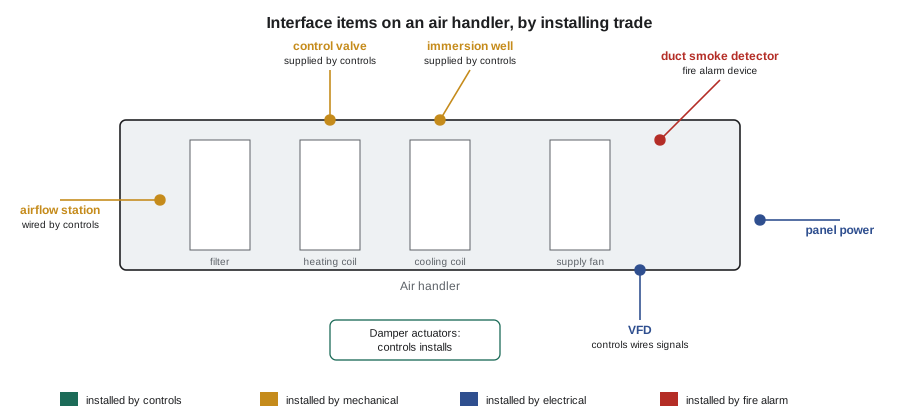
At Marlow Lane the matrix settled a question that comes up on almost every job: who installs the valves. Quillon supplied the reheat valves for the 36 boxes and the two AHU-1 coil valves, and the mechanical service contractor's pipefitters installed them, because cutting into hot water piping is mechanical work. Quillon then mounted the actuators and wired them. The two resized valves from submittal comment S-6 had to be ordered separately and delivered to the mechanical contractor's shop, which the matrix made easy to arrange.
Coordination meetings
On a large project, the general contractor runs weekly site meetings for all trades. On a smaller job like Marlow Lane, where Quillon's contract was with Halvern directly, Ivo ran a short coordination meeting every Tuesday morning with Halvern's operators, the mechanical service contractor, the electrical contractor and, from October, the balancer and Philippa. Each meeting followed the same agenda, and minutes went out the same day.
- Safety: anything that had gone wrong or nearly gone wrong in the past week, and the coming week's hazards, such as roof work or work near live panels.
- Two-week lookahead: what each trade planned to do, where, and what it needed from others.
- Open items: requests for information, submittals, deliveries and access.
- Occupants: which floors would be affected, and what notice tenants had been given.
- Actions: who will do what by when, written as one line each.
Ivo's rule was that every action had one name and one date. "Electrical to confirm panel power" became "electrical foreman to confirm third-floor panel power by Friday". A minute that says "all to review" means nobody will.
The lookahead schedule
A controls schedule is mostly made of links to other people's work. Quillon cannot terminate a valve actuator until the valve is installed, cannot check out a box until it has power, cannot finish balancing support until the boxes are controlled, and cannot run functional tests until balancing is finished. The project schedule shows these links, but the two-week lookahead is where they are managed day to day.
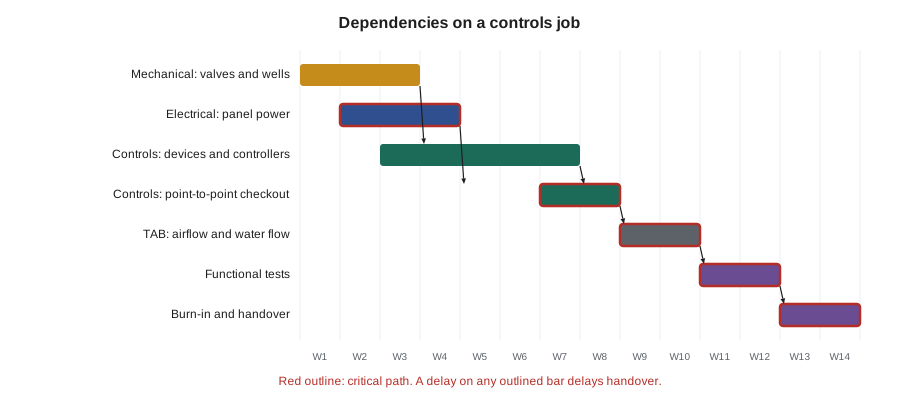
Ivo showed Callie the lookahead from the week of Monday, October 26, when AHU-1's functional test ran. It listed the AHU-1 functional test on Monday and Tuesday, the balancer's last six boxes on the first floor, still waiting for ceiling access, the fire alarm interface test on Wednesday, October 28, and the start of the burn-in week on Thursday. Each line had a trade, a location, a day and a note of what it depended on.
Requests for information
When the documents are unclear, contradictory or impossible to build, the contractor asks the design team in writing with a request for information (RFI). An RFI states the question, refers to the drawing or specification section, suggests an answer if the contractor has one, and says by when an answer is needed to avoid a delay. The answer becomes part of the contract documents.
RFI-04   17 Marlow Lane controls replacement          Sent: Mon Jul 20
To: consulting engineer   From: Quillon (I. Bartek)   Answer needed by: Mon Jul 27
Reference: drawing M-401 control diagram AHU-1; spec 23 09 23 part 3
Question: The duct static pressure sensor is shown two-thirds of the way
down the main supply duct. On site, the main duct splits into two branches
at the first-floor riser and there is no single location two-thirds down.
Proposed: one sensor in each branch at about two-thirds of its length,
with the static loop using the lower of the two readings.
Impact if not answered by Jul 27: second-floor ceiling closes Jul 31;
sensor tubing must be run before then.
The engineer accepted the proposal in four days, and the second sensor became a change to the contract, because it added a device and wiring that were not in the original scope. Ivo pointed out the most useful line in the RFI: the impact. Without it, an RFI is just a question; with it, the design team knows the cost of waiting.
Changes and change orders
A change order is a written agreement to change the contract's scope, price or time. Controls contractors see many small changes: an added point, a moved sensor, a different sequence, extra visits caused by someone else's delay. Each one should be priced and agreed in writing before the work is done, or at least recorded the day it happens, because changes agreed by conversation are the most common cause of disputes at the end of a job.
The contract sets the rules for pricing changes, usually the labour rates and the markup allowed on cost. Marlow Lane's contract allowed a markup of 15 in 100 on the cost of changed work.
Worked problem
Pricing a small change
The second static pressure sensor from RFI-04 needed a sensor costing 310 dollars, 10 m of tubing and cable at sample prices totalling 40 dollars, 3 hours of installation and 1 hour of programming and checkout at the sample rate of 105 dollars an hour. With a 15 in 100 markup on cost, what is the change order price?
Show solution
- Materials: 310 + 40 = 350 dollars.
- Labour: 4 h × 105 = 420 dollars.
- Cost: 350 + 420 = 770 dollars.
- Markup: 770 × 0.15 = 115.50 dollars.
- Price: 770 + 115.50 = 885.50 dollars.
Answer: About 886 dollars, agreed by Halvern before the sensor was installed. Small amounts add up: Marlow Lane had two change orders, and Ivo kept a log of several more items that Quillon chose to absorb as goodwill.
The second change order came from a delay. The first floor's tenant had its own ceiling contractor, who closed the ceiling over six boxes, VAV-1-07 to VAV-1-12, before balancing, and access had to be arranged through Halvern and the tenant. The balancer could not finish those boxes until Friday, October 30, and Quillon tested them on Monday, November 2. Quillon priced its two extra visits as a change and Halvern agreed, because the cause was outside Quillon's scope and Ivo had recorded it in the minutes the day it happened.
Working in occupied buildings
Retrofit work happens around people who are trying to do their own jobs. On Marlow Lane, line 2 of Halvern's requirements said that occupied floors could not lose heating or cooling, so every cutover from the old controls to the new was planned at night or on a weekend, one floor at a time, with the old controls left in place until the new ones had been checked. Tenants were told a week ahead which nights work would happen above their offices, and Quillon's crew left every space as they found it: tiles back, dust cleaned, furniture moved back.
- Access: sign in with the building, wear identification, and follow the owner's rules for keys and locked rooms.
- Advance notice: tell the owner, and through the owner the tenants, before any work that could affect comfort, noise or access.
- Protection: cover desks and floors, clean up daily, and never leave tools or ladders in occupied space.
- Fallback: plan how to restore heating, cooling and ventilation if a cutover goes wrong, before starting it.
- Safety: ladders and lifts in shared spaces, live panels, roof access and hot work all need the owner's and the other trades' agreement.
Coordinating with IT and security
Modern controls jobs add a trade that older coordination files never mentioned: the owner's IT department or provider. Network connections, server space, addresses, remote access and security rules all need agreement before installation, and IT staff have their own schedules and approval processes. On Marlow Lane, the VPN account for Halvern's remote access took two visits to set up with Halvern's IT provider, which Ivo had not planned for. On Sandmere, Callie's first question on the specification in BAS-430 had been to ask the library's IT department how it wanted the controls network connected.
Declan's notes from the Thistledown kickoff on November 4 showed how many parties a small fit-out can involve: Fenwright Engineering as the tenant's engineer, Brackley Interiors as the general contractor, Kelso Electric as Brackley's electrical subcontractor, Lumacor for lighting, Ironmark for card access, Ilona for the building owner, Thistledown's own IT manager, and Quillon. The plans call for Fenwright's permit drawings in December, work from January to March 2027, the fire alarm verification and integrated test in March, and occupancy in April. Callie's integration plan for the floor, drafted for BAS-340, would go to Sophie before Fenwright's drawings, so that the controls requirements were in the permit set rather than added later as changes.
| Party | Main interface with controls | First action (plans) |
|---|---|---|
| Fenwright Engineering | Design of the floor's HVAC and controls requirements | Include Quillon's integration requirements in the permit drawings in December |
| Brackley Interiors | Schedule, ceilings, access to the floor | Add controls milestones to the fit-out schedule |
| Kelso Electric | Power to new boxes and the tenant meter | Confirm circuits for four new boxes |
| Lumacor | Lighting system interface and schedules | Agree the integration points list |
| Ironmark | Card access events for after-hours requests | Agree the event mapping by suite and time |
| Thistledown IT | Data feed and security questionnaire | Review the edge gateway design and the hardening plan |
Safety coordination on a shared site
Safety is the first item on every coordination agenda because trades create hazards for each other. A pipefitter's hot work can set off a smoke detector the controls crew has just connected; an electrician's open panel is a hazard to anyone working nearby; a controls installer's ladder in a corridor is a hazard to occupants. On a construction project, the constructor or general contractor coordinates safety for everyone; on a small owner-managed job like Marlow Lane, Ivo agreed the arrangements with Halvern and the other trades at the first meeting.
- Orientation: every worker on site learns the building's emergency routes, alarms, first aid and reporting before starting.
- Hot work and fire alarm impairments: agreed in advance with the owner and the fire alarm contractor, with fire watches where required.
- Lockout: where the controls crew works on equipment another trade isolates, each worker applies a personal lock, and nobody removes another's.
- Roof and height work: guardrails, fall protection and weather limits agreed before work starts.
Ivo kept a short incident and near-miss log in the coordination file. It had three entries for Marlow Lane, all minor, and each led to one line in the next meeting's minutes about what would change.
Common mistakes
MistakeStarting work without an agreed responsibility matrix.
InsteadAgree who furnishes, installs, wires and tests each interface item at the first meeting.
MistakeWriting actions without a name and a date.
InsteadGive every action one person and one date.
MistakeSending RFIs without saying when an answer is needed.
InsteadState the impact and the date after which a delay will follow.
MistakeDoing changed work on a verbal agreement.
InsteadPrice and agree changes in writing, or at least record them in the minutes the day they happen.
MistakeForgetting the owner's IT staff in the schedule.
InsteadPlan network connections, accounts and approvals with IT as a trade of its own.
Summary and key terms
- Most controls delays come from the boundaries between trades.
- A responsibility matrix says who furnishes, installs, wires and tests each interface item.
- Coordination meetings follow a fixed agenda, and every action has one name and one date.
- The lookahead schedule manages the links between trades, and the critical path shows which delays move handover.
- RFIs state the question, the reference, a proposed answer and the impact of a late reply.
- Change orders are priced by the contract's rules and agreed in writing.
- Occupied buildings need notice, protection, fallbacks and clean work; IT is now a trade to coordinate with.
- Responsibility matrix
- A table showing which trade furnishes, installs, wires and tests each interface item.
- Lookahead schedule
- A short-range schedule, typically two weeks, used to coordinate daily work.
- Critical path
- The chain of dependent tasks that sets the earliest finish date.
- Request for information (RFI)
- A written question to the design team about the contract documents.
- Change order
- A written agreement changing a contract's scope, price or time.
Practice problems
Work each problem on paper first, then reveal the answer to check.
Who usually installs control valves, and why?
Show answer
The mechanical contractor, because cutting into piping is mechanical work; the controls contractor supplies, wires and programs them.
A change needs 200 dollars of material and 2 hours at 105 dollars. With a 15 in 100 markup, what is the price?
Show answer
Cost 200 + 210 = 410; markup 61.50; price 471.50 dollars.
Why did Quillon's two extra visits on the first floor become a change order?
Show answer
The tenant's contractor closed the ceiling before balancing, a cause outside Quillon's scope, and Ivo recorded it the day it happened.
Name the line that turns an RFI from a question into a schedule tool.
Show answer
The impact if it is not answered by a stated date.
Lesson quiz · 5 questions
Score 60% or more to complete this lesson.
Create a free account to save your progress, take quizzes and earn a certificate.