
BAS-440 · Lesson 6 of 12 · 20 min
Customer service for controls technicians
▶ Video coming soon A video version of this lesson is on the way.
Prakash kept a second session for customer service, and he started it with a confession. Early in his career, at a hospital, he had fixed an air handler fault in twenty minutes and left without telling anyone. The charge nurse who had called it in spent the rest of the afternoon thinking nobody had come, and called again, and then called the hospital's facilities director. "The fix was perfect," Prakash said. "The service was terrible. The customer doesn't see the fix. The customer sees us."
This lesson covers the people side of controls service: who the customers are, how to take and handle a call, how to explain technical problems to people who are not technicians, how to handle complaints and disagreements, how to behave on site, and how to write so that the customer understands what was done.
Who the customer is
A controls technician serves several kinds of customer at once, and they want different things. Knowing which one is in front of you changes what you say.
| Customer | Example | What they usually want |
|---|---|---|
| Owner or property manager | Ilona Vescovi at Ninefield; Rowena Strand at Marlow Lane | Comfortable tenants, predictable costs, no surprises, clear recommendations |
| Facilities manager | Gus Thibodeaux at Harcastle | Reliable systems, plans and budgets, evidence for decisions |
| Building operator | Nell Nakagawa; Halvern's operators | To understand the system, to be told what changed, and to be trusted with it |
| Occupant or tenant | The occupant of office 214 at Tilden; a tenant on Ninefield's seventh floor | To be comfortable, and to be listened to |
| Contractor customer | A mechanical contractor on a new building | Work done on schedule, with no extra cost or trouble |
| Engineer or commissioning provider | Coralie Vantreight; Philippa Quaid | Work that meets the design and the owner's requirements, documented |
Operators deserve special attention. They live with the system after the contractor leaves, and they often know the building better than anyone. At Harcastle, Nell had been the first to explain the steam plant to Callie, and she had approved the converter tuning in BAS-130 only after watching the trends for a week. Treating operators as partners rather than as people to be worked around is the quickest way to earn a long service relationship.
Taking a call
Most service begins with a call to Quillon's service coordinator, who books the visit, or directly to a technician's phone. The first minutes decide how the rest goes. Prakash taught a simple sequence for any service call.
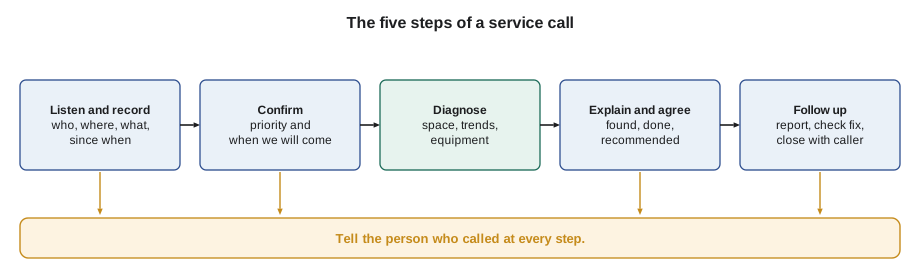
- Listen and record. Who is calling, where the problem is, what is happening, since when, and what has already been tried. Write it down in the caller's words, because a complaint of "freezing" in a morning meeting is different from one of "a bit cool all week".
- Confirm and set expectations. Repeat the problem back, agree the priority, and say when someone will come or call back. Then keep the promise, or call before it is broken.
- Diagnose on site. Check the space first if the complaint is comfort, then the trends and the equipment, using the method from BAS-420.
- Explain and agree. Before leaving, tell the caller what was found, what was done and what is recommended, in plain words, and agree any next steps.
- Follow up. Write the report, check that the fix held, and close the call with the caller, not just in the system.
The room 108 call at Tilden Hall in BAS-110 followed this pattern. The complaint came from the room's occupant through Nell. Callie and Prakash checked the room first, then followed the system from plant to zone. When they found the slipped actuator coupling, they told Nell before they fixed it, and Prakash's repair on Friday, November 13 was followed by Callie's service report the same day and a trend left running to check the next cold morning. Nobody had to call twice.
Explaining technical problems
Customers need to understand enough to make decisions, not enough to do the technician's job. The skill is choosing what to leave out. Prakash offered three rules.
- Start with the effect, not the cause. "The room was too hot because the heating valve was stuck open" before "the actuator coupling had slipped on the valve stem".
- Use the customer's words and units. Operators talk about valves and setpoints; property managers talk about tenants and costs; occupants talk about being too hot or too cold.
- Say what happens next and who decides. "I've fixed it today. I'm recommending a rule that would warn us if it happens again; Declan will include it in his proposal to Gus."
Analogies help when used sparingly. Prakash often explained a stuck valve to occupants as a tap left running, and a control loop as someone adjusting a shower. He avoided jargon such as priority arrays, MS/TP or PID unless the customer used those words first, and he never used them to make a customer feel small.
Worked problem
Translating a finding
Callie's technical note for a Ninefield call reads: "VAV-7-14 at default MAC 3 duplicating VAV-7-03; terminator left on; 12 m stub to new box; trunk resistance 41 ohms; corrected to 61 ohms; 23 devices online." Write one sentence for Ilona and one for the operators.
Show solution
- For Ilona: "A box installed by the fit-out contractor in July was set up with the same address as another box and had a setting left on that disturbed the network, so several boxes on the seventh floor had stopped reporting; it's fixed and all 23 are back online."
- For the operators: "VAV-7-14 had a duplicate MAC address and its terminator on, with a long stub to a new box; we readdressed it, removed the extra termination and the trunk now reads normal, so you'll see all 23 devices again."
Answer: Same facts, two audiences. The property manager needs the cause in general terms, the effect and the outcome; the operators need enough detail to recognize the problem if it happens again.
Handling complaints and disagreements
Some calls are not technical at all. A tenant is angry because the office has been uncomfortable for weeks; an owner disputes a bill; an operator feels that a contractor changed something without telling them. The technical fix may be simple, but the conversation has to come first.
- Let the person finish. Interrupting with an explanation makes people repeat themselves more loudly.
- Acknowledge the problem without arguing about blame. "That sounds like a miserable week" is not an admission; it is a recognition.
- Separate facts from feelings, gently. Ask what happened, when, and where, and write it down.
- Say what you will do and when, and do it.
- Do not promise what someone else decides. A technician cannot promise a refund, a new piece of equipment or a change to a lease.
Callie had seen a hard example in BAS-320: the seventh-floor tenant at Ninefield who disputed an after-hours bill because requests had been made under a shared tenant account, so nobody could show who had asked for what. The technical part of the answer was a personal account for each tenant contact and an audit trail, which became part of the hardening plan in BAS-430. The customer part belongs to Ilona: she has to explain to the tenant what the records can and cannot show and agree a fair answer, which the plan is to settle from the request log once tenants have personal accounts. Quillon's job is to give her accurate records and a system that prevents the dispute next time, not to argue with the tenant.
When a technician has made a mistake, the right response is to say so promptly, fix it and explain what will be done to prevent it happening again. Prakash's view was that admitting a mistake early almost always strengthens a relationship, and hiding one almost always ends it.
Behaviour on site
A building is someone else's workplace, and often someone else's home or classroom. The way a technician behaves there is part of the service.
| Situation | Good practice |
|---|---|
| Arriving | Sign in, wear identification, tell the contact you are there and roughly how long you will be |
| Occupied rooms | Knock, explain briefly, ask before moving anything, work quietly, apologize for the interruption |
| Ceilings and floors | Use drop sheets, put tiles back square, vacuum dust, never leave ladders unattended |
| Mechanical and electrical rooms | Close doors and panels, lock what was locked, leave no tools or offcuts |
| Making changes | Tell the operator before changing settings that affect comfort or energy; record every change |
| Leaving | Report to the contact, sign out, and say when the report will arrive |
| Phones and cameras | Ask before photographing occupied spaces or people; never post photos of customers' buildings |
Prakash also stressed confidentiality. Technicians see tenants' offices, server rooms, access control records and building security arrangements. What they see stays with the job. That rule extends to the building automation system itself: as BAS-430 taught, a technician does not discuss a building's network layout, accounts or weaknesses outside the people who need to know.
Writing for the customer
Most of what customers remember about a service call is what they read afterwards. A service report should be short, factual and readable by someone who was not there. Callie's report on room 108 in BAS-420 had five parts: a summary, the findings, the actions taken, how the fix was verified and recommendations. Prakash asked her to apply the same structure to every report and to read it once as the customer before sending it.
BEFORE (technician's notes)
VAV-1-08 DAT 34 C w/ RH cmd 0. Valve stem rotated vs actuator, coupling
slipped. Reset, witness mark. Max flow found 200 L/s (design 150) changed
Nov 11 by operator acct. Reset to design. Trend left.

AFTER (for Gus and Nell)
Summary: Room 108 was too hot because its reheat valve was stuck open.
Found: The valve's actuator had slipped on the valve stem, so the valve
  stayed open while the controller told it to close. The box's maximum
  airflow had also been raised on November 11 from an operator account.
Done: Re-fitted and marked the coupling; returned the box to its design
  maximum; checked that the air from the box now cools when heating is off.
Next: A trend is running to confirm on the next cold morning. We recommend
  an automatic check for this fault, included in Declan's proposal.
The report also says what it does not know. Callie's room 108 report noted that the box maximum had been raised from an operator account on November 11, but that the reason was not recorded. She did not guess who had done it or why; she recommended asking. Reports that guess become arguments later; reports that state what is known and unknown build trust.
Building a long relationship
Service relationships last when customers feel the contractor is on their side. That comes from small habits repeated over years: answering calls, keeping promises, explaining honestly, recommending only what is needed, pricing fairly, and remembering what the customer cares about. Margit tracked one number above all for Quillon's service department: how many customers renewed. Prakash tracked a different one: how many times a customer had to call twice about the same problem.
After-hours and emergency calls
Calls at night and on weekends test customer service hardest, because the caller is often stressed and alone, and the technician may be half asleep. Quillon's on-call technician answers with name and company, asks the same questions as in the daytime, and decides with the caller what can wait until morning. Many problems can be made safe by phone: an operator can be talked through restarting a tripped unit, starting a standby pump or raising a setpoint for the night, as long as the technician is sure the action is safe and the operator is authorized to take it.
Remote access changes what is possible. Nell had cleared a boiler flame-failure lockout at Harcastle from home at 2:40 one night in February 2026, using the facilities remote access path. A technician helping remotely follows the same rules as on site: say what will be done before doing it, change only what is needed, record the change, and tell the operator in the morning what was found.
When a site visit is needed at night, the technician tells the caller roughly when they will arrive, calls if that changes, and on arrival finds the person who called before going to the equipment. The report the next day is as complete as any daytime report, because night calls are the ones most likely to be questioned later.
Prakash's last piece of advice on night calls was about tone. A tired, worried caller remembers how they were spoken to long after they forget what was fixed. Speak slowly, repeat back what you heard, and never let the caller feel that the call was an inconvenience, even when it could have waited.
Common mistakes
MistakeFixing a problem and leaving without telling the caller.
InsteadReport to the person who called before leaving, and follow up in writing.
MistakeExplaining causes in jargon before effects.
InsteadStart with what the customer noticed, then the cause in their words, then what happens next.
MistakeArguing about blame with an upset occupant.
InsteadListen, acknowledge, record the facts and say what you will do.
MistakePromising things only the owner can decide.
InsteadPromise only your own actions; pass other requests to the person who decides.
MistakeGuessing in a report.
InsteadState what is known, what is not, and what you recommend to find out.
Summary and key terms
- Customers include owners, facilities managers, operators, occupants, contractors and engineers, each wanting different things.
- Operators live with the system and are partners, not obstacles.
- A service call has five steps: listen and record, confirm and set expectations, diagnose, explain and agree, follow up.
- Explanations start with the effect, use the customer's words and say what happens next and who decides.
- Complaints need listening and acknowledgement before technical answers; mistakes are admitted early.
- Site behaviour, confidentiality and clean work are part of the service.
- Reports are short, factual, readable by someone who was not there and honest about what is not known.
- Service coordinator
- The person who takes service calls, sets priorities and books visits.
- Callback
- A second call about the same problem, usually a sign the first visit did not resolve it.
- Setting expectations
- Telling the customer what will happen and when, so that the promise can be kept.
- Service report
- A written record of a visit: summary, findings, actions, verification and recommendations.
Practice problems
Work each problem on paper first, then reveal the answer to check.
What did Prakash do wrong at the hospital early in his career?
Show answer
He fixed the fault and left without telling the person who called.
Rewrite "RH valve stuck at 100" for an occupant.
Show answer
"The heating in your room was stuck on; we've fixed it and the room should cool down within the hour."
Why did Callie's room 108 report not say who raised the box maximum?
Show answer
The reason was not recorded; she stated what was known and recommended asking rather than guessing.
Which number did Prakash track for service quality?
Show answer
How many times a customer had to call twice about the same problem.
Lesson quiz · 5 questions
Score 60% or more to complete this lesson.
Create a free account to save your progress, take quizzes and earn a certificate.