
BAS-440 · Lesson 1 of 12 · 19 min
The controls industry and its career paths
▶ Video coming soon A video version of this lesson is on the way.
Margit Brodeur kept the last course of Callie's program for herself, at least at the start. Through the fall, Prakash, Sophie, Declan and Ivo had each walked Callie through one part of the trade: devices and wiring, programs and sequences, networks, front ends, energy, commissioning, troubleshooting and security. Margit wanted to finish with the part none of them had covered directly, which was the business those skills are sold in and the careers people build from them. "You can be the best technician in the city," she said at the first of her evening sessions in the small meeting room at Quillon's office, "and still not know why a job made money or lost it, or why one customer calls us back and another never does. This course is about that."
This last course does three things. Lessons 1 to 7 cover the working side of the trade: the industry and its careers, estimating and planning, submittals and documents, coordination with other trades, service contracts, customer service and certifications. Lessons 8 to 11 review the technical program in four blocks: field devices and wiring, programming and sequences, networks and protocols, and commissioning and troubleshooting. Lesson 12 is a capstone that carries a small commercial building, the Sandmere Branch Library, from drawings to handover.
Who is in the controls industry
Building automation sits between several older industries. It grew out of temperature control, when pneumatic thermostats and dampers were sold and installed by the same few manufacturers that made them. It now overlaps with electrical contracting, information technology, energy services and facilities management. Margit drew the industry on the whiteboard as a set of overlapping groups, each of which a controls technician will work with, work for, or compete against.
- Manufacturers design and build controllers, sensors, actuators, valves and front-end software. Some sell only through independent contractors; some also run their own branch offices that install and service their products; some do both in different regions.
- Manufacturer branch offices install, program and service one maker's products, often on large buildings, campuses and national accounts. They are usually backed by the manufacturer's engineering and training staff.
- Independent controls contractors and systems integrators, like Quillon, install and service products from one or more manufacturers, and integrate other systems such as lighting, meters and chillers. Many are authorized dealers of a particular product line, which gives them training, software and support.
- Mechanical contractors with controls divisions bid controls work as part of their mechanical contract, either with their own staff or by subcontracting to a controls contractor.
- Service companies and facilities management firms maintain whole buildings, often employing their own controls technicians or calling in specialists.
- Building owners and institutions such as colleges, hospitals and governments employ in-house controls staff, operators and energy managers. Harcastle College's facilities group, with Gus Thibodeaux and Nell Nakagawa, is one example.
- Consulting engineers design systems and write sequences and specifications; commissioning providers check that the work meets the owner's requirements; testing, adjusting and balancing firms measure airflow and water flow.
- Software and analytics companies sell front ends, fault detection, energy dashboards and cloud services that connect to building systems.
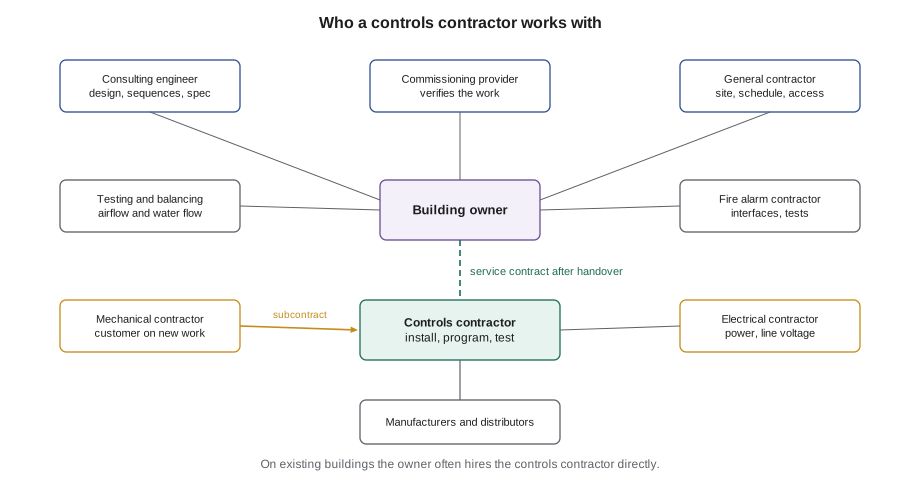
How a controls contractor gets its work depends on the project. On new construction and major renovations, the owner hires an engineer who writes a specification, contractors bid, and the controls work usually ends up as part of the mechanical contract, so the controls contractor's customer is the mechanical contractor. On existing buildings, the controls contractor often works directly for the owner, as Quillon does at Harcastle College and at Ninefield Tower, and as it did at 17 Marlow Lane when Halvern Properties replaced the old controls. After any project, the owner may sign a service contract with whoever does the best job, which is why Margit called handover "the first day of the next sale".
Quillon as an example
Margit used her own company as the example, because it was a typical size for an independent contractor. Quillon has about thirty people, organized around the work they do rather than the products they sell.
| Group | People | Main work |
|---|---|---|
| Management and office | 4 | Margit as president; accounting, payroll, purchasing and the company's own IT |
| Project management and estimating | 3 | Declan and two other project managers; estimates, contracts, schedules, change orders, customer contact on projects |
| Applications engineering and programming | 4 | Sophie and three programmers; submittal drawings, sequences, programs, graphics |
| Installation | 8 | Installation technicians and helpers; mounting devices, pulling cable, terminating, panel shop work |
| Project technicians | 2 | Ivo Bartek and one other; start-up, point-to-point checkout, front ends, commissioning support |
| Service | 8 | Prakash and six other service technicians, plus a service coordinator who takes calls and books visits |
| Panel shop | 1 | A panel builder who also manages the shop's stock of spare controllers |
A larger branch office might have separate departments for estimating, engineering, installation, service and sales, each with its own manager. A small contractor might have five people who all do everything. The work itself is the same: someone has to price the job, design it, install it, program it, prove it works, hand it over and keep it running. Each of those tasks is a career path.
The main career paths
Most people enter the trade as installers or junior technicians, the way Callie did on Tuesday, September 8. From there the paths divide according to what a person is good at and enjoys. Margit listed the common ones, with the skills each one rewards.
| Role | What the work is | Skills it rewards |
|---|---|---|
| Installation technician | Mounting devices and panels, pulling and terminating cable, labelling, working to drawings | Care, neatness, reading drawings, safe work at heights and near live equipment |
| Field or project technician | Start-up, point-to-point checkout, loading programs, fixing installation faults | Methodical testing, electrical and HVAC knowledge, documentation |
| Service technician | Answering calls, finding faults, preventive maintenance, small upgrades | Troubleshooting, customer contact, working alone, judgment |
| Programmer or applications engineer | Writing sequences, programs and graphics; designing systems for submittals | Logic, attention to detail, HVAC theory, communication with engineers |
| Commissioning technician or provider | Writing and running functional tests, keeping issues logs, checking other people's work | Independence, test design, clear writing, standards |
| Integration or network specialist | Connecting systems and protocols, front ends, security | Networking, protocols, IT coordination, security practice |
| Project manager | Running jobs: schedule, budget, people, customer, changes | Organization, negotiation, money, writing, calm under pressure |
| Estimator or sales engineer | Pricing jobs and proposals from drawings and site visits | Reading drawings, cost knowledge, judgment, customer understanding |
| Energy or analytics specialist | Fault detection, energy studies, measurement and verification | Data, HVAC theory, writing reports owners act on |
| Operations and facilities roles | In-house controls technician, operator, energy manager for an owner | Knowing one site deeply, planning, working with occupants |
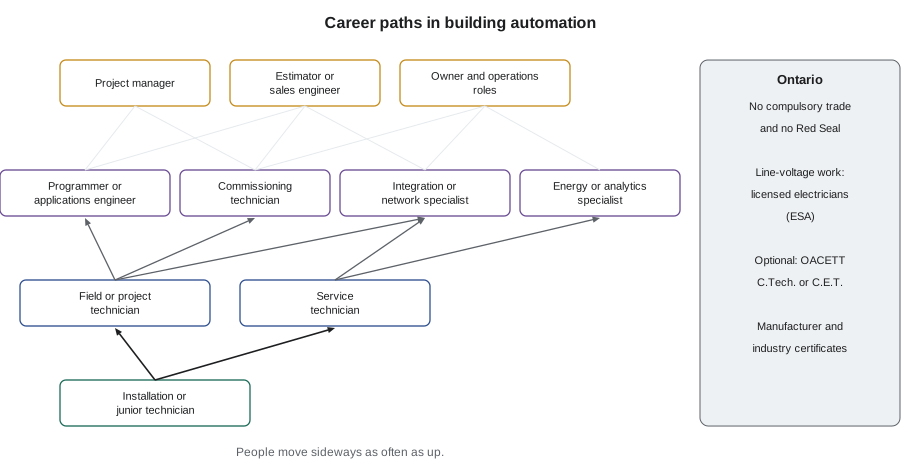
The people Callie had worked with showed how varied the paths are. Prakash started on pneumatics twenty-two years ago and stayed in the field because he liked being the person who finds the fault; he trains every new technician and turns down offers to manage. Sophie came in as a programmer and now designs systems and leads the programmers. Declan began as a service technician, moved into project management and now writes most of Quillon's estimates. Ivo is a project technician who is becoming the company's front-end specialist. Margit herself had worked in the field, in service and in project management before running the company. None of them had followed a straight line.
Licensing and the trade's status
Building automation is not a compulsory trade in Ontario, and there is no Red Seal for it. Most people enter through a college program, as Callie did, or through electrical, HVAC or electronics training followed by experience. The federal Job Bank lists building automation systems technicians under the engineering technologists and technicians occupation group (NOC 22310), and OACETT, the Ontario association for engineering technicians and technologists, offers voluntary certification (C.Tech. and C.E.T.) that some employers value. What is regulated is the work around the controls. Line-voltage electrical work belongs to licensed electrical contractors and electricians under the Electrical Safety Authority, which is why Kelso Electric brought the 120 V circuit and disconnect to RTU-1 and Quillon's work started at the transformer secondary. Whether a particular low-voltage installation needs a licensed electrical contractor or an ESA notification depends on the work and is a question to settle with ESA before the job, not after.
The lack of a licence does not mean the lack of a standard. Customers, engineers and general contractors judge controls companies by their record, their manufacturer authorizations, their safety programs and the certifications their people hold. Lesson 7 covers those certifications in detail.
What employers look for
Margit had hired most of Quillon's staff, and she was direct about what she looked for in a junior technician. Technical knowledge mattered, but it could be taught. What she could not teach easily was the habit of finishing things properly.
- Electrical basics: safe work, meters, low-voltage power and wiring, reading wiring diagrams.
- HVAC basics: how air handlers, boilers, chillers and terminal units work, and what the controls are trying to do.
- Networking and computers: IP addressing, switches, laptops, remote access and security habits.
- Programming and logic: reading a sequence and a program, and changing a program without breaking it.
- Documentation: labels, point lists, backups, change logs and reports that someone else can use.
- Customer behaviour: courtesy, explaining clearly, cleaning up, telling the truth about what went wrong.
- Safety: knowing when to stop, lock out, ask, or refuse unsafe work.
"The technicians I worry about," Margit said, "are the clever ones who don't write anything down. The building is going to outlive them. Somebody else has to understand what they did." She pointed out that every case Callie had studied that fall, from the room 108 coupling to the seventh-floor trunk, had been slower to solve because someone earlier had changed something and not recorded it.
The changing industry
The industry Callie was joining in 2026 was not the one Prakash had joined. Several changes were shaping the next ten years, and Margit wanted Callie to see them as opportunities rather than threats.
- Open protocols and IT networks. BACnet over IP, secure connections and standard network equipment mean that controls technicians now need IT skills, and IT departments now care about building systems.
- Security. Building systems are expected to meet the same security practices as other connected systems, as BAS-430 showed. Owners' questionnaires, like Thistledown Analytics' in November, are becoming routine.
- Energy and decarbonization. Owners face energy reporting, building performance rules and electrification goals. The controls are the cheapest tool for saving energy, and the data they collect is how savings are proved.
- Data and analytics. Fault detection, tagging and cloud analytics turn the trends a system already collects into maintenance work, which needs technicians who can read data and act on it.
- Retrofit work. Many buildings from the 1970s to the 2000s have controls at the end of their life, so replacement and migration projects like Marlow Lane are a large share of the work.
- Skills shortage. Experienced technicians are retiring faster than new ones are trained, so people who combine HVAC, electrical and IT knowledge are in demand.
A first-year development plan
At the end of the session Margit asked Callie to write a one-page development plan, which Quillon asks of every technician once a year. It had four parts: what she had learned this year, what she wanted to be doing in three years, what she needed to learn to get there, and what support she needed from Quillon. Callie wrote that she enjoyed troubleshooting most and wanted to become a service technician who could also handle integration and security work, and listed what she would need: her diploma, manufacturer training on Quillon's main product line, a networking certificate and more time on service calls with Prakash.
| Item | Callie's plan | Support from Quillon |
|---|---|---|
| Finish the program | Complete the diploma, including this capstone | Time off for exams; study days |
| Manufacturer training | Quillon's main controller line, then its front end | Course fees and travel; paired jobs afterwards |
| Networking | An entry-level networking certificate within two years | Study materials; lab time with Sophie |
| Service experience | Ride along with Prakash on service calls one day a week | Scheduling by the service coordinator |
| Writing | A service report for every call, reviewed by Prakash for the first three months | Templates and feedback |
Margit read it and changed one thing. Under writing, she added "teach someone else": by the following fall, Callie would show the next new technician how to make a controller backup, because teaching a task is the fastest way to find out whether you really understand it.
Common mistakes
MistakeThinking the only path upward is into management.
InsteadThere are senior technical paths in service, programming, integration, commissioning and analytics; many of the best people stay technical.
MistakeAssuming no licence means no rules.
InsteadElectrical work around the controls is regulated, and customers expect certifications, safety programs and manufacturer authorization.
MistakeTreating the customer as only the person who pays.
InsteadEngineers, operators, occupants and other trades all judge the work; any of them can bring the next job or lose it.
MistakeLeaving career development to chance.
InsteadWrite a plan each year with goals, training and the support needed, and review it with a manager.
Summary and key terms
- The controls industry includes manufacturers, branch offices, independent contractors, mechanical contractors, service firms, owners' staff, engineers, commissioning providers and software companies.
- On new work the controls contractor is usually a subcontractor to the mechanical contractor; on existing buildings it often works directly for the owner.
- Career paths include installation, field and service work, programming, commissioning, integration, project management, estimating, energy and operations roles.
- Building automation is not a licensed trade in most places, but the electrical work around it is regulated and certifications matter.
- Employers look for technical basics, documentation habits, customer behaviour and safety judgment.
- Open protocols, security, energy, analytics, retrofits and a skills shortage are shaping the industry.
- A yearly development plan turns career goals into training and experience.
- Systems integrator
- A contractor that connects building systems from different makers so they work together.
- Branch office
- A manufacturer's own local office that installs and services its products.
- Authorized dealer
- An independent contractor licensed by a manufacturer to sell, install and support its products.
- Applications engineer
- A person who designs control systems for projects and writes their sequences and programs.
- Development plan
- A yearly written plan of a person's goals, training and support needs.
Practice problems
Work each problem on paper first, then reveal the answer to check.
On a new building, who is the controls contractor's customer most often?
Show answer
The mechanical contractor, because the controls work is usually part of the mechanical contract.
Name two career paths for someone who enjoys finding faults.
Show answer
Service technician and commissioning technician (integration specialist is another).
Why did Margit call handover the first day of the next sale?
Show answer
Because the owner chooses a service contractor after the project, often the one who did the best job.
What habit did Margit say she could not easily teach?
Show answer
Finishing things properly, including writing down what was done.
Lesson quiz · 5 questions
Score 60% or more to complete this lesson.
Create a free account to save your progress, take quizzes and earn a certificate.