
BAS-440 · Lesson 10 of 12 · 20 min
Review: networks and protocols
▶ Video coming soon A video version of this lesson is on the way.
The third review covered the network half of the program: BACnet and the other protocols from BAS-310, the front end from BAS-320, the integrations from BAS-340 and the security practice from BAS-430. Prakash ran it as one of his Tuesday network nights, with a bench controller, a laptop and the Ninefield numbering plan pinned to the wall. "Networks are where controls and IT meet," he said, "and where most technicians either become very useful or very dangerous."
Why open protocols
BAS-310 began with the podium rooftop units at Ninefield, whose 2004 controllers spoke a proprietary language that only a protocol converter could translate. Open protocols let products from different manufacturers share data, let owners choose among contractors, and make integration with lighting, meters and chillers possible. BACnet, ASHRAE Standard 135, is the main open protocol for building automation; Modbus is common on meters, drives and equipment; LonWorks, KNX and DALI appear in other places, such as the 2008 LonWorks system at Ellery Clinic that Quillon migrated to BACnet floor by floor, and Ninefield's DALI lighting behind its 2019 gateway.
BACnet objects, properties and services
BACnet describes every device as a collection of objects, each with properties. A device object identifies the controller; analog input, output and value objects hold measured and calculated numbers; binary objects hold on and off states; schedule, calendar, trend log and notification class objects hold time and alarm functions. Each object has properties such as Present_Value, Status_Flags, Units, Out_Of_Service and, for commandable objects, Priority_Array.
Services are the messages that act on objects. ReadProperty and ReadPropertyMultiple fetch values; WriteProperty changes them; SubscribeCOV asks a device to send a change-of-value notification when a value changes by more than its increment; Who-Is and I-Am discover devices; event and alarm services carry alarms. On the bench controller in BAS-310, unplugging the discharge air sensor on AI-3 showed its Reliability property change to OPEN_LOOP and its Status_Flags show a fault, which is how a front end knows a reading is not to be trusted.
| Concept | What to remember | Case |
|---|---|---|
| Polling versus COV | Polling reads on a timer; COV sends only on change. COV reduces traffic but needs sensible increments. | The low delta-T morning at Ninefield and the choice of trend methods |
| Priority array | Sixteen priority levels for commands; the highest active one wins; relinquishing returns control to lower levels | Quillon's priorities: 2 smoke control, 5 equipment protection, 8 operator, 10 supervisory and demand limit, 16 program |
| Out of service | Disconnects the present value from the physical input for testing | Used during point-to-point checkout, then cleared |
| Device instance | A number unique on the whole internetwork | Ninefield plan: 100,000 + 1,000 × floor + MAC |
| Network number | Identifies each BACnet network; routers join them | IP network 1; floor trunks 100 + floor; penthouse 201 to 203; podium 204 |
Callie explained the priority array with the case from BAS-420: a Tilden box damper held at 100 in 100 by an operator command at priority 8, left there since a summer heat wave, so the program's command at priority 16 had no effect. Releasing the override, not writing a different value, was the fix.
MS/TP
BACnet MS/TP runs on RS-485 twisted-pair trunks, the network under most VAV boxes and unitary controllers. Masters pass a token from one MAC address to the next, and only the token holder may send. The rules Callie had learned on Ninefield's seventh floor are the ones that cause most trunk faults.
- Each MAC address on a trunk must be unique; masters use the low range, and Max_Master should be set just above the highest master address in use.
- The trunk is a daisy chain, not a star, with a 120 Ω terminator at each end and nowhere else.
- Shields are continuous and grounded at one point; cable is the right impedance for RS-485.
- All devices must use the same baud rate.
Worked problem
Reading a trunk with a meter
With power off and every device connected, a meter across the data pair of a correctly terminated MS/TP trunk reads close to the two 120 Ω terminators in parallel. On Ninefield's seventh floor on Monday, September 21, Prakash measured 41 Ω. What does each reading mean?
Show solution
- Two 120 Ω terminators in parallel: 1 ÷ (1/120 + 1/120) = 60 Ω.
- Three in parallel: 1 ÷ (3/120) = 40 Ω.
- 41 Ω is close to 40 Ω, so there was an extra terminator on the trunk.
Answer: The extra terminator was on VAV-7-14, which the fit-out contractor had installed in July with its terminator switched on and its MAC left at the default 3, the same as VAV-7-03. After readdressing it, removing the terminator and dealing with the long stub to a new box, the meter read 61 Ω and all 23 controllers came back.
The instance plan made the fix permanent. Under Ninefield's plan, the new box controller at MAC 23 on the seventh floor has instance 100,000 + 7,000 + 23 = 107,023, so anyone reading the front end can tell where a device is from its number.
BACnet/IP, routers and BBMDs
BACnet/IP carries BACnet messages over UDP, normally on port 47808 (hexadecimal BAC0). Devices on the same IP subnet find each other by broadcast. Because routers do not pass broadcasts between subnets, a BACnet Broadcast Management Device (BBMD) on each subnet forwards them when a BACnet network spans several subnets, as at Harcastle, where BBMDs at the central plant, Tilden and Morrow House join the campus. Where everything is on one subnet, as at Ninefield, a BBMD is unnecessary, which is why the one left enabled on Ninefield's front-end server with foreign device registration became a finding in BAS-430.
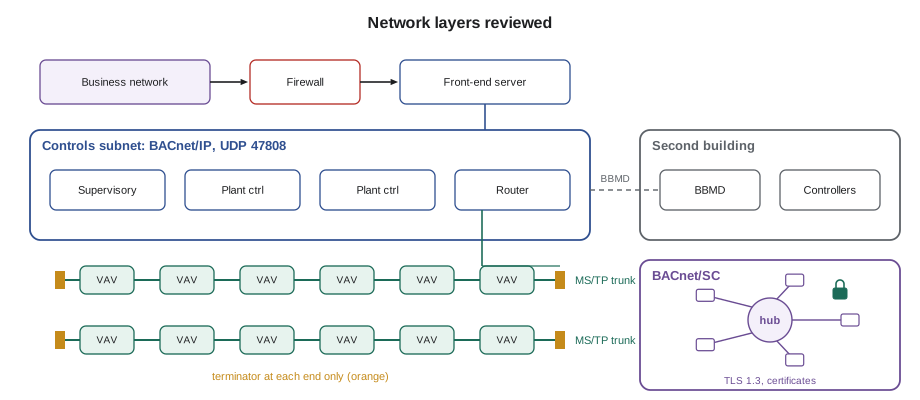
BACnet Secure Connect (BACnet/SC), added to the standard by Addendum bj, replaces broadcast-based BACnet/IP with connections over TLS 1.3 secure WebSockets, with each device authenticated by a certificate. Devices connect to a primary hub, with a failover hub as backup. It removes the need for BBMDs and makes BACnet traffic encrypted and authenticated. The Sandmere draft specification asked for BACnet/SC on every building-level controller, with the primary hub on the supervisory controller, the failover hub on the front end and the VAV boxes on MS/TP behind an SC router, which is the architecture the capstone in lesson 12 uses.
Modbus and other protocols
Modbus is simpler than BACnet: a master reads and writes numbered registers in slave devices, with no objects or units. The integration of Ninefield's main switchboard meter PM-1 in August, from BAS-310's case study, showed the two classic Modbus faults. A floating-point value spread across two registers read as −3.7 × 10¹⁹ until the word order was swapped, when it became 623.5 kW. And the energy value was one register out, because the meter's documentation numbered registers from 1 while the gateway counted from 0: register 43204 in the manual meant 3203 in the configuration.
| Check | Modbus RTU | Modbus TCP |
|---|---|---|
| Physical | RS-485, daisy chain, terminated | Ethernet, IP addressing |
| Settings to match | Baud rate, parity, stop bits, slave address | IP address, port, unit identifier |
| Data checks | Register numbering (0 or 1 based), word and byte order, scaling | Same |
| Ninefield PM-1 | 19,200 baud, 8 data bits, even parity, 1 stop bit; address 1; 12 values | Not used |
The front end
BAS-320 covered the layer operators use: supervisory controllers and servers, graphics, alarms, trends, schedules, users and remote access. Prakash asked Callie to name the three things a front end must do well, and she chose from Sophie's sessions: show operators the truth quickly, with high-performance graphics that use colour only for abnormal states; tell them what needs action, with alarms that are few, meaningful and prioritized; and keep a record, with trends and an audit trail of who changed what. The Tilden alarm week in October, with 1,512 alarms, nine floods and three chronic points producing 790 of them, showed what happens when the second is neglected.
- Licences: Ninefield's front end is licensed for 200 BACnet devices; 157 were in use in September, 160 after the podium work and 165 after the Thistledown floor, all planned.
- Time: every controller's clock should follow the server by NTP; one Ninefield controller had drifted 73 minutes.
- Accounts: personal accounts with roles; Harcastle's review removed or changed 19 of 41 accounts.
- Backups: the front end and every controller, with firmware versions, on Quillon's rotation of 14 daily, 8 weekly and 12 monthly copies, plus the offline copy.
Integration
BAS-340 extended the network to other building systems: lighting, access control, metering, elevators, the generator and the fire alarm. The rules were the same at each interface: agree exactly which points cross it and in which direction, decide what happens if the link fails, keep life safety functions hardwired and listed, and test the interface with the other contractor. Ninefield's annual fire alarm test on Sunday, October 18, when AHU-2's shutdown showed as a fan failure because its fire alarm status contact was listed as a spare, and the Marlow Lane integrated test on Wednesday, October 28, when AHU-1 restarted automatically after reset although the design required an operator restart, were Callie's examples of interfaces found wrong only by testing.
Security
BAS-430 tied the network review together. A building automation system should never be reachable directly from the internet; it should sit in its own zone, with firewalls allowing only the connections it needs; remote access should pass through a VPN with multi-factor authentication to a jump host; every person should have a personal account with the least privilege they need; patches and firmware should be tested and applied; logs should be kept and read; vendors' access should be controlled per session; and backups should be tested by restoring them. The Ninefield hardening plan applies those rules in four phases from December 2026 to spring 2027.
| Rule | Why | Ninefield finding |
|---|---|---|
| No direct internet exposure | Exposed controllers are found and attacked quickly | A port forward to the old front end, removed at takeover |
| Segment and filter | A VLAN alone does not stop traffic unless the router filters it | Office and controls VLANs routed with no filtering |
| MFA on remote access | Passwords alone are stolen or guessed | VPN with a password only |
| Personal accounts, least privilege | Shared accounts hide who did what | nightops and tenant7 shared accounts |
| Remove what is not needed | Every unneeded service is another way in | BBMD with foreign device registration on a single subnet |
Prakash's last question was practical. A tenant's IT manager asks whether the building system can send live data to the tenant's cloud dashboard. What does Callie answer? Her answer came from BAS-340 and BAS-430: yes, through an edge gateway in the boundary zone that reads the front end with a read-only account and sends data outbound only, encrypted, to the tenant's system, with no path from the tenant's network back into the controls. That is the design planned for Thistledown.
Names, tags and time
Prakash added three small subjects that cause large problems on networks. The first was naming. A point name should tell anyone where the point is and what it is, following one convention across the site, such as the NF.RTU1 names Sophie and Callie used when they built the RTU-1 database on Monday, October 26. Marlow Lane's submittal comment S-4, which corrected twelve software point names, showed that engineers and owners check this.
The second was tagging. Semantic tags, such as the Project Haystack tags used on RTU-1, describe what each point is in a form software can read: a supply air temperature sensor on an air handler, a cooling valve command, a zone setpoint. Tags let analytics, fault rules and dashboards find points without someone mapping each one by hand, which is why the fault detection quote for Ninefield in BAS-320 included tagging the 1998 cooling tower points as a proposal line.
The third was time. Schedules, trends, alarms and audit trails all depend on clocks, so every controller should follow the server's time by NTP, and the server should follow a reliable time source. The Ninefield controller that had drifted 73 minutes in BAS-320 had been starting equipment more than an hour late, and its trends could not be lined up with anything else. Prakash checks time on every network health review, because a wrong clock makes every other record harder to trust.
Prakash ended the section with a simple check Callie could make on any site: pick five points at random on the front end, find each one in the building from its name alone, and check that its time stamp agrees with the clock on the wall. If any of the five fails, the documentation needs work before anything else does.
Common mistakes
MistakeLeaving MAC addresses at factory defaults.
InsteadAddress every device to the site plan before connecting it to a trunk.
MistakeTerminating every device on a trunk.
InsteadTerminate only the two ends; check with a meter for about 60 Ω.
MistakeWriting a new value to override an override.
InsteadFind the active priority and relinquish it.
MistakeIgnoring Modbus word order and register numbering.
InsteadCheck both against a known value before trusting the data.
MistakeLeaving BBMDs and services enabled because they might be needed.
InsteadEnable only what the network design requires.
Summary and key terms
- Open protocols let products from different makers work together; BACnet is the main one, with Modbus common on equipment.
- BACnet devices hold objects with properties, acted on by services such as reads, writes, COV and alarms.
- The priority array decides which command wins; overrides must be relinquished, not overwritten.
- MS/TP needs unique MACs, a daisy chain, two terminators, one shield ground and matched baud rates.
- BACnet/IP uses UDP 47808; BBMDs join subnets; BACnet/SC adds TLS-secured hub connections and certificates.
- Front ends must show the truth, raise meaningful alarms and keep records, with licences, time, accounts and backups managed.
- Integrations need agreed points, failure behaviour and testing; security rules apply to every connection.
- Object
- A BACnet data structure representing an input, output, value or function in a device.
- Change of value (COV)
- A BACnet notification sent when a value changes by more than a set increment.
- MAC address (MS/TP)
- A device's address on an MS/TP trunk, unique on that trunk.
- BBMD
- A device that forwards BACnet/IP broadcasts between IP subnets.
- BACnet/SC hub
- The device that BACnet/SC nodes connect to over secure WebSockets.
- Word order
- The order in which two Modbus registers are combined into one value.
Practice problems
Work each problem on paper first, then reveal the answer to check.
What instance does a fourth-floor box at MAC 15 get under Ninefield's plan?
Show answer
100,000 + 4,000 + 15 = 104,015.
A trunk reads 60 Ω with power off. What does that suggest?
Show answer
Two terminators, as it should be.
Why is a BBMD unnecessary at Ninefield?
Show answer
All its BACnet/IP devices are on one subnet.
What two faults appeared in the PM-1 Modbus integration?
Show answer
Word order on a floating-point value and a one-register offset from 1-based numbering.
Lesson quiz · 5 questions
Score 60% or more to complete this lesson.
Create a free account to save your progress, take quizzes and earn a certificate.